
You can lift heavier weights, run faster or jump higher and still have questions about how evenly your body produces force. Are both legs contributing equally? Are you landing with control? Has your strength actually improved, or are you simply getting better at performing one particular exercise?
These are the kinds of questions ForceDecks testing in Springwood can help investigate.
ForceDecks uses force plates to measure how your body produces and absorbs force during selected movements. The results provide objective information about physical performance, strength and movement strategies that may not be obvious during a standard gym session.
For athletes, people returning from injury and those working on strength development, ForceDecks testing in Springwood can provide useful information to guide training decisions. It doesn't replace a physical assessment, but it gives you another way to measure progress.
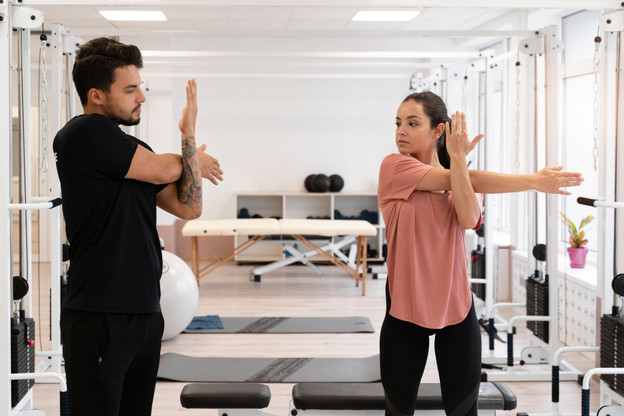
What Is ForceDecks Testing and How Does It Work?
ForceDecks testing uses specialised force plates that measure the forces applied through the feet during movements such as jumping, landing and certain strength tests.
The plates collect data while you perform a selected task. Depending on the test, the results may provide information about:
-
How much force you produce.
-
How quickly you produce force.
-
How you absorb force when landing.
-
Differences in force between the left and right legs.
-
Changes in performance across repeated tests.
For example, during a countermovement jump, the system can measure how you produce force as you lower your body and push upwards.
ForceDecks testing in Springwood can make these measurements easier to track over time. Rather than relying only on how a movement looks or feels, you have numerical information that can be considered alongside your training history and physical capabilities.
What Can ForceDecks Results Reveal About Your Strength?
Strength isn't always as straightforward as the amount of weight you can lift. Two people might perform the same squat or jump, but use different movement strategies to produce the result.
ForceDecks testing in Springwood can help identify differences that deserve a closer look.
For example, a force plate assessment may reveal that one leg contributes more force than the other during a jump. This could be relevant when reviewing lower-limb strength after an injury.
However, an asymmetry doesn't automatically mean there's an injury or a problem that needs correcting. Natural differences between sides are common, and results need to be interpreted in context.
The person's sport, training experience, injury history and previous test results all matter. A single number shouldn't determine the entire training programme.
How Can ForceDecks Testing Help Athletes Improve Performance?
Athletes need more than general strength to perform well. Depending on their sport, they may need to produce force quickly, absorb impact efficiently and repeat powerful movements without losing control.
ForceDecks testing in Springwood can provide information relevant to these physical qualities.
Consider a basketball player working on vertical jumping. Testing may help track jump performance and changes in force production over a training block.
A field-sport athlete might be more interested in lower-limb force differences and landing performance, particularly when preparing for running, jumping and changes of direction.
The results can help an exercise professional decide whether to focus more on strength development, explosive power or other physical qualities.
Force plate data doesn't tell an athlete exactly how to train. It helps inform the discussion about what needs attention.
Can ForceDecks Testing Support Injury Rehabilitation?
Yes. Force plate testing may be useful at selected stages of rehabilitation when someone is rebuilding strength and preparing to return to demanding physical activity.
For example, a person recovering from a knee injury may initially focus on restoring movement and basic strength. Later, testing could help assess how each leg contributes during jumping or landing tasks.
ForceDecks testing in Springwood may form part of this process by providing measurable information that can be compared with previous results.
It can be particularly relevant when someone is progressing towards sport-specific activity. However, force plate results alone cannot confirm that a person is ready to return to competition.
Pain, swelling, joint movement, muscle strength, balance, confidence and the demands of the sport also need consideration.
What Happens During a ForceDecks Testing Session?
A testing session generally starts with a discussion about your goals, training background and relevant injury history.
The exercise professional then selects suitable tests based on what needs to be measured. You may be asked to perform movements such as:
-
Countermovement jumps.
-
Squat jumps.
-
Repeated jumping tasks.
-
Isometric strength tests.
-
Other selected force-production tasks.
The instructions and number of attempts depend on the test. Consistent technique matters because changes in how you perform a movement can affect the results.
After testing, the data can be reviewed alongside your physical assessment and training objectives.
ForceDecks testing in Springwood is most useful when the results answer a practical question. For instance, are you producing more force than you did during your previous assessment? Has a strength difference between your legs changed? Are you improving in a quality that matters for your sport?
Who Should Consider ForceDecks Testing in Springwood?
You don't need to be an elite athlete to benefit from objective performance testing.
It may be worth considering if you're:
-
An athlete monitoring strength and jumping performance.
-
Returning to sport after a lower-limb injury.
-
Working on explosive power or lower-body strength.
-
Interested in tracking changes during a strength programme.
-
Looking for measurable information to support rehabilitation decisions.
An exercise physiologist in Springwood may use testing as part of a broader exercise physiology programme, depending on your goals and physical requirements.
The important part is choosing tests that are relevant to you. Testing without a clear purpose can produce plenty of numbers without giving you useful direction.
What Is the Difference Between an Exercise Physiologist and a Physiotherapist?
The exercise physiologist vs physiotherapist question often comes up when someone is considering performance testing or injury rehabilitation.
Both professionals work with movement and exercise, but their roles differ.
An exercise physiologist generally focuses on developing exercise programmes to improve health, strength and physical capacity. A physiotherapist assesses and manages injuries, pain and movement problems, and may guide rehabilitation.
There can be overlap. For example, someone recovering from an injury may work with a physiotherapist before progressing to exercise physiology and more advanced strength or performance training.
Understanding what does an exercise physiologist do can help clarify where performance testing fits. An exercise physiologist may use the results to guide exercise selection and monitor physical progress.
The exercise physiologist vs personal trainer distinction is also relevant. Personal trainers generally focus on fitness and training goals, while Accredited Exercise Physiologists have clinical training to work with people managing health conditions and more complex exercise needs.
Frequently Asked Questions About ForceDecks Testing
Is ForceDecks testing painful?
The testing itself is generally non-invasive. It involves performing selected physical movements, which may include jumping or strength tasks. The exercises should be appropriate for your current ability and any relevant injury restrictions.
Can ForceDecks testing diagnose an injury?
No. Force plates measure physical performance characteristics, not the underlying cause of an injury. Results should be interpreted alongside a clinical assessment and relevant medical information.
How often should I have ForceDecks testing?
There isn't one schedule that suits everyone. Testing frequency depends on your goals, training programme and whether the results are being used to monitor rehabilitation or performance changes.
Do I need to be fit before having ForceDecks testing?
Not necessarily. The tests can be selected according to your current physical ability. However, some movements may not be suitable during certain stages of injury recovery.
What is exercise physiology, and how does it relate to ForceDecks testing?
What is exercise physiology? It's the study and practical application of how the body responds to physical activity. Force plate testing can provide measurable information that an exercise professional may use when planning strength, conditioning or rehabilitation programmes.
An exercise physiology assessment may include other checks of strength, mobility, balance and fitness. ForceDecks is one possible assessment tool, not a complete evaluation on its own.
How Can ForceDecks Testing in Springwood Help Guide Your Training?
Good training decisions need more than guesswork. Whether you're improving athletic performance, rebuilding strength after an injury or monitoring changes in physical capacity, useful measurements can help show where you're progressing and where further work may be needed.
ForceDecks testing in Springwood provides objective information about force production, jumping and landing performance. When combined with a physical assessment and clear training goals, the results can help guide the next stage of your programme.
The value isn't in collecting the biggest report or the most numbers. It's in understanding what the results mean and using that information to make better decisions about your training and rehabilitation.