
Anchor installation becomes risky when the concrete surface gives no indication of what is buried underneath. At Superior Scanning, concrete scanning in Downtown LA helps contractors identify rebar, post-tension tendons, and other detectable embedded features before drilling, giving crews clearer field information before anchor locations are finalized.
Why Does Anchor Placement Need More Than a Tape Measure?
An anchor location can look correct on a layout drawing and still conflict with reinforcement inside the slab.
Concrete floors may contain reinforcing bars, welded wire reinforcement, post-tension tendons, electrical conduit, sleeves, and other embedded components. Their actual field positions may differ from assumptions based only on plans, especially in existing buildings that have gone through renovations, tenant improvements, or structural modifications.
That makes anchor bolt placement in concrete a coordination issue, not simply a drilling task.
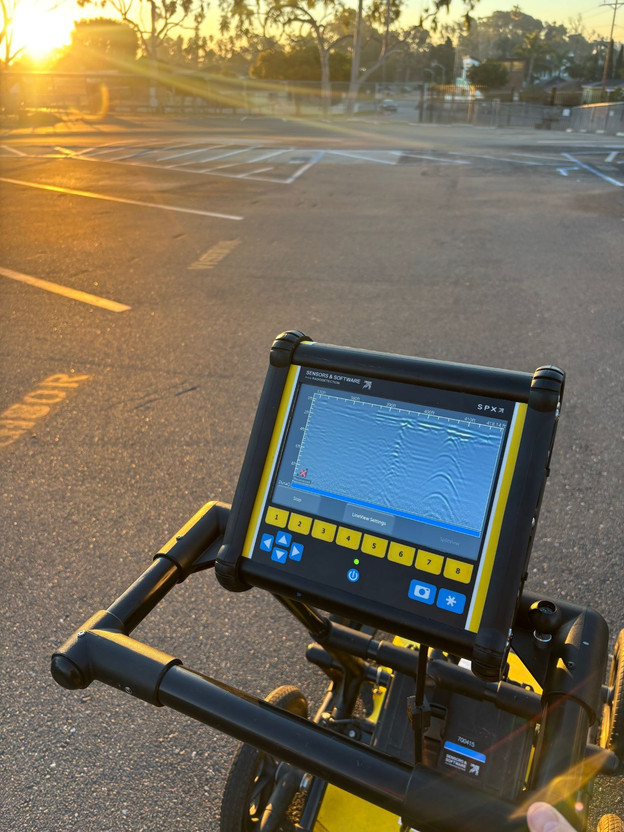
At Superior Scanning, technicians use ground-penetrating radar to evaluate the proposed anchor area and mark interpreted subsurface features directly on the concrete surface. This gives contractors a practical reference for comparing the planned drill points with detectable reinforcement below.
What Does GPR Show Before Anchor Drilling Begins?
GPR concrete scanning helps identify changes within a concrete slab that may indicate rebar, post-tension tendons, conduit, or other detectable embedded features.
Ground-penetrating radar sends electromagnetic energy into the concrete and records reflections from subsurface materials. Reinforcing steel commonly produces strong responses, while other embedded objects may appear differently depending on their depth, material, orientation, and surrounding concrete conditions.
At Superior Scanning, the objective is to translate those radar responses into usable field markings.
Depending on slab conditions, technicians may mark:
-
Rebar runs and grid patterns
-
Possible post-tension tendon paths
-
Detectable conduit or embedded components
-
Congested reinforcement areas
-
Proposed drilling points that overlap subsurface features
-
Areas that may require additional investigation
These markings help turn subsurface data into information contractors can use directly at the work area.
GPR is not an X-ray and should not be treated as a guarantee that every concealed object will be detected. Slab thickness, moisture, reinforcement density, access, depth, and material type can all affect results.
How Does Concrete Slab Scanning Support Anchor Layout?
A useful anchor-scanning process starts before drilling equipment is brought into the slab.
1. Mark the Proposed Anchor Pattern
The contractor first identifies the intended anchor or baseplate location.
This may include anchors for:
-
Structural steel
-
Seismic bracing
-
Equipment bases
-
Guardrails
-
Mechanical supports
-
Electrical equipment
-
Retrofit connections
-
Tenant-improvement framing
At Superior Scanning, having the proposed drill points marked in advance allows the scan to focus on the actual work area rather than an arbitrary section of concrete.
2. Scan Beyond the Exact Drill Points
Concrete slab scanning in Downtown LA is often more useful when the surrounding area is evaluated along with the individual anchor locations.
If a proposed anchor conflicts with reinforcement, the contractor may need room to consider an alternate position. Scanning a wider footprint can reveal nearby rebar patterns and other detectable features before the layout is changed.
This is particularly useful for baseplates or equipment installations where several anchors must maintain a specific relationship to one another.
3. Mark the Rebar Grid and Other Detectable Features
During GPR rebar scanning in Downtown LA, interpreted reinforcement can be marked directly on the slab.
For example, crossing lines may represent the general reinforcement grid. Other responses that appear inconsistent with ordinary rebar may be marked separately for further consideration.
At Superior Scanning, field markings are intended to make subsurface conditions easier to interpret for contractors, superintendents, engineers, and drilling crews.
4. Compare the Proposed Anchors With the Scan Results
Once the detectable features are marked, the planned anchor locations can be compared with the subsurface layout.
|
Field Condition |
What Scanning May Indicate |
Typical Project Response |
|
Anchor falls between mapped reinforcement |
No interpreted reinforcement directly at the point |
Review required clearances before drilling |
|
Anchor overlaps a rebar line |
Reinforcement conflict |
Consider relocation or engineering direction |
|
Several bars cross the work area |
Congested reinforcement |
Reevaluate anchor placement |
|
Possible tendon crosses the location |
Potential post-tension conflict |
Stop and verify before drilling |
|
Radar response remains unclear |
Subsurface condition is uncertain |
Perform additional investigation |
At Superior Scanning, the scan provides field information. The structural engineer, contractor, or other responsible project professional determines whether an anchor can be moved or whether the connection must be redesigned.
Can Contractors Drill Between Two Marked Rebar Lines?
A space between mapped rebar lines may provide a possible drilling zone, but it does not automatically mean the location is approved for an anchor.
The anchor still needs to meet project requirements for embedment, spacing, edge distance, structural capacity, and installation method.
The relationship between the anchor and nearby reinforcement may also matter to the engineered connection.
That is why the field sequence should remain:
scan → mark → review → approve → drill.
At Superior Scanning, the purpose of concrete scanning is to provide information before the irreversible step begins.
Why Is Scanning a Post-Tension Slab Before Anchoring More Critical?
Scanning a post-tension slab before anchoring is especially important because a drill can encounter a stressed structural tendon instead of ordinary reinforcement.
A post-tension tendon contains high-strength steel that has been tensioned to place the concrete into compression. These tendons may pass directly through areas where contractors plan to drill anchors, cores, or penetrations.
At Superior Scanning, suspected tendon paths can be marked on the concrete so the project team can evaluate conflicts before drilling.
If a possible tendon crosses a proposed concrete anchor location, the safest response is not to drill as close to the line as possible.
The location should be treated as a potential conflict until the appropriate project professional determines how the work should proceed.
What Happens If an Anchor Location Conflicts With Rebar?
The best time to solve an anchor conflict is before the drill reaches the concrete.
Depending on the project, the contractor or engineer may consider:
-
Shifting the anchor pattern
-
Reorienting a baseplate
-
Moving equipment
-
Expanding the scan area
-
Selecting another connection point
-
Revising an engineered detail
-
Evaluating another section of the slab
At Superior Scanning, scanning identifies the subsurface condition. It does not determine whether a structural connection can be altered.
That distinction becomes especially important on retrofit projects where anchors may form part of a defined load path.
Why Is Concrete Scanning Important for DTLA Structural Retrofitting?
Downtown Los Angeles contains a mix of older concrete buildings, adaptive-reuse projects, seismic upgrades, tenant improvements, and modern renovations.
Many of these projects require new structural or mechanical components to connect to existing concrete.
That may involve drilling for:
-
Seismic retrofit steel
-
Structural brackets
-
Equipment supports
-
Mechanical systems
-
Electrical installations
-
Interior framing
-
New penetrations
Existing slabs can contain reinforcement patterns that are not obvious from the surface.
At Superior Scanning, concrete scanning in Downtown LA helps project teams compare proposed drilling locations with detectable subsurface features before anchoring, coring, or cutting begins.
This can be particularly useful where older drawings are incomplete, field conditions have changed, or existing