
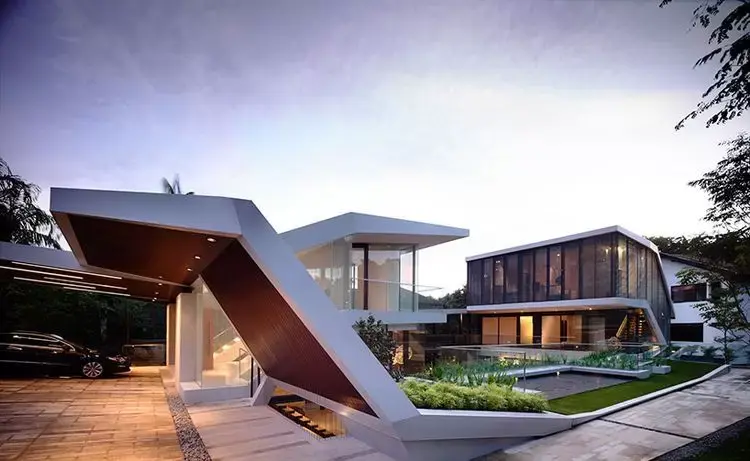
Derived from the Hindi word banglã, the word ‘bungalow’ came into use in the English language in the late 17th century. Back in the day, bungalows more aptly referred to the quaint cottages that were built in early European colonial settlements in Bengal. Traditionally a one-story house with a low-pitched roof and a front porch, the humble bungalow has come a long way since then, thanks to advances in technology and architectural ingenuity.
Today, it is the very epitome of sophisticated living and prestige, to the extent where entire residences have become fully equipped with smart technology, so that every aspect of the house’s function, from climate control to entertainment, can be accessed and adjusted with the touch of a button.
There is the bungalow – and then there is the Good Class Bungalow
In Singapore, the most coveted of bungalows are known as Good Class Bungalows – and there’s a very good reason behind this fancy epithet. Not only are they owned by the wealthiest of the wealthiest, they are also extremely rare in this land-scarce dot on the map.
Good Class Bungalows, or GCBs for short, have to adhere to a pretty strict criteria implemented by the Urban Redevelopment Authority (URA). According to its guidelines, a GCB has to be two-storeys high or less, with a plot size of at least 1,400 sqm and ample surrounding greenery. The actual built-up area cannot exceed 35-40 percent of the plot size and the bungalow can only be located in any of the 39 areas designated by the URA to qualify as a GCB. These include the prime residential districts such as Districts 10, 11 as well as the upscale bungalow estates in Districts 20, 21 & 23.
So while bungalows with large plot sizes exceeding 1,400sqm may be found in other districts in Singapore, as they are not gazetted as GCBs, they do not enjoy this classification and subsequently, the value and prestige that accompanies it. As a result, supply is exceptionally limited. With barely a possibility of increasing in numbers, the prices of GCBS tend to be stable over time, which adds to the attractiveness of procuring such a residence.
Location, location, location
Think GCB and names like Nassim, Cluny Road, Chatsworth, Ladyhill and Bishopsgate immediately come to mind. The names alone are perfumed with the intoxicating air of sophistication and finesse. Located in District 10, off Singapore’s swanky downtown shopping belt, Orchard Road, the allure of these bungalows lie in the lush greenery that surrounds them, despite being a stone’s throw away from the country’s bustling lifestyle core and neighbouring international embassies, like the majestic greystone American embassy and the opulent Brunei High Commission, with its gilded wrought-iron gates.
Surrounding the lush greenery of Singapore’s central catchment area are districts 20-23, with GCBs dotting Windsor Park (a name befitting royalty indeed!), Binjai Park, Yarwood Avenue and Chestnut Avenue.
Couple the location factor with the fact that landed property comprises only 5.1 percent of total housing stock in Singapore and one can fathom the allure of the GCB, being the crème de la crème of residences on the island.
The pandemic years and how the GCB fared
The GCB became an even more attractive, high-end real estate procurement as the island slipped into lockdown in 2020, forcing everyone (with the exception of essential workers and healthcare professionals) to work, study and play from home. As a result, the overall sales volume for landed properties increased by 38 percent between 2019 and 2020.
“GCBs were no exception, as sales outperformed the pre-pandemic years, with 46 deals completed in 2020 itself, a trend which only rose in the subsequent year. Last year saw a total of 90 GCBs changing hands, with a total transaction value of over $2.564 billion, one of the most significant being the Nasim Road GCB which went for $128.8 million in March. Two months later, a GCB still under construction at Cluny Hill went for 63.8 million,” says Sunita Gill of Singapore Luxury Homes, who transacts about 2 to 3 GCBs a year.
Singapore – the perfect balance of political and economic stability
Not only has Singapore its own share of the ultra-rich hailing from old money, as characterised by hit Hollywood movie, Crazy Rich Asians, more and more ultra-high-net-worth (UHNW) families are moving to Singapore to become citizens. With this, the market for GCBs is only becoming more and more resilient. These nouveau riche, with assets exceeding $30 million, find the country an attractive place to set up home and invest in property due to its stable economy and solid political leadership, the latter of which only proved itself all the more so in the way in effectively handled the pandemic.
The past two years of the pandemic have also taken its toll on many around the region. With Asian countries still imposing strict COVID restrictions, on top of what has been deemed as the erosion of democracy in parts of East Asia, more and more UNHNW families have had enough and are finding it more attractive to relocate to Singapore altogether. As these families obtain citizenship here, many seek to acquire the prestigious GCB for posterity, securing their wealth in an economy that is world-renowned for its stability despite the current recession.
Apart from UHNW families, many tech firms are also choosing Singapore as their base of operations. Individuals, such as start-up millionaires who headquarter their businesses here, eventually become citizens and are thus eligible to purchase GCBs (only citizens are allowed to own GCBs; however special exemption may be granted to foreigners).
The relocation of family offices by foreigners from around the globe is another reason why the demand for GCBs is set to continue rising over the next few years. Famous names include Alphabet Inc’s Sergey Brin and American investor Ray Dalio. As these families grow their roots here, with members eventually becoming Singapore citizens, they qualify to own GCBs. This has spurred local buyers to invest in these luxury homes, considering their limited supply, for potential future sale to these new citizens.
Also putting in their offers for a slice of the GCB pie are the billionaire Singaporeans who reside overseas, despite only being able to view these luxury homes virtually.
The GCB is the quintessential Singapore billionaire home – and it looks set to remain that way for years to come.