
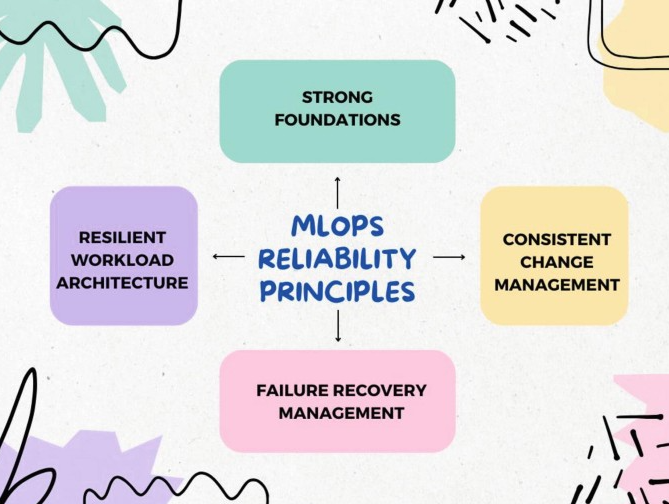
Introduction: The Production AI Bottleneck
Transitioning a machine learning model from a development notebook to a production environment is the single biggest challenge in modern AI. While data science often focuses on model accuracy, production environments demand reliability, scalability, and observability. Engineers frequently face "the wall of production"—where models fail silently due to data drift, infrastructure bottlenecks, or manual deployment errors. MLOps (Machine Learning Operations) has emerged as the essential framework, applying engineering rigor to the entire lifecycle to ensure AI systems deliver consistent, reliable value.
Understanding MLOps in Modern AI Systems
MLOps is the systematic application of DevOps principles—Continuous Integration (CI), Continuous Deployment (CD), and Continuous Training (CT)—to the ML lifecycle.
-
The Lifecycle: MLOps orchestrates every stage, from data versioning and feature engineering to model deployment and proactive monitoring.
-
Research vs. Production: Research is exploratory; production is operational. MLOps enforces the rigors of software engineering on ML models, moving them from static artifacts to managed, versioned services.
-
Automation: By automating the training and deployment pipeline, teams eliminate manual "hand-offs," ensuring reproducibility and reducing the risk of human error in high-stakes environments.
Why MLOps Is in High Demand
Industry adoption of AI is accelerating, but enterprise infrastructure is struggling to keep pace. Companies are no longer asking how to build a model; they are asking how to sustain one. The inability to monitor performance or scale inference leads to massive technical debt. Consequently, there is a critical hiring demand for MLOps engineers who understand how to design pipelines that are resilient to real-world data volatility.
About MLOps Foundation Certification
The MLOps Foundation Certification is designed to standardize the technical competencies required to manage the modern ML lifecycle. It moves beyond theory to focus on the architecture and tools necessary for production environments. By completing this certification, professionals gain the framework needed to build pipelines that are modular, testable, and compliant, directly addressing the operational challenges of enterprise AI.
Certification Ecosystem Table
| Certification | Level | Focus Area | Best For | Skills Covered | Career Value |
| MLOps Foundation | Foundation | Processes & Lifecycle | All AI Roles | Pipelines, Automation | Baseline Competency |
| Advanced MLOps Engineer | Professional | Architecture/Scaling | ML Engineers | CI/CD, K8s, Cloud ML | Senior/Lead Roles |
| AIOps/DataOps Architect | Advanced | Infrastructure/Strategy | Architects | Orchestration, Security | Strategic Leadership |
Core Skills Covered in MLOps Foundation
This certification focuses on the technical essentials of maintaining a high-availability AI ecosystem:
-
CI/CD for ML: Designing automated pipelines that test code and model artifacts before any production release.
-
Model Training Pipelines: Orchestrating repeatable training runs that version both data and hyperparameters.
-
Model Deployment Strategies: Mastering techniques like blue-green or canary rollouts to minimize service downtime.
-
Monitoring & Drift Detection: Setting up real-time telemetry to trigger retraining when production data diverges from the training set.
-
Automation Workflows: Removing manual intervention through containerized, scalable, and self-healing infrastructure.
Real-World MLOps Use Cases
-
Fraud Detection: Automatically updating models as transaction patterns evolve, ensuring threats are caught in real-time.
-
Recommendation Engines: Managing high-concurrency model serving that updates dynamically based on user behavior.
-
Predictive Analytics: Establishing robust AI monitoring to guarantee that automated supply chain decisions remain accurate during market fluctuations.
Career Growth in MLOps
The career path for an MLOps professional is distinct and high-growth. By moving from a standard ML or Data Science role into MLOps, you transition into the "systems" side of AI—the most critical link in the technology stack. Cloud-native engineering paths and infrastructure design are increasingly dependent on MLOps expertise, making this a future-proof career trajectory.
MLOps vs Traditional Machine Learning Workflow
Traditional workflows are manual, siloed, and static. They treat models as one-off projects. MLOps, by contrast, treats the model as an active, continuously learning service. It replaces fragmented, manual updates with a unified, automated pipeline that reacts to environment changes.
Challenges Solved by MLOps
-
Model Failure: Identifying and fixing performance degradation through proactive observability.
-
Data Drift: Adapting models automatically to real-world changes.
-
Scalability: Handling inference spikes through standardized, containerized orchestration.
Future of MLOps
The industry is trending toward the convergence of AutoML and MLOps. Future AI infrastructure will be defined by self-healing, cloud-native platforms. Mastering these foundations now positions you to architect the AI infrastructure of tomorrow.
Who Should Take This Certification
-
ML Engineers: To formalize the operational side of your expertise.
-
Data Scientists: To gain the engineering autonomy required to manage models at scale.
-
DevOps/Cloud Engineers: To pivot into the critical, high-paying field of AI infrastructure.
-
Software Engineers: To specialize in integrating intelligent systems into enterprise applications.
Frequently Asked Questions
1. Is this certification for beginners?
It is ideal for anyone with a technical background (Data or DevOps) looking to master the production-grade operations of ML models.
2. How does this differ from standard DevOps?
MLOps includes data lifecycle, model versioning, and drift monitoring—tasks unique to the non-deterministic nature of machine learning.
3. Will this certification help me get a job?
It provides a professional, vendor-neutral validation of your skills, making you a more versatile candidate for AI/ML engineering roles.
4. How long is the curriculum?
It is designed to be self-paced, allowing professionals to gain deep insights while maintaining their current roles.
5. Does it cover cloud-native tools?
Yes, it covers the principles and architectural patterns that apply to all major cloud-native ML environments.
Conclusion
MLOps is the difference between an AI experiment and a sustainable enterprise asset. By mastering the principles of automated, reliable, and observable production pipelines, you ensure that your work provides long-term, scalable value. The MLOps Foundation Certification is the strategic first step in building the professional skills required to lead in the age of production-grade AI. Start your journey today to ensure your AI systems—and your career—are ready for the future.