
Every Eid al-Adha you celebrate is directly and inseparably connected to Hajj.
Most Muslims around the world celebrate Eid al-Adha with prayers, Qurbani, and family gatherings. But many celebrate without fully understanding why. Why do we sacrifice an animal on this day? Why does Eid fall exactly when it does? What are the pilgrims doing in Makkah while we celebrate at home?
The truth is, eid al adha hajj are not two separate events happening at the same time. They are one unified act of worship, split between those performing pilgrimage in Makkah and those worshipping at home across the world. Understanding this connection transforms how you experience Eid forever.
This guide explains the profound spiritual link between Hajj and Eid al-Adha, the expected hajj date 2026 and Eid dates, the significance of the Day of Arafat, and how you can deepen your worship whether you are in Makkah or at home.
Let us begin with the story that started everything.
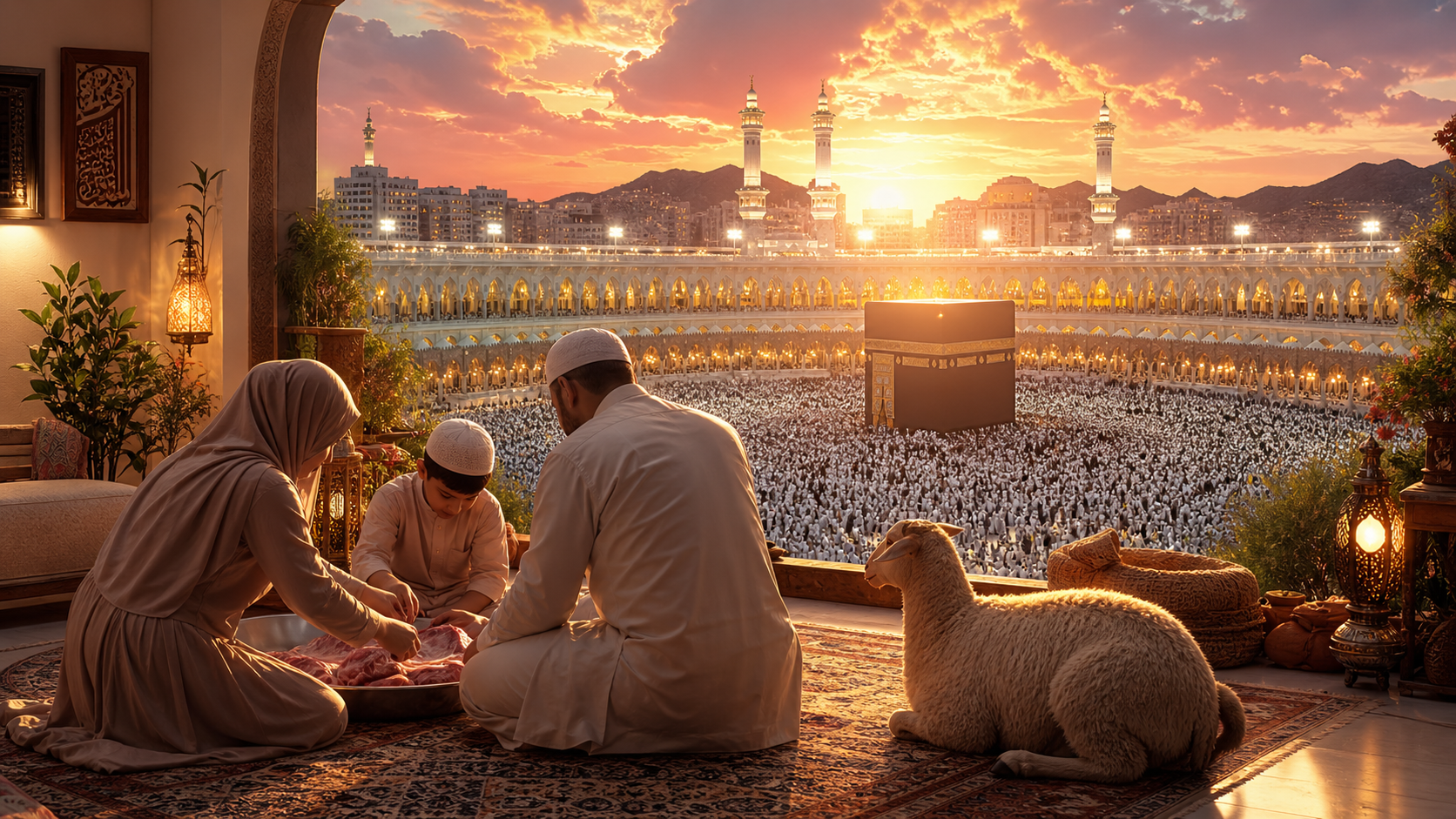
The Sacred Link Between Eid al-Adha and Hajj
To understand why hajj and eid al adha are inseparable, you must return to the story of Prophet Ibrahim (AS). This is not just history. It is the living foundation of every ritual Muslims perform today.
The Story of Prophet Ibrahim and the Origins
Prophet Ibrahim (AS) dedicated his entire life to the worship of Allah. He left his homeland, rejected idol worship when everyone around him worshipped idols, and submitted completely to Allah's command at every test he faced.
The greatest test came when Allah commanded Ibrahim (AS) in a dream to sacrifice his beloved son, Ismail (AS). Ibrahim told his son what Allah had commanded. Ismail, displaying the same extraordinary faith as his father, responded: "Do what you have been commanded. You will find me, Insha'Allah, among the patient."
As recorded in Surah As-Saffat, verses 99-113, Ibrahim laid his son down and raised the knife. At that moment, Allah called out to him: "O Ibrahim, you have fulfilled the vision." A ram was sent from the heavens as a substitute sacrifice. Ibrahim and Ismail had passed the ultimate test of faith.
This moment is the origin of Eid al-Adha and Qurbani. Every year, Muslims around the world sacrifice an animal on the 10th of Dhul Hijjah in honor of Ibrahim's submission and Allah's mercy. It is not simply a ritual. It is a declaration: we too submit completely to Allah, whatever He asks.
How Hajj Rituals Relive This Sacred Story
Every single ritual of Hajj directly re-enacts the story of Ibrahim, Hajar, and Ismail. This is why eid ul adha and hajj are permanently bound together.
Tawaf (circling the Kaaba) honors the House that Ibrahim and Ismail built together for the worship of Allah alone. Sa'i (walking between Safa and Marwa) relives Hajar's desperate search for water for her infant son Ismail. Zamzam water is the miraculous spring Allah caused to spring forth for Hajar and Ismail.
Rami al-Jamarat (stoning the pillars in Mina) relives Ibrahim's rejection of Shaytan, who appeared three times trying to stop him from obeying Allah's command. Qurbani (the sacrifice) commemorates the moment Allah sent the ram to replace Ismail.
Every pilgrim walking through Hajj is literally following in the footsteps of Ibrahim, Hajar, and Ismail. And every Muslim performing Qurbani at home is participating in the same commemoration. Hajj pilgrims and home worshippers are united in a single act of global submission to Allah.
When is Hajj 2026? Expected Dates Explained
Understanding the hajj 2026 date helps you appreciate when the sacred rituals are happening and how they connect to Eid.
The 2026 Hajj Date and Five Sacred Days
Hajj 2026 is expected to begin on approximately Saturday, June 20, 2026 (8th Dhul Hijjah) and conclude around Wednesday, June 24, 2026 (12th Dhul Hijjah). The most sacred day, the Day of Arafat, falls on approximately Sunday, June 21, 2026 (9th Dhul Hijjah).
Here is the complete hajj days 2026 breakdown:
|
Hajj Day |
Islamic Date |
Expected Gregorian Date |
Key Ritual |
|
Day 1 |
8th Dhul Hijjah |
Saturday, June 20, 2026 |
Enter Ihram, travel to Mina |
|
Day 2 |
9th Dhul Hijjah |
Sunday, June 21, 2026 |
Stand at Arafat (most important) |
|
Day 2 Night |
9th-10th |
Sunday night |
Sleep in Muzdalifah |
|
Day 3 |
10th Dhul Hijjah |
Monday, June 22, 2026 |
Stone, sacrifice, shave, Tawaf |
|
Day 4 |
11th Dhul Hijjah |
Tuesday, June 23, 2026 |
Stone all three pillars |
|
Day 5 |
12th Dhul Hijjah |
Wednesday, June 24, 2026 |
Final stoning, farewell Tawaf |
These dates are based on astronomical calculations using the Islamic calendar 2026 Dhul Hijjah dates. Official confirmation comes only after moon sighting by Saudi authorities approximately one month before.
For a detailed explanation of what happens during each of these five days, read our complete Hajj step by step guide.
Why Hajj Dates Change Every Year
Many Muslims wonder why the islamic hajj date falls on different Gregorian calendar dates each year. The reason is straightforward.
Islam follows the lunar (Hijri) calendar, which is approximately 11 days shorter than the solar (Gregorian) calendar we use for daily life. Hajj always occurs during the month of Dhul Hijjah (the 12th month of the Islamic year), but because the Islamic year is shorter, Dhul Hijjah moves 11 days earlier on the Gregorian calendar every year.
This means Hajj rotates through all seasons over approximately 33 years. In recent years, Hajj has fallen during summer (extremely hot in Makkah). By the 2030s, it will move toward spring, then winter, offering pilgrims cooler conditions.
This rotation carries wisdom. No single generation permanently bears the hardship of summer Hajj. And no single generation permanently enjoys the ease of winter Hajj. Every Muslim community across history shares both the ease and the difficulty.
When is Eid al-Adha 2026?
Eid al-Adha 2026 is expected to fall on Monday, June 22, 2026 - the 10th of Dhul Hijjah. This is the same day pilgrims in Makkah perform their Qurbani sacrifice, shave their heads, and complete Tawaf al-Ifadah.
Expected Eid al-Adha 2026 Date
The 10th of Dhul Hijjah simultaneously marks two extraordinary events happening across the world:
In Makkah, 2-3 million pilgrims perform Qurbani after stoning Jamarat al-Aqabah. They shave their heads, exit Ihram, and perform the main Tawaf of Hajj. They are physically exhausted but spiritually reborn.
Around the world, hundreds of millions of Muslims perform Eid prayers, sacrifice animals, distribute meat to the poor, and celebrate with family. They are not in Makkah, but they are participating in the same global act of worship.
This simultaneous observance is unique in Islam. No other religious observance unites pilgrims at a specific location with the entire global Muslim community in real-time worship at exactly the same moment.
Moon Sighting and Date Confirmation
The exact date of Eid al-Adha 2026 will be officially confirmed by moon sighting authorities approximately one month before. Different countries and Islamic organizations may announce Eid on slightly different dates based on their moon sighting methodology.
In the UK, organizations like the Hilal Committee and major mosques announce Eid dates following moon sighting. Most UK Muslims follow the Saudi moon sighting, which typically aligns with the dates above. Some communities follow local UK moon sighting, which occasionally results in a one-day difference.
Whatever the confirmed date in your community, the spiritual reality is the same. Eid al-Adha celebrates Ibrahim's submission and Allah's mercy on the same sacred day pilgrims complete their Hajj.
If you are inspired to register for Hajj and experience this day from Makkah yourself, start with our Hajj 2026 registration guide today.
The Day of Arafat - The Heart of Both Observances
The Day of Arafat (9th Dhul Hijjah) is the spiritual peak of both Hajj and the entire Dhul Hijjah season. It is the day before Eid al-Adha, and its significance cannot be overstated.
What Happens on the Day of Arafat
On this day, every Hajj pilgrim travels to the plains of Arafat — a vast open desert approximately 20 kilometers from Makkah. They stand, sit, pray, and make dua from midday until sunset. This standing is called Wuquf and it is the single most essential pillar of Hajj.
The Prophet Muhammad ﷺ said: "Hajj is Arafat." Missing Arafat means missing Hajj entirely. No other ritual carries this absolute status.
At Arafat, pilgrims pour their hearts out to Allah. They ask for forgiveness for every sin of their lives. They pray for their families, their communities, and the entire Muslim Ummah. The Prophet ﷺ described this day saying Allah descends to the lowest heaven and boasts to the angels about His servants standing at Arafat, saying: "Look at my servants, they have come to me disheveled and dusty."
For a deeper understanding of what pilgrims experience at Arafat, read our article on what happens on the Day of Arafat.
Fasting Arafat for Non-Pilgrims at Home
One of the most powerful acts of worship for Muslims not performing Hajj is fasting on the Day of Arafat (9th Dhul Hijjah — Sunday, June 21, 2026).
According to authentic Hadith (Muslim: 1162), the Prophet Muhammad ﷺ was asked about fasting on the Day of Arafat. He replied: "It expiates the sins of the previous year and the coming year."
This single fast carries the reward of two full years of sin forgiveness. No other voluntary fast in Islam carries this specific promise. It is arguably the most rewarding single day of fasting in the entire Islamic calendar.
While pilgrims at Arafat are exempt from this fast (they should not fast during Hajj to maintain strength), all Muslims at home are strongly encouraged to fast this day.
Example: Maryam from Sheffield had been unable to perform Hajj due to health reasons for three consecutive years. Every Dhul Hijjah, she fasted on the Day of Arafat, prayed extra prayers, and made dua for hours. She said: "I cry every year on Arafat day. I imagine the pilgrims standing there while I stand in my living room. But I feel connected to them. I feel like Allah hears me too." Her spiritual experience illustrates that the reward of Dhul Hijjah is not limited to those physically present at Arafat.
The Takbeer of Eid and Days of Dhul Hijjah
The first ten days of Dhul Hijjah are the most sacred days of the Islamic year. The Prophet ﷺ said: "There are no days on which righteous deeds are more beloved to Allah than these ten days." (Bukhari)
Takbeer Tashreeq Explained
From the Fajr prayer on the 9th of Dhul Hijjah (Day of Arafat) until the Asr prayer on the 13th of Dhul Hijjah (the last day of Tashriq), Muslims recite Takbeer Tashreeq after every obligatory prayer:
"Allahu Akbar, Allahu Akbar, la ilaha illallah, Allahu Akbar, Allahu Akbar, wa lillahil hamd."
Translation: "Allah is the Greatest, Allah is the Greatest, there is no god but Allah, Allah is the Greatest, Allah is the Greatest, and to Allah belongs all praise."
This Takbeer is recited by pilgrims in Makkah and Muslims worldwide simultaneously. For those five days, the entire Muslim world — from London to Lahore, from Cairo to Cape Town — raises the same words of praise to Allah together.
This unified global Takbeer is unique. No other act of worship involves every Muslim on Earth performing the same words at the same times across the same five consecutive days.
First 10 Days of Dhul Hijjah Significance
The ten days before Eid are a period of intensified worship for all Muslims, not just pilgrims.
Recommended acts during first 10 days of Dhul Hijjah:
-
Increase voluntary fasting (especially the 9th — Day of Arafat)
-
Recite Takbeer, Tahmeed (Alhamdulillah), and Tahleel (La ilaha illallah) frequently
-
Give extra Sadaqah (charity) during these blessed days
-
Perform extra voluntary prayers and Quran recitation
-
Make sincere intention and plan for Hajj if not yet performed
-
Avoid cutting hair and nails from 1st Dhul Hijjah until after Qurbani (for those sacrificing)
These days offer every Muslim — whether performing Hajj or not — an annual opportunity for spiritual renewal and elevated reward. Use them fully.
Celebrating Eid at Home vs in Makkah
The contrast between Eid al-Adha for pilgrims in Makkah and Muslims at home reveals how this celebration unites the entire Ummah across geography.
What Pilgrims Experience on Eid Day
For hajj day 2026 pilgrims, the 10th of Dhul Hijjah is the most physically demanding and spiritually overwhelming day of their lives.
They wake before Fajr in Muzdalifah, having slept on rocky desert ground under the open sky. They collect pebbles by torchlight. After Fajr prayer, they rush to Mina to throw stones at Jamarat al-Aqabah before the sun rises too high. The crowd is massive. The heat intensifies by the minute.
After stoning, they sacrifice their Qurbani animal (arranged through their operator). Then they shave or trim their hair — symbolizing humility and the shedding of their old self. They change out of Ihram into regular clothes for the first time in days. They travel to Makkah, perform Tawaf al-Ifadah around the Kaaba, walk between Safa and Marwa, then return to Mina.
By the time Eid evening arrives, most pilgrims are exhausted beyond description. Their feet are blistered. Their bodies ache from days of walking. But their hearts are fuller than they have ever felt. Many describe this day as simultaneously the hardest and most beautiful of their entire lives.
Example: Omar from London performed Hajj in 2023. He called his family on Eid day from Mina at 9pm UK time. He could barely speak. His daughter asked if he was okay. He said: "I am better than okay. I cannot explain it. I am exhausted and I am crying and I have never felt this close to Allah in my life. Make dua for me." His family, celebrating Eid at home in London, understood for the first time what Hajj actually means.
How to Maximize Eid al-Adha at Home
For Muslims celebrating at home, Eid al-Adha offers profound opportunities for worship and reflection that many people miss while focusing purely on celebration.
How to deepen your Eid al-Adha experience:
-
Wake for Fajr and make sincere dua while pilgrims are standing at Arafat the night before
-
Fast on the 9th of Dhul Hijjah (Day of Arafat) for two years' sin expiration
-
Attend Eid prayer and listen to the khutbah with genuine attention
-
Make intention in your heart: "This year I celebrate Eid. Next year, Insha'Allah, I will celebrate from Makkah"
-
Distribute Qurbani meat generously — one third for family, one third for friends, one third for those in need
-
Call or visit elderly relatives who cannot attend Eid prayer
-
Teach your children the story of Ibrahim and Ismail — connect them to the meaning
-
Make dua specifically for Hajj pilgrims by name if you know them
The experience of Eid al-Adha at home is beautiful and complete in itself. But every celebration should also kindle the intention for Hajj. Every year you celebrate Eid at home is a reminder that one year, Insha'Allah, you will celebrate it at the Kaaba.
When that intention becomes firm, take the next step. Explore our Hajj 2026 packages from UK and begin your journey toward being among those pilgrims your family calls on Eid day.
Frequently Asked Questions
When is Hajj 2026?
Hajj 2026 is expected to begin on approximately Saturday, June 20, 2026 (8th Dhul Hijjah) and conclude around Wednesday, June 24, 2026 (12th Dhul Hijjah). The Day of Arafat falls on approximately Sunday, June 21, 2026. Official dates are confirmed by Saudi moon sighting authorities approximately one month before.
When is Eid al-Adha 2026?
Eid al-Adha 2026 is expected on Monday, June 22, 2026, which corresponds to the 10th of Dhul Hijjah. The exact date will be officially confirmed by moon sighting. Some UK communities may celebrate one day earlier or later depending on their moon sighting methodology. Most UK Muslims follow Saudi moon sighting confirmation.
What is the Day of Arafat?
The Day of Arafat is the 9th of Dhul Hijjah, the most important day of Hajj and the most sacred day of the Islamic year. Pilgrims stand on the plains of Arafat from midday to sunset making dua and seeking forgiveness. The Prophet ﷺ said Hajj is Arafat. Non-pilgrims are encouraged to fast this day, which expiates sins of the previous and coming year.
Why do we sacrifice on Eid al-Adha?
Qurbani commemorates Prophet Ibrahim's willingness to sacrifice his son Ismail in obedience to Allah's command. When Allah saw Ibrahim's complete submission, He sent a ram as a substitute sacrifice and declared Ibrahim's test passed. Every Muslim who can afford it sacrifices an animal on the 10th of Dhul Hijjah in honor of this supreme act of faith and submission.
What is the connection between Hajj and Eid al-Adha?
Both Hajj and Eid al-Adha commemorate the same event: Prophet Ibrahim's submission to Allah through his willingness to sacrifice Ismail. Pilgrims performing Hajj re-enact Ibrahim's journey physically through Tawaf, Sa'i, Muzdalifah, and Qurbani. Muslims worldwide celebrate Eid al-Adha on the same day pilgrims perform Qurbani in Makkah. They are one unified global act of submission happening simultaneously.
Conclusion
Eid al-Adha and Hajj are not two separate events. They are one magnificent act of collective worship spanning the entire Muslim world simultaneously. Pilgrims stand at Arafat while you fast at home. Pilgrims perform Qurbani in Mina while you sacrifice in your city. The same Takbeer rises from Makkah and Manchester at the same moment.
Understanding this connection transforms every future Eid al-Adha you celebrate. You are not just enjoying a holiday. You are participating in a 4,000-year-old act of submission to Allah, united with millions of pilgrims at the sacred sites and billions of Muslims across the world.
If this understanding has deepened your desire to perform Hajj yourself, do not delay your intention. Contact Premier Hajj today and explore our Hajj 2026 packages from UK. May Allah write your name among the pilgrims of 2026.
May Allah accept from all of us, unite us at His House, and grant us the understanding to worship Him as He deserves. Ameen.