
Introduction
3D modeling has revolutionized the gaming industry, enabling developers to create immersive and visually stunning environments. Whether you're an aspiring 3D artist or a game developer looking to improve your skills, understanding the fundamentals of 3D modeling for games is essential. This guide will introduce you to key concepts, software, and techniques involved in creating high-quality 3D game assets, from simple props to complex game environments.
Understanding 3D Modeling for Games
At its core, 3D modeling games involve creating digital objects using specialized software like Blender, Maya, or 3ds Max. These objects, known as 3D game assets, range from simple props to detailed characters and intricate environments.
Each 3D model is built using a mesh, which consists of vertices, edges, and faces. Properly optimizing these models ensures they perform well within a game engine like Unity or Unreal Engine. Game assets should be designed with efficiency in mind, balancing visual quality with performance.
Choosing the Right Software for 3D Game Asset Creation
To create professional-grade 3D game assets, you need the right tools. Some of the most popular 3D modeling software options include:
-
Blender: A free and open-source software with powerful modeling, sculpting, and texturing tools.
-
Autodesk Maya: A professional industry standard for animation and 3D modeling games.
-
3ds Max: A versatile tool used extensively in game development for modeling and rendering.
-
ZBrush: Ideal for high-detail sculpting, often used for character creation.
-
Substance Painter: A crucial tool for texturing 3D game assets with realistic materials.
3D Game Environment Modeling: Crafting Immersive Worlds
One of the most important aspects of game development is 3D game environment modeling. This involves creating realistic landscapes, buildings, and props that set the scene for gameplay. A well-designed 3D game environment enhances immersion and storytelling.
When working on a 3D game environment, consider factors such as:
-
Scale and Proportions: Ensure objects fit logically within the game world.
-
Texturing and Materials: Use high-quality textures to add realism.
-
Lighting: Proper lighting enhances the mood and visibility of the environment.
-
Optimization: Reduce unnecessary polygons and use LODs (Level of Detail) to optimize performance.
Hard Surface Modeling for Game Assets
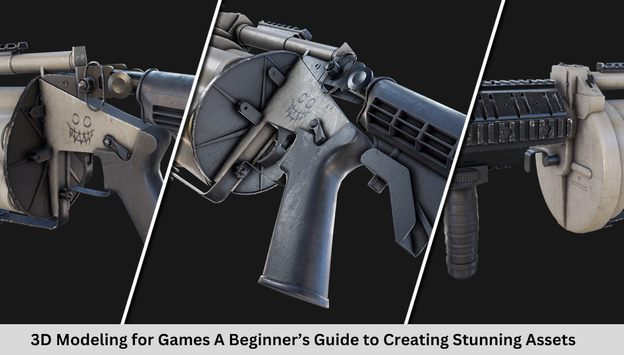
Hard surface modeling is essential for creating mechanical and artificial objects such as weapons, vehicles, and buildings. 3D hard surface modeling involves crafting smooth, precise models with clean topology. Some common techniques include:
-
Subdivision Modeling: Refining edges to create smooth surfaces.
-
Boolean Operations: Using Boolean tools to cut and merge shapes.
-
Beveling: Softening edges to create a realistic look.
-
Retopology: Optimizing high-poly models into game-friendly low-poly versions.
Creating High-Quality 3D Vehicles for Games
Vehicles play a crucial role in many game genres, from racing to open-world adventures. A well-crafted car 3D model requires attention to detail and realistic proportions. When working on 3D vehicle modeling, keep these tips in mind:
-
Reference Images: Gather real-world images for accuracy.
-
Edge Flow: Maintain clean edge loops for smooth surfaces.
-
Texturing and Materials: Use PBR (Physically Based Rendering) materials for realism.
-
Animation-Ready Design: Ensure the model is rigged correctly for animation.
Props 3D Modeling: Adding Detail to Game Worlds
Props are essential elements that bring 3D environment modeling to life. From furniture to weapons, props 3D model creation follows a structured pipeline:
-
Concept and Reference Gathering: Define the look and purpose of the prop.
-
Blocking Out Shapes: Start with simple geometric forms.
-
High-Poly Sculpting: Add intricate details if needed.
-
Retopology: Convert high-poly to low-poly for game use.
-
UV Mapping and Texturing: Apply textures and materials for realism.
-
Importing to Game Engine: Optimize and test within the game engine.
Optimizing 3D Game Assets for Performance
Performance is key in game development. Here are some best practices for optimizing 3D game assets:
-
Polygon Count Reduction: Use only necessary polygons to maintain visual quality without overloading the engine.
-
Efficient UV Mapping: Optimize UV layouts to reduce texture stretching.
-
Baking Details: Use normal maps to simulate high-poly details on low-poly models.
-
LOD (Level of Detail): Create multiple versions of an asset for different viewing distances.
Conclusion
Mastering 3D modeling for games takes time and practice, but with the right techniques, tools, and dedication, you can create stunning 3D game assets. Whether you're working on 3D game environments, hard surface modeling, or props, optimizing your models for game engines ensures a smooth gaming experience. By continuously refining your skills and experimenting with different techniques, you’ll be well on your way to becoming a proficient 3D artist in the gaming industry.