
You should use exothermic welding instead of compression connectors when you need a permanent, low-resistance, corrosion-resistant electrical connection for earthing and lightning protection systems. In India, exothermic welding is the preferred solution for substations, solar power plants, telecom towers, railway infrastructure, and industrial grounding grids where long-term reliability is more important than future modifications. Compression connectors are better suited for accessible installations that may require maintenance or replacement.
Introduction
A dependable earthing system is essential for every electrical installation, from residential buildings and commercial complexes to high-voltage substations and renewable energy projects. The effectiveness of an earthing system depends not only on the quality of conductors and ground rods but also on how those conductors are connected.
One of the most common questions among electrical engineers, contractors, and project consultants is whether exothermic welding is better than compression connectors. Although both methods create electrical grounding connections, they differ significantly in durability, conductivity, corrosion resistance, and long-term performance.
This comprehensive guide explains when exothermic welding should be chosen over compression connectors, how exothermic welding powder works, and why selecting the right Exothermic Welding Product is critical for Indian infrastructure projects.
What Is Exothermic Welding?
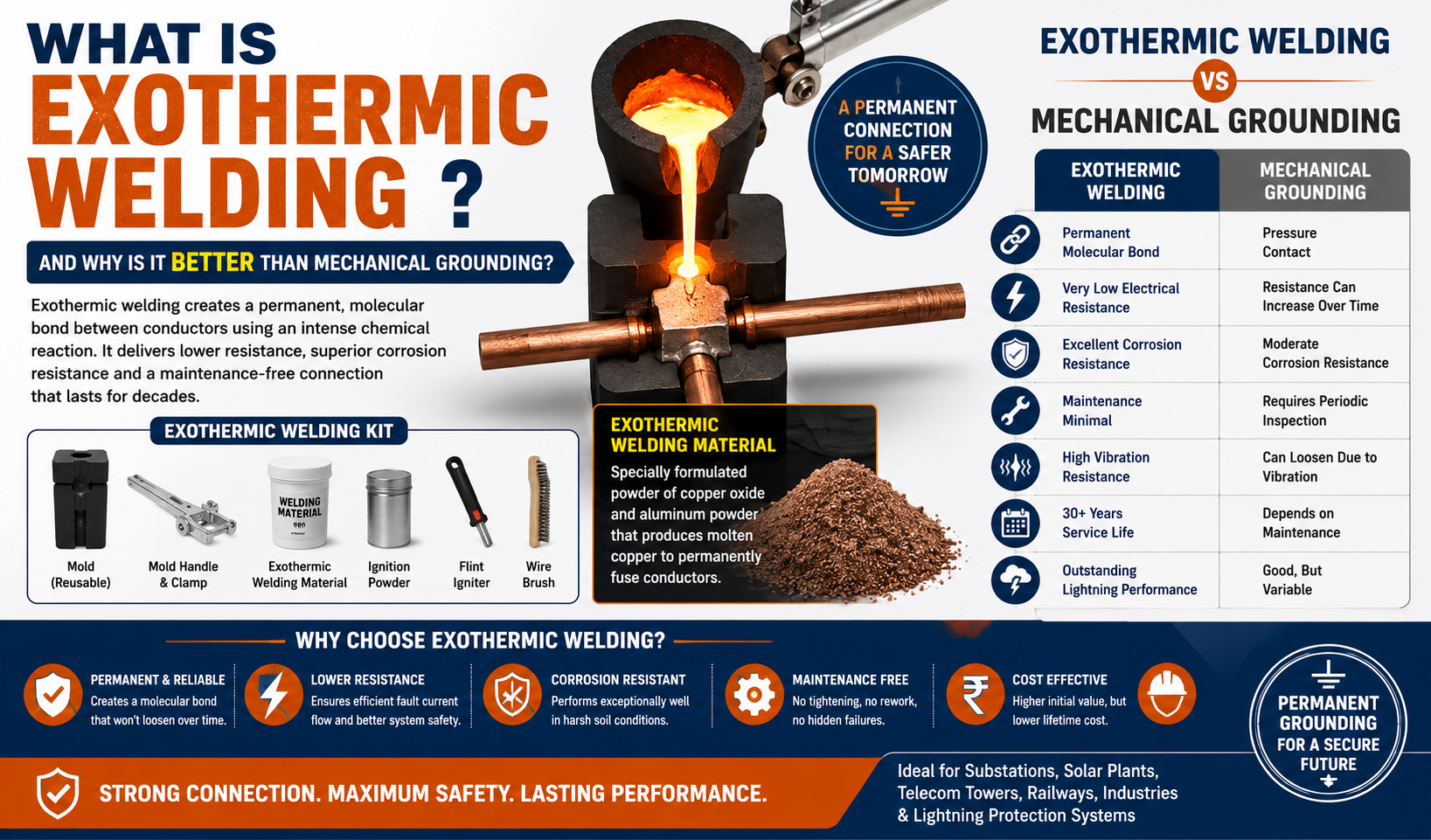
Exothermic welding is a permanent metal joining process that creates an electrical connection through a chemical reaction rather than mechanical pressure. During the process, exothermic welding powder is ignited inside a graphite mold. The reaction generates extremely high temperatures that melt copper and permanently fuse the conductors together.
Unlike traditional welding, exothermic welding does not require an external power source. The finished connection becomes a molecular bond with conductivity equal to or better than the connected conductor. This makes it one of the most reliable methods for grounding and bonding applications.
In India, exothermic welding is widely used in power transmission, substations, telecom infrastructure, solar projects, metro rail systems, petrochemical plants, and lightning protection installations.
What Are Compression Connectors?
Compression connectors are mechanical devices used to join electrical conductors by applying high hydraulic pressure. A copper or copper alloy connector is compressed around the conductor using a crimping tool and matching dies.
These connectors are popular because they are quick to install and do not require chemical materials or graphite molds. When properly installed, they provide excellent electrical performance for many grounding applications.
However, their long-term reliability depends on correct crimping pressure, installation quality, and environmental conditions.
The Core Difference Between the Two Methods
The primary difference lies in how the connection is created. Exothermic welding permanently fuses metals into one continuous conductive path, while compression connectors rely on mechanical force to maintain electrical contact.
Because exothermic welding eliminates bolts, screws, and moving components, it offers exceptional stability over decades of service. Compression connectors remain effective but are generally preferred where accessibility and future maintenance are important considerations.
When Should You Use Exothermic Welding?
Underground Earthing Systems
Underground grounding grids are designed to remain buried for several decades. Excavating failed joints is expensive and can interrupt industrial operations. Exothermic welding creates permanent underground connections that maintain low electrical resistance throughout the life of the installation.
This makes it the preferred choice for substations, industrial plants, manufacturing facilities, airports, and large commercial developments across India.
Lightning Protection Systems
Lightning generates extremely high impulse currents within milliseconds. Every grounding connection must safely transfer that energy into the earth without creating excessive resistance or heat.
Exothermic welded joints are highly resistant to repeated lightning currents and provide reliable performance in lightning protection systems installed on factories, hospitals, data centers, hotels, and high-rise buildings.
Solar Power Plants
India's rapidly growing renewable energy sector requires durable grounding systems capable of operating for more than 25 years in harsh outdoor environments. Utility-scale solar farms contain thousands of grounding connections that are exposed to heat, moisture, dust, and seasonal weather changes.
Exothermic welding minimizes maintenance requirements and helps maintain consistent grounding performance throughout the project's operational life.
Railway and Metro Infrastructure
Railway signaling equipment, metro stations, and traction power systems demand highly reliable earthing connections. Constant vibration and environmental exposure make permanent molecular bonds more dependable than ordinary mechanical joints in many critical applications.
Oil, Gas, and Heavy Industries
Industrial facilities often operate in corrosive environments where moisture, chemicals, and temperature fluctuations accelerate metal deterioration. Exothermic welding removes the risk of loose hardware and creates a connection that performs reliably even in demanding industrial conditions.
When Are Compression Connectors the Better Option?
Compression connectors are not inferior—they simply serve different engineering needs. They are often the preferred choice for indoor electrical rooms, accessible grounding bars, retrofit projects, temporary installations, and facilities where electrical systems may require future expansion.
If technicians need to inspect, modify, or replace grounding conductors during maintenance, compression connectors provide greater flexibility. They also reduce installation time because they require only hydraulic crimping tools instead of graphite molds and welding materials.
For many commercial buildings and accessible electrical installations, compression connectors offer an efficient and cost-effective solution.
Exothermic Welding vs Compression Connectors
|
Feature |
Exothermic Welding |
Compression Connectors |
|---|---|---|
|
Connection Type |
Molecular fusion |
Mechanical compression |
|
Electrical Conductivity |
Excellent |
Very good |
|
Corrosion Resistance |
Excellent |
Good |
|
Maintenance |
Minimal |
Periodic inspection |
|
Underground Installation |
Ideal |
Suitable |
|
Lightning Protection |
Highly recommended |
Suitable |
|
Installation Method |
Graphite mold and welding powder |
Hydraulic crimp tool |
|
Expected Service Life |
30–50+ years |
Depends on installation and environment |
Why Exothermic Welding Powder Is Important
The performance of an exothermic connection depends heavily on the quality of the exothermic welding powder. The powder contains precisely controlled metallic compounds that generate molten copper during the chemical reaction.
Using high-quality powder ensures complete fusion, consistent conductivity, and strong mechanical integrity. Poor-quality materials may produce porous welds, incomplete bonding, or excessive slag, reducing the overall reliability of the grounding system.
For professional installations, engineers should always select welding powder that matches the conductor size, mold type, and connection configuration.
What Is Included in an Exothermic Welding Product?
A complete Exothermic Welding Product typically consists of reusable graphite molds, exothermic welding powder, ignition powder, retaining discs, mold handles, cleaning brushes, and accessories designed for specific conductor sizes.
Different molds are manufactured for cable-to-cable, cable-to-ground rod, cable-to-rebar, copper tape, and structural steel connections. Choosing the correct product ensures accurate weld geometry and consistent installation quality.
Industries in India That Prefer Exothermic Welding
India's infrastructure growth has significantly increased the demand for permanent grounding solutions. Power utilities use exothermic welding for transmission substations and switchyards. Solar EPC companies install welded grounding grids across renewable energy projects. Telecom operators rely on permanent earthing for communication towers and data centers. Railway authorities use welded grounding for signaling and traction systems, while petrochemical industries depend on corrosion-resistant grounding for hazardous environments.
These sectors prioritize long operational life, minimal maintenance, and dependable electrical safety, making exothermic welding an ideal solution.
Is Exothermic Welding Worth the Higher Initial Cost?
Exothermic welding generally costs more during installation because it requires specialized molds, welding powder, and trained technicians. However, installation cost represents only a small portion of a grounding system's total lifecycle expense.
In projects where excavation is difficult, maintenance access is limited, or equipment downtime is expensive, permanent welded connections often provide better long-term value. Reduced maintenance, fewer repairs, and greater reliability frequently outweigh the higher upfront investment.
Compression connectors remain economical for accessible installations where maintenance can be performed easily.
Best Installation Practices
Proper installation is essential for achieving reliable exothermic welds. Conductors should always be clean, dry, and free from oxidation before welding. Graphite molds must be inspected regularly for wear because damaged molds can produce inconsistent connections. Moisture should never be present inside the mold, as it can affect weld quality and create safety hazards during ignition.
Using the correct exothermic welding powder size for each conductor combination is equally important for producing a strong, low-resistance joint.
How to Choose Between Exothermic Welding and Compression Connectors
The right choice depends on the installation environment rather than price alone. If the connection will remain buried underground for decades, experience severe corrosion, carry lightning currents, or become inaccessible after construction, exothermic welding is usually the preferred engineering solution.
If the connection is located inside an electrical room, requires future modifications, or needs quick installation with easy maintenance access, compression connectors are often the better option.
Understanding the project's lifecycle requirements helps engineers select the most suitable grounding technology.
Conclusion
Choosing between exothermic welding and compression connectors is ultimately a decision about reliability, maintenance, and service life. For permanent earthing systems in Indian substations, solar power plants, telecom towers, railway infrastructure, and industrial facilities, exothermic welding offers exceptional conductivity, corrosion resistance, and long-term durability.
High-quality exothermic welding powder and the correct Exothermic Welding Product ensure consistent performance and help create grounding systems capable of protecting people, equipment, and critical infrastructure for decades. Compression connectors continue to play an important role in accessible installations, but for permanent underground and high-reliability applications, exothermic welding remains the preferred solution.
Frequently Asked Questions (FAQ)
1. What is exothermic welding used for?
Exothermic welding is used to create permanent electrical grounding and bonding connections between copper conductors, ground rods, rebar, and structural steel.
2. Why is exothermic welding better than compression connectors?
Exothermic welding creates a molecular bond with excellent conductivity and corrosion resistance, making it ideal for permanent grounding systems.
3. Can exothermic welding be used underground?
Yes. It is specifically designed for underground earthing grids where long-term reliability and minimal maintenance are required.
4. What is exothermic welding powder?
Exothermic welding powder is a chemical mixture that produces molten copper through an exothermic reaction, permanently joining electrical conductors.
5. Does exothermic welding require electricity?
No. The process is powered entirely by a controlled chemical reaction and does not require an external electrical supply.
6. Which industries in India commonly use exothermic welding?
Power transmission, solar energy, telecom, railway, metro, petrochemical, mining, and industrial manufacturing sectors widely use exothermic welding.
7. How long does an exothermic welded connection last?
A properly installed exothermic weld can last 30 to 50 years or more, often matching the lifespan of the grounding system.
8. Are compression connectors suitable for earthing?
Yes. Compression connectors are suitable for many grounding applications, particularly where the connections remain accessible for inspection and maintenance.
9. Is exothermic welding safe for lightning protection?
Yes. Exothermic welded joints are widely used in lightning protection systems because they safely carry high impulse currents with low resistance.
10. How do I select the right Exothermic Welding Product?
Select the product according to conductor size, cable material, ground rod diameter, connection type, graphite mold compatibility, and the recommended exothermic welding powder size for the application.