
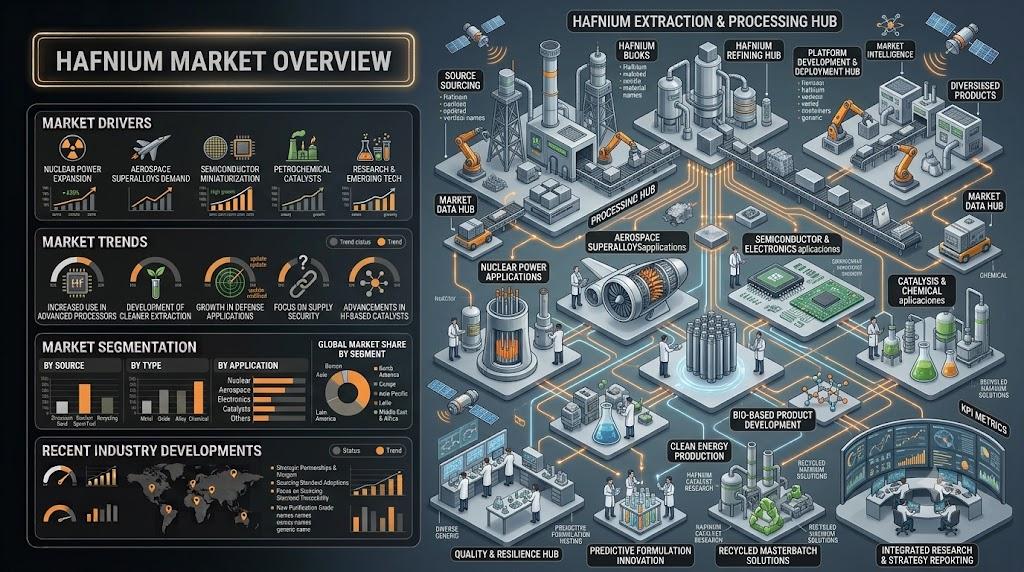
Market Overview:
According to IMARC Group's latest research publication, "Hafnium Market: Global Industry Trends, Share, Size, Growth, Opportunity and Forecast 2026-2034", The global hafnium market size reached 92.3 Tons in 2025. Looking forward, IMARC Group expects the market to reach 142.6 Tons by 2034, exhibiting a growth rate (CAGR) of 4.81% during 2026-2034.
This detailed analysis primarily encompasses industry size, business trends, market share, key growth factors, and regional forecasts. The report offers a comprehensive overview and integrates research findings, market assessments, and data from different sources. It also includes pivotal market dynamics like drivers and challenges, while also highlighting growth opportunities, financial insights, technological improvements, emerging trends, and innovations. Besides this, the report provides regional market evaluation, along with a competitive landscape analysis.
How AI is Reshaping the Future of the Hafnium Market
- AI-powered demand forecasting is helping hafnium producers and buyers navigate supply tightness, with global pure hafnium metal supply concentrated at just 70 to 75 tons per year across four countries, including France, the United States, China, and Russia.
- Rising demand from AI data centers and next-generation memory technologies is accelerating hafnium oxide consumption, as hafnia-based materials are increasingly used in non-volatile memory and neuromorphic computing applications.
- Industry forecasts indicate that the hafnium market segment associated with AI and data infrastructure alone could grow from an estimated USD 420 million in 2026 to approximately USD 726 million by 2030, reflecting the direct link between AI hardware expansion and hafnium demand.
- AI-driven materials discovery is accelerating research into ferroelectric hafnium, with scientists from the University of Rochester and the University of Tennessee, Knoxville, collaborating to create a ferroelectric form of hafnium suited for high-density data storage devices.
- Semiconductor manufacturers are deploying AI to optimize hafnium-based high-k dielectric deposition processes, improving transistor performance consistency as chip architectures push below the 10nm threshold.
Download a sample PDF of this report: https://www.imarcgroup.com/hafnium-market/requestsample
Key Trends in the Hafnium Market
- Advancements in the Semiconductor Industry: The shift toward smaller and more efficient electronic devices is driving demand for hafnium-based high-k dielectrics, which enable continued transistor miniaturization in modern microprocessors. The use of hafnium oxide in synaptic field-effect transistors is expanding applications in next-generation AI semiconductor technologies that mimic the human brain's efficiency, opening a new and rapidly growing demand channel for hafnium oxide beyond traditional chip designs.
- Increasing Nuclear Power Generation: As global emphasis on minimizing carbon emissions intensifies, nuclear power is being reconsidered as a viable low-carbon energy source. The shift toward advanced nuclear technologies, including small modular reactors, relies on hafnium's unique neutron-absorbing properties. India's second home-built 700 MW nuclear power reactor at Kakrapar Atomic Power Station in Gujarat reaching full operational capacity reflects the broader global expansion of nuclear infrastructure that directly supports hafnium consumption in control rods and reactor components.
- Innovations in Material Science for Data Storage: Hafnia is chemically versatile and can be made ferroelectric, enabling its use as a non-volatile memory material. This positions hafnium at the center of the next generation of data storage solutions. Research collaborations across leading universities are progressing toward commercializable ferroelectric hafnium products, making this an emerging application segment with significant long-term market implications.
- Surging Aerospace and Superalloy Demand: Hafnium is a critical element in the development of superalloys that require exceptional oxidation resistance and high-temperature strength, particularly for jet engine turbine blades and aerospace structural components. Rolls-Royce's development of aircraft engines featuring hafnium-containing superalloys exemplifies how the aerospace sector continues to deepen its reliance on this rare metal, with ongoing investments in next-generation aircraft models further reinforcing demand.
- Price Volatility Reflecting Supply-Demand Imbalance: Hafnium prices in Europe climbed sharply in October 2025, reaching USD 5,100 to 5,800 per kilogram duty unpaid Rotterdam, a 24% increase within a single week. This price surge reflects simultaneous demand growth from the electronics, gas turbine, and aerospace sectors against a backdrop of limited annual global supply, underscoring the structural tightness that characterizes the hafnium market.
We explore the factors propelling the hafnium market growth, including technological advancements, consumer behaviors, and regulatory changes.
Growth Factors in the Hafnium Market
- Rising Utilization in High-Performance Alloys: Hafnium's ability to enhance the durability and temperature resistance of superalloys used in gas turbines and aircraft engines is a primary demand driver. The European Space Agency's incorporation of hafnium into rocket engine components to enhance durability in extreme conditions demonstrates the critical, non-substitutable role hafnium plays in mission-critical aerospace applications.
- Expanding Nuclear Energy Infrastructure: Governments across Asia, Europe, and North America are investing in both new reactor builds and the upgrade of existing nuclear facilities. Hafnium's superior neutron absorption capabilities make it the material of choice for control rods in pressurized water reactors and naval reactors. This sustained expansion of nuclear infrastructure represents a structural and long-term demand driver for the hafnium market.
- Growth of the Optical Coating Segment: Hafnium oxide's high refractive index and optical transparency make it an essential material in thin-film optical coatings for high-power lasers, defense optics, and precision instruments. The escalating demand for high-performance optical systems across defense, telecommunications, and semiconductor photolithography applications is directly amplifying hafnium oxide consumption in this segment.
- Critical Mineral Supply Security Initiatives: In May 2026, Critical Metals Corp. highlighted that the Tanbreez Project in Greenland is expected to produce a minimum of 130,000 tons of concentrate annually by 2030, with hafnium concentrations within the exported eudialyte concentrate expected to exceed 2,300 ppm. This initiative reflects growing government and corporate focus on securing alternative hafnium supply sources outside of China, which currently holds approximately 75% of global market supply, reducing geopolitical concentration risk.
- Demand Surge Driven by AI and Memory Technologies: The AI computing boom is creating a new and rapidly growing demand vector for hafnium oxide in ferroelectric RAM and neuromorphic computing chips. Excess demand of an estimated 12 tons in the market that cannot currently be met, as reported by industry traders, underscores the acute supply-demand mismatch created by accelerating AI hardware investments and the physical constraints of global hafnium refining capacity.
Leading Companies Operating in the Global Hafnium Industry:
- American Elements
- ATI Inc.
- Chemsavers, Inc.
- China Nuclear JingHuan Zirconium Industry Co. Ltd.
- Framatome
- Nanjing Youtian Metal Technology Co., Ltd.
- Neo Performance Materials
- Phelly Materials Inc.
- Sizen Limited
- Thermo Fisher Scientific Inc.
Hafnium Market Report Segmentation:
Breakup By Type:
- Hafnium Metal
- Hafnium Oxide
- Hafnium Carbide
- Others
Hafnium metal accounts for the largest share due to its thermal stability, high corrosion resistance, and neutron-absorbing capability, making it indispensable across aerospace superalloys, semiconductor high-k dielectrics, and nuclear reactor components.
Breakup By Application:
- Super Alloy
- Optical Coating
- Nuclear
- Plasma Cutting
- Others
Super alloy dominates the application segment owing to the extensive use of hafnium-containing superalloys in jet engines, gas turbines, and aerospace structural components that demand high-temperature strength and oxidation resistance.
Breakup By Region:
- North America (United States, Canada)
- Asia Pacific (China, Japan, India, South Korea, Australia, Indonesia, Others)
- Europe (Germany, France, United Kingdom, Italy, Spain, Russia, Others)
- Latin America (Brazil, Mexico, Others)
- Middle East and Africa
Europe holds the leading position in the global hafnium market, driven by a well-established aerospace manufacturing ecosystem, growing investments in advanced aircraft engine programs, and the European Space Agency's active use of hafnium in spacecraft components, all supported by significant regional R&D expenditure.
Recent News and Developments in the Hafnium Market
- May 2026: Critical Metals Corp. highlighted industry forecasts indicating that global hafnium demand could increase by nearly 70% by 2030. The company's Tanbreez Project in Greenland is expected to produce a minimum of 130,000 tons of concentrate annually by 2030, with hafnium concentrations within the exported eudialyte concentrate expected to exceed 2,300 ppm, positioning it as a major alternative supply source aimed at reducing the market's dependence on Chinese production.
- June 2026: Hafnium metal prices in the United States reached USD 6,419,625 per metric ton, recording a strong upward movement during the second quarter of 2026, supported by tight raw material availability, supply chain constraints across imported feedstock channels, and sustained demand from aerospace and nuclear applications, which collectively reduced inventory levels among key buyers.
- October 2025: Hafnium prices in Europe climbed sharply, with the weekly assessment for hafnium at minimum 99% purity spiking to USD 5,100 to 5,800 per kilogram duty unpaid Rotterdam, a 24% increase from the prior week and 38% higher than end-of-September levels, reaching its highest point since December 2023 as simultaneous demand surged from the electronics, gas turbine, and aerospace sectors against structurally limited global supply.
Note: If you require specific details, data, or insights that are not currently included in the scope of this report, we are happy to accommodate your request. As part of our customization service, we will gather and provide the additional information you need, tailored to your specific requirements. Please let us know your exact needs, and we will ensure the report is updated accordingly to meet your expectations.
About Us:
IMARC Group is a global management consulting firm that helps the world's most ambitious changemakers to create a lasting impact. The company provides a comprehensive suite of market entry and expansion services. IMARC offerings include thorough market assessment, feasibility studies, company incorporation assistance, factory setup support, regulatory approvals and licensing navigation, branding, marketing and sales strategies, competitive landscape and benchmarking analyses, pricing and cost research, and procurement research.
Contact Us:
IMARC Group
134 N 4th St. Brooklyn, NY 11249, USA
Email: sales@imarcgroup.com
Tel No: (D) +91 120 433 0800
United States: +1-201-971-6302