
You're standing at the boat ramp, engine key in hand, ready for a day on the water — and nothing happens. A boat that won't start is one of the most common frustrations boaters face, but the good news is that the vast majority of no-start problems trace back to a short list of predictable causes. Most of them can be diagnosed in minutes and fixed without a trip to the mechanic.
This guide walks through the eight most common reasons a boat engine won't start, how to identify each one, and exactly what to do about it. We'll also cover preventive maintenance so you can avoid getting stranded in the first place.
Quick Diagnosis: What Happens When You Turn the Key?
Before diving into individual causes, listen carefully to what your boat does (or doesn't do) when you turn the key. This single clue narrows down the problem immediately.
|
What You Hear |
Likely Cause |
Where to Start |
|
Total silence, no clicks |
Dead battery, battery switch off, safety switch engaged |
Battery switch, kill switch, neutral position |
|
Rapid clicking |
Weak battery or bad connection |
Battery voltage, terminal corrosion |
|
Slow, groaning crank |
Battery low on power, corroded cables |
Charge battery, clean terminals |
|
Engine cranks normally but won't fire |
Fuel or ignition problem |
Fuel supply, spark plugs, priming |
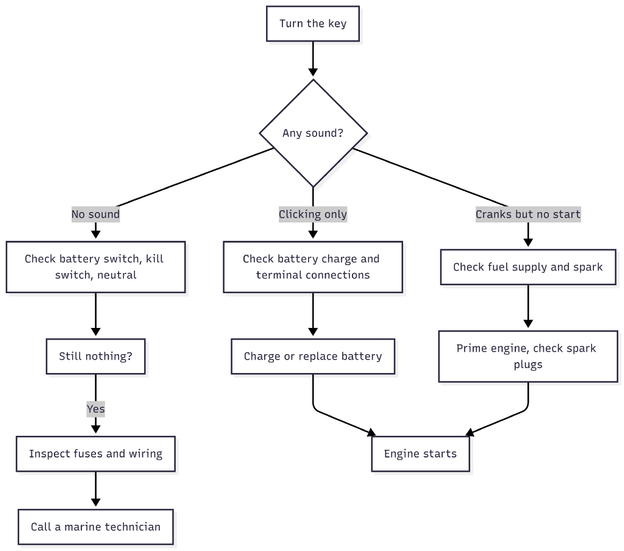
The flowchart below summarizes the troubleshooting logic most marine technicians use first.
1. Safety Lanyard or Kill Switch Disconnected
Almost every modern boat is equipped with an emergency kill switch — a small clip attached to a lanyard that the operator wears. If the clip isn't fully seated in its slot, the ignition circuit stays open and the engine won't fire, even though the starter may still crank.
Fix: Locate the kill switch near the throttle, pull the clip out, and firmly push it back into place. If the switch itself looks corroded or damaged, that alone can prevent a solid connection — clean the contacts or replace the switch if needed.
2. Boat Not in Neutral
For safety, virtually all outboard and sterndrive engines are wired so they cannot start while the shift lever is in forward or reverse. It doesn't take much — a shift lever that's just slightly out of true neutral will trip the safety interlock and block ignition.
Fix: Give the throttle/shift lever a firm wiggle to confirm it's centered in neutral, then try the key again. This is one of the most overlooked fixes and solves the problem more often than boaters expect.
3. Battery Switch Turned Off
Every boat has a battery isolator switch, and its location varies by make and model — sometimes under a seat, sometimes at the helm. If it's off or set to the wrong bank, the engine gets no power at all, and you'll hear nothing when you turn the key.
Fix: Flip the switch to "On," "Both," or "All," depending on your setup, and check your voltage display. On boats with dual batteries, you can also switch to the backup bank if the primary is dead.
4. Dead or Weak Battery
A weak battery is the single most common reason a boat won't start. Marine batteries lose cranking power over time due to age, incomplete charging cycles, deep discharges, or long periods of storage. A battery can show some voltage on a display and still lack the burst of amperage needed to turn the engine over.
|
Voltage Reading |
Battery Condition |
|
12.6V+ |
Fully charged, healthy |
|
12.0V–12.4V |
Partially discharged, charge before use |
|
Below 12.0V |
Low charge, may struggle to start engine |
|
Below 11.5V |
Likely dead or failing, charge or replace |
Fix: Charge the battery fully, switch to a backup bank if available, or jump-start using another battery or a portable jump pack. If a battery is more than 3–4 seasons old and struggles to hold a charge, replacement is usually the more reliable long-term fix. Many boaters are now switching to lithium marine starting batteries, which deliver more consistent voltage, faster recharge times, and stronger cranking amps than traditional lead-acid batteries.
5. Corroded or Loose Battery Terminals
Even a brand-new, fully charged battery won't help if the current can't reach the starter. Corrosion buildup or loose cable connections create resistance that chokes off power exactly when you need it most.
Signs of a connection problem include:
-
Clicking when you turn the key, but no crank
-
Dash lights or gauges flickering
-
Visible white or greenish corrosion on the terminals
-
Warm battery cables after attempting to start
Fix: Disconnect the cables, clean off corrosion with a wire brush or marine-safe cleaning solution, and reconnect with tight, secure connections. Apply a thin coat of dielectric grease to slow future corrosion.
6. Blown Fuse or Tripped Breaker
Boats rely on fuses and boats circuit breakers to protect their electrical systems from overload. If one blows or trips, it can cut power to the starting circuit entirely, mimicking a dead battery.
Fix: Check the main fuse near the battery as well as the helm fuse panel. Replace any blown fuses with one of the same amperage rating. If a fuse blows repeatedly, there's likely an underlying short or overloaded circuit that needs professional attention rather than a simple fuse swap.
7. Fuel Supply Problems (Empty Tank, Unprimed Engine, or Bad Fuel)
If the engine cranks normally but won't fire, fuel delivery is often the culprit. This can mean an empty tank, a closed fuel valve, an unprimed fuel line, or fuel that's gone stale after sitting through the off-season.
Fix:
-
Confirm you actually have fuel — don't rely on memory from your last trip.
-
Open the fuel tank vent and make sure the shutoff valve is open.
-
Squeeze the primer bulb until it feels firm, which indicates the fuel system is pressurized.
-
If the fuel looks discolored or smells sour, it may need to be drained and replaced, and the fuel filter changed.
Air vents and exhaust outlets can also cause fuel or ignition issues if blocked — check that gas tank vents are clear and that nothing (including rodent nests after winter storage) is obstructing the exhaust.
8. Dirty, Damaged, or Improperly Gapped Spark Plugs
Fouled or worn spark plugs prevent the combustion needed to start the engine, and can also cause rough idling or hesitation even after the engine does start.
Fix: Remove the spark plugs and inspect them for carbon buildup, damage, or incorrect gap spacing. Clean, re-gap, or replace as needed. Most marine spark plugs are inexpensive — typically $8–$20 each — and are one of the easiest DIY fixes on this list.
Common Causes at a Glance
|
Cause |
Symptom |
Typical Fix |
DIY Difficulty |
|
Kill switch disconnected |
No start, engine may crank |
Reattach clip |
Easy |
|
Not in neutral |
No start |
Wiggle shift lever |
Easy |
|
Battery switch off |
Total silence |
Flip switch on |
Easy |
|
Dead/weak battery |
Slow crank or silence |
Charge or replace |
Easy–Moderate |
|
Corroded terminals |
Clicking, flickering gauges |
Clean and tighten |
Easy |
|
Blown fuse |
Total silence |
Replace fuse |
Easy |
|
Fuel supply issue |
Cranks but won't fire |
Prime, refuel, check lines |
Easy–Moderate |
|
Bad spark plugs |
Cranks but won't fire, rough idle |
Clean/replace plugs |
Moderate |
When the Problem Is More Than the Basics
If you've worked through all eight causes above and your boat still won't start, the issue may be deeper in the electrical or mechanical system:
-
Faulty starter motor – wears out over time from moisture and vibration; a mechanic can test amperage draw to confirm.
-
Failing ignition switch – sends the signal from battery to starter solenoid; if it fails, nothing happens even with a good battery.
-
Weak alternator or charging system – if your battery keeps dying between trips, the charging system may not be replenishing it properly.
-
Accessory drain – fish finders, livewells, and stereos left connected to the starting battery can quietly drain voltage below the threshold needed to crank the engine.
These issues typically require a multimeter, some electrical know-how, or a certified marine technician to diagnose accurately.
Preventing Future No-Start Problems
A little routine maintenance prevents most starting issues before they happen:
-
Charge and inspect the battery regularly, especially between long periods of storage.
-
Use a fuel stabilizer if the boat will sit for more than a few weeks, since ethanol-blended fuel degrades quickly.
-
Run the boat periodically, even during the off-season, to keep the battery, fuel system, and seals in good condition.
-
Separate accessory loads from the starting battery with an isolator or a dedicated house battery, so electronics don't drain your ability to start the engine.
-
Perform an annual tune-up, including spark plugs, fuel filters, and terminal cleaning, before the start of boating season.
Final Thoughts
Most of the time, a boat that won't start comes down to something simple: a disconnected kill switch, a battery that needs a charge, or a shift lever that isn't quite in neutral. Working through the checklist above — from safety switches to fuel and spark — resolves the
overwhelming majority of no-start situations without a service call.
If you've checked every item on this list and your engine still won't turn over, it's time to bring in a certified marine technician. Electrical faults like a failing starter, ignition switch, or alternator require diagnostic tools to pinpoint safely and correctly. But for the everyday hiccups — a dead battery, a loose cable, or an empty tank — you now have everything you need to get back on the water quickly and confidently. Read More on BoatsGeek.com