
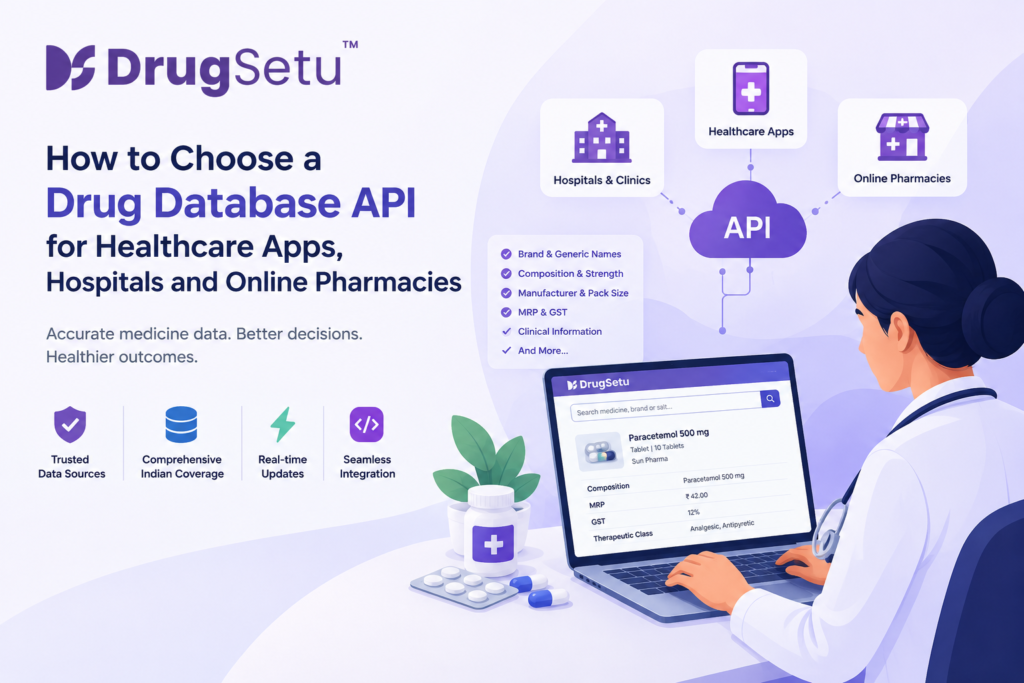
Picking a drug database API looks like a technical decision, so it usually lands on the engineering team’s desk. In practice it is also a product, clinical and finance decision. The medicine record your app displays is the same record that ends up on a patient’s screen, a pharmacist’s pick list and a hospital’s bill.
If you are comparing options for an Indian healthcare app, a hospital information system or an online pharmacy, this guide gives you a practical way to decide. You will find the criteria that matter, what each type of buyer should weigh most, a test you can run on your own product list in a week, and the questions that expose a weak vendor quickly. Where a global provider is the better fit, we say so.
The short version
- Choose an API whose records come from manufacturers or regulators, not from scraped listings.
- Check that it covers Indian brands, salts, strengths and pack sizes, not just ingredient names.
- Ask how often each field changes, not how often the database is updated overall.
- Read the licence before you read the feature list. Caching and redistribution rights decide your long-term cost.
- Never sign off on a vendor until it has passed a test using your own SKUs.
What is a drug database API?
A drug database API is a web interface that lets software search and retrieve structured medicine records, such as brand name, salt composition, strength, manufacturer, pack size and price, on demand. Developers call it with an API key and receive JSON, so apps stay current without maintaining their own medicine list.
That definition covers a lot of ground, and the products behind it vary widely. Some are thin lookup services over a single government dataset. Others are full clinical knowledge bases with interaction engines. Knowing which kind, you actually need is the first real decision.
Drug database API vs drug information API: what is the difference?
People use the two terms interchangeably, but the data underneath is different, and so is the responsibility that comes with it.
| Medicine master data (catalogue) | Clinical drug information | |
| What it answers | What is this product and who makes it? | How is it used, and what should I watch for? |
| Typical fields | Product ID, brand, composition, strength, form, pack, manufacturer, MRP, images | Indications, side effects, interactions, pregnancy and driving notes, therapeutic class |
| Main users | E-pharmacy catalogues, billing, inventory, search | Patient apps, prescribing support, pharmacist tools |
| Main risk if wrong | Wrong product, wrong price, failed reconciliation | Misleading advice shown to a patient or clinician |
| Who should review it | Catalogue and operations teams | Pharmacists and clinicians |
Most serious products need both layers. The mistake we see often is buying clinical content when the real problem is messy product data, or the reverse. Decide which layer is blocking you today, then check that the vendor can grow into the other one.
A note of caution for anyone building patient-facing features. A drug information API supplies reference content. It does not replace a validated clinical decision support system, and it does not replace the judgement of a doctor or pharmacist. Build your screens so that the source is visible and the advice to consult a professional is never hidden.
Why Indian medicine data is harder than it looks
If you have only worked with US or European drug data, India will surprise you. A few reasons the problem is different here:
- Brands lead; generics follow. Prescriptions and shelves are organised around brand names, and one salt can sit under hundreds of brands. Your API must map brand to composition reliably, in both directions.
- Combination products are everywhere. A strip may contain two or three salts, each with its own strength. A database that stores only a single ingredient field will quietly break these.
- Same name, different product. Strengths, pack sizes and manufacturers differ across look-alike names. Matching on name alone creates wrong substitutions.
- Prices are regulated in layers. NPPA fixes ceiling prices for scheduled formulations, the medicines in the National List of Essential Medicines, under the Drugs (Prices Control) Order, 2013. For non-scheduled medicines, manufacturers set the MRP but cannot raise it by more than 10 percent in a 12-month period. Ceiling prices are also revised from time to time, including annual wholesale price index adjustments. Stale price data is therefore not a cosmetic problem. It can put you out of step with the rules.
- GST and pack-level pricing matter. MRP, tax rate and pack size travel together. Without all three you’re billing and reconciliation drift apart.
- The product universe is wide. Allopathic prescription medicines sit next to OTC and FMCG healthcare items, AYUSH products and nutraceuticals. Many global databases barely touch the last three.
- Records churn constantly. Launches, discontinuations, pack changes and price revisions happen all year.
None of this is a reason to avoid an API. It is a reason to test one against Indian reality before you commit.
Nine criteria for choosing a drug database API
Use these as a scorecard. Not every criterion carries equal weight for every team, and a later section shows how to weight them.
- Coverage that matches your market
Start with the basics: how many products, and which kinds? Ask for coverage by category (prescription, OTC, AYUSH, nutraceutical, FMCG) and by company. A large headline number is not enough. A catalogue of several lakh records can still miss the long tail of regional brands that your pharmacy customers buy every day.
Also ask what happens when a product is missing. Can you request an addition? How long does it take? A vendor with a clear answer has done this before.
- Where the data comes from
Provenance is the single best predictor of long-term quality. Data can come from manufacturers who publish their own catalogues, from regulators, from distributor feeds, from editorial teams, or from scraping retail sites. Each has strengths. Manufacturer-sourced data tends to be accurate on composition and pack details. Distributor and retail data tends to be broad but inconsistent. Scraped data is the cheapest to produce and the hardest to defend when something goes wrong.
Ask three things. Who submits a record? Who reviews it? Is there an audit trail showing what changed and when?
- Freshness, asked field by field
‘Updated daily’ is a marketing phrase until you break it down. A product’s composition rarely changes, while price and availability change often. Ask for the update process per data type: new products, price revisions, discontinuations, images, clinical text. Then ask what the timestamp on a record actually means. It could be the time the vendor fetched it, loaded it or the date the change took effect.
Good vendors can also tell you how a change reaches you. Versioned records with a visible history are far easier to trust than silent overwrites.
- Schema quality and stable identifiers
A clean schema saves months. Look for:
- a permanent product ID that does not change when a name is edited
- composition stored as structured salts with individual strengths, not a single text blob
- separate fields for dosage form, strength, pack size, quantity and manufacturer
- consistent naming rules, so one salt is not spelled four ways
- clear handling of discontinued and merged products
If you intend to join the data with your own inventory or with other systems, stable identifiers matter more than almost anything else. Ask whether barcode, GTIN or EAN matching is available today or only planned.
- Pricing and regulatory fields
For pharmacies and billing teams this is where value is made or lost. Check which of these fields exist and how they are sourced: MRP, GST rate, price to retailer, scheduled or non-scheduled status, NLEM tagging, NPPA ceiling price and prescription category. Some of these are available in current plans from certain vendors and listed as upcoming by others, so read plan details carefully and note any dates.
If a field is marked as coming soon, plan your roadmap around what is live, not what is promised.
- Clinical content, and who stands behind it
If you need usage, side effects, interactions with alcohol, pregnancy and driving, or drug to drug interactions, ask where that text comes from and who reviews it. Check whether it is attributed, dated and written in language your users can follow. For a hospital, ask whether the content is intended for clinical decision support or for reference only. Those are very different promises.
- API design, speed and limits
Developers will feel this criterion first. Review the documentation before you speak to sales. You want a predictable REST design, JSON responses, sensible error codes, pagination, search by brand, salt and company, and a sandbox. Then look at the limits: requests per month, requests per second and records per request. These three numbers determine whether your autocomplete search, your nightly sync and your bulk catalogue import are even possible.
Do not rely on a quoted average response time. Measure it yourself from the region where your servers run, at the hours your users are busiest, and look at the slow tail, not just the average.
- Licensing, caching and redistribution
This is the criterion teams skip, and the one that causes the most pain later. Read the terms for:
- whether you may store API responses in your own database, and for how long
- whether you may show the data to your end users, or only use it internally
- whether you may resell, sublicense or bundle it into a product for other businesses
- limits on scraping, bulk export and use for training machine learning models
- what happens to your cached data if you cancel
Global providers are often explicit here. For example, DrugBank states that commercial use, redistribution and API access require a paid licence. Whatever vendor you consider, get the answers in writing.
- Support, security, versioning and exit
A drug database sits in a critical path, so look at the boring things. Is there a status page? How are breaking changes announced and how long do old versions stay alive? Can you rotate API keys and create separate keys for staging and production? Is there an SLA for enterprise plans, and a named contact when something breaks?
On privacy, a medicine lookup should never need patient identifiers. Keep patient data out of your API calls by design. Your own app still has obligations under India’s Digital Personal Data Protection Act, 2023, so involve your legal advisor early.
Finally, plan your exit. Ask how you would export or migrate if you changed vendors in two years.
What each buyer should weigh most
The same scorecard produces different winners depending on who is buying.
| Criterion | Developers and health apps | Hospitals and clinics | Online pharmacies |
| Coverage of Indian brands | High | High | Very high |
| Provenance and audit trail | Medium | Very high | High |
| Freshness of price and status | Medium | High | Very high |
| Structured composition and IDs | High | Very high | Very high |
| Pricing and GST fields | Low | High | Very high |
| Clinical content | High for patient apps | High, with clinical review | Medium |
| API limits and docs | Very high | Medium | High |
| Licence and caching rights | High | High | Very high |
| Support and SLA | Medium | Very high | High |
If you are a developer or a health app team
Your pain is search quality and integration speed. Prioritise clear documentation, a free trial or sandbox, generous records per request, and consistent identifiers. Build a thin wrapper around the API from day one, so that swapping the vendor later means changing one module, not forty screens. Cache carefully and within the licence, and keep a fallback message for when the API is unreachable.
If you run a hospital or clinic
Your pain is consistency. The pharmacy, the billing desk, the EMR and procurement often keep separate medicine lists, and every mismatch becomes a manual reconciliation job. Prioritise a standardised master list with stable IDs and an audit trail. Ask how formulary changes and discontinued products are handled. Involve your pharmacy and clinical governance teams in the evaluation, not just IT, and treat any interaction content as reference material that clinicians review.
If you run an online pharmacy
Your pain is catalogue accuracy at scale. Wrong strengths, missing images and outdated MRPs cost you conversions, returns and trust. Prioritise pack-level data, images, MRP and GST, substitute mapping by composition, and a clear update feed. Check how the provider treats Schedule H, H1 and X prescription categories, and make sure your storefront never displays a price above what the rules allow.
Build, buy or use open data?
Most teams consider three paths before they settle.
Build your own. This gives you full control and looks cheap at the start. The cost shows up later in the update pipeline, the deduplication work, the review process and the engineers who must keep it running. A medicine list is never finished.
Use open or free data. Public sources such as openFDA and RxNorm are excellent for what they do, but they describe US products and US identifiers. They will not tell you what an Indian brand contains or what its MRP is. Free Indian datasets on code-sharing sites are usually one-time snapshots of unknown origin, with no update promise and no accountability. They are fine for a prototype and risky for production.
Buy a maintained API. You pay a recurring fee and hand the update pipeline to someone whose job it is. The trade-offs are licence terms and dependence on the vendor, which is exactly why criteria 8 and 9 matter.
Many mature teams end up combining a maintained API for fast-moving fields with their own enrichment layer for what is unique to their business.
How global and Indian options differ
We would rather you pick the right tool than ours, so here is an honest map of the landscape.
- Global clinical databases such as DrugBank and First Databank are built around US, Canadian and European markets. They are strong where you need deep clinical intelligence for those regions. They are generally not designed around Indian brand, salt, pack and MRP structures.
- Government and open sources such as RxNorm and openFDA are free, authoritative for their own countries and a good learning ground. They do not solve Indian catalogue problems.
- Indian providers focus on local brands and pricing. They differ in sourcing, update method, licence and depth. Eka Care, for instance, documents an Indian branded drug search across more than 500,000 products for its API users. DrugSetu lists more than 5.99 lakh products and sources its records from manufacturers.
- Static datasets and scrapers are cheap and quickly outdated.
If you also serve patients abroad, a sensible pattern is a global clinical API for those markets and an Indian API for local catalogue and price data.
A one week test you can run before you sign
Demos are designed to impress. Your own data is not. Here is a simple test that works for any vendor.
- Assemble 200 real SKUs. Pull them from your inventory, formulary or order history. Include fast sellers, slow movers and awkward cases: combination salts, look-alike names, injectables, AYUSH products, nutraceuticals and a few recently discontinued items.
- Run every SKU through the search endpoint. Record whether the API returns an exact match, an ambiguous set of candidates or nothing.
- Compare fields against a trusted source. Check composition, strength, pack size and MRP against the printed strip or carton for a sample of 30 products.
- Test the edges. Try misspellings, brand names in capitals, salt-only queries and partial strings. See how search behaves, not just whether it works.
- Measure speed and limits. Call the API from your actual server region at peak hours, and simulate your nightly sync against the rate limit.
- Ask for change evidence. Request examples of price or status changes in the last 60 days and how they were delivered.
- Review the licence with legal and finance. Confirm caching, display and resale rights in writing.
Score each step. As a starting point, many teams look for an exact match rate around 90 percent or better, a very low rate of wrong matches, and zero surprises in the licence. Treat those numbers as a prompt for discussion, not an industry standard, and set your own bar based on the risk of your use case.
Red flags to watch for
- The vendor cannot say where its data comes from.
- ‘Real time’ is claimed but nobody can show a change log.
- Composition is a single free-text field.
- Documentation sits behind a sales call.
- Pricing is hidden until after a long discovery process.
- There is no clear answer on caching or redistribution.
- Clinical text has no source, date or reviewer.
- The trial is too small to test your catalogue.
Questions to ask every vendor
- Who publishes and who reviews each record?
- How often does each field type change, and how do I find out?
- What identifiers are stable, and what happens when a product is merged or discontinued?
- Which fields are live today, and which are planned with dates?
- What are the limits per month, per second and per request, and what happens when I exceed them?
- May I store and display the data, and for how long?
- What is the exit process if I leave?
- How are errors, outages and breaking changes communicated?
Where DrugSetu fits
DrugSetu is an Indian medicine database and API built around a CDSCO-aligned schema. Its model is that pharmaceutical companies publish and maintain their own product information, with a review step before records go live and a history of changes. Here is what that looks like in practice, based on what is listed on the pricing page at the time of writing.
| Starter | Growth | |
| Price | Rs 1,499 per month plus 18% GST | Rs 2,599 per month plus 18% GST |
| Data | Product ID, name, composition, marketing company, packaging, form, MRP, images | Everything in Starter, plus usage, benefits, side effects, alcohol, pregnancy and driving notes, therapeutic and chemical class, drug interactions and FAQ data |
| Requests | 50,000 per month | 100,000 per month |
| Rate limit | 1 per second | 2 per second |
| Records per request | 10 | 20 |
There is also a 7 day free trial so you can test with your own SKUs, and add-ons for extra request volume. Annual billing is available at a lower effective price.
We would rather be clear about what is not available yet, so you can plan around it. A Professional tier is in development and is expected to add ATC codes, NLEM tagging, schedule classification, barcode, GTIN and EAN data, NPPA ceiling price and batch verification. Barcode and SKU matching is described as upcoming, and the Pharma Dashboard for manufacturers is not yet released. If any of those are essential on day one, ask us for the current timeline before you decide.
To see whether DrugSetu suits your use case, read the use cases, try the free trial, or talk to the team about volumes, custom fields or institutional onboarding. The FAQ covers common questions, and about us explains the thinking behind the platform. For the wider background on why standardised data matters, see our earlier article on why India needs a unified medicine intelligence platform.
Frequently asked questions
What is the best drug database API for India?
There is no single best option, because it depends on your use case. For Indian brand, salt, pack and MRP data, look for an Indian provider with manufacturer-sourced records and a clear licence. For deep clinical intelligence on US or European drugs, a global provider may fit better. Test any shortlist against your own SKUs.
Is there a free drug database API?
Yes, for some markets. openFDA and RxNorm are free but cover US products. Free Indian datasets are usually static snapshots without update guarantees. Some commercial providers, including DrugSetu, offer a limited free trial so you can evaluate before paying.
What is the difference between a medicine database API and a drug information API?
A medicine database API focuses on product master data such as brand, composition, strength, pack and price. A drug information API adds clinical content such as uses, side effects and interactions. Many providers combine both layers in tiered plans.
How often should a drug database be updated?
It depends on the field. Prices, launches and discontinuations change often and need frequent updates, while composition rarely changes. Ask vendors for an update schedule per data type, plus a change history, rather than one overall number.
Can I store API data in my own database?
Only if the licence allows it. Some providers permit limited caching, others restrict storage, display or resale. Confirm caching duration, display rights and what happens to stored data if you cancel, and get the answer in writing.
Which fields matter most for an online pharmacy?
Product ID, brand, structured composition, strength, form, pack size, manufacturer, MRP, GST, images, prescription category and substitute mapping. Barcode or SKU identifiers help match supplier feeds to your catalogue.
Do hospitals need interaction data inside the drug API?
Only if the content is clinically governed. Interaction text from an API is reference material. Hospitals should review it with their pharmacy and clinical teams and, for prescribing alerts, use a validated clinical decision support process.
How much does a medicine database API cost in India?
Prices vary with data depth, volume and licence terms. Entry plans from Indian providers can start in the low thousands of rupees per month, and enterprise licensing is quoted separately. DrugSetu lists its Starter and Growth plans on its pricing page.
Does a drug database API handle patient data?
It should not. A medicine lookup needs only product queries. Keep patient identifiers out of API calls and review your own obligations under India’s Digital Personal Data Protection Act, 2023.
Final thoughts
The best drug database API is the one that holds up against your own data, your own workflows and your own regulators. Look past the product count and the demo. Check where records come from, how they change, what you are allowed to do with them and how the vendor behaves when something goes wrong.
Run the one-week test. You will learn more in five days than from any comparison table, including this one.
Ready to test with your own product list? Start a free trial or contact the DrugSetu team.
Medical disclaimer: This article is for general information about software and data selection. It is not medical, legal or regulatory advice. Medicine information shown to patients should be reviewed by qualified professionals, and regulatory requirements such as NPPA pricing rules should be confirmed against current official notifications.