
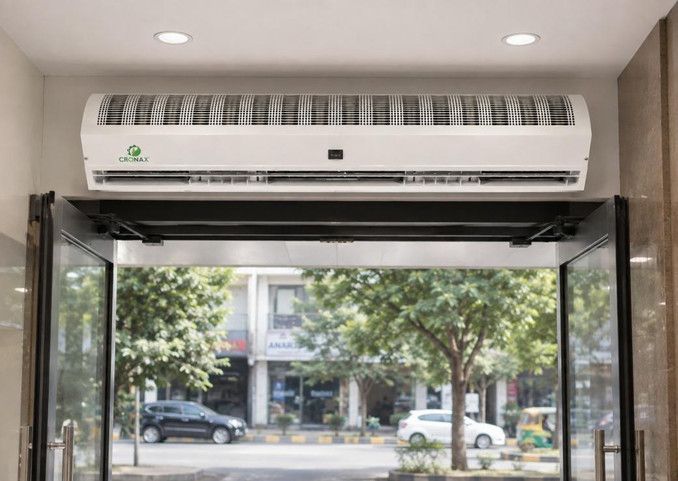
Pharmaceutical facilities are built around one core idea — control. Controlled temperatures, controlled air quality, and controlled movement of people and materials. But entrances are often the trickiest point to manage, since doors need to open constantly for staff, materials, and equipment. This is exactly where an air curtain becomes a useful addition, helping keep entrances cleaner without slowing down daily operations.
In this blog, we'll look at how air curtains support cleaner entrances in pharmaceutical facilities, what to consider when choosing one, and what typically factors into air curtain price for this kind of environment.
What Is an Air Curtain?
An air curtain is a device installed above or beside a doorway that creates a continuous stream of air across the opening. This stream acts as a barrier, reducing the exchange of air, dust, and contaminants between two spaces, even while the door stays open.
In a pharmaceutical setting, this becomes especially valuable, since entrances are used frequently throughout the day and can't always stay closed without disrupting workflow.
Why Entrances Are a Weak Point in Pharmaceutical Facilities
Pharmaceutical manufacturing relies on maintaining strict environmental conditions inside production and packaging areas. But every entrance is a potential gap in that control, especially when:
- Staff move in and out frequently during shifts
- Raw materials and finished products are transported through the same doorways
- Doors need to stay open longer during loading or unloading activities
- Outside air, dust, or particles have a chance to enter with every door opening
Since these entrances can't simply be closed off completely, facilities need a way to reduce the risks that come with keeping them accessible.
How Air Curtains Help Maintain Cleaner Entrances
1. Reducing Particle and Dust Entry
Every time a door opens, there's a chance for dust or airborne particles to move between the outside environment and the facility's controlled zones. An air curtain helps reduce this exchange right at the doorway.
2. Supporting Consistent Internal Air Quality
Pharmaceutical facilities often need to maintain specific air quality standards in certain zones. By limiting how much outside air mixes in through entrances, an air curtain helps support more consistent internal conditions.
3. Allowing Doors to Stay Functional Without Full Closure
Instead of relying on staff to open and close doors quickly every single time, an air curtain allows entrances to remain more accessible for daily movement, while still reducing the risk of contamination.
4. Complementing Other Cleanroom Measures
An air curtain isn't a replacement for gowning procedures, filtration systems, or other contamination control steps already in place — it works alongside them, adding an extra layer of protection specifically at entry points.
What to Look for in an Air Curtain for Pharmaceutical Facilities
Choosing the right setup for this kind of environment involves more careful thought than a standard commercial doorway. A few things worth checking:
- Airflow consistency – The unit needs to create a steady, effective barrier suited to sensitive environments.
- Noise levels – Since pharmaceutical facilities often value a controlled, stable working environment, quieter operation is generally preferred.
- Compatibility with existing cleanroom design – The air curtain should fit into your facility's layout without disrupting other contamination control measures.
- Reliability for continuous use – Facilities running multiple shifts need equipment that performs consistently throughout the day.
What Affects Air Curtain Price in a Pharmaceutical Setting
If you're budgeting for this kind of installation, air curtain price can vary based on a few factors:
- Size of the doorway – Larger openings require units capable of covering that width effectively.
- Airflow requirements – More precise or higher-performance airflow settings may affect the overall cost.
- Noise reduction features – Facilities prioritizing quieter operation may need additional consideration in their unit selection.
- Installation complexity – Site-specific factors, like existing structure and wiring, can influence the total setup cost.
Rather than comparing air curtain price as a standalone number, it's worth looking at how well a particular setup addresses your facility's specific entrance challenges.
Points Worth Considering When Comparing Suppliers
- Does the supplier understand pharmaceutical-specific contamination control needs, or only general industrial use?
- Are recommendations based on your actual entrance traffic and layout?
- Is there clarity on air curtain price without unnecessary add-ons being pushed?
- Is support available after installation for adjustments or questions?
Cronax Industries approaches these conversations by first understanding a facility's specific entrance challenges, then suggesting a configuration that genuinely fits, rather than leading with a fixed product recommendation.
Final Thoughts
In pharmaceutical facilities, keeping entrances clean without disrupting daily movement is a constant balancing act. Air curtains offer a practical way to support this balance, reducing particle entry and helping maintain more consistent air quality right at the doorway.
If you're evaluating air curtain price and options for your pharmaceutical facility, it's worth having a proper conversation about what will genuinely support your specific entrance challenges.
Reach out to Cronax Industries to discuss your facility's layout, air quality needs, and entrance traffic, so you can choose an air curtain solution that truly fits your pharmaceutical operations.