
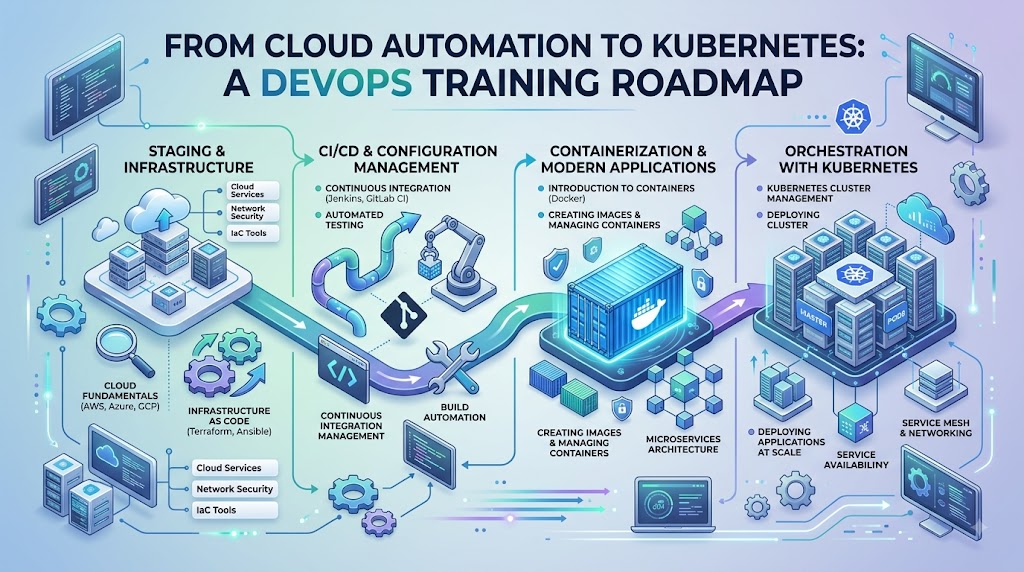
Software teams are expected to release features faster, operate applications reliably, protect systems from security risks, and manage increasingly complex cloud environments. This has changed the skills required across development, infrastructure, cloud engineering, security, and operations. DevOps helps bring these responsibilities closer together. It encourages teams to improve collaboration, automate repetitive work, use feedback from production systems, and treat delivery as an ongoing process rather than a one-time release activity. However, adopting DevOps tools does not automatically create DevOps capability. A team may use cloud services, containers, or CI/CD pipelines but still struggle with manual deployments, unclear ownership, inconsistent infrastructure, weak monitoring, or slow incident response. Practical learning is needed to connect technology choices with day-to-day engineering work. A well-planned DevOps training program helps learners understand how code, infrastructure, testing, security, deployment, and production operations fit together. It should prepare professionals to think beyond individual tools and work through real technical situations.
Understanding the Work of a DevOps Trainer
A DevOps Trainer helps learners build practical knowledge across software delivery and production operations. The role includes explaining concepts, demonstrating tools, creating lab exercises, reviewing common problems, and helping participants understand how different technical areas connect.
For example, a learning session may begin with a source-code repository and then move through automated builds, tests, container packaging, cloud deployment, monitoring, and troubleshooting. This gives learners a clearer view of the complete delivery lifecycle.
A trainer may teach topics such as:
-
Version control and collaborative workflows
-
Continuous integration and continuous delivery
-
Cloud infrastructure fundamentals
-
Infrastructure as Code
-
Docker and container technologies
-
Kubernetes operations
-
Monitoring and observability
-
Security checks in delivery pipelines
-
Release management and rollback planning
-
Incident response and troubleshooting
The strongest training programs do not treat DevOps as a list of products. Instead, they explain why teams automate a deployment, how infrastructure changes are reviewed, what happens when a release fails, and which operational signals indicate that a service is unhealthy.
Why DevOps Learning Is Valuable
Modern applications often depend on multiple services, cloud resources, APIs, databases, containers, and security controls. This means developers and operations teams need broader awareness of how systems are built and maintained.
DevOps training can help reduce common knowledge gaps. Developers may gain a better understanding of deployment and monitoring. Infrastructure engineers may become more familiar with code-driven automation. Security professionals may learn how to add useful controls within delivery workflows.
Key areas where training can help include:
-
Moving away from error-prone manual deployment processes
-
Improving confidence with cloud platforms
-
Understanding CI/CD pipeline stages
-
Managing container-based workloads
-
Creating repeatable infrastructure configurations
-
Building stronger monitoring and alerting practices
-
Introducing security earlier in development
-
Improving collaboration across technical roles
Training is not a replacement for real project work. Teams still need to gain experience through design reviews, production support, incident management, and continuous improvement. However, practical instruction can reduce the time required to understand core concepts and provide a safer environment for experimentation.
Corporate DevOps Training for Business Context
Corporate DevOps Training is designed for teams that need learning aligned with their own environment. Unlike a standard course for individual learners, corporate sessions can reflect the organization’s cloud platform, deployment process, internal tools, skill levels, and operational priorities.
For instance, a company using AWS, GitLab CI/CD, Terraform, and EKS will have different learning needs from a company using Azure Pipelines, AKS, and Bicep templates. Both teams may need automation and cloud skills, but their examples, labs, and workflow discussions should be different.
A customized program may include:
-
Team-specific skill assessment
-
Training based on current technology choices
-
Guided workshops for developers and operations staff
-
Cloud and CI/CD lab environments
-
Kubernetes deployment exercises
-
Security and compliance discussions
-
Internal documentation practices
-
Production troubleshooting scenarios
-
Knowledge-sharing sessions for long-term adoption
Customization does not mean creating an entirely new course for every team. It means focusing the learning on relevant problems while maintaining strong DevOps fundamentals.
Online DevOps Training: Where It Works Well
An Online DevOps Trainer can deliver live technical sessions to professionals and teams working from different locations. Remote learning is particularly useful for distributed organizations, hybrid workplaces, and learners who need flexible schedules.
Virtual training can include live demos, lab walkthroughs, shared terminals, screen sharing, discussion sessions, recordings, and practical assignments. Cloud-based labs also allow learners to access a common environment without requiring every participant to build infrastructure locally.
Online delivery can be useful because it offers:
-
Flexible participation across locations
-
Easier scheduling for remote teams
-
Access to live demonstrations and recordings
-
Opportunities for shared cloud lab environments
-
Lower travel and venue requirements
At the same time, online training has limitations. A passive webinar format may not create strong technical understanding. Participants can also face connectivity problems, limited lab time, or difficulty asking questions in large groups.
The best remote programs include active participation. Learners should deploy applications, modify configurations, review logs, investigate failures, and discuss technical decisions rather than only watch demonstrations.
How to Evaluate a DevOps Trainer in India
Organizations searching for a DevOps Trainer in India should review teaching quality as carefully as technical knowledge. A person may know many tools but still struggle to explain them clearly or design useful practical exercises.
A good evaluation should consider the following areas:
| Area | Questions to Ask |
|---|---|
| Practical experience | Has the trainer worked with delivery pipelines, cloud services, automation, and operational workflows? |
| Teaching ability | Can complex subjects be explained in clear and simple language? |
| Lab approach | Do learners build, test, deploy, and troubleshoot systems themselves? |
| Course relevance | Does the syllabus match the team’s technologies and goals? |
| Cloud knowledge | Is there practical awareness of AWS, Azure, or other relevant cloud platforms? |
| Security coverage | Are secrets, access control, scanning, and secure delivery included? |
| Operations focus | Does the program address monitoring, incidents, and reliability? |
| Communication | Is there enough time for questions, discussion, and feedback? |
Technical knowledge matters, but training quality depends on structure, examples, communication, and the ability to make complex workflows understandable.
Kubernetes Training for Practical Operations
Kubernetes has become an important platform for running containerized applications, but it should not be taught only as a set of YAML files. Learners need to understand how application deployment relates to networking, storage, access control, scaling, observability, and operational support.
A Kubernetes Trainer should cover core areas such as:
-
Cluster architecture and node concepts
-
Pods, Deployments, ReplicaSets, and StatefulSets
-
Services and ingress configuration
-
ConfigMaps and Secrets
-
Persistent volumes and storage
-
Resource requests and limits
-
Scaling and autoscaling
-
Helm and deployment packaging
-
Logging, monitoring, and alerting
-
Role-based access control
-
Kubernetes security practices
-
Troubleshooting failed workloads
Practical exercises are especially important. Learners should investigate issues such as a Pod that will not start, an unavailable image, a failed health check, incorrect configuration, or a networking problem between services.
Managed platforms including AWS EKS, Azure AKS, and Google GKE simplify some infrastructure responsibilities, but they do not remove the need for sound workload design and operational knowledge.
AWS DevOps Learning
An AWS DevOps Trainer should help learners understand how AWS services can support automated delivery and cloud operations. Training may include services such as EC2, ECS, EKS, Lambda, IAM, CloudWatch, S3, and container registries.
Infrastructure automation is a central topic. Tools such as Terraform and AWS CloudFormation allow teams to define cloud resources through version-controlled configuration. This supports more consistent provisioning and makes infrastructure changes easier to review.
AWS DevOps training may cover:
-
CI/CD pipeline design
-
Infrastructure provisioning
-
Identity and access management
-
Container deployment
-
Monitoring and logging
-
Automated release workflows
-
Cloud cost awareness
-
Backup and recovery planning
-
Release validation and rollback approaches
The correct AWS design depends on application architecture, regulatory requirements, scale, team experience, and operational priorities. Training should help learners understand these trade-offs instead of presenting one service as the answer to every problem.
Azure DevOps Learning
Azure-focused DevOps training is relevant for teams using Microsoft cloud services and Azure development workflows. An Azure DevOps Trainer may introduce Azure Repos, Azure Pipelines, Azure Artifacts, AKS, Azure Monitor, container registries, and Infrastructure as Code options.
Practical Azure sessions should demonstrate how changes move through source control, build validation, testing, artifact creation, deployment, monitoring, and rollback. Learners should understand the role of environment variables, permissions, service connections, secrets, and approvals.
Important Azure DevOps learning topics can include:
-
Git collaboration and repository management
-
Azure Pipelines for builds and releases
-
Automated testing in delivery workflows
-
Infrastructure provisioning with Terraform, Bicep, or ARM
-
AKS deployment practices
-
Monitoring applications and cloud resources
-
Secure release configuration
-
Production troubleshooting
The objective is to help teams understand cloud delivery as a complete process, not simply learn how to configure a pipeline screen.
DevSecOps: Security as Part of Delivery
Security should be built into software delivery rather than handled only after development is complete. DevSecOps promotes shared security responsibility across developers, cloud teams, platform engineers, and security specialists.
A DevSecOps Trainer can help teams understand how security controls fit into normal engineering workflows. This may include secure CI/CD configuration, code scanning, dependency analysis, container scanning, secrets management, vulnerability remediation, and infrastructure policy checks.
The purpose is not to overload every pipeline with tools. Instead, teams should learn how to create useful security feedback, protect credentials, identify meaningful risks, and address issues at appropriate stages of the delivery lifecycle.
Security learning becomes more effective when participants see practical examples. A lab might include identifying a secret stored incorrectly in code, reviewing a vulnerable dependency, fixing an insecure container setting, or applying access controls to a cloud resource.
SRE Training and Reliable Services
SRE training helps teams view reliability as an engineering responsibility. While DevOps often focuses on delivery and collaboration, Site Reliability Engineering adds a structured approach to service availability, performance, observability, and incident response.
An SRE Trainer may teach:
-
Service-level indicators
-
Service-level objectives
-
Service-level agreements
-
Error budgets
-
Monitoring and alerting
-
Logs, metrics, and traces
-
Incident response
-
Root-cause analysis
-
Capacity planning
-
Performance engineering
SLIs measure aspects of user-facing service performance, while SLOs define a target level of performance. Error budgets help teams balance feature delivery with the need for reliability improvements.
Training should also include incident scenarios. Learners can practice reading alerts, checking dashboards, reviewing logs, identifying possible causes, and writing an incident review focused on system improvement rather than blame.
MLOps Training for Production Systems
Machine-learning projects need operational discipline when they move from experimentation to production. MLOps connects model development with deployment, monitoring, automation, infrastructure, and governance practices.
An MLOps Trainer may cover model versioning, data pipelines, experiment tracking, deployment automation, monitoring, scalable infrastructure, and operational support.
MLOps is important because a deployed model is part of a wider system. It depends on data quality, cloud resources, APIs, access controls, monitoring, and release processes. Teams need to manage both application reliability and model-related changes.
| Training Area | Typical Learning Need |
|---|---|
| DevOps Training | Learn automated delivery and operational practices |
| Corporate DevOps Training | Build consistent team-wide capabilities |
| Online DevOps Training | Access flexible remote instruction |
| Kubernetes Training | Operate containerized workloads |
| AWS DevOps Training | Apply DevOps practices in AWS environments |
| Azure DevOps Training | Build Azure-based delivery workflows |
| DevSecOps Training | Embed security into software delivery |
| SRE Training | Improve reliability and observability practices |
| MLOps Training | Operate machine-learning workloads in production |
Benefits of Hands-On DevOps Learning
Hands-on learning helps participants move from understanding a concept to applying it. It gives learners a chance to make changes, observe outcomes, diagnose issues, and improve their approach.
Practical DevOps training can support:
-
Better understanding of software delivery workflows
-
More confidence with cloud platforms
-
Stronger automation skills
-
Improved ability to troubleshoot deployment problems
-
Greater awareness of security risks
-
Better monitoring and reliability knowledge
-
Improved communication between developers and operations teams
-
Clearer understanding of containers and Kubernetes
A useful lab might require learners to deploy an application through a pipeline, identify a configuration error, review logs, correct the issue, and redeploy safely. This combines multiple skills in one realistic activity.
Common DevOps Training Mistakes
Several training mistakes can reduce the value of a learning program:
-
Too much theory: Learners need practical tasks, not only explanations.
-
Tool overload: Covering many tools quickly can prevent deeper understanding.
-
No troubleshooting practice: Real environments include failure, misconfiguration, and unexpected behavior.
-
Outdated examples: Training should reflect current cloud, security, and automation practices.
-
Ignoring learner levels: Beginners and experienced engineers need different learning paths.
-
Weak security coverage: Secure delivery should not be treated as an optional final topic.
-
No production focus: Monitoring, rollback, incidents, and reliability deserve attention.
-
Generic labs: Exercises should relate to realistic engineering decisions and workflows.
Frequently Asked Questions
What does a DevOps Trainer teach?
A DevOps Trainer may teach CI/CD, cloud services, automation, containers, Kubernetes, Infrastructure as Code, monitoring, security, and production troubleshooting.
What is Corporate DevOps Training?
It is structured team training tailored to an organization’s technologies, workflows, skill gaps, and business requirements.
Is online DevOps training suitable for teams?
Yes. It can work well for remote and distributed teams when live interaction, labs, discussion, and troubleshooting exercises are included.
What should Kubernetes training include?
Kubernetes training should include Pods, Deployments, Services, networking, storage, security, scaling, Helm, observability, and troubleshooting.
Why is DevSecOps training important?
It helps teams include security checks, secure configurations, and vulnerability awareness throughout the software delivery lifecycle.
What is the purpose of SRE training?
SRE training helps teams understand reliability, monitoring, service objectives, incident response, and capacity planning.
How is MLOps different from DevOps?
DevOps focuses on software delivery and operations. MLOps applies similar operational principles to machine-learning workflows, models, data, and production ML systems.
Conclusion
DevOps learning has become essential for teams that build and operate modern software. The subject now includes far more than deployment automation. It covers cloud services, CI/CD, containers, Kubernetes, Infrastructure as Code, security, monitoring, reliability, and production operations. The most useful training approach depends on the learner’s current role, the organization’s technology stack, team maturity, business priorities, and practical responsibilities. A developer, cloud engineer, security specialist, SRE professional, and MLOps engineer may all need DevOps knowledge, but their learning paths will differ.