
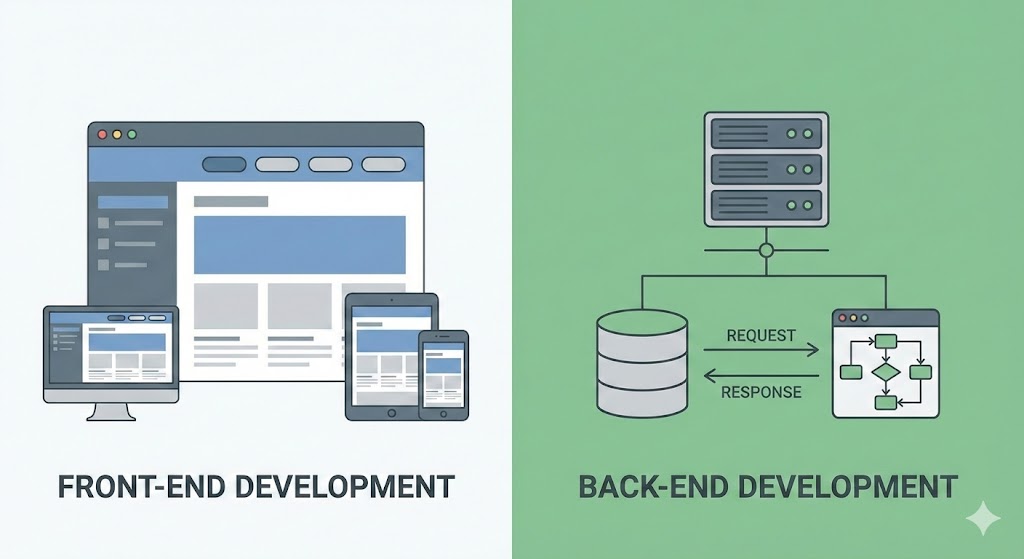
Business leaders, aspiring developers, and decision-makers involved in planning or building a website often reach a critical point where a website development company must clearly explain the difference between front-end and back-end development and why understanding this distinction directly impacts performance, scalability, and success.
Understanding this distinction is critical. Front-end and back-end development are two core pillars of modern website development, each responsible for different but equally essential aspects of how a website looks, functions, performs, and scales. While users interact only with the front end, the back end silently powers everything behind the scenes, from data storage to security and performance.
In this guide, we will break down front-end vs back-end development in a clear, practical, and business-focused manner. You will learn their roles, responsibilities, tools, required skills, career scope, and how they work together to create fast, secure, and scalable websites.
What Is Front-End Development?
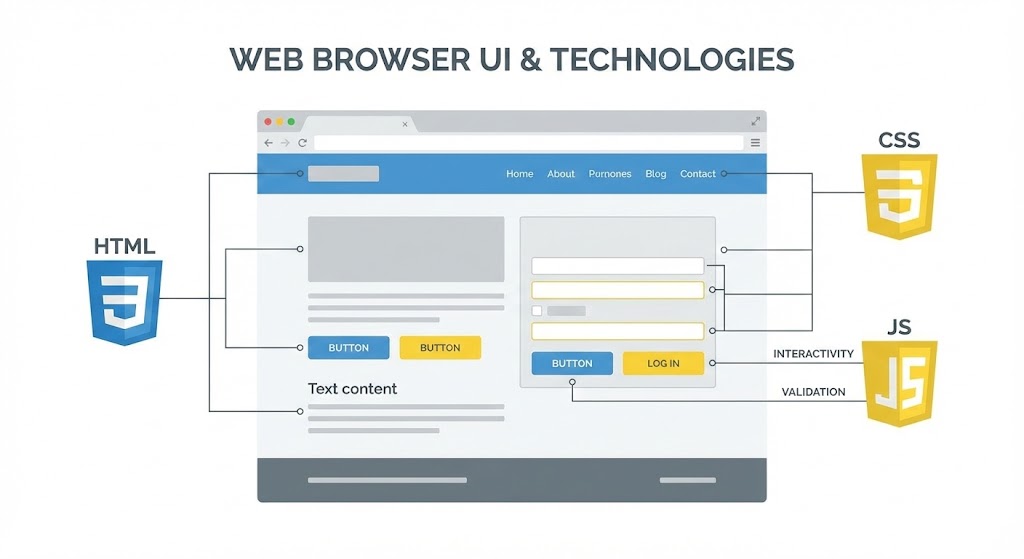
Front-end development refers to the client-side part of website development. It focuses on everything users see, touch, and interact with directly in their browsers.
When a user visits a website, the layout, colors, typography, buttons, animations, navigation menus, and responsive behavior across devices are all handled by front-end development.
Role of Front-End Development in Website Development
The primary goal of front-end development is to create a seamless user experience. It ensures that a website is visually appealing, easy to navigate, fast-loading, and accessible across all screen sizes and browsers.
A well-built front end directly impacts:
-
User engagement
-
Conversion rates
-
Brand perception
-
Core Web Vitals and SEO performance
Key Responsibilities of a Front-End Developer
A front-end developer’s responsibilities extend far beyond just writing code:
-
Converting UI/UX designs into functional web pages
-
Implementing responsive design for mobile, tablet, and desktop
-
Ensuring cross-browser compatibility
-
Optimizing performance and load speed
-
Implementing accessibility standards (WCAG compliance)
-
Integrating APIs provided by back-end systems
-
Debugging UI and interaction issues
Front-end developers act as the bridge between design and functionality.
What Is Back-End Development?
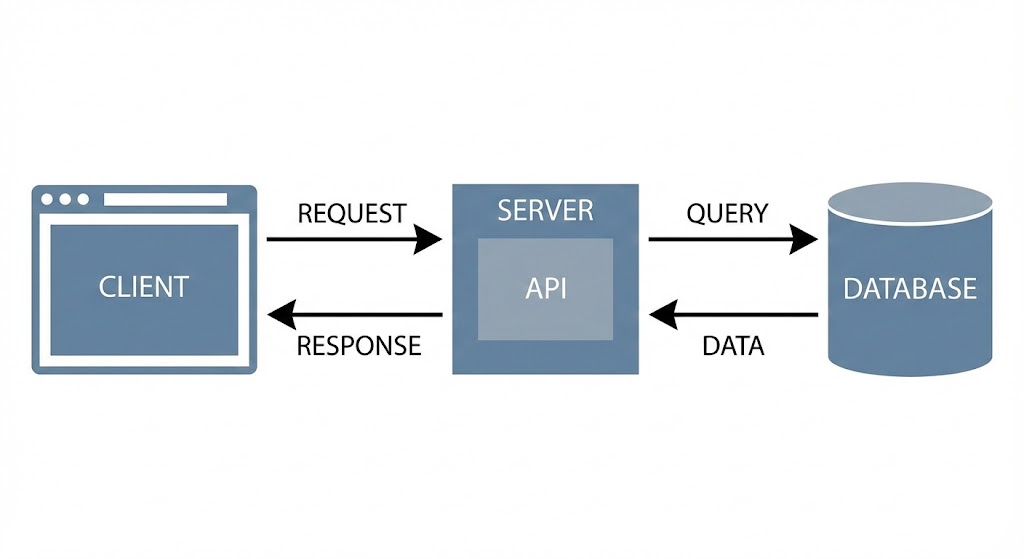
Back-end development refers to the server-side of a website. It handles everything users do not see but rely on for the website to work correctly.
This includes servers, databases, APIs, authentication systems, and application logic.
If the front end is the storefront, the back end is the warehouse, billing system, security guard, and operations manager combined.
Role of Back-End Development in Website Development
Back-end development ensures that:
-
Data is stored and retrieved correctly
-
User accounts are secure
-
Business logic works as intended
-
Websites scale under high traffic
-
Integrations with third-party services function reliably
Without a strong back end, even the best-looking website will fail.
Key Responsibilities of a Back-End Developer
Back-end developers focus on stability, security, and scalability:
-
Writing server-side logic and APIs
-
Designing and managing databases
-
Handling user authentication and authorization
-
Implementing payment gateways and third-party integrations
-
Ensuring application security
-
Optimizing performance at the server and database level
-
Managing cloud infrastructure and deployment
Back-end development is logic-driven and architecture-focused.
Front-End vs Back-End Development: Core Differences
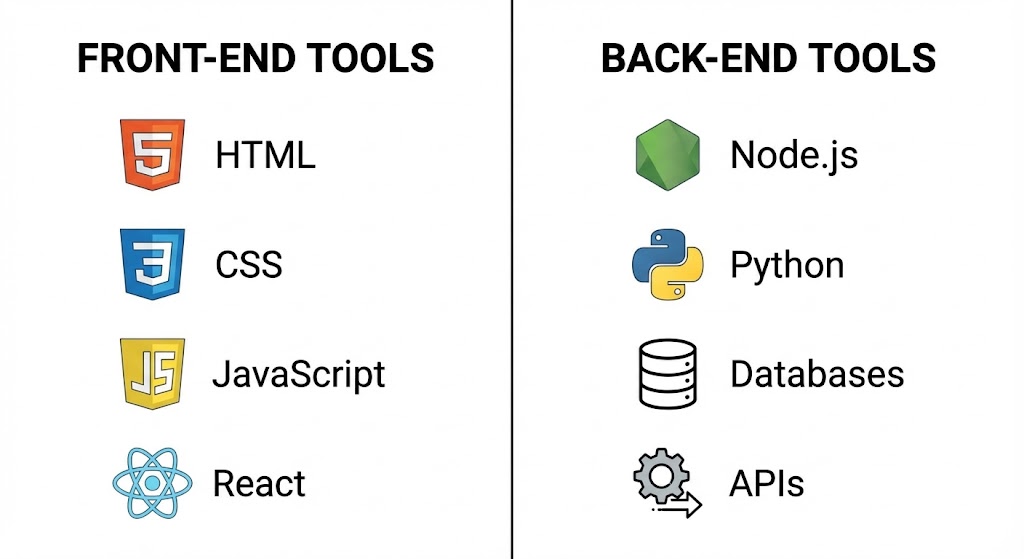
Understanding the fundamental differences helps businesses hire correctly and developers choose the right career path.
Focus and Purpose
-
Front-End Development: User interface, visual presentation, and interactions
-
Back-End Development: Data processing, logic, security, and system operations
User Interaction vs Server Operations
Front-end handles:
-
Button clicks
-
Form submissions
-
Animations
-
Page rendering
Back-end handles:
-
Processing requests
-
Validating data
-
Fetching and storing information
-
Sending responses back to the front end
Front-End Development Tools and Technologies
Front-end development relies on a combination of core languages, frameworks, and tooling.
Front-End Programming Languages
-
HTML: Structure of web pages
-
CSS: Styling, layout, and responsiveness
-
JavaScript: Interactivity and dynamic behavior
These three form the foundation of all front-end development.
Popular Front-End Frameworks and Libraries
Modern front-end development uses frameworks to improve efficiency and scalability:
-
React: Component-based, widely adopted
-
Angular: Full-featured enterprise framework
-
Vue: Lightweight and flexible
Emerging trends include:
-
Server Components
-
Partial hydration
-
Edge rendering
Front-End Development Tools
-
Build tools: Vite, Webpack
-
Version control: Git
-
Package managers: npm, pnpm
-
Testing tools: Jest, Playwright
-
Performance auditing: Lighthouse
These tools help maintain quality and speed at scale.
Back-End Development Tools and Technologies
Back-end development involves a different stack focused on logic, storage, and security.
Back-End Programming Languages
Commonly used languages include:
-
JavaScript (Node.js)
-
Python
-
Java
-
PHP
-
Ruby
The choice depends on project requirements and scalability needs.
Back-End Frameworks
Frameworks simplify development and enforce best practices:
-
Express.js and NestJS (Node.js)
-
Django and Flask (Python)
-
Spring Boot (Java)
-
Laravel (PHP)
Databases and Storage Systems
Back-end developers work with data extensively:
-
Relational databases: MySQL, PostgreSQL
-
NoSQL databases: MongoDB, Redis
Database design directly impacts performance and scalability.
Skills Required for Front-End Developers
A successful front-end developer needs a mix of technical and design-aware skills:
-
Strong understanding of HTML, CSS, and JavaScript
-
Knowledge of UI/UX principles
-
Responsive and mobile-first design expertise
-
Performance optimization techniques
-
Accessibility standards
-
Debugging and testing skills
Front-end developers must think like users.
Skills Required for Back-End Developers
Back-end developers require strong analytical and system-level thinking:
-
Database design and optimization
-
API architecture and documentation
-
Authentication and security practices
-
Scalability and load handling
-
Cloud and server management basics
-
Performance tuning
Back-end developers think in terms of systems and data flows.
Salary and Career Scope Comparison
Both roles offer strong career prospects.
Front-End Development Career Scope
-
High demand due to UX focus
-
Opportunities in startups and agencies
-
Freelancing and contract work
-
Rapid evolution of tools and frameworks
Back-End Development Career Scope
-
Strong demand in enterprise systems
-
Higher involvement in architecture decisions
-
Often, higher average salaries
-
Critical role in large-scale platforms
Salary varies by region, experience, and specialization.
Front-End vs Back-End vs Full-Stack Development
What Is Full-Stack Development?
Full-stack developers work on both front-end and back-end systems. They understand the entire application lifecycle.
When Full-Stack Makes Sense
-
Small teams and startups
-
MVP development
-
Freelance projects
Specialization vs Full-Stack
-
Specialists go deeper and scale better
-
Full-stack developers offer flexibility
-
Large projects still rely on specialized roles
Which One Should You Choose?
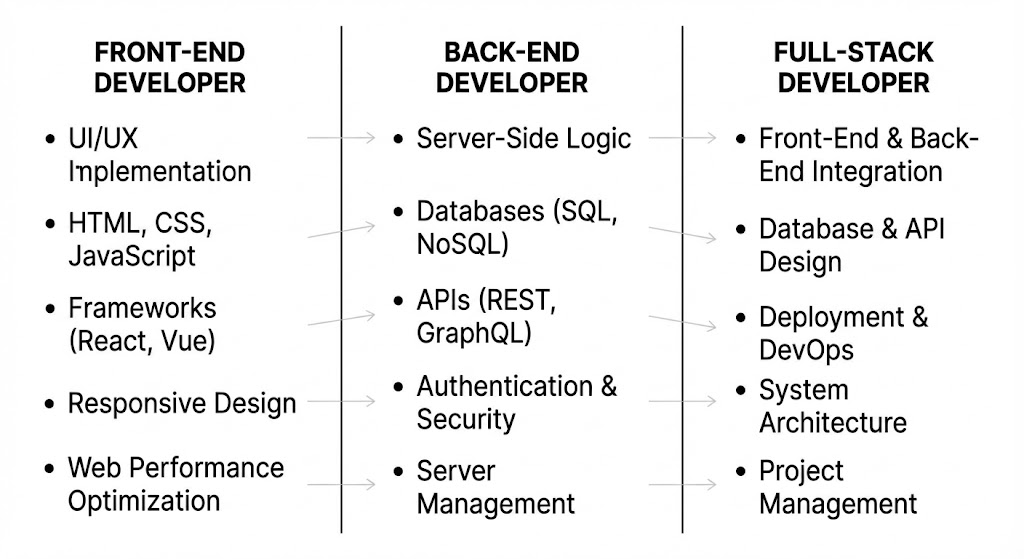
For Beginners
Front-end development is often easier to start with due to visual feedback and faster results.
For Logic-Oriented Thinkers
Back-end development suits those who enjoy problem-solving, data structures, and system design.
For Business Owners
Hiring both roles ensures long-term scalability and performance.
How Front-End and Back-End Work Together
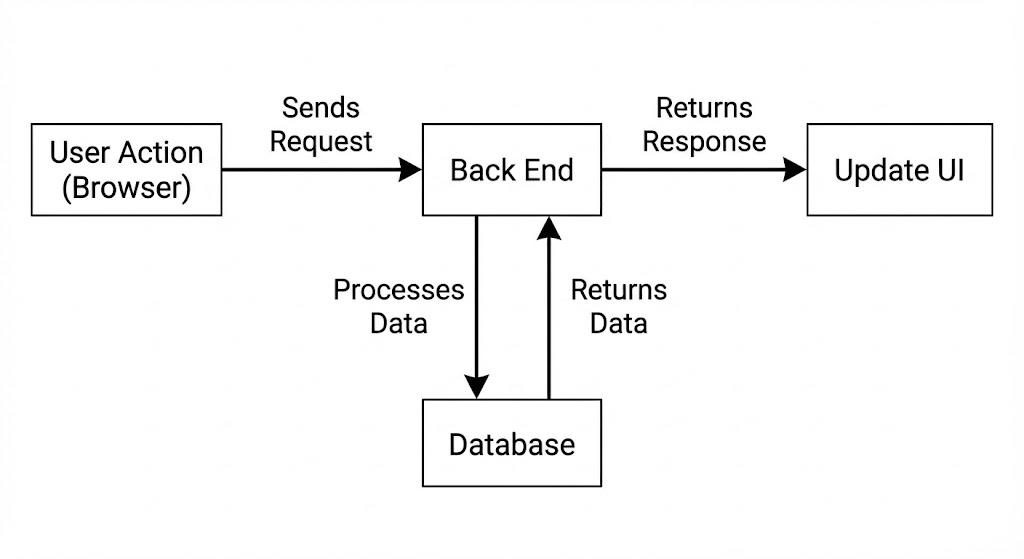
Front-end and back-end development are deeply interconnected.
-
User interacts with the front end
-
The request is sent to the back end
-
Back-end processes logic and data
-
Response is returned to the front end
-
Front-end updates the UI
Strong collaboration ensures:
-
Faster development
-
Fewer bugs
-
Better performance
Future Trends in Front-End and Back-End Development
Website development is evolving rapidly.
Front-End Trends
-
Server Components
-
Edge rendering
-
Performance-first development
Back-End Trends
-
API-first architecture
-
Cloud-native systems
-
AI-assisted backend automation
Both roles are becoming more performance and security-focused.
Frequently Asked Questions (FAQs)
Is front-end development easier than back-end?
Front-end is more visual; back-end is more logic-driven. Difficulty depends on individual strengths.
Can one person handle both?
Yes, but large projects benefit from specialization.
Which pays more?
Back-end roles often pay slightly more, but senior front-end developers are equally valued.
Do front-end developers need back-end knowledge?
Basic back-end understanding is highly beneficial but not mandatory.
Conclusion
Front-end and back-end development are two sides of the same coin in website development. One focuses on user experience, while the other ensures reliability, security, and scalability. Businesses that understand this distinction make better hiring decisions, and developers who understand both roles become more effective professionals.
Whether you are building a website, hiring a website development company, or embarking on a development career, understanding how front-end and back-end development differ and work together is essential for long-term success.