
Introduction
Cloud systems are no longer limited to hosting a few applications or virtual machines. Modern organisations use cloud platforms for business applications, databases, security, analytics, artificial intelligence, disaster recovery, automation, and global customer services.As these environments become more complex, organisations need professionals who can design complete cloud solutions rather than manage individual resources. This is where an Azure solutions architect plays an important role.The Microsoft Certified Azure Solutions Architect Expert credential is designed for professionals who want to demonstrate advanced skills in designing secure, reliable, scalable, manageable, and cost-conscious solutions on Microsoft Azure.It is suitable for working engineers, software developers, cloud administrators, technical leads, consultants, managers, and architects who participate in technology and business decisions.
Microsoft Certified Azure Solutions Architect Expert at a Glance
| Item | Details |
|---|---|
| Certification name | Microsoft Certified Azure Solutions Architect Expert |
| Certification level | Expert |
| Primary role | Azure Solutions Architect |
| Required prerequisite | Microsoft Certified Azure Administrator Associate |
| Required exam | AZ-305: Designing Microsoft Azure Infrastructure Solutions |
| Main technology | Microsoft Azure |
| Recommended experience | Azure administration, networking, security, compute, storage, governance, development, and DevOps |
| Suitable for | Cloud engineers, software engineers, administrators, architects, consultants, technical leads, and managers |
| Training provider | DevOpsSchool |
| Certification information | Microsoft Certified Azure Solutions Architect Expert |
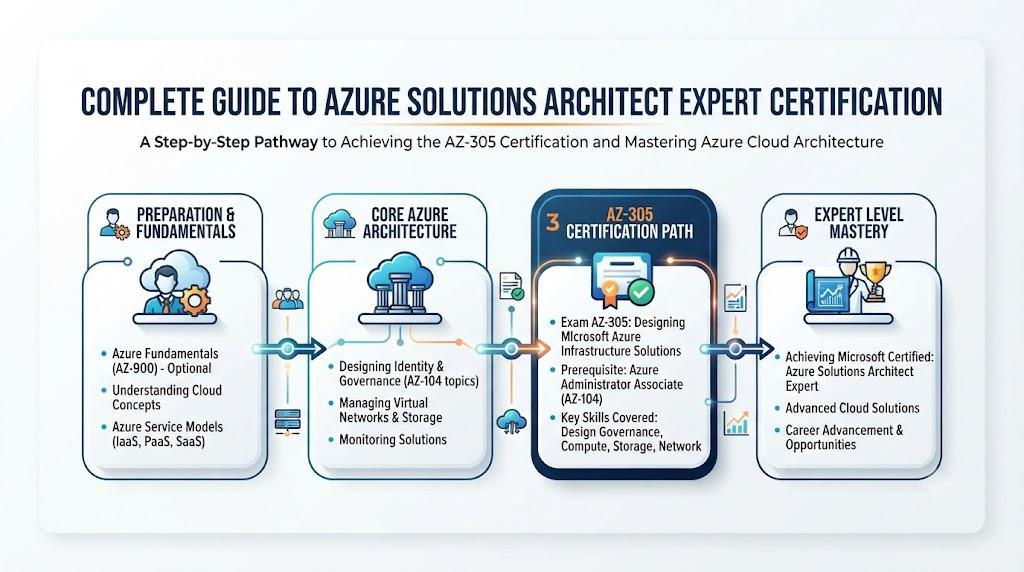
Microsoft currently requires candidates to earn the Microsoft Certified Azure Administrator Associate credential and pass the AZ-305 exam to become an Azure Solutions Architect Expert. What Is Microsoft Certified Azure Solutions Architect Expert?
The Microsoft Certified Azure Solutions Architect Expert certification validates a professional’s ability to design cloud and hybrid solutions using Microsoft Azure.
It focuses on architecture decisions involving identity, governance, networking, compute, storage, security, monitoring, migration, availability, backup, disaster recovery, and application infrastructure.
The certification is not only about knowing Azure service names. Candidates must understand how different services work together and how technical choices affect cost, security, performance, reliability, and operational complexity.
Important Certification and Training Distinction
The official Microsoft credential is awarded only after a candidate meets Microsoft’s prerequisite requirement and passes the required Microsoft exam.
A course-completion certificate issued by a training provider is separate from the official Microsoft credential. Training organisations can provide classes, labs, projects, mentoring, mock tests, and preparation support, but Microsoft controls the official certification requirements.
DevOpsSchool also states that its own completion certificate is a DevOpsSchool-issued credential rather than a Microsoft vendor exam. Candidates should therefore use training to prepare for the official Microsoft certification path. Certification Path and Recommended Order
The Azure Solutions Architect Expert journey normally includes two important stages.
Step One: Build Azure Administration Skills
Candidates must earn the Microsoft Certified Azure Administrator Associate certification.
This stage develops the implementation-level knowledge needed to manage Azure identities, subscriptions, virtual networks, storage, compute resources, monitoring, security, and governance.
The Azure Administrator Associate certification is important because architects must understand how their designs will be implemented and operated.
Step Two: Prepare for AZ-305
After building administration knowledge, candidates should prepare for:
AZ-305: Designing Microsoft Azure Infrastructure Solutions
AZ-305 tests whether a candidate can analyse business requirements, compare possible solutions, identify trade-offs, and recommend an appropriate Azure architecture.
The exam currently covers four major areas:
- Designing identity, governance, and monitoring solutions
- Designing data storage solutions
- Designing business continuity solutions
- Designing infrastructure solutions
Microsoft places the greatest weight on infrastructure design, followed by identity, governance, monitoring, and data storage. Certification Roadmap
| Track | Level | Who It’s For | Prerequisites | Skills Covered | Recommended Order | Link |
| Azure Fundamentals | Foundation | Beginners and non-cloud professionals | Basic IT knowledge | Cloud concepts, Azure services, pricing, security basics | Optional first step | Certification page |
| Azure Administrator Associate | Intermediate | Administrators, engineers and support professionals | Networking, operating systems and basic cloud knowledge | Identity, compute, networking, storage, monitoring and governance | Complete before expert credential | Certification page |
| Azure Architecture Preparation | Advanced | Experienced administrators and cloud engineers | Strong Azure implementation knowledge | Requirements analysis, architecture patterns and technical trade-offs | Complete after administration skills | Certification page |
| AZ-305 Exam Preparation | Expert | Aspiring Azure solutions architects | Azure Administrator Associate and architecture experience | Infrastructure, identity, governance, monitoring, data, availability and recovery design | Final exam preparation stage | Certification page |
| Microsoft Certified Azure Solutions Architect Expert | Expert | Architects, technical leads, consultants and managers | Active Azure Administrator Associate credential and AZ-305 exam | End-to-end Azure and hybrid solution design | Final target | View certification information |
Who Should Take This Certification?
This certification is suitable for professionals who already understand cloud infrastructure and want to move toward architecture, consulting, leadership, or enterprise design responsibilities.
Cloud Engineers
Cloud engineers who deploy and operate Azure services can use this certification to develop stronger architecture and design skills.
It helps them move from implementing assigned tasks to recommending complete technical solutions.
Software Engineers
Software engineers can benefit when they design cloud-native applications, APIs, microservices, integration platforms, or distributed systems.
The certification helps developers understand infrastructure, networking, identity, storage, availability, and operational requirements around their applications.
Azure Administrators
Azure administrators already have valuable operational knowledge. The expert path helps them understand why a particular service, network model, identity design, or recovery strategy should be selected.
DevOps and Platform Engineers
DevOps professionals can use architecture knowledge to improve deployment platforms, infrastructure automation, release systems, observability, governance, and cloud reliability.
Technical Leads and Managers
Technical managers may not configure every Azure resource, but they must review architecture proposals, control risks, estimate costs, and coordinate teams.
This certification provides a structured understanding of Azure design decisions.
Solution Architects and Consultants
Existing architects and consultants can use the certification to validate their Azure knowledge and strengthen their ability to communicate with customers, developers, security teams, administrators, and business leaders.
Recommended Prerequisites
Microsoft requires the Azure Administrator Associate credential for the Azure Solutions Architect Expert certification. Candidates should also have practical experience with Azure operations and architecture. ore preparing for AZ-305, candidates should understand:
- Azure subscriptions, management groups and resource groups
- Microsoft Entra ID and role-based access control
- Virtual networks, routing, DNS and network security
- Virtual machines, containers and serverless services
- Azure Storage and managed database services
- Monitoring, logging and alerting
- Backup, high availability and disaster recovery
- Infrastructure as code concepts
- Azure governance and policy
- Application integration and messaging
- Cost estimation and resource optimisation
- Basic DevOps and software delivery processes
Candidates should also be comfortable discussing technical trade-offs. For example, they should be able to explain why one storage, compute, database, networking, or recovery option is more suitable than another.
Skills You Will Gain
After preparing for this certification, you should be able to:
- Translate business requirements into Azure architecture
- Design secure identity and access solutions
- Recommend management-group and subscription structures
- Design governance using policies, roles, tags and compliance controls
- Select suitable logging and monitoring solutions
- Design relational and non-relational data platforms
- Compare storage services based on cost, performance and durability
- Design data integration and analytics solutions
- Recommend high-availability architectures
- Design backup and disaster-recovery strategies
- Select appropriate compute services
- Design application architectures
- Recommend hybrid and cloud networking models
- Design internet-facing and private connectivity
- Plan workload and database migrations
- Balance security, reliability, cost and performance
- Present architecture decisions to technical and business stakeholders
Microsoft expects candidates to have advanced knowledge of IT operations, including networking, virtualisation, identity, security, business continuity, disaster recovery, governance, and data platforms. Candidates should also understand Azure administration, development, and DevOps processes. Main AZ-305 Knowledge Areas
Identity, Governance and Monitoring
This area covers the controls needed to manage users, applications, subscriptions, resources, security responsibilities, and operational visibility.
You should understand authentication, authorisation, identity governance, secrets management, certificates, logging, monitoring, compliance, tagging, management groups, and subscription organisation.
Data Storage Solutions
Architects must select storage and database services based on workload needs.
You should be able to compare relational, non-relational, semi-structured, and unstructured data options. You must also consider scalability, data protection, durability, performance, integration, and cost.
Business Continuity
Business continuity includes backup, high availability, fault tolerance, recovery, and disaster-recovery planning.
Candidates must understand recovery time objectives, recovery point objectives, regional failures, zone failures, database recovery, workload recovery, and hybrid recovery requirements.
Infrastructure Solutions
This is the largest knowledge area.
It covers compute, application architecture, migrations, networking, load balancing, routing, hybrid connectivity, network security, performance, and infrastructure selection.
The objective is not to memorise every Azure service. The candidate must select the best service for a given technical and business situation.
Real-World Projects You Should Be Able to Complete
Certification preparation should produce practical ability, not only exam knowledge.
After completing the learning path, you should be able to work on projects such as:
- Designing a multi-subscription Azure landing zone
- Creating an identity and access architecture for an enterprise
- Designing a hub-and-spoke network
- Planning secure connectivity between offices and Azure
- Designing a highly available web application
- Selecting compute services for APIs and background workloads
- Designing a relational and non-relational data platform
- Creating a backup and disaster-recovery plan
- Designing monitoring and central logging
- Planning a data-centre migration to Azure
- Designing a hybrid-cloud architecture
- Creating a governance model using policies and management groups
- Comparing infrastructure as a service and platform as a service options
- Building a cost-aware architecture for a growing application
- Preparing an architecture decision document for management review
Recommended Capstone Project
A strong capstone project should combine several Azure architecture areas.
Design an Azure platform for a global business application with users in multiple regions. The application should include:
- Secure user authentication
- Web and API components
- Private application services
- A relational database
- Object storage
- Central monitoring
- Backup and disaster recovery
- High availability
- Hybrid connectivity
- Governance controls
- Estimated costs
- A migration approach
Create an architecture diagram and a written decision document.
For every major component, explain:
- Why it was selected
- What alternative was considered
- What security controls are required
- How failures will be handled
- How the solution can scale
- How costs will be controlled
This type of project builds both exam readiness and job-ready architecture skills.
Preparation Plan
7–14 Day Preparation Plan
This plan is suitable for experienced Azure professionals who already hold the required administrator credential and work with Azure regularly.
Days 1–2: Review the current AZ-305 skills outline. Identify weak areas and organise your study notes.
Days 3–4: Study identity, governance, management groups, subscriptions, policies, monitoring, and logging.
Days 5–6: Review relational databases, non-relational databases, storage services, protection, durability, and data integration.
Days 7–8: Study backup, high availability, disaster recovery, recovery objectives, zones, and regions.
Days 9–11: Focus on compute, application architecture, networking, load balancing, routing, private connectivity, and migrations.
Days 12–13: Complete architecture scenarios and practice questions. Review why incorrect options are unsuitable.
Day 14: Complete a final revision and focus only on weak topics.
This accelerated plan is not recommended for candidates without hands-on Azure experience.
30-Day Preparation Plan
A 30-day plan is suitable for working professionals who can study for one or two hours each day.
Week One: Review Azure administration, identity, governance, subscriptions, policies, roles, monitoring, and logging.
Week Two: Study storage, databases, data integration, compute services, containers, serverless options, and application architecture.
Week Three: Focus on networking, hybrid connectivity, routing, load balancing, security, migration, backup, availability, and disaster recovery.
Week Four: Complete scenario-based practice, architecture diagrams, revision, and at least one small design project.
During the final week, spend more time explaining design decisions than memorising definitions.
60-Day Preparation Plan
The 60-day plan is recommended for software engineers, new cloud professionals, and candidates moving from operations into architecture.
Weeks One and Two: Strengthen Azure administration skills. Practise identity, storage, compute, networking, monitoring, governance, and security.
Weeks Three and Four: Study the AZ-305 architecture domains. Build comparison notes for services and common design patterns.
Weeks Five and Six: Complete hands-on exercises involving networking, compute, databases, monitoring, backup, and hybrid connectivity.
Week Seven: Design two complete Azure solutions. Document requirements, assumptions, risks, alternatives, security, recovery, and costs.
Week Eight: Complete practice assessments, revise weak topics, and explain architecture decisions without using notes.
How to Study Architecture Questions
Architecture questions often contain several technically possible answers. Your task is to select the option that best matches the stated requirements.
Use the following method:
- Identify the business goal.
- Identify mandatory technical requirements.
- Note security and compliance restrictions.
- Identify availability and recovery expectations.
- Check performance and scalability needs.
- Review management and operational limitations.
- Consider cost restrictions.
- Remove options that fail any mandatory requirement.
- Select the option with the best overall balance.
Do not select a service only because it has more features. The best answer is usually the service that meets the requirements with suitable cost, security, reliability, and operational effort.
Common Mistakes
- Preparing for AZ-305 without completing the required prerequisite
- Memorising service names without understanding use cases
- Ignoring networking fundamentals
- Studying only from questions and answers
- Avoiding hands-on Azure practice
- Choosing the most expensive or complex architecture automatically
- Ignoring cost requirements
- Confusing backup with high availability
- Confusing authentication with authorisation
- Ignoring recovery time and recovery point objectives
- Focusing only on infrastructure and skipping governance
- Failing to compare alternative services
- Not reading scenario restrictions carefully
- Using outdated exam objectives
- Treating a training certificate as the official Microsoft credential
- Registering certification records under an account that may later become inaccessible
Microsoft recommends using a personal Microsoft account for exam registration so certification records remain available even after a candidate leaves an employer or educational organisation. Choose Your Path
After developing Azure architecture skills, learners can specialise according to their role and career direction.
| Track | Level | Who It’s For | Prerequisites | Skills Covered | Recommended Order | |
| DevOps | Advanced | DevOps engineers, release engineers and platform teams | Azure administration and architecture basics | CI/CD, source control, infrastructure automation, release strategy and observability | Azure architecture → DevOps engineering | |
| DevSecOps | Advanced | Security engineers, DevOps engineers and cloud architects | Azure security, identity and delivery knowledge | Secure pipelines, policy as code, secrets, vulnerability control and compliance | Architecture → DevOps → DevSecOps | |
| SRE | Advanced | Reliability engineers, operations leads and platform engineers | Monitoring, networking, automation and application knowledge | Reliability, SLOs, incident response, automation, capacity and recovery | Architecture → Observability → SRE | |
| AIOps/MLOps | Advanced | AI engineers, data scientists, operations teams and architects | Cloud, data, automation and monitoring knowledge | Model delivery, AI operations, event analysis, automation and intelligent monitoring | Architecture → Data/AI basics → AIOps or MLOps | |
| DataOps | Advanced | Data engineers, analytics teams and data architects | Azure data and integration knowledge | Data pipelines, quality, orchestration, governance and observability | Architecture → Data engineering → DataOps | |
| FinOps | Intermediate to advanced | Architects, managers, finance teams and cloud owners | Azure architecture and cloud-cost knowledge | Cost allocation, budgeting, forecasting, optimisation and governance | Architecture → Cost management → FinOps |
Best Next Certification After This
For many professionals, the best next option is Microsoft Certified DevOps Engineer Expert.
This direction is useful for architects who want to connect infrastructure design with delivery pipelines, infrastructure as code, monitoring, release governance, and development processes.
Security-focused professionals can move toward a cybersecurity architecture path. Data-focused candidates can study Azure data engineering, analytics, DataOps, or artificial intelligence.
The correct next certification should depend on the work you want to perform:
- Choose DevOps for delivery and platform automation.
- Choose DevSecOps for secure software delivery.
- Choose SRE for reliability and production engineering.
- Choose AIOps/MLOps for intelligent operations and AI platforms.
- Choose DataOps for data delivery and governance.
- Choose FinOps for cloud financial management.
Top Institutions Supporting Training and Certification Preparation
DevOpsSchool
DevOpsSchool provides structured preparation support for cloud, DevOps, SRE, security, data, and automation professionals.
Its Azure architecture training page describes live sessions, practical labs, assignments, capstone activities, recordings, mentoring options, and exam-preparation support. Learners should confirm the current schedule, fees, curriculum, and certificate type before enrolling. Cotocus
Cotocus can be considered by organisations looking for consulting-oriented and enterprise-focused learning support.
Its approach may be useful for teams that want to connect certification preparation with real organisational challenges, transformation planning, architecture discussions, or customised learning requirements. Learners should request a detailed curriculum before selecting a program.
ScmGalaxy
ScmGalaxy may help professionals who want to strengthen source control, configuration management, automation, build, release, and DevOps knowledge alongside Azure architecture.
This can be valuable for architects who need to understand how infrastructure and application changes move through a software-delivery lifecycle.
BestDevOps
BestDevOps can support learners exploring DevOps practices, automation, CI/CD, containers, cloud platforms, and infrastructure management.
It may be suitable for professionals who want to connect Azure architecture decisions with practical delivery and operational processes. Candidates should compare the practical-lab coverage with the current certification objectives.
DevSecOpsSchool
DevSecOpsSchool is relevant for learners who want to add security to their Azure and DevOps skills.
Professionals can focus on secure pipelines, identity, secrets, vulnerability management, compliance, policy enforcement, cloud security, and security automation. This direction is useful after building basic Azure architecture knowledge.
SRESchool
SRESchool can help professionals develop site reliability engineering and production-operations knowledge.
Azure architects can use SRE concepts to improve availability, monitoring, incident response, capacity planning, automation, recovery, and service-level management. These skills support stronger production-ready architecture decisions.
AIOpsSchool
AIOpsSchool is suitable for professionals interested in combining artificial intelligence with IT operations.
Learners can explore event analysis, anomaly detection, intelligent monitoring, automation, prediction, correlation, and operational decision support. Azure architecture knowledge provides a useful foundation for designing these platforms.
DataOpsSchool
DataOpsSchool can support data engineers, data architects, analytics professionals, and platform teams.
It can help learners understand data pipelines, orchestration, quality, governance, observability, automation, and reliable data delivery. This direction complements the data-storage and integration knowledge covered in Azure architecture.
FinOpsSchool
FinOpsSchool is relevant for architects, engineering managers, cloud owners, finance teams, and technology leaders.
It can help professionals improve cloud-cost visibility, allocation, budgeting, forecasting, optimisation, governance, and accountability. These skills are important because architecture decisions directly affect long-term cloud spending.
Certification Renewal
Microsoft role-based and expert certifications require periodic renewal. Microsoft currently provides a free online renewal assessment through Microsoft Learn.
Professionals should not treat certification as a one-time achievement. Azure services and recommended architecture practices continue to change, so regular learning remains necessary. Final Preparation Checklist
Before scheduling the exam, confirm that you can:
- Explain all major AZ-305 knowledge areas
- Compare Azure services based on requirements
- Design secure identity and governance
- Design monitoring and logging
- Select suitable databases and storage
- Design high availability and disaster recovery
- Recommend compute and application platforms
- Design secure Azure and hybrid networking
- Plan workload and database migrations
- Explain cost, security and operational trade-offs
- Complete scenario-based practice questions
- Create and defend an end-to-end Azure architecture
- Confirm that your Azure Administrator Associate credential is active
- Review the latest skills outline before the examination
Conclusion
The Microsoft Certified Azure Solutions Architect Expert certification is an advanced goal for professionals who want to design complete Azure and hybrid-cloud solutions.It is especially useful for cloud engineers, Azure administrators, software engineers, DevOps professionals, consultants, technical leads, managers, and existing architects who want to improve their decision-making skills.Success requires more than memorising Azure products. Candidates must understand business requirements, architecture patterns, security, governance, networking, data, compute, monitoring, availability, recovery, migration, and cost management.