
In a world that moves fast and demands certainty, it’s easy to assume that expertise means having answers ready at all times. Especially in mental health—where pain is urgent and families are desperate for clarity—there is enormous pressure to diagnose quickly, intervene decisively, and promise solutions.
Mendi Baron takes a different approach.
Before offering answers, before naming a treatment plan, before suggesting change, he asks questions. Not checklist questions. Not surface-level assessments. But thoughtful, often uncomfortable questions that slow the process down and make space for nuance. In complex teen and family cases, this curiosity is not hesitation—it is clinical strength.
Why Questions Matter More Than Speed
When a teen is struggling, adults often want certainty immediately: What’s wrong? How bad is it? What do we do next? These are understandable questions, but when they dominate too early, they can flatten the story.
Mendi Baron understands that rushing to answers can unintentionally silence the very information that matters most. Teens, especially those dealing with addiction, eating disorders, anxiety, or trauma, are highly sensitive to being categorized. When they feel “figured out” too quickly, they often shut down or perform compliance rather than engage honestly.
By asking questions first, Mendi creates space for complexity. He allows contradictions to exist. A teen can be angry and scared. A parent can be loving and overwhelmed. A family can be doing their best and still be stuck. None of that needs to be resolved immediately to be understood.
The First Question: “What’s Actually Being Protected Here?”
Behavior is rarely random. Even the most self-destructive actions often serve a purpose—protection, regulation, control, relief. One of the core questions Mendi Baron asks before offering answers is not “How do we stop this?” but “What does this behavior protect?”
For a teen, substance use may protect against unbearable anxiety. Restrictive eating may protect against chaos. Defiance may protect against vulnerability. When professionals skip this question, treatment can become a battle against symptoms rather than a conversation about needs.
This lens changes everything. It replaces blame with curiosity and allows interventions to address the root rather than the surface.
Listening for What Isn’t Being Said
Mendi is known for listening not just to words, but to patterns, tone, and silence. Often, the most important information in a family system isn’t what’s being argued about—it’s what’s being avoided.
A teen’s sarcasm may be grief. A parent’s anger may be fear. A family’s constant crisis may be the only way closeness still exists.
Before offering answers, Mendi listens for what hasn’t yet found language. This requires restraint. It means tolerating ambiguity and resisting the urge to correct or redirect too soon. But this patience often reveals dynamics that no standardized assessment ever could.
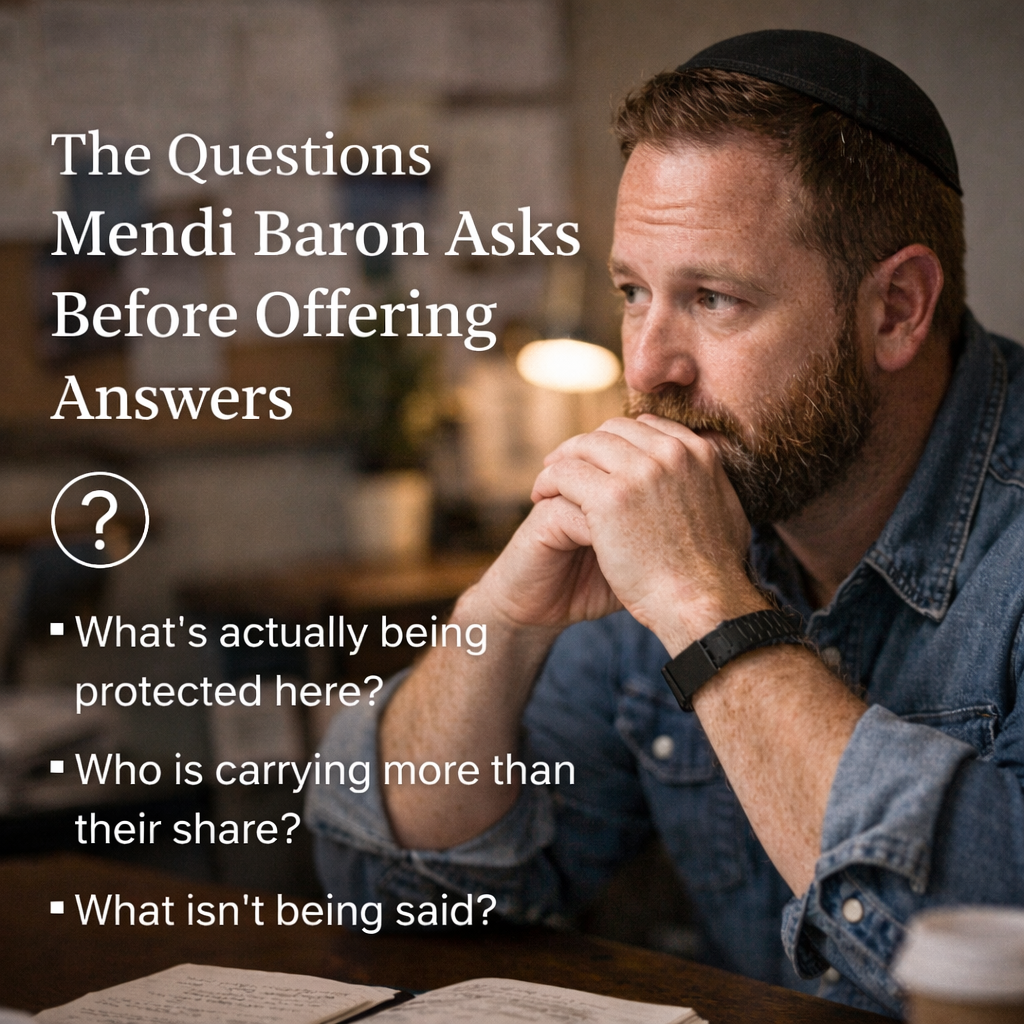
“Who Is Carrying More Than Their Share?”
Another question that guides Mendi Baron’s work is about emotional load. In many families, one member—often the identified patient—is carrying far more than their share of stress, responsibility, or unspoken emotion.
Rather than asking, “What’s wrong with this teen?” Mendi asks, “What is this teen holding for the system?” This shift is subtle but powerful. It reframes symptoms as signals rather than failures.
When families begin to see how pressure, conflict, or unresolved pain circulates through the system, responsibility becomes shared. Healing becomes collaborative rather than corrective.
The Role of Restraint in Clinical Leadership
In treatment settings, restraint is often misunderstood as passivity. In reality, it is an active choice. Mendi Baron practices restraint by not over-interpreting too quickly, not escalating prematurely, and not confusing urgency with importance.
This approach is especially critical with adolescents, whose identities are still forming. Labels and narratives introduced too early can become self-fulfilling. By staying curious longer, Mendi allows teens the dignity of evolving rather than being defined by a single chapter of their lives.
Restraint also models emotional regulation. When teens see adults who can tolerate discomfort without reacting impulsively, they learn that intensity does not have to lead to chaos.
Questions That Invite Ownership, Not Compliance
Rather than telling teens what they need to do, Mendi often asks questions that invite reflection:
- What feels hardest right now?
- What would make this even 5% more tolerable?
- What do you wish adults understood about this?
These questions don’t demand insight or motivation. They invite participation. And participation builds agency.
Compliance can be forced. Ownership cannot. Mendi’s questioning style respects this distinction and treats teens as collaborators in their own care rather than problems to be managed.
Answers That Come Later—and Land Deeper
When answers do come in Mendi Baron’s work, they land differently. They are grounded in understanding rather than assumption. They are specific rather than generic. And they are more likely to be trusted because the person receiving them feels seen first.
In complex teen and family cases, certainty is rarely the gift people need most. Being understood is. By leading with questions—careful, compassionate, and honest—Mendi Baron creates the conditions where real answers can eventually emerge.
Not louder. Not faster. But truer.