
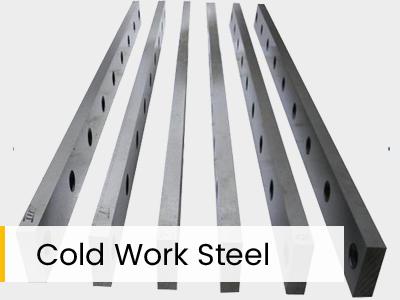
Die life is one of those metrics that quietly determines whether a stamping or forming operation is profitable. Every unplanned die change eats into uptime, and every early tool failure means re-cutting, re-grinding, or in the worst cases, building a replacement die from scratch. Cold work steel has become the default answer for shops trying to push die life further without redesigning their entire tooling program.
The basic reason cold work steel performs well here comes down to how it's formulated. These grades are built to maintain hardness and wear resistance at operating temperatures near ambient, which describes the overwhelming majority of stamping, blanking, and forming applications. Grades like D2, A2, and O1 each bring a different mix of wear resistance, toughness, and machinability, which means the "best" cold work steel really depends on what the die is being asked to do.
For high-volume production of abrasive or coated materials, D2's chromium content gives it strong resistance to abrasive wear, which directly translates into more parts between sharpenings. Shops running progressive dies on galvanized steel or aluminum, where surface coatings and oxide layers accelerate wear, tend to see the clearest die life improvements when moving to D2 from a lower-alloy grade like O1.
Toughness is the other half of the die life equation, and it's easy to overlook. A die can have excellent wear resistance and still fail early if it chips or cracks under repeated impact. This is especially true on dies with sharp internal corners, thin punch sections, or features prone to stress concentration. A2 tends to be the go-to when toughness needs to take priority over maximum wear resistance, since it holds up better against chipping while still offering solid abrasion resistance.
Heat treatment plays just as large a role as grade selection, arguably larger. Two dies made from the exact same steel can have meaningfully different service lives depending on whether the hardening cycle was controlled properly, whether the steel was tempered correctly, and whether stress-relieving was done at the right stages of machining. Vacuum hardening in particular helps minimize decarburization and distortion, both of which shorten die life if left unaddressed.
Surface treatments add another layer of improvement on top of the base steel. Nitriding, PVD coatings like TiN or TiCN, and cryogenic treatment are all commonly paired with cold work steel dies to push wear resistance and fatigue life even further, sometimes doubling die life compared to an uncoated tool in the right application.
The practical takeaway for anyone managing die programs is that die life improvements rarely come from a single change. Selecting the right cold work grade, controlling the heat treatment tightly, and applying an appropriate surface treatment work together, and shops that treat these as one integrated decision consistently get more parts, more consistency, and fewer surprises out of their tooling investment.