Introduction
Modern software teams need to release applications quickly, keep systems stable, improve security, and reduce manual work.
Because of this, DevOps skills have become useful for developers, system administrators, cloud engineers, and technical beginners.
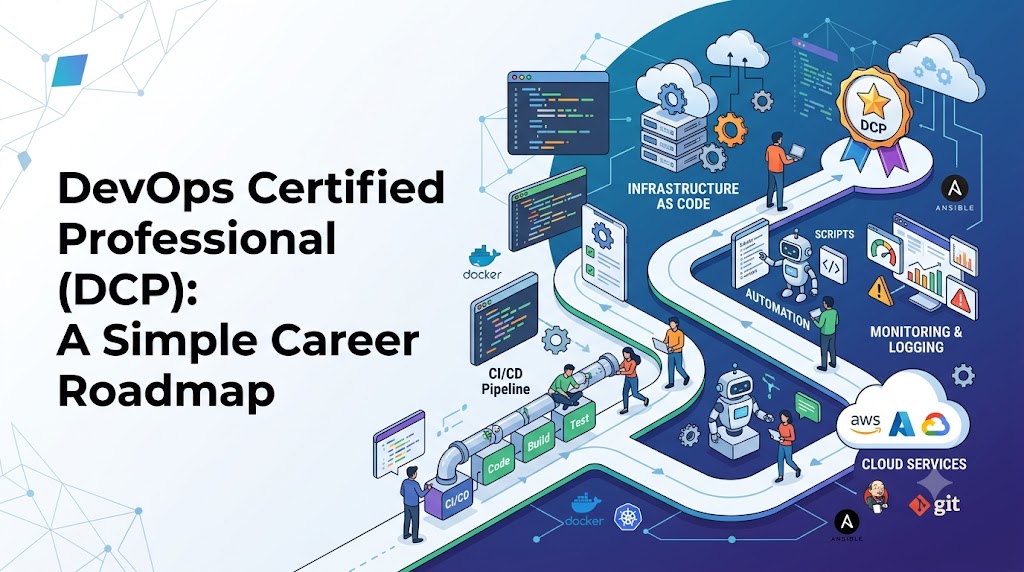
The DevOps Certified Professional (DCP) certification offers a structured way to learn software delivery, automation, infrastructure, containers, cloud platforms, monitoring, and security.
It can help new learners build a strong base and allow experienced professionals to improve their practical understanding.
What Is DevOps Certified Professional?
DevOps Certified Professional is a technical certification focused on the complete software delivery process.
It explains how code moves through source control, testing, building, deployment, monitoring, and production support.
The certification may include topics such as:
- Linux fundamentals
- Networking basics
- Git and version control
- Shell scripting
- Build automation
- CI/CD pipelines
- Infrastructure as Code
- Configuration management
- Docker and containers
- Kubernetes
- Cloud services
- Monitoring and logging
- Security automation
- Incident response
The main goal is to help learners understand how these areas work together in real projects.
Who Should Pursue DCP?
DCP can be useful for different types of learners.
Beginners and Students
Beginners can follow a clear learning order instead of studying tools without direction.
Software Developers
Developers can learn how applications are tested, packaged, deployed, monitored, and maintained.
System Administrators
Administrators can add scripting, automation, cloud, containers, and infrastructure management to their existing skills.
DevOps Engineers
DevOps professionals can improve their knowledge of pipelines, deployment automation, monitoring, cloud operations, and platform tools.
Cloud Engineers
Cloud engineers can learn how to create infrastructure, automate environments, deploy services, and monitor systems.
SRE and Security Professionals
SRE professionals can strengthen reliability and incident-management skills. Security professionals can learn how security checks fit into automated delivery workflows.
Why DCP Is Valuable
DevOps includes many tools and practices. Without a proper roadmap, learners may study technologies separately without understanding the complete workflow.
DCP can provide:
- A clear study structure
- Better automation skills
- Stronger software delivery knowledge
- Practical cloud and container understanding
- Improved troubleshooting ability
- Awareness of monitoring and security
- Preparation for different technical roles
Certification alone does not guarantee employment. Its value increases when learners combine it with hands-on projects, regular practice, and problem-solving.
DCP Learning Levels
| Level | Suitable For | Main Focus |
|---|---|---|
| Foundation | Beginners and students | Linux, Git, scripting, DevOps basics |
| Professional | Developers and working engineers | CI/CD, containers, cloud, automation |
| Advanced | Senior engineers and architects | Kubernetes, GitOps, reliability, platform design |
Foundation Level
The foundation level introduces the basic skills needed for a DevOps career.
Learners may study Linux commands, networking, Git workflows, scripting, build systems, and basic containers.
A useful beginner project is to store application code in Git, automate the build process, and run the application inside a container.
The focus should be on understanding the purpose of each step instead of memorizing commands.
Professional Level
The professional level focuses on complete and repeatable delivery workflows.
Important skills may include:
- CI/CD pipeline creation
- Automated testing
- Infrastructure provisioning
- Configuration management
- Container image creation
- Kubernetes deployment
- Cloud automation
- Monitoring and logging
- Security scanning
A strong practical project should move an application from source code to a deployed and monitored environment.
Advanced Level
The advanced level is designed for professionals managing large systems and production platforms.
Topics may include:
- Advanced Kubernetes
- GitOps
- Platform engineering
- Observability
- Reliability engineering
- Policy automation
- Security governance
- Disaster recovery
- Cloud cost management
This level is suitable for senior DevOps engineers, SREs, platform engineers, architects, and technical leaders.
Choose the Right Learning Path
DevOps Path
Learn Linux, Git, scripting, CI/CD, containers, Kubernetes, cloud platforms, and monitoring.
DevSecOps Path
Focus on secure pipelines, vulnerability scanning, secrets management, access control, and compliance automation.
SRE Path
Study service reliability, observability, incident response, automation, and performance.
AIOps Path
Learn anomaly detection, intelligent alerting, event correlation, and automated remediation.
MLOps Path
Focus on model deployment, experiment tracking, monitoring, retraining, and governance.
DataOps Path
Study data pipelines, workflow orchestration, data quality, testing, and observability.
FinOps Path
Learn cloud cost visibility, budgeting, optimization, governance, and financial responsibility.
Recommended Path by Role
| Role | Recommended Path |
| Beginner | DCP Foundation |
| Software Developer | DCP Professional |
| System Administrator | DCP Professional and cloud automation |
| DevOps Engineer | DCP Professional followed by Advanced |
| Site Reliability Engineer | DCP Professional and SRE |
| Security Engineer | DCP Foundation and DevSecOps |
| Platform Engineer | DCP Advanced and Kubernetes |
| Data Engineer | DCP Foundation and DataOps |
| Machine Learning Engineer | DCP Foundation and MLOps |
Practical Skills to Build
Learners should focus on real tasks instead of only reading theory.
Useful project ideas include:
- Creating a Git workflow
- Building a CI/CD pipeline
- Writing automation scripts
- Creating container images
- Deploying applications to Kubernetes
- Provisioning infrastructure through code
- Adding monitoring and alerts
- Running security checks
- Recording technical errors and solutions
These projects help learners understand how DevOps works in practical environments.
Common Mistakes to Avoid
One common mistake is trying to learn too many tools at once.
Another is copying scripts or configuration files without understanding them.
Learners should also avoid depending only on visual dashboards. Logs, command-line tools, configuration files, permissions, and error messages are equally important.
A better approach is to learn one concept, practise it, document the result, and then connect it with the next stage.
Frequently Asked Questions
1. Is DCP suitable for beginners?
Yes. Basic knowledge of Linux, Git, networking, and scripting can make learning easier.
2. Does DCP cover only one tool?
No. It covers several tools and practices across software delivery and operations.
3. Is programming required?
Advanced programming is not necessary, but basic scripting is important.
4. Can developers benefit from DCP?
Yes. Developers can learn how applications are built, deployed, monitored, and supported.
5. Are practical projects important?
Yes. Projects help learners understand real errors, configurations, dependencies, and troubleshooting.
6. Does DCP guarantee a job?
No. Employers also consider practical skills, projects, communication, and problem-solving ability.
7. What can learners study after DCP?
Possible next steps include DevSecOps, SRE, Kubernetes, cloud engineering, AIOps, MLOps, DataOps, FinOps, and platform engineering.
8. How should candidates prepare?
Candidates should practise regularly, build projects, document mistakes, review weak areas, and understand the complete workflow.
Final Thoughts
DevOps Certified Professional can help learners build a structured understanding of software delivery, automation, infrastructure, cloud platforms, containers, monitoring, and security.
Its real value comes from applying the knowledge through practical work.
DCP should be treated as the beginning of long-term technical growth, not as a replacement for real engineering experience.