
Here's a story you'll hear in almost every EV repair shop. A rider plugs in his charger at night,but in the morning he sees that his battery is still empty, the little light is dead, and he's convinced the battery has gone bad. He's ready to spend a big chunk of money to buy a new one.
Then some trained technician will come and open the charger of the Ebike and find a burnt fuse and a tired capacitor, then he will conclude that the battery was fine all along. In our Multitech Institute’s Ebike Charger Repairing we will provide you with that skill that saves riders from that kind of expensive mistake, and it's what Multitech Institute teaches in this course. Let's follow the power on its trip, from the wall socket to the battery, and see where things go wrong.
Step One: The Plug, the Cable and the Fuse
Power starts at the wall, so your checking starts there too. A cracked cable, a loose pin or a blown fuse can make a perfectly good charger look dead. In our Multitech Institute’s Ebike Charger Repairing we will teach to test the cable for breaks, check the fuse and spot the little signs, like discoloured plastic or a hot pin, that tell you the story before you even open the case.
It sounds basic, and it is. But a surprising number of "dead" chargers come back to life right here.
Step Two: The Rectifier and the Big Capacitor
Wall power is AC, and a battery needs DC. So the first job inside is to convert it. A set of diodes does the conversion, and a large capacitor smooths the result out.
When this part fails, you'll see a bulging capacitor, a burnt smell or a charger that hums and does nothing.In our Multitech Institute’s Ebike Charger Repairing we will teach to test each part, take out the faulty one and fit a proper replacement, not just whatever is lying around. Matching ratings matters here. A wrong part might work today and fail next week.
Step Three: The Switching Section
This is the heart of Ebike Charger Repairing, and it's where most of the interesting faults live. A switching circuit chops the power up very fast and passes it through a small transformer to bring the voltage down to what the battery wants.
The key parts are the power MOSFET, the transformer and the little resistors and diodes around them. When one of them dies, it often takes a neighbour with it..In our Multitech Institute’s Ebike Charger Repairing we will teach to read the board, find the whole chain of damage and fix it properly the first time. Otherwise the charger works for an hour and then pops again. That's the lesson that separates a real technician from a part-swapper.
Step Four: The Brain That Keeps Voltage Steady
A charger can't just push power into a battery. It has to hold the voltage steady and cut back when the battery is nearly full. A small control chip does this job, along with a feedback part called an optocoupler and a reference chip that watches the output voltage.
When this section goes wrong, you get strange symptoms. The charger might overcharge, undercharge or keep switching between green and red lights for no reason. These faults can't be seen with the eye.In our Multitech Institute’s Ebike Charger Repairing we will teach to measure signals, follow the feedback path and set the output voltage correctly, so the battery is never put at risk.
Step Five: The Output Side and the Light
On the last stretch, the power passes through an output diode, then the charging lead and the connector into the battery. Burnt connectors, weak joints and tired output diodes show up here a lot. So do the little indicator lights that tell the rider what's going on.
In our Multitech Institute’s Ebike Charger Repairing we will teach to check the output under load, not just with nothing connected, because some chargers look perfect until a battery is attached. That's a trick you only learn by doing it.
What You Learn in Our Ebike Charger Repairing Course?
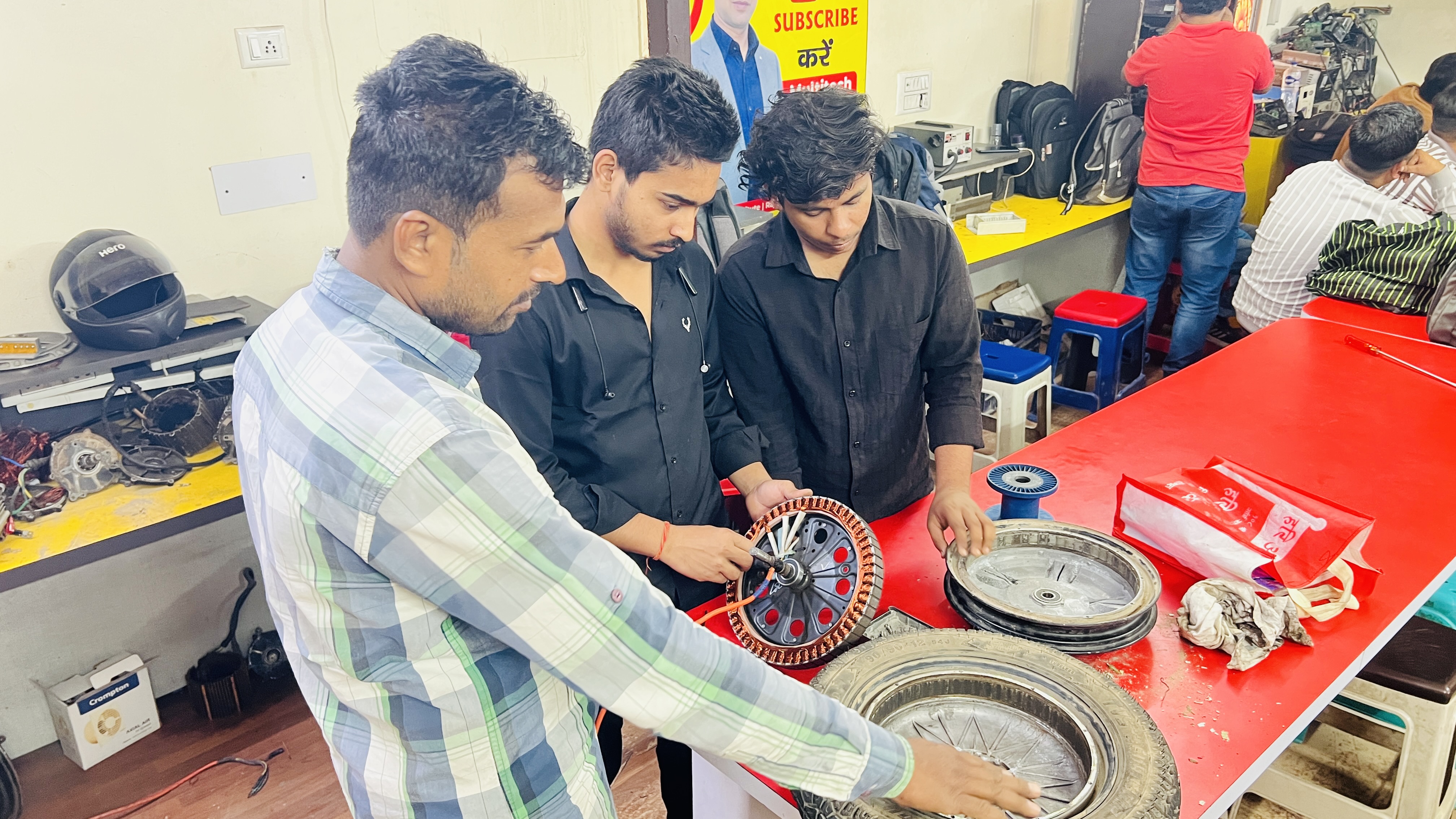
In our Multitech Institute’s Ebike Charger Repairing we will provide you training step by step, so you never feel lost and we believe in hand-on-repair skills while practicing on real Ebike Charger boards.
-
We will teach you about the basics of Ebike charger like AC and DC, voltage, current and how a multimeter works.
-
We will teach you about to identify charger types and their different voltages, plug types and designs
-
We will teach you about different board parts like fuses, diodes, capacitors, MOSFETs, transformers and control chips
-
We will teach you to find faults in a clear order of tests, so you stop guessing
-
We will teach you to solder and desolder it comes when you do lots of practice on real boards
-
We will teach you to test under load by proving that how repair works with a real battery before the charger goes back
-
We will teach you to talk with customer by giving honest quotes and explaining the fault in simple words
Safety Comes First During Ebike Charger Repairing
Chargers deal with mains power, and the big capacitor inside can hold a charge even after the plug is pulled out. That can give you a nasty shock. At Multitech Institute we will teach you about having safe habits from the very beginning in a lesson.In our Ebike Charger Repairing we will teach you to discharge capacitors properly, keep your bench tidy and test with care, so these habits stay with you when you open your own shop in future.
Who Should Join Ebike Charger Repairing Training?
In Ebike Charger Repairing at Multitech Institute those who are two-wheeler mechanics, since ebikes keep arriving at their counters. Electricians, ITI and diploma students and mobile repair technicians can join they pick it up quickly because they already have a small electronics shop but not the skills.
Shop owners who want to add EV service can join too. You don't need a degree. If you're patient, curious and comfortable working with your hands, the basics are taught from the start.
Why Are These Ebike Chargers Repairing in Demand?
Chargers get abused. They're dragged around, plugged in on bad power and left in hot rooms. That means they fail often, and most riders would much rather pay for a repair than buy a new one.
A shop that offers Ebike Charger Repairing gets steady small jobs that add up and the technicians who know these skills the customer will handsomely pay money to them and it earns a reputation as the place that saves people money. Riders remember that, and they recommended their friends
Frequently Asked Question:
How long is the ebike charger repairing course?
Batch lengths and timings can change, so please call Multitech Institute directly for the current schedule.
Do I need an electronics background to learn ebike charger repairing?
No. The course starts from the basics and builds up slowly as you practise.
Will I work on real chargers?
Yes. You'll spend your time on real boards with real faults, not just watching demonstrations.
Can I start my own shop after ebike charger repairing training?
Many learners aim for exactly that. The course also covers talking to customers and quoting a fair price, which helps when you open your own counter.
Is every ebike charger the same inside?
Not at all. Voltage, parts and board design change from model to model, which is why you learn the logic behind them instead of memorising one brand.
Is it dangerous to work on chargers?
There's real mains voltage inside, so care matters. That's why safe handling is taught from the first day.
Ready to Get Started at Multitech Institute
Next time a dead charger lands on your counter, you could be the one who opens it, follows the power through and fixes it in an afternoon. Visit Multitech Institute, ask about the current batch and see the bench for yourself. Ebike Charger Repairing is a skill that pays for itself every time a rider walks in with a charger that's gone quiet.