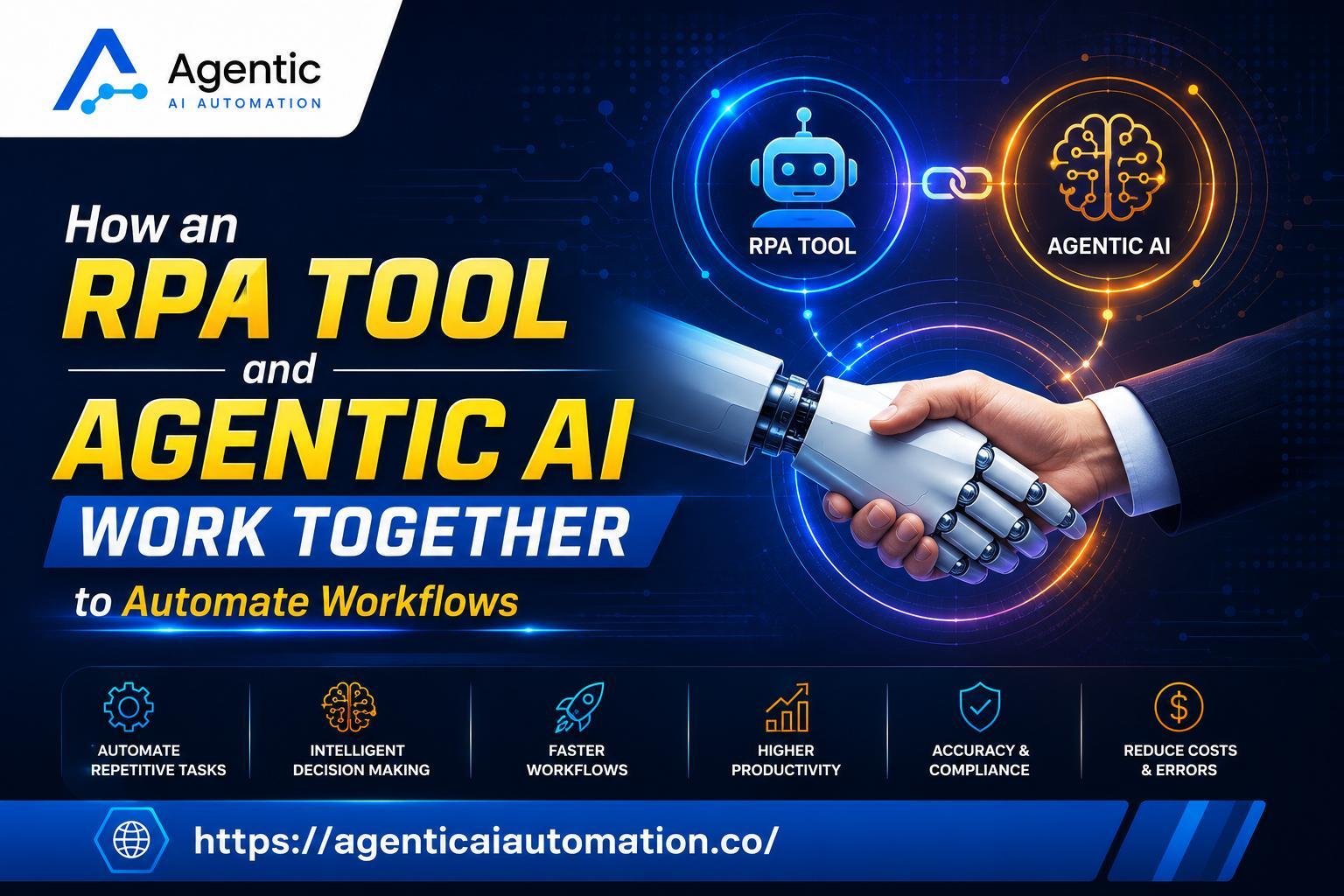
If you've spent any time researching business process automation lately, you've probably noticed two terms popping up everywhere: agentic AI and RPA tool. They're often talked about as if they're competitors, or worse, as if one is about to replace the other. In reality, the most powerful automation strategies don't pick a side. They combine the two.
In this guide, we'll break down what each technology actually does, why pairing an RPA tool with agentic AI creates automation that's smarter and more resilient than either one alone, and how you can start applying this combination to your own workflows, even if you're just getting started with automation.
What Is an RPA Tool, Exactly?
An RPA tool (Robotic Process Automation tool) is software designed to mimic repetitive, rule-based human actions inside digital systems. Think of tasks like copying data from a spreadsheet into a CRM, extracting information from invoices, logging into portals to download reports, or moving files between folders based on a naming convention.
RPA tools are excellent at following instructions exactly as written. They don't get tired, they don't make typos, and they can work around the clock. Popular platforms in this space include UiPath, Automation Anywhere, and Microsoft Power Automate, but the underlying concept is the same across vendors: a bot follows a predefined script, step by step, with little room for interpretation.
That predictability is both the greatest strength of RPA and its biggest limitation. A traditional bot performs beautifully when the process never changes. The moment something unexpected happens, like a new invoice format, a missing field, or a website layout update, the bot typically breaks or halts, waiting for a human to intervene.
What Is Agentic AI?
Agentic AI refers to artificial intelligence systems that can reason, plan, and take independent action to achieve a goal, rather than simply responding to a single prompt or following a fixed script. Instead of being told exactly what steps to take, an agentic AI system can break a broader objective into smaller tasks, decide which tools or data sources to use, evaluate the results, and adjust its approach if something doesn't go as expected.
This is a meaningful shift from earlier generations of AI, which were mostly reactive: you asked a question, it gave an answer. Agentic AI behaves more like a digital coworker. It can look at a messy email, figure out what's actually being requested, decide which system to check, pull the relevant information, and even flag exceptions that need human judgment.
Where agentic AI really shines is in handling ambiguity and variation, exactly the situations where rule-based automation tends to struggle.
Why Combine Agentic AI and an RPA Tool?
Here's the key insight: agentic AI and an RPA tool solve two different problems. RPA is built for structured, repetitive execution. Agentic AI is built for reasoning, judgment, and adapting to change. When you put them together, you get automation that can handle both the routine and the exceptions, without constant human babysitting.
Think of it this way: the RPA tool is the hands, reliably executing tasks across systems. Agentic AI is the brain, deciding what needs to happen, interpreting unstructured information, and course-correcting when circumstances shift. Neither one needs to do the other's job. Together, they form a system that's both fast and flexible.
A Simple Example
Imagine an accounts payable process. A traditional RPA bot can extract data from a standard invoice and enter it into your accounting system in seconds. But what happens when a vendor sends a PDF in a completely different layout, or an invoice is missing a purchase order number?
With agentic AI layered on top, the system can recognize that this invoice doesn't match the expected pattern, read the document contextually to figure out what's missing, check historical vendor records to fill in gaps, or route the exception to the right person with a clear explanation of what needs review. The RPA tool still does the heavy lifting of data entry and system updates; the agentic AI handles the thinking around it.
How the Two Technologies Work Together in Practice
There are a few common patterns for combining agentic AI with an RPA tool inside a broader business process automation strategy.
1. Agentic AI as the Orchestrator
In this model, the agentic AI system sits at the top of the workflow, deciding what needs to be done and in what order. It might receive an incoming request, such as a customer email or a new sales order, interpret the intent, and then trigger the appropriate RPA bots to carry out specific steps. The AI acts like a project manager, delegating structured tasks to the RPA tool while retaining oversight of the overall goal.
2. RPA as the Execution Layer, AI as the Exception Handler
Many organizations start here because it's the least disruptive path. The existing RPA tool keeps doing what it already does well: high-volume, repetitive execution. Agentic AI is introduced specifically to catch and resolve exceptions, the 10 to 20 percent of cases that used to require manual intervention. This hybrid approach delivers a fast return on investment because it improves an existing automation program rather than replacing it.
3. AI-Driven Document and Data Understanding
A lot of business process automation depends on extracting information from unstructured sources: emails, scanned documents, contracts, chat messages. Agentic AI can read and interpret this content with far more nuance than older optical character recognition tools, then hand off clean, structured data to the RPA tool for processing in downstream systems.
4. Continuous Learning and Process Improvement
Agentic AI systems can also monitor how workflows perform over time, spotting bottlenecks, recurring errors, or opportunities to streamline steps. Rather than automation being a one-time setup, this creates a feedback loop where the AI recommends refinements to how the RPA tool is used, keeping the process efficient as business needs evolve.
Real-World Use Cases
This combination isn't theoretical. Companies across industries are already blending an RPA tool with agentic AI to strengthen business process automation. A few examples:
• Finance and accounting: Automating invoice processing, reconciliations, and expense approvals, while AI handles mismatches, fraud flags, and vendor communication.
• Customer service: RPA bots update tickets and customer records while agentic AI reads incoming messages, determines intent, and decides whether to resolve, escalate, or request more information.
• Human resources: Onboarding workflows where RPA creates accounts and provisions system access, while AI reviews submitted documents for completeness and answers new-hire questions.
• Supply chain and procurement: RPA tools update inventory and order systems, while agentic AI forecasts demand shifts and adjusts purchasing recommendations accordingly.
• Healthcare administration: Automating claims processing and scheduling, with AI interpreting clinical notes or resolving coding discrepancies that require contextual judgment.
Benefits of Combining Agentic AI and RPA Tools
Bringing these two technologies together delivers advantages that go beyond what either could achieve alone.
• Higher automation coverage: Instead of automating only the simplest, most predictable tasks, businesses can extend automation into more complex, variable processes.
• Fewer manual escalations: Exceptions that once landed in a human's inbox can often be resolved automatically, freeing up staff for higher-value work.
• Faster time to value: Since RPA tools are already deployed in many organizations, adding an agentic AI layer is often faster than building an entirely new automation program from scratch.
• Improved accuracy and compliance: AI can apply consistent judgment to edge cases, reducing the inconsistency that comes from ad hoc manual decisions.
• Scalability: As business volume grows, the combined system can handle more variation without a proportional increase in headcount.
Challenges to Keep in Mind
This combination is powerful, but it isn't a plug-and-play fix, and it's worth going in with realistic expectations.
• Data quality matters: Agentic AI is only as good as the information it can access. Messy, inconsistent, or siloed data will limit how well it can reason and decide.
• Governance and oversight: Giving AI more autonomy means you need clear guardrails, audit trails, and escalation paths for decisions that carry financial, legal, or compliance risk.
• Change management: Teams accustomed to purely rule-based bots may need training to trust and work alongside a system that makes judgment calls.
• Integration complexity: Connecting agentic AI systems to existing RPA tools and business systems takes thoughtful architecture, especially in organizations with legacy infrastructure.
None of these challenges are reasons to avoid the combination. They're simply signals to roll out the technology in phases, starting with lower-risk processes, and building governance as you scale.
Getting Started: A Practical Approach
If you're considering this path for your own organization, you don't need to overhaul everything at once. A phased approach tends to work best.
• Start with an existing bottleneck: Identify a process where your current RPA tool frequently hits exceptions or requires manual review.
• Add AI where judgment is needed: Introduce agentic AI specifically to handle the ambiguous parts of that process, not the entire workflow.
• Measure the impact: Track how much manual intervention decreases and how much faster the process completes end to end.
• Expand gradually: Once you've proven value in one area, apply the same pattern to adjacent processes across finance, HR, customer service, or operations.
This incremental approach keeps risk low while building internal confidence in how agentic AI and RPA tools perform together.
The Future of Business Process Automation
The line between rule-based automation and intelligent decision-making is going to keep blurring. As agentic AI systems become more capable of planning multi-step tasks and coordinating across tools, and as RPA platforms increasingly build AI capabilities directly into their products, the distinction between "RPA" and "AI automation" may eventually fade altogether.
For now, though, the most practical and cost-effective strategy for most businesses is to treat them as complementary. Let your RPA tool handle the structured, high-volume execution it's already good at. Let agentic AI bring the reasoning, adaptability, and judgment that structured automation has always lacked. Together, they turn business process automation from a brittle, narrow tool into a genuinely intelligent system that can keep up with how work actually happens.
Final Thoughts
Agentic AI and RPA tools aren't rivals fighting for the same job. They're two halves of a more complete automation strategy. One executes with precision; the other thinks on its feet. When you bring them together thoughtfully, starting small, focusing on real bottlenecks, and building in the right oversight, you end up with business process automation that doesn't just save time, but actually adapts as your business does.