
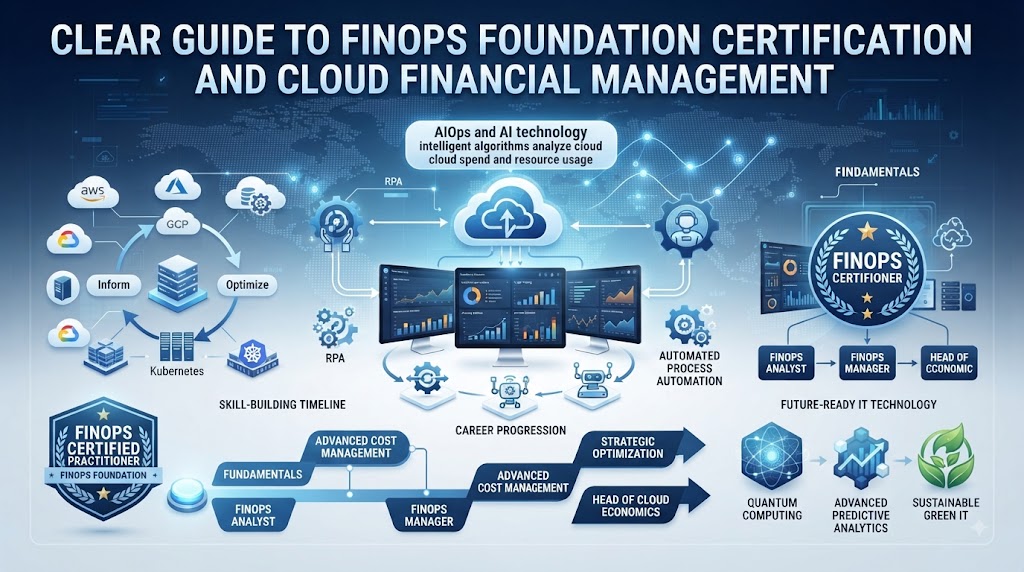
Cloud computing provides flexibility, scalability, and faster innovation. However, it can also make technology spending difficult to understand and manage. Teams can provision cloud infrastructure quickly, but without visibility and accountability, organizations may face unused resources, unclear ownership, inaccurate forecasts, and unexpected costs. A FinOps Foundation Certification helps professionals understand how to manage cloud and technology spending through collaboration, data, financial accountability, and business-value thinking. FinOps, short for Financial Operations, brings engineering, finance, leadership, procurement, product, and business teams together to make better technology decisions. This guide explains FinOps Foundation Certification, the FinOps Framework, key skills, cloud cost optimization methods, career relevance, practical projects, and preparation strategies.
What Is FinOps Foundation Certification?
FinOps Foundation Certification refers to training and credentials that help professionals build knowledge of FinOps practices and cloud financial management. A common foundational option is the FinOps Certified Practitioner credential, which introduces learners to the FinOps Framework, cloud economics, collaboration models, and cost-management practices.
The goal is not simply to teach people how to lower cloud bills. FinOps helps teams make informed decisions about cost, speed, performance, reliability, risk, and business outcomes.
A FinOps certification can help professionals develop a common language for discussing cloud costs. It also provides structured knowledge that can be applied to real-world situations involving cloud billing, reporting, budgeting, forecasting, cost allocation, and resource optimization.
What Is FinOps?
FinOps is an operational practice that helps organizations maximize the business value of cloud and technology investments. It connects technical, financial, and business teams so they can work together on cloud spending decisions.
In simple words, FinOps helps organizations understand:
-
Who is using cloud resources
-
Why cloud costs are increasing or decreasing
-
Which teams, products, or projects own specific costs
-
Whether cloud resources are being used efficiently
-
How much cloud spending is expected in the future
-
Whether cloud investments are creating enough business value
FinOps does not mean finance teams control every technical decision. It also does not mean engineers need to become accountants. Instead, FinOps creates a shared responsibility model.
For example, an engineering team may discover that test servers run all day even though developers only use them during working hours. The team can create schedules to stop those servers overnight. Finance can measure the cost impact, while leadership can assess whether the change supports business goals without affecting productivity.
Why FinOps Is Important
Cloud spending is variable. Unlike traditional infrastructure, where organizations buy hardware upfront, cloud costs change based on actual usage. Costs may increase because of computing workloads, storage growth, data transfer, managed services, AI workloads, or new application releases.
FinOps is important because it improves several areas:
-
Cloud cost visibility: Teams can see where cloud spending happens.
-
Cost control: Organizations can identify waste, idle resources, and unnecessary services.
-
Budget management: Business and finance teams can compare actual spend with planned budgets.
-
Forecasting: Historical usage and planned projects help estimate future cloud costs.
-
Resource optimization: Engineers can rightsize resources and improve workload efficiency.
-
Financial accountability: Teams understand the cost impact of their technology decisions.
-
Business alignment: Organizations can connect technology investment with customer, product, and business outcomes.
The objective is not always to spend less. A higher cloud bill may be acceptable if it supports higher revenue, better reliability, improved customer experiences, faster delivery, or business growth.
About the FinOps Foundation
The FinOps Foundation is an organization and community focused on advancing FinOps practices, cloud financial management education, and collaboration across the technology industry.
It provides a common framework for organizations that want to improve visibility, accountability, cost optimization, and business-value measurement across cloud and technology spending.
The Foundation contributes to the FinOps ecosystem through:
-
FinOps Framework guidance
-
Training and professional certifications
-
Community learning and knowledge sharing
-
Best practices for cloud financial management
-
Resources for organizational FinOps adoption
-
Work related to standardizing cloud cost and usage data
The FinOps Framework is designed to be flexible. Organizations do not need to implement every FinOps practice immediately. They can start with basic cost visibility and gradually mature their processes over time.
FinOps Certification Structure
FinOps Foundation Certification includes multiple learning paths for different roles and experience levels. The best path depends on whether a person works mainly in engineering, cloud architecture, finance, analytics, leadership, or FinOps operations.
| Certification or Path | Main Focus | Best For | Key Skills |
|---|---|---|---|
| FinOps Certified Practitioner | FinOps fundamentals | Beginners and FinOps professionals | Framework, cost accountability, collaboration |
| FinOps Engineer Learning Path | Engineering and cloud cost management | Cloud, DevOps, and platform engineers | Cost-aware engineering and optimization |
| FOCUS Learning Path | Cloud cost and usage data | Analysts and data professionals | Billing data and cost analysis |
| FinOps for AI Learning Path | AI financial management | Teams managing AI workloads | AI costs, value, and governance |
| Advanced FinOps Learning | Strategy and leadership | Experienced practitioners and leaders | Governance, strategy, and business value |
| Cloud Certifications | Platform-specific cloud expertise | Engineers and architects | AWS, Azure, Google Cloud services |
Always review the official certification page before registering because training options, assessments, pricing, exam requirements, and certification policies may change.
Who Should Take FinOps Foundation Certification?
FinOps certification can be useful for professionals who work with cloud technology, IT budgets, cloud operations, business planning, or technology leadership.
Relevant roles include:
-
FinOps Practitioners
-
FinOps Analysts
-
Cloud Engineers
-
DevOps Engineers
-
Platform Engineers
-
Cloud Architects
-
Cloud Consultants
-
Finance Professionals
-
IT Managers
-
Engineering Managers
-
Product Managers
-
Procurement Teams
-
Technology Leaders
Suitability depends on career goals and current knowledge. A cloud engineer may use FinOps knowledge to design cost-aware systems. A finance professional may use it to improve cloud budget forecasting. A technology leader may use it to establish accountability and governance across teams.
Eligibility and Prerequisites
Formal requirements depend on the specific FinOps certification. For foundational learning, basic cloud knowledge is recommended but not always mandatory.
Helpful knowledge includes:
-
Cloud computing fundamentals
-
Compute, storage, networking, and managed services
-
Basic cloud billing concepts
-
Budgeting and forecasting fundamentals
-
Cost reports and dashboards
-
Basic business and financial terminology
-
Experience with cloud operations, engineering, finance, procurement, or IT management
Beginners can start by learning cloud fundamentals and FinOps concepts before attempting a certification assessment. People with engineering or finance backgrounds may find different parts of FinOps easier, but both groups can benefit from learning the broader model.
Skills You Can Gain
FinOps training can help learners develop practical cloud financial management skills.
Important areas include:
-
Cloud cost visibility
-
Cost allocation
-
Billing analysis
-
Budgeting
-
Forecasting
-
Cost optimization
-
Cloud economics
-
Financial accountability
-
Reporting and dashboards
-
Data-driven decision-making
-
Cross-functional collaboration
-
Governance and policy awareness
-
Business value measurement
For example, a FinOps professional may help create a tagging standard so that cloud spending can be assigned to the correct business unit, application, team, product, or environment. This makes cloud bills more useful because decision-makers can identify who owns each cost.
FinOps Framework Explained
The FinOps Framework provides a structured operating model for organizations that want to manage cloud and technology spending effectively. It supports collaboration between engineering, finance, business, procurement, product, and leadership teams.
The Framework includes concepts such as:
-
FinOps principles
-
Personas
-
Domains
-
Capabilities
-
Lifecycle phases
-
Maturity levels
-
Business value
-
Collaboration practices
-
Financial accountability
FinOps helps organizations move from simply seeing cloud costs to understanding, optimizing, and managing technology value.
| FinOps Area | Purpose | Example Activities |
|---|---|---|
| Understand Usage and Cost | Improve cost visibility and accuracy | Cost reporting, allocation, tagging, anomaly detection |
| Quantify Business Value | Connect spending with outcomes | Forecasting, budgeting, unit economics, KPIs |
| Optimize Usage and Cost | Improve efficiency and value | Rightsizing, scheduling, storage optimization |
| Manage the FinOps Practice | Build a repeatable operating model | Governance, education, automation, stakeholder communication |
FinOps Principles
FinOps principles guide how teams work together to manage cloud and technology costs.
Key principles include:
-
Teams need to collaborate across engineering, finance, and business functions.
-
Decisions should be driven by business value rather than cost alone.
-
Everyone should take ownership of their technology usage and costs.
-
Cost data should be timely, accessible, and easy to understand.
-
Organizations should use a centralized FinOps practice to support distributed teams.
-
Teams should take advantage of the variable cost model of cloud computing.
In practice, a product team might need more cloud capacity during a seasonal sales event. FinOps does not automatically recommend reducing spending. Instead, it helps the organization understand the expected cost, forecast demand, evaluate potential revenue, and make an informed decision.
FinOps Lifecycle
The FinOps lifecycle is iterative, meaning organizations repeat its stages as cloud usage and business priorities change.
Inform
The Inform phase focuses on visibility. Organizations collect billing and usage data, create reports, allocate costs, establish budgets, and identify spending patterns.
Common activities include:
-
Creating cost dashboards
-
Improving tagging and labeling
-
Assigning cost ownership
-
Tracking spending by product or team
-
Detecting cost anomalies
-
Forecasting future cloud spend
Optimize
The Optimize phase focuses on improving cloud efficiency and value. Teams identify opportunities to reduce waste or use cloud services more effectively.
Common actions include:
-
Rightsizing compute resources
-
Removing unused storage
-
Scheduling development environments
-
Optimizing databases
-
Reviewing storage tiers
-
Using commitment-based pricing when appropriate
-
Improving application architecture
Operate
The Operate phase makes FinOps a regular business practice. Organizations establish governance, recurring reviews, policies, metrics, and automation.
Common activities include:
-
Reviewing budgets and forecasts
-
Tracking savings and optimization progress
-
Defining cost accountability
-
Automating reporting
-
Establishing governance policies
-
Educating engineering and finance teams
Cloud Financial Management and Cost Optimization
Cloud financial management is the practical process of controlling, understanding, and improving cloud spending. It combines financial planning with technical optimization.
Organizations can improve cloud financial management by:
-
Monitoring cloud costs regularly
-
Setting budgets and alerts
-
Tracking usage by team, product, environment, and project
-
Identifying unused or underutilized resources
-
Improving cost allocation
-
Reviewing cost anomalies
-
Forecasting future spending
-
Connecting costs to business metrics
-
Involving engineering teams in cost decisions
Rightsizing is one common optimization method. If a virtual machine uses only a small portion of its available capacity, the team may move it to a smaller instance. However, the decision should consider workload performance, traffic spikes, availability needs, and future growth.
FinOps Tools and Technologies
FinOps teams use different categories of tools depending on their cloud environment, data complexity, and maturity.
Common tool categories include:
-
Cloud provider billing portals
-
Cost-management dashboards
-
Budget and forecasting tools
-
Billing-data analysis platforms
-
Cost allocation and tagging tools
-
Reporting and visualization tools
-
Resource optimization tools
-
Governance and policy tools
-
Monitoring and anomaly detection systems
-
Data warehouses and business intelligence platforms
Cloud providers offer native cost-management capabilities, while organizations may also use third-party FinOps platforms, internal dashboards, spreadsheets, data warehouses, or custom reporting systems.
Tools are useful, but FinOps is not only a tooling problem. Organizations also need clear processes, ownership, communication, accurate data, and shared business goals.
Real-World FinOps Use Cases
Cloud Cost Optimization
A company identifies virtual machines that are consistently underused. Engineers rightsize those workloads, while FinOps teams measure the savings and confirm that application performance remains acceptable.
Multi-Cloud Cost Management
An enterprise uses more than one cloud provider. FinOps teams create reporting standards that allow leaders to compare spending across environments and business units.
Budget Forecasting
A growing software company forecasts future cloud spending based on customer growth, planned product releases, seasonal demand, and historical usage trends.
Engineering Cost Accountability
A platform engineering team creates dashboards that show the cost of each Kubernetes cluster, environment, and workload. Teams can then see the financial impact of technical decisions.
Cost Allocation
A shared cloud platform supports multiple business units. The organization creates allocation rules to distribute shared costs fairly based on usage, team ownership, or business activity.
Hands-On FinOps Projects
Practical work helps learners understand FinOps beyond theory. Useful projects include:
-
Building a monthly cloud spending dashboard
-
Creating a cloud-cost allocation model
-
Designing a tagging and labeling policy
-
Preparing a budget-versus-actual report
-
Building a cloud spending forecast
-
Identifying idle or unused resources
-
Completing a rightsizing analysis
-
Designing cost anomaly alerts
-
Creating a team-level cost accountability report
-
Measuring cloud cost per customer, order, transaction, or product feature
A simple project could involve analyzing one month of cloud billing data. Categorize costs by service, environment, team, and application. Then identify the top spending areas, investigate major changes, and recommend actions based on value and technical requirements.
Benefits of FinOps Foundation Certification
FinOps Foundation Certification can provide realistic professional benefits, including:
-
Better understanding of cloud financial management
-
Stronger knowledge of cloud economics
-
Improved cloud-cost optimization awareness
-
Clearer communication between technical and financial teams
-
Structured understanding of the FinOps Framework
-
Greater confidence when reviewing cloud cost data
-
Professional development for cloud and finance-related roles
-
Better preparation for hands-on FinOps responsibilities
A certification does not guarantee a job, promotion, salary increase, or career outcome. However, it can strengthen a professional profile when combined with practical cloud, engineering, analytics, finance, or leadership experience.
FinOps Certification Preparation Roadmap
-
Learn cloud computing fundamentals, including compute, storage, networking, and billing.
-
Understand the basics of cloud economics and variable cloud costs.
-
Study FinOps concepts, principles, personas, domains, and lifecycle phases.
-
Review the FinOps Framework in detail.
-
Explore official learning resources for your chosen certification.
-
Practice reading cost reports and cloud billing data.
-
Complete a hands-on project, such as a dashboard or spending forecast.
-
Work through real-world scenarios involving budgets, allocation, and optimization.
-
Identify knowledge gaps and revise weak areas.
-
Review current official requirements before scheduling an assessment.
Study Resources and Preparation Tips
Useful preparation resources include:
-
Official FinOps Foundation training material
-
FinOps Framework documentation
-
Cloud provider cost-management documentation
-
Cloud billing and pricing guides
-
Hands-on cloud projects
-
Cost reporting exercises
-
Cloud architecture case studies
-
FinOps community discussions
-
Practical budgeting and forecasting exercises
Focus on understanding how concepts connect. For instance, cost allocation supports accountability, accountability supports informed decisions, and informed decisions improve business value.
Avoid preparing only by memorizing terminology. Certification learning is more valuable when you can apply concepts to a real cloud environment.
Common Mistakes to Avoid
-
Memorizing terms without understanding their practical purpose
-
Focusing only on reducing cloud spending
-
Ignoring cloud economics and pricing models
-
Skipping cost allocation and ownership practices
-
Treating FinOps as only a finance responsibility
-
Ignoring engineering and architecture decisions
-
Neglecting business value and product outcomes
-
Avoiding hands-on billing-data analysis
-
Using outdated certification information
-
Assuming tools alone solve cloud-cost problems
Career Opportunities and Job Roles
FinOps knowledge can support a range of cloud and technology careers.
| Role | Typical Responsibilities |
|---|---|
| FinOps Practitioner | Supports FinOps processes, reporting, collaboration, and optimization |
| FinOps Analyst | Analyzes billing data, forecasts spend, and prepares cost reports |
| FinOps Engineer | Builds cost-aware engineering practices and automation |
| Cloud Cost Analyst | Monitors cloud costs, allocation, budgets, and anomalies |
| Cloud Architect | Designs scalable, secure, and cost-aware cloud solutions |
| Cloud Consultant | Advises organizations on cloud strategy, governance, and optimization |
| Platform Engineer | Builds shared platforms with reliability, efficiency, and cost accountability |
| Technology Leader | Aligns technology spending with organizational strategy and value |
Certification can complement these roles, but it does not automatically qualify someone for a specific job. Employers also evaluate cloud expertise, practical experience, communication ability, industry background, and problem-solving skills.
FinOps Salary and Career Growth
Salary and career growth in FinOps-related roles depend on many factors:
-
Professional experience
-
Geographic location
-
Cloud provider expertise
-
Engineering or finance background
-
Industry and company size
-
Technical and analytical skills
-
Leadership responsibilities
-
Depth of FinOps experience
-
Ability to work across engineering, finance, and business teams
Rather than focusing only on salary, professionals should build a combination of practical cloud knowledge, financial awareness, reporting skills, stakeholder communication, and real-world optimization experience.
FinOps Certification vs Related Certifications
| Certification / Path | Main Focus | Best For | Key Skills |
|---|---|---|---|
| FinOps Foundation Certification | Cloud financial management | FinOps, engineering, finance, and leadership professionals | Cost accountability, optimization, business value |
| Cloud Architecture Certification | Cloud solution design | Cloud architects and senior engineers | Architecture, security, scalability, reliability |
| DevOps Certification | Software delivery and operations | DevOps and SRE professionals | CI/CD, automation, monitoring, reliability |
| Cloud Engineering Certification | Cloud implementation and operations | Cloud engineers and administrators | Infrastructure, services, deployment, operations |
| Data Certification | Data platforms and analytics | Analysts, engineers, and data teams | Data pipelines, reporting, analysis |
| Cloud Financial Management Learning | Cost and value management | Finance and technical professionals | Forecasting, allocation, budgeting, optimization |
FinOps certification works well alongside cloud architecture, engineering, DevOps, data, and finance learning paths because cloud financial management requires both technical and business understanding.
Future of FinOps
FinOps will continue to evolve as cloud environments become more complex. Important trends include:
-
AI-assisted cloud cost optimization
-
Automated cost anomaly detection
-
Improved multi-cloud cost management
-
Greater use of unit economics
-
More detailed business-value reporting
-
FinOps integration with platform engineering
-
Cloud sustainability and resource-efficiency reporting
-
Increased financial accountability for engineering teams
-
FinOps practices for AI, containers, SaaS, and other technology spending
As organizations use more cloud services, data platforms, AI workloads, and distributed applications, FinOps will become increasingly important for making responsible technology investment decisions.
Recommended Learning Path After Certification
After completing a foundational FinOps certification, learners can choose a specialization based on career goals.
-
Cloud engineers can deepen skills in cloud architecture, Kubernetes, automation, and cost-aware engineering.
-
DevOps professionals can focus on infrastructure automation, observability, reliability, and deployment efficiency.
-
Finance professionals can explore forecasting, allocation, unit economics, procurement, and technology financial management.
-
Data professionals can develop skills in cloud billing data, reporting, FOCUS, dashboards, and analytics.
-
Leaders can focus on governance, FinOps operating models, strategy, and business-value measurement.
-
Cloud consultants can combine FinOps knowledge with cloud migration, optimization, and transformation expertise.
Key Takeaways
-
FinOps connects engineering, finance, and business teams around technology spending.
-
FinOps Foundation Certification can provide structured cloud financial management knowledge.
-
FinOps focuses on business value, not only cloud cost reduction.
-
The FinOps Framework supports visibility, optimization, accountability, and governance.
-
The FinOps lifecycle includes Inform, Optimize, and Operate.
-
Cost allocation, reporting, budgeting, forecasting, and optimization are key FinOps skills.
-
Hands-on projects build stronger FinOps knowledge than theory alone.
-
Certification can support career development when combined with practical experience.
FAQs
What is FinOps Foundation Certification?
FinOps Foundation Certification is a professional learning and credential path focused on FinOps practices, cloud financial management, cost optimization, and business-value accountability.
What does FinOps mean?
FinOps means Financial Operations. It is a collaborative approach that helps engineering, finance, and business teams manage cloud and technology spending.
Who should take a FinOps certification?
Cloud engineers, DevOps engineers, platform engineers, architects, finance professionals, IT managers, product leaders, analysts, and FinOps professionals can benefit from FinOps learning.
Is FinOps Foundation Certification suitable for beginners?
Yes, foundational FinOps learning can be suitable for beginners. Basic cloud knowledge is helpful, but learners can start with cloud and FinOps fundamentals.
Are there prerequisites for FinOps certification?
Requirements vary by certification. Basic cloud computing, cloud billing, financial concepts, and reporting knowledge are commonly recommended.
How can I prepare for FinOps Foundation Certification?
Study FinOps fundamentals, learn cloud economics, understand the FinOps Framework, use official resources, practice real-world cost scenarios, and complete hands-on projects.
What skills does FinOps certification teach?
FinOps learning can cover cloud cost management, cost allocation, budgeting, forecasting, optimization, reporting, accountability, governance, and stakeholder collaboration.
What is the FinOps lifecycle?
The FinOps lifecycle includes three iterative stages: Inform, Optimize, and Operate.
How does FinOps reduce cloud costs?
FinOps helps teams identify unused resources, improve allocation, rightsize workloads, forecast spending, monitor anomalies, and make cost-aware cloud decisions.
Does FinOps only focus on cloud cost optimization?
No. FinOps focuses on maximizing business value from cloud and technology spending while balancing cost, performance, speed, reliability, and business needs.
What is cloud cost allocation?
Cloud cost allocation is the process of assigning cloud spending to specific teams, products, projects, applications, environments, or business units.
Can FinOps certification help career growth?
It can strengthen cloud financial management knowledge and support professional development. Career growth also depends on experience, skills, location, industry, and job responsibilities.
What jobs use FinOps skills?
Roles that can use FinOps skills include FinOps Practitioner, FinOps Analyst, Cloud Cost Analyst, FinOps Engineer, Cloud Architect, Cloud Consultant, DevOps Engineer, and Platform Engineer.
What should I learn after FinOps certification?
Depending on your goals, you can explore advanced FinOps, cloud architecture, cloud engineering, DevOps, platform engineering, cloud financial management, data analytics, or cloud consulting.
Conclusion
FinOps Foundation Certification can be a valuable step for professionals who want to understand cloud financial management, cost accountability, cloud economics, and business-value optimization. It is relevant to both technical and non-technical professionals because effective cloud financial management requires collaboration between engineering, finance, leadership, product, and business teams. The strongest way to build FinOps expertise is to combine structured learning with practical experience. Analyze cloud cost data, create allocation models, track budgets, build forecasts, identify optimization opportunities, and learn how to connect technology spending with measurable business outcomes. FinOps is an ongoing practice that helps organizations make smarter cloud decisions as technology, workloads, and business priorities evolve.