
Market Overview
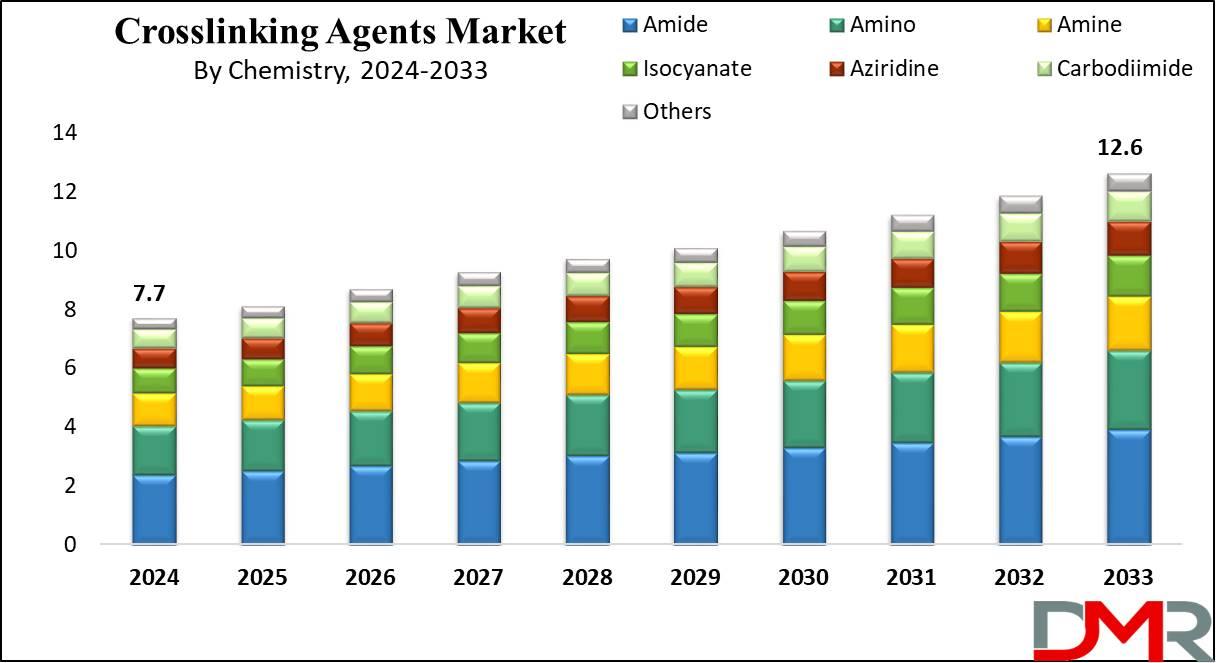
The Global Crosslinking Agents Market is undergoing a phase of significant development as various industrial sectors prioritize the use of high-performance materials known for their durability and chemical stability. The global market size is estimated to be valued at USD 7.7 billion in 2024 and is further anticipated to reach a market value of USD 12.6 billion by 2033. This growth represents a steady compound annual growth rate (CAGR) of 5.6% during the forecast period 2024–2033. The expansion of the market is largely fueled by the rising necessity for high-quality coatings in the construction and automotive industries, as well as the increasing integration of crosslinking technology in the water treatment and pharmaceutical sectors.

Crosslinking agents are reactive chemicals that enable the creation of chemical bridges between polymer chains, forming a complex three-dimensional network. This procedure, often referred to as vulcanization or curing, markedly improves the mechanical attributes of materials, such as their structural strength, heat resistance, and flexibility. From the protective clear coats on high-end vehicles to specialized adhesives in the aerospace industry, crosslinking agents are fundamental to modern industrial production and material science.
The importance of this market is further emphasized by the transition toward specialized, environmentally conscious chemical options. As international regulations regarding volatile organic compounds (VOCs) become more stringent, producers are creating innovative powder-based and water-borne crosslinking agents. This shift ensures that high performance is maintained while supporting global objectives for environmental safety and industrial sustainability.
Definition and Market Significance
The global crosslinking agents industry involves the manufacture of chemical additives—including isocyanates, amino resins, epoxies, and aziridines—that alter the physical characteristics of polymers. The market is categorized by Chemistry (Amide, Isocyanate, Amino, Aziridine, etc.), Application (Industrial, Decorative, and others), and End-User Industry. These agents are essential for ensuring that finished products can endure UV radiation, harsh weather, and significant mechanical pressure.
The significance of the market stems from its wide-ranging utility. In the medical field, crosslinking is crucial for creating drug-delivery systems and hydrogels. In the energy industry, it enhances the longevity of wind turbine blades and solar panel components. By connecting raw polymers to high-strength finished materials, crosslinking agents act as a vital element in the global chemical supply chain.
Market Drivers
A major driver for the global market is the Rapid Expansion of the Construction and Automotive Sectors. Modern infrastructure and vehicle manufacturing require adhesives and coatings that provide long-lasting defense against wear and corrosion. The rise of Electric Vehicles (EVs), which utilize unique battery adhesives and lightweight composites, further increases the demand for sophisticated crosslinking technology.
The Surging Demand for High-Performance Coatings is another significant factor. Sectors like marine, electronics, and packaging are increasingly using coatings that offer superior resistance to moisture and chemicals. Crosslinking agents are the essential components that allow these coatings to solidify into tough, protective layers, protecting valuable industrial equipment.
Furthermore, Advancements in Polymer Science are encouraging market growth. The creation of UV-curable systems and low-temperature curing agents enables manufacturers to accelerate production and lower energy use. These improvements make crosslinking more cost-effective and efficient, leading to broader use in various manufacturing applications.
Market Trends
A prominent trend in the industry is the Move Toward Bio-based and Eco-friendly Crosslinking Agents. Due to increasing environmental regulations, there is a clear shift away from formaldehyde-based resins in favor of "green" solutions. Companies are investing in bio-derived agents that provide the same quality as synthetic versions but with a much lower environmental impact.
The Growth of Water-borne Technologies is another key trend. Historically, many crosslinking methods used solvent-based systems that released high levels of VOCs. Current trends favor water-borne options, especially in decorative and architectural coatings where environmental safety and indoor air quality are major priorities for regulators and consumers.
Additionally, there is an increasing focus on Multifunctional Crosslinkers. New formulations are being engineered to offer multiple advantages, such as enhancing both flexibility and adhesion at the same time. These agents streamline manufacturing by reducing the variety of additives needed, resulting in more efficient and leaner production processes.
Market Restraints
Fluctuating Raw Material Costs continue to be a primary restraint for the crosslinking agents market. Many crosslinking chemicals are sourced from petrochemicals, which are prone to global price changes. These fluctuations can impact manufacturer profits and result in higher prices for consumers in the automotive and construction industries.
Strict Health and Environmental Regulations also pose challenges. Certain chemicals, such as specific aziridines and isocyanates, must follow rigorous disposal and handling rules due to potential health risks. Meeting various regional standards—like REACH in Europe—involves substantial testing and administrative costs, which can limit market entry for smaller firms and slow the introduction of new products.
Market Opportunities
The Growth of the Semiconductor and Electronics Industry offers a significant opportunity. Crosslinking agents are vital for producing electronic adhesives, circuit board coatings, and photoresists. As global demand for 5G infrastructure and consumer electronics rises, the requirement for high-purity, specialized crosslinkers will increase accordingly.
The Rise of Sustainable Packaging is another promising area. As the packaging sector shifts toward biodegradable and recyclable materials, there is a need for crosslinked coatings and adhesives that do not hinder the recycling process. Developing agents that offer protection while remaining environmentally friendly is a high-potential area for chemical innovation.
Segmentation
The market for crosslinking agents is segmented by chemistry and application.
By Chemistry, the market features Amide, Amine, Amino, Aziridine, Carbodiimide, and Isocyanate. The Amide-based segment is anticipated to dominate the market in 2024 and throughout the forecast period. Meanwhile, the isocyanate segment is recognized as the fastest-growing during this timeframe.
By Application, the market is split into Industrial and Decorative. The Industrial application segment is projected to hold the largest revenue share in 2024, supported by heavy use in the aerospace, automotive, electronics, and construction sectors.
Regional Analysis
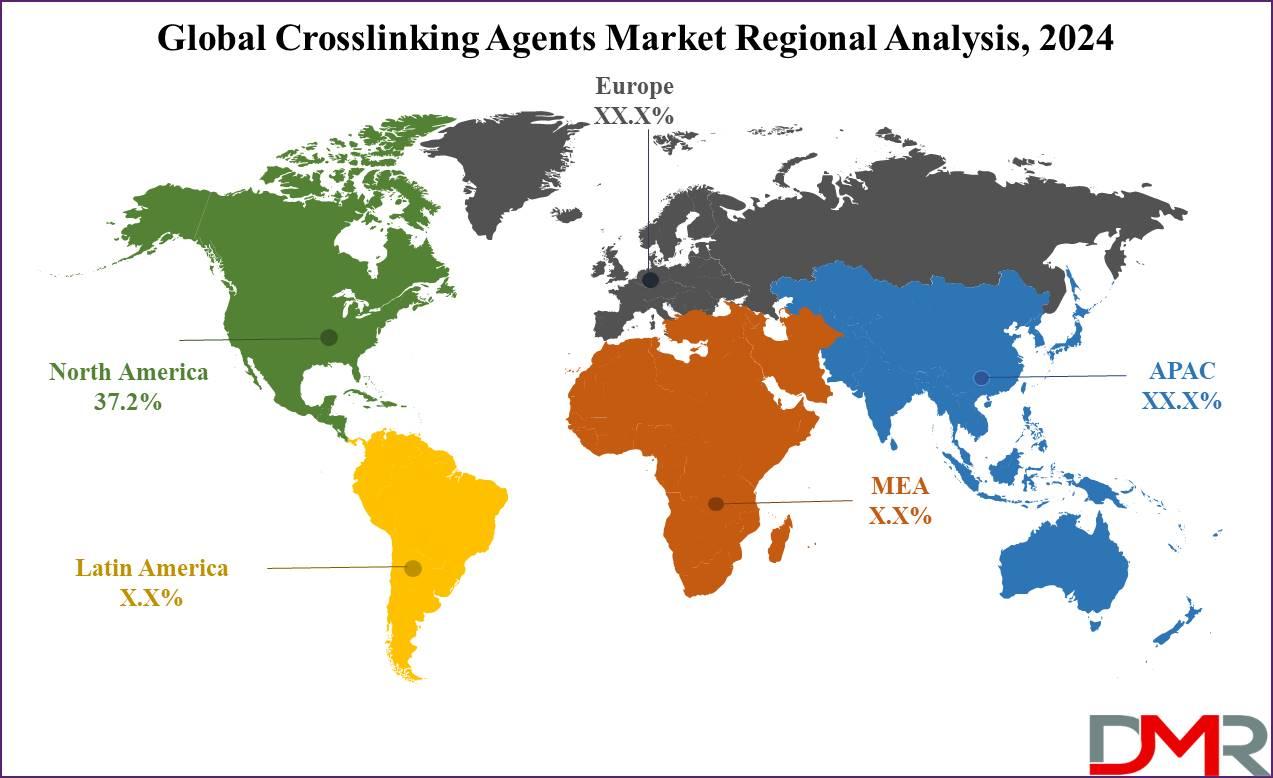
North America North America is expected to be a leading region in this industry, with the US Crosslinking Agents Market projected to hold a 37.2% share of revenue in 2024. Growth in this region is driven by high demand in the packaging, healthcare, automotive, and electronics sectors, particularly in the United States.
Europe Europe remains a vital market, known for having some of the highest environmental compliance standards. The region's dedication to sustainable chemistry and the presence of major global chemical producers drive the need for bio-based and low-VOC crosslinking solutions.
Asia-Pacific Asia-Pacific is set to experience the most rapid growth during the forecast period. The fast-paced industrialization in India and China, along with the relocation of manufacturing centers to this region, is creating a high demand for adhesives and coatings, thereby increasing the use of crosslinking agents.
Download a Complimentary PDF Sample Report
https://dimensionmarketresearch.com/request-sample/crosslinking-agents-market/
Competitive Landscape
The competitive market includes a variety of specialized producers and global chemical giants. Leading companies are focusing on R&D and strategic acquisitions to expand their range of sustainable products. Firms are also growing their manufacturing capabilities in emerging markets to meet local industrial needs. Prominent players in the Global Crosslinking Agents market include BASF SE, Aditya Birla Chemicals, Covestro AG, Allnex GMBH, Evonik Industries AG, The Dow Chemical Company, and Arkema.
Future Outlook
The future of the crosslinking agents market is centered on Green Chemistry and High-Tech Functionality. By 2033, as the market reaches USD 12.6 billion, we anticipate the broad use of "self-healing" polymers supported by reversible crosslinking. Furthermore, the industry is likely to adopt circular economy goals, designing agents that can be easily "unzipped" during recycling to allow for the reuse of high-value polymers.
FAQs
What is the projected value of the global market by 2033?
The global market is expected to reach USD 12.6 billion by 2033.
What is the growth rate (CAGR) for the crosslinking agents industry?
The sector is expanding at a CAGR of 5.6% from 2024 to 2033.
Which chemistry segment is expected to lead the market?
The Amide-based crosslinking segment is predicted to lead the market starting in 2024 and continue its dominance.
Which application holds the largest revenue share?
The Industrial application segment is projected to have the major revenue share in 2024.
What is the market share of North America?
North America is expected to hold a 37.2% share of the global revenue in 2024.
Summary of Key Insights
The Global Crosslinking Agents Market is on a consistent growth trajectory, expected to rise from USD 7.7 billion in 2024 to USD 12.6 billion by 2033 at a 5.6% CAGR. The industry is moving toward Sustainable (Water-borne) and High-performance systems. While North America is a leading force (37.2% share in 2024), global expansion is bolstered by the increasing needs of the construction, automotive, and electronics industries. Despite raw material price changes, the focus on advanced material properties and sustainable innovation ensures the market's vital role in global manufacturing.
Purchase the report for comprehensive details
https://dimensionmarketresearch.com/checkout/crosslinking-agents-market/