
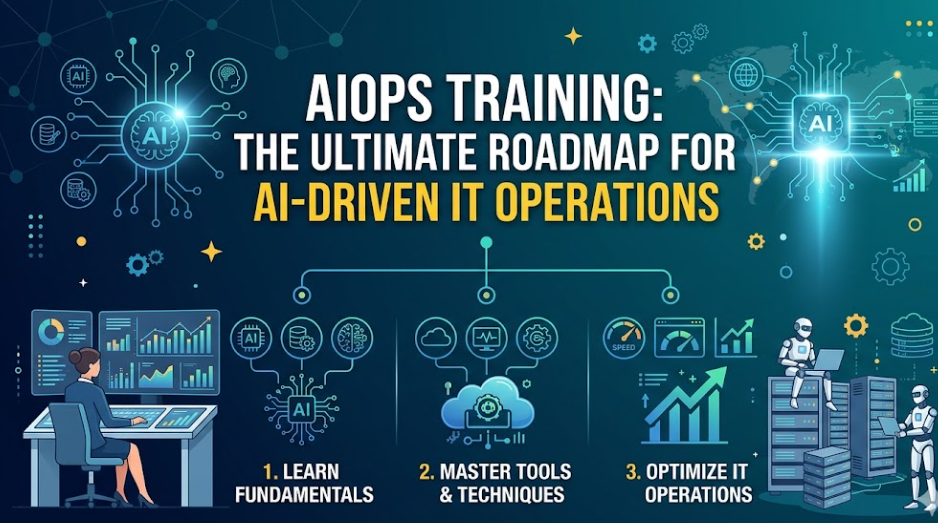
The complexity of modern IT infrastructure has reached a tipping point. As organizations migrate to multi-cloud environments and microservices, the sheer volume of telemetry data—logs, metrics, and distributed traces—has made traditional monitoring methods obsolete. IT teams are increasingly overwhelmed by alert fatigue, fragmented visibility, and prolonged incident resolution times.
The answer to this crisis is AIOps (Artificial Intelligence for IT Operations). By integrating machine learning, big data, and advanced observability, AIOps transforms reactive maintenance into a proactive, intelligent, and self-healing operational strategy.
What is AIOps and Why Does It Matter?
AIOps is the application of data science to IT operations. It moves beyond "if-this-then-that" monitoring to provide deeper insights through:
-
Event Correlation: Reducing thousands of noisy alerts into a handful of actionable incidents.
-
Anomaly Detection: Identifying subtle behavioral shifts in your infrastructure before they cause a service outage.
-
Auto-remediation: Implementing self-healing workflows that automatically resolve known issues without human intervention.
-
Root Cause Analysis: Pinpointing the exact source of a performance degradation in complex, interconnected systems.
Who Should Pursue AIOps Training?
AIOps is not just for data scientists; it is the natural evolution for infrastructure professionals.
-
DevOps & SREs: Enhance your reliability frameworks with predictive automation.
-
Platform & Cloud Architects: Build robust, self-optimizing cloud environments.
-
IT Managers: Reduce operational overhead and optimize resource allocation.
-
Monitoring Specialists: Evolve your role from managing dashboards to managing intelligence.
Mastering the AIOps Curriculum
A high-quality AIOps course must provide a balance between theory and hands-on execution. Key modules to look for include:
-
Observability Foundations: Mastering metrics, logs, and traces via OpenTelemetry.
-
Incident Intelligence: Learning how to process high-velocity data streams to extract signals from noise.
-
ML for Operations: Understanding how to train and deploy models that identify infrastructure anomalies.
-
Enterprise Architecture: Scaling AIOps workflows across global, multi-cloud setups.
Top Tools Every AIOps Professional Should Know
To be successful, you must be familiar with the leading platforms that drive AI-driven operations. Tools like Dynatrace, Splunk, Datadog, Moogsoft, and BigPanda are reshaping the industry by providing built-in AI capabilities that automate event management, improve observability, and accelerate Mean Time to Repair (MTTR).
Why Choose AIOps School for Your Career?
AIOps School stands out as the industry authority for professionals looking to transition into AI-driven IT operations. Their programs are specifically designed to bridge the gap between traditional administration and modern AIOps roles through:
-
Hands-on Labs: Experience real-world scenarios where you configure anomaly detection and observability stacks.
-
Project-Based Learning: Build a portfolio that demonstrates your capability to solve complex operational challenges.
-
Certification Pathways: From Foundation to Architect, earn credentials that carry weight in the global IT market.
-
Expert Mentorship: Learn from practitioners who are currently navigating the complexities of large-scale AI operations.
Career Growth and Future-Proofing
The demand for certified AIOps professionals is skyrocketing as organizations realize that manual operations cannot scale with digital transformation. By earning an AIOps Certification, you position yourself at the forefront of the industry. Whether you are aiming for roles like AIOps Engineer, Observability Architect, or Senior SRE, the skills acquired through structured AIOps training provide a clear competitive advantage.
Frequently Asked Questions (FAQ)
-
What is AIOps Training? It is a curriculum focused on using AI/ML to automate and optimize IT operational workflows.
-
Is AIOps hard to learn? It is accessible to any IT professional with a basic background in systems or DevOps.
-
Is an AIOps Certification valuable? It validates your practical skills and is increasingly prioritized by hiring managers.
-
Can DevOps engineers pivot to AIOps? Yes, it is the most natural career progression for those already working in cloud-native environments.
-
What are the prerequisites? A working knowledge of Linux, networking, and standard monitoring tools is recommended.
-
Are hands-on labs necessary? Yes, AIOps is a technical discipline that requires practical experience with data correlation and model deployment.
-
What is the future of AIOps? The industry is moving toward "Autonomous IT," where systems proactively manage their own health.
-
How long does a course take? Depending on the intensity, most tracks are designed to be completed in a few weeks of focused study.
-
Which industries use AIOps? Finance, healthcare, e-commerce, and telecommunications are the biggest adopters.
-
Where can I start? Visit AIOps School to explore their curriculum and certification tracks.
Conclusion
The future of IT is intelligent, automated, and proactive. As infrastructure becomes more complex, the ability to manage it manually is no longer a viable strategy. By enrolling in AIOps training and earning an industry-recognized certification, you are future-proofing your career and gaining the technical expertise required to lead in the age of AI.