
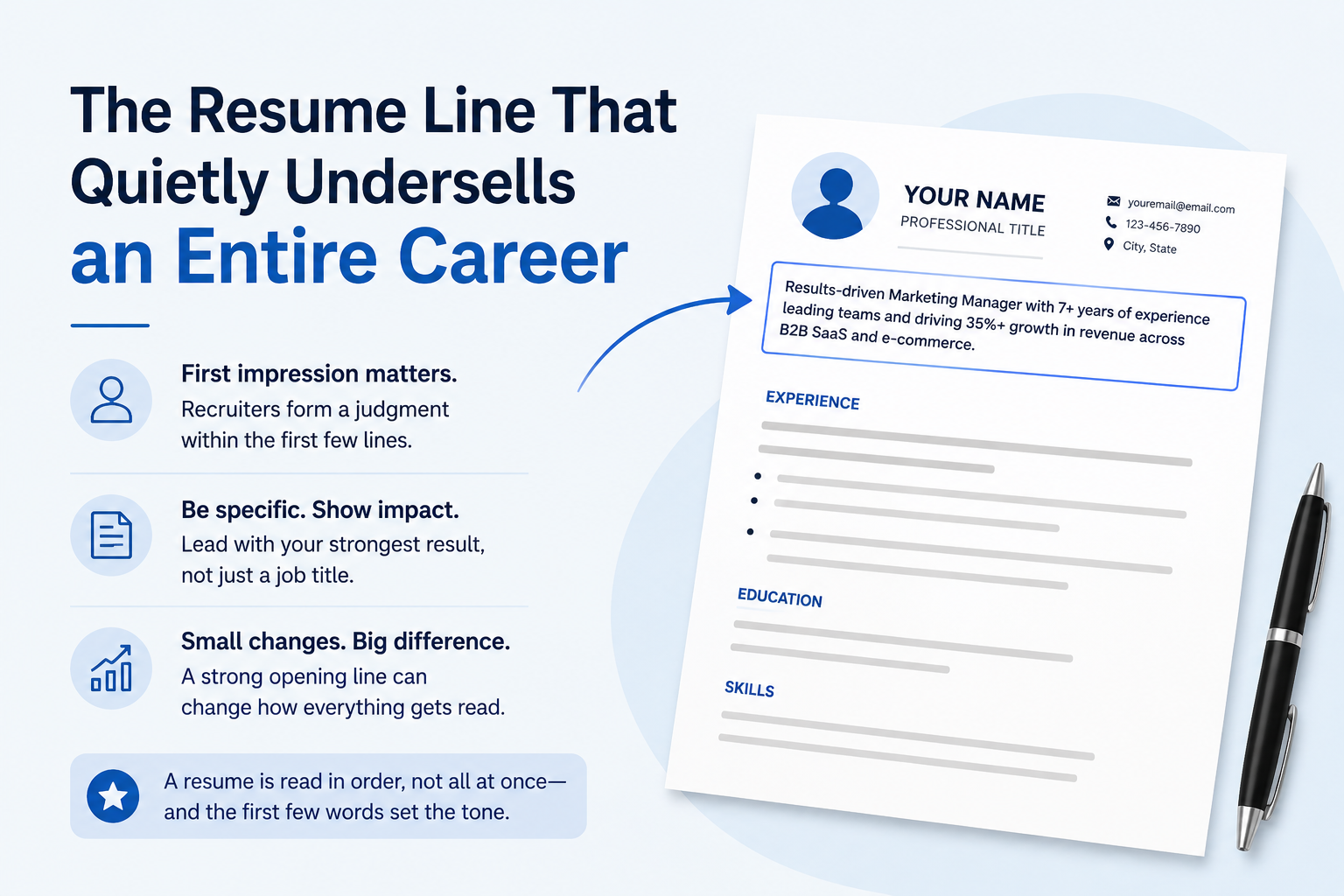
Most resumes have one line — often near the top — that sets the tone for how a recruiter reads everything after it. When that line is vague or generic, it can undersell years of otherwise strong experience, simply by failing to signal quality early. This is a core reason professional resume writing services focus so heavily on the opening sections of a resume, not just the details further down.
Why the First Impression Sets the Frame
A recruiter forms a rough judgment within the first few lines and then reads the rest of the resume through that lens. A strong, specific opening line signals competence and makes a reader more inclined to interpret ambiguous details generously later on. A generic one does the opposite — it primes a reader to expect more of the same, even if stronger material follows later in the document. This isn't a conscious bias recruiters are aware of; it's simply how fast reading works. Once a reader forms an early impression, they tend to scan the rest of the document looking for confirmation of that impression rather than starting fresh with every line.
Where This Line Usually Goes Wrong
The most common failure is defaulting to a title or duty rather than a scope or outcome — something like "Marketing professional with experience in campaigns" instead of a line that specifies scale, industry, or a standout result. It's not inaccurate, but it's forgettable, and forgettable is often functionally the same as invisible in a fast recruiter scan. This pattern tends to repeat because the opening line is usually written last, after the rest of the resume, almost as an afterthought summary — which means it often gets the least careful attention of any line on the page, despite carrying the most weight.
There's also a tendency to hedge in this line specifically, using cautious, modest language because it feels safer than a bold, specific claim. Ironically, this caution is what makes the line forgettable in the first place. A specific, well-supported claim reads as more credible than a vague, safe one, not less.
What Changes With a Rewrite
Fixing this typically means identifying the single strongest, most specific fact about a candidate's experience and leading with it — a number, a scope, a distinctive skill — rather than a generic descriptor that could apply to almost anyone in the same field. The rest of the resume doesn't need to change dramatically; often, just resequencing and sharpening the opening changes how the entire document is read.
This process usually starts with a simple question: if a recruiter could only read one line, what would need to be true for them to keep reading with genuine interest rather than passive obligation? The answer is rarely a job title. It's almost always a specific, credible claim about scale or impact — the size of a team led, the percentage a metric improved, the scope of a project delivered — something concrete enough that it can't be mistaken for boilerplate.
Why Small Changes at the Top Have an Outsized Effect
Because the opening line shapes how everything after it gets read, a relatively small edit at the top of a resume often has a larger effect on outcomes than extensive edits scattered throughout the rest of the document. This is part of why resume improvements sometimes look deceptively modest on paper — a rewritten opening line, tightened phrasing in a few bullet points — while still producing a meaningfully different response rate. The changes aren't necessarily larger; they're better targeted at the part of the resume doing the most work.
CareerZeno pay particular attention to this opening impression, making sure the strongest fact about a candidate's experience is the first thing a recruiter actually sees, rather than a generic line that quietly sets a lower bar for everything that follows.
A resume is read in order, not all at once — and the first few words often decide how generously the rest gets interpreted.