
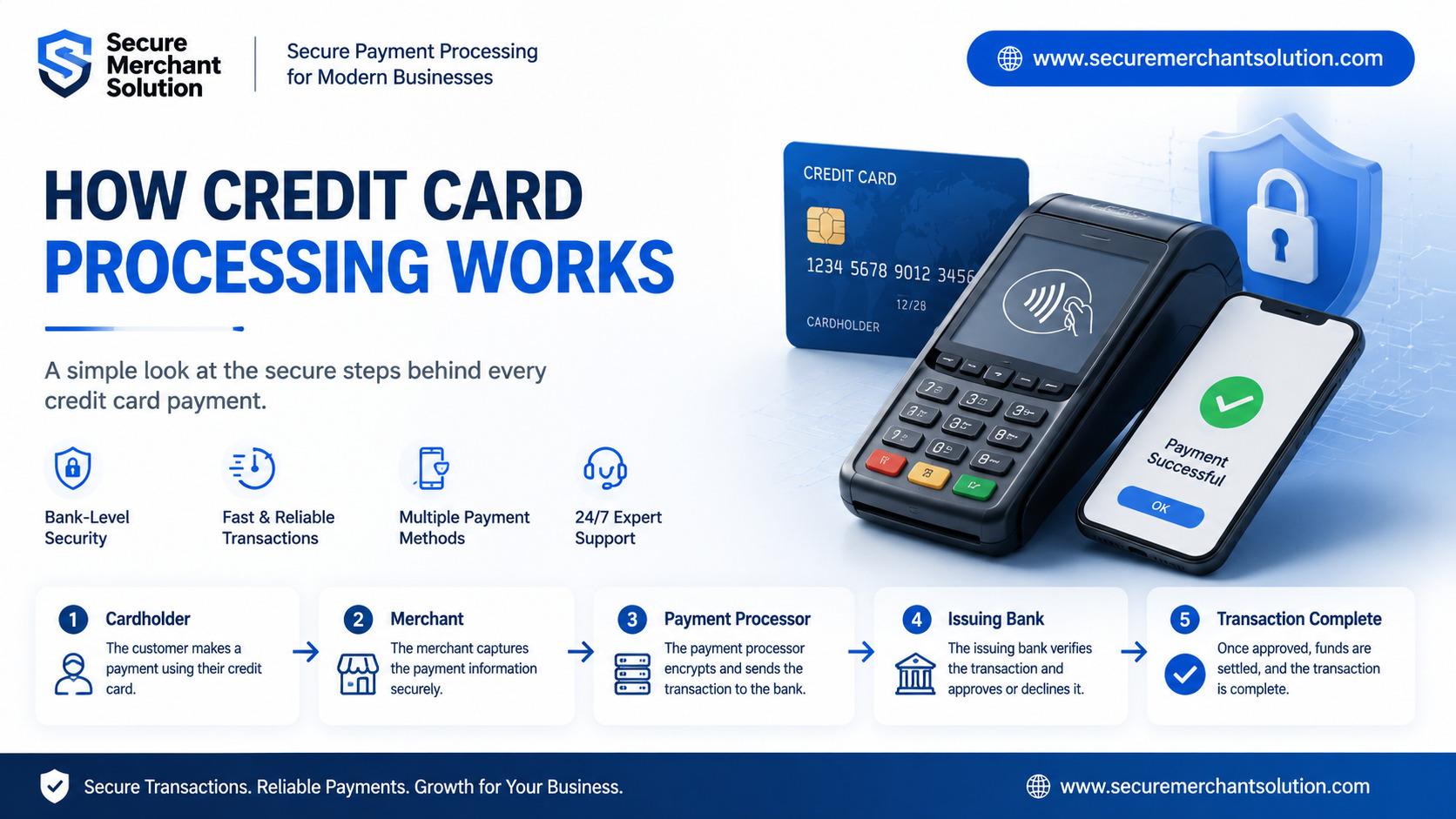
Credit cards are one of the most common ways customers pay for products and services, but the payment process involves much more than tapping or inserting a card. Understanding how credit card processing works can help business owners see what happens behind a transaction and make smarter choices when selecting payment services.
From the initial card authorization to the final movement of funds, several parties work together to complete a payment. Each stage has an important purpose in making card transactions possible.
Why Is Credit Card Processing Important?
For businesses, accepting credit cards can make it easier for customers to pay at checkout. However, merchants also need a reliable system for handling transactions and receiving funds.
A credit card processing system connects the merchant's payment technology with banks and card networks. It helps verify transactions, communicate approval decisions, and process authorized payments for settlement.
Understanding the process also gives merchants a better foundation for reviewing processing costs and payment service agreements.
What Happens During a Credit Card Transaction?
A typical credit card transaction can be divided into two major parts: authorization and settlement.
During authorization, the payment is checked to determine whether it can be approved. During settlement, approved transactions are processed so funds can move toward the merchant's account.
Here is how the complete process works.
1. The Customer Presents a Card
The transaction starts when a customer chooses to pay by credit card.
At a physical location, the card may be tapped, inserted, or swiped using a payment terminal. In an online store, the customer enters card information through a checkout form.
The payment system collects the information required to begin processing.
2. The Merchant Sends the Transaction
The merchant's terminal or online payment system sends the transaction details to a payment processor.
The processor helps facilitate communication between the merchant and other participants in the payment system. For online transactions, a payment gateway may also be used to transmit payment information securely.
3. The Request Travels Through the Card Network
The transaction is routed through the appropriate card network. The network connects the merchant's payment side with the financial institution that issued the customer's card.
This allows the authorization request to reach the correct issuing bank.
4. The Issuing Bank Makes a Decision
The issuing bank reviews the transaction to determine whether it can be approved.
The decision may depend on factors such as account status, available credit, and security checks. If the transaction is approved, an authorization response is sent back through the payment network.
If the transaction does not meet the required conditions, it may be declined.
5. The Merchant Receives Approval
The response eventually reaches the merchant's payment system.
When the transaction is approved, the merchant can complete the sale. The customer sees a successful payment, but the funds still need to move through the settlement process.
This distinction between authorization and settlement is important when understanding how credit card processing works.
6. Funds Move Through Settlement
After authorization, transactions are submitted for settlement. The payment system processes the approved transactions and facilitates the movement of funds toward the merchant's account.
The time required for funding can differ depending on the processor, merchant account arrangement, banking institutions, and transaction circumstances.
Which Companies and Institutions Are Involved?
A credit card payment typically involves several different participants:
- Cardholder: The person using the credit card.
- Merchant: The business accepting the payment.
- Payment processor: Facilitates transaction communication and processing.
- Acquiring bank: Supports the merchant's card acceptance.
- Issuing bank: Provides the customer's credit card.
- Card network: Routes transaction information between the relevant parties.
- Payment gateway: Helps securely transmit payment information for online purchases.
Together, these participants create the infrastructure needed to process a card payment.
How Secure Merchant Solution Can Help Merchants
Understanding payment processing is an important part of choosing the right merchant payment approach. Secure Merchant Solution can help businesses learn about credit card processing and evaluate payment solutions based on their specific operational needs.
Merchants should consider more than a provider's advertised processing rate. A complete evaluation can include transaction charges, monthly fees, equipment expenses, payment gateway costs, supported payment methods, security features, contract conditions, and customer support.
Businesses should also consider whether a payment system works effectively with their existing point-of-sale technology, website, or other business tools.
What Are Credit Card Processing Fees?
Processing fees are the costs businesses may pay for accepting credit card transactions. The total cost can vary depending on the processor, card network, transaction type, pricing structure, and merchant agreement.
Common charges may include:
- Interchange-related costs
- Processor fees
- Card network assessments
- Monthly account charges
- Payment gateway fees
- Hardware or terminal costs
Because pricing models can differ, merchants should review the complete fee structure before signing an agreement.
How Does Online Credit Card Processing Work?
Online credit card processing follows the same basic authorization and settlement principles as in-person payments.
The main difference is that the customer enters payment information through a website or application. A payment gateway securely transmits the transaction information for authorization.
The transaction is then routed through the appropriate payment network and issuing bank. Once approved, it proceeds toward settlement.
For online businesses, merchants should consider secure checkout functionality, mobile compatibility, reliable payment acceptance, and integration with their existing website or software.
Tips for Choosing a Credit Card Processor
Before selecting a payment processing provider, businesses should:
- Compare the complete pricing structure.
- Check which payment methods are supported.
- Review equipment and software requirements.
- Understand contract and cancellation terms.
- Consider security and payment-data protection.
- Evaluate customer service and technical support.
- Make sure the solution fits the business's payment volume and operating model.
Final Thoughts
Learning how credit card processing works helps merchants understand what happens after a customer submits a card payment. The transaction passes through authorization, routing, approval, and settlement before the payment is fully completed.