
The landscape of modern IT infrastructure is shifting rapidly toward intelligent automation. As systems grow in complexity, the ability to manage, monitor, and resolve operational issues through machine learning has transitioned from a luxury to a necessity. The AIOps Foundation Certification provides the core knowledge required to navigate this shift. Professionals looking to standardize their approach to algorithmic operations often turn to AIOps School to build a solid baseline. Understanding these principles is essential for anyone aiming to improve system reliability and reduce the cognitive load on engineering teams.
What is the AIOps Foundation Certification?
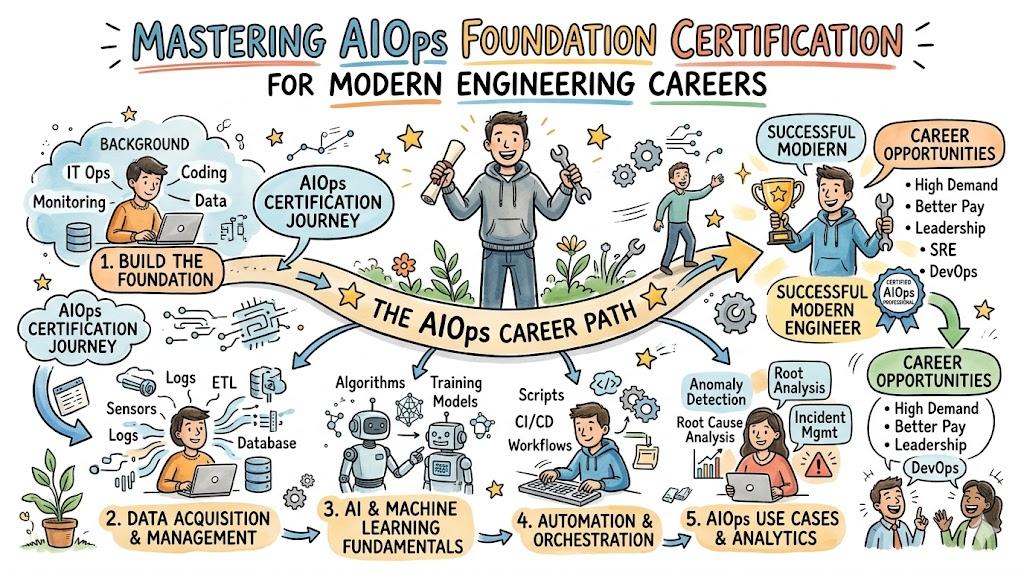
The AIOps Foundation Certification is a structured educational program designed to bridge the gap between traditional IT operations and data-driven automation. It focuses on the application of machine learning, big data, and analytics to automate IT operations tasks.
At its core, the certification covers how to ingest, analyze, and act upon operational data from diverse sources. The purpose is to move beyond manual alert management and reactive troubleshooting. Instead, it emphasizes predictive analysis, enabling engineers to identify potential service disruptions before they impact users. It serves as the primary credential for professionals seeking to demonstrate proficiency in using AI to enhance the observability and performance of complex distributed systems.
Who Should Pursue AIOps Foundation Certification?
This certification is designed for a broad range of technology professionals who deal with operational complexity.
-
DevOps Engineers: Those looking to integrate intelligent monitoring into their CI/CD pipelines.
-
Site Reliability Engineers (SREs): Professionals focused on high availability who need better tools for incident prediction and root cause analysis.
-
Cloud Architects: Engineers managing massive, multi-cloud environments that produce overwhelming amounts of telemetry data.
-
Security Professionals: Specialists interested in using pattern recognition to detect anomalies that may indicate security threats.
-
Engineering Managers: Leaders who need to understand how AIOps can drive operational efficiency and reduce technical debt.
-
Data Engineers: Those responsible for the pipelines that feed the operational data necessary for machine learning models.
Why AIOps Foundation Certification is Valuable
In the current job market, technical skills are constantly evolving. The value of this certification lies in its focus on the "how" and "why" of operational automation. As organizations scale, the volume of logs, metrics, and traces becomes impossible to manage with traditional, manual monitoring tools.
Holding this credential signals that a professional understands how to manage noise, automate incident response, and align operational data with business goals. It provides a long-term advantage by preparing engineers to work with the next generation of infrastructure tools that rely on automated decision-making.
AIOps Foundation Certification Overview
The AIOps Foundation Certification is delivered via AIOps Foundation Certification and is hosted on AIOps School
. This program is structured to accommodate working professionals by offering a blend of theoretical concepts and practical, industry-aligned scenarios.
AIOps Foundation Certification Tracks & Levels
The certification path is tiered to ensure a progressive learning experience, allowing professionals to build expertise from the ground up.
-
Foundation Level: Focuses on core concepts, terminology, and the basic architecture of AIOps systems.
-
Professional Level: Shifts toward implementation, configuration, and integration with existing tools.
-
Advanced Level: Covers model tuning, architectural design, and complex problem-solving in large-scale environments.
Complete AIOps Foundation Certification Table
| Track | Level | Who it’s for | Prerequisites | Skills Covered | Recommended Order |
| Core | Foundation | Beginners/Ops | Basic IT Knowledge | Concepts & Principles | 1 |
| Implementation | Professional | DevOps/SRE | Foundation Cert | Tooling & Integration | 2 |
| Architecture | Advanced | Architects | Professional Cert | Model Design | 3 |
Detailed Guide for Each AIOps Foundation Certification
Foundation Level
-
What it is: The entry point into algorithmic operations.
-
Who should take it: Systems administrators and junior engineers.
-
Skills you’ll gain: Understanding observability, data collection, and basic anomaly detection.
-
Real-world projects: Implementing a basic log monitoring dashboard.
-
Preparation plan: 7 days of intensive study on core terminology.
-
Common mistakes: Skipping the basics of data quality.
-
Next certification: Professional Level.
Professional Level
-
What it is: A deep dive into the operationalization of AI models.
-
Who should take it: Experienced DevOps and SREs.
-
Skills you’ll gain: Tool integration, alert correlation, and predictive analytics.
-
Real-world projects: Automating incident ticket classification.
-
Preparation plan: 30 days of hands-on lab practice.
-
Common mistakes: Focusing only on tools rather than business outcomes.
-
Next certification: Advanced Level.
Advanced Level
-
What it is: Strategic design and architectural mastery.
-
Who should take it: Lead engineers and architects.
-
Skills you’ll gain: Model lifecycle management and complex incident orchestration.
-
Real-world projects: Designing a full-scale automated remediation system.
-
Preparation plan: 60 days of project-based study.
-
Common mistakes: Underestimating the need for clean data.
-
Next certification: Specialized domain tracks.
Choose Your Learning Path
-
DevOps Path: Focuses on integrating AI into deployment workflows.
-
DevSecOps Path: Focuses on using AIOps for security anomaly detection.
-
SRE Path: Focuses on leveraging predictive data for SLO management.
-
AIOps Path: Deep specialization in operational machine learning models.
-
MLOps Path: Focuses on managing the lifecycle of ML models within operations.
-
DataOps Path: Focuses on the data engineering requirements for AIOps.
-
FinOps Path: Focuses on using AIOps to optimize cloud infrastructure costs.
Role → Recommended AIOps Foundation Certifications
| Role | Recommended Certifications |
| DevOps Engineer | Foundation, Professional |
| SRE | Foundation, Professional, Advanced |
| Security Analyst | Foundation, Professional |
| Engineering Manager | Foundation |
Next Certifications to Take After AIOps Foundation Certification
-
Same Track: Proceed from Foundation to Professional or Advanced.
-
Cross Track: Move into MLOps or DataOps to strengthen technical breadth.
-
Leadership Track: Focus on certifications related to IT strategy and operational management.
Why AIOps Foundation Matters for Developers and Engineers
For the readers of this platform, the shift toward AIOps represents a shift in how you interact with your code in production. You are no longer just writing software; you are responsible for the intelligent ecosystem that sustains it. By mastering the principles in this certification, you gain the ability to predict system failures rather than just reacting to them. This reduces the time spent on manual debugging and incident response, allowing you to focus on building new features and improving performance. For those working in high-growth environments, these skills are the difference between a stable deployment and a critical failure.
Training & Certification Support Providers for AIOps Foundation Certification
DevOpsSchool
DevOpsSchool provides a comprehensive ecosystem for learners, offering a structured approach to technical certification. Their training model emphasizes hands-on experience, ensuring that students can apply theoretical knowledge to real-world infrastructure challenges. They maintain a focus on industry standards, making their certification preparation highly relevant for professionals looking to stay ahead in the competitive DevOps landscape.
Cotocus
Cotocus specializes in delivering deep technical training tailored to the needs of enterprise teams. Their methodology is rooted in practical application, focusing on the nuances of tools and the architectural decisions that impact system reliability. By aligning their curriculum with current market requirements, they help professionals gain the skills necessary to implement complex operational solutions effectively.
Scmgalaxy
Scmgalaxy is recognized for its focus on software configuration and lifecycle management. They integrate AIOps concepts into their broader training frameworks, helping engineers understand how intelligent operations fit into the end-to-end software delivery lifecycle. Their approach is highly modular, allowing professionals to select the specific skills they need to advance their careers.
BestDevOps
BestDevOps focuses on the fundamental practices that drive high-performing engineering teams. Their support for the certification involves a clear, step-by-step approach to learning, which is ideal for those who prefer structured paths. They provide resources that simplify complex operational topics, making it easier for learners to grasp the essentials of machine learning in IT.
DevSecOpsSchool
DevSecOpsSchool bridges the gap between operational intelligence and security. They offer training that helps professionals understand how to apply AI-driven insights to security monitoring and threat detection. This is a critical area for those who want to ensure their automated systems are as secure as they are efficient.
SRESchool
SRESchool is dedicated to the discipline of Site Reliability Engineering. Their training resources for the certification are tailored to help SREs manage reliability at scale. By focusing on incident management and observability, they ensure that learners are prepared to handle the pressures of modern, high-traffic production environments.
AIOpsSchool
AIOpsSchool serves as the primary source for technical knowledge specifically focused on algorithmic operations. Their comprehensive curriculum covers everything from the basics of AI to advanced implementation strategies. They are committed to providing clear, unbiased content that helps professionals navigate the certification process with confidence and clarity.
DataOpsSchool
DataOpsSchool focuses on the data-centric aspects of modern engineering. They provide training that helps engineers manage the flow of data across systems, which is the foundation of any AIOps implementation. Their programs are designed to build proficiency in data architecture, ensuring that operational models are built on high-quality, reliable data.
FinOpsSchool
FinOpsSchool focuses on the intersection of cloud finance and operational efficiency. They help professionals understand how to use AIOps to optimize infrastructure usage and reduce cloud costs. Their training is highly practical, focusing on the specific use cases where AI can drive financial accountability in engineering teams.
Frequently Asked Questions
-
What is the primary goal of AIOps? To improve IT operations using machine learning and data.
-
Is coding required for the Foundation certification? Basic understanding is helpful, but advanced coding is not required.
-
How long does it take to prepare? Usually 1–2 weeks for the Foundation level.
-
Are these certifications globally recognized? Yes, they are aligned with global industry standards.
-
Can I take these exams online? Yes, they are designed for remote participation.
-
What is the difference between DevOps and AIOps? DevOps is a culture; AIOps is a data-driven operational strategy.
-
Do I need a background in AI? No, the Foundation level covers the necessary basics.
-
Is this certification worth the investment? It provides a measurable boost to professional credibility.
-
How often is the content updated? The curriculum is reviewed regularly to match industry changes.
-
Can I use this for my career transition? Yes, it is a strong differentiator for those moving into SRE or DevOps roles.
-
Are there group discounts available? Most providers offer corporate packages for teams.
-
Is there a lab requirement? Practical exercises are recommended for the best learning outcomes.
FAQs on AIOps Foundation Certification
-
What does the Foundation exam cover? It covers core concepts, terminology, and basic use cases.
-
How is the certification verified? You receive a digital credential upon successful completion.
-
Are there specific tools I must learn? You will learn tool-agnostic principles that apply to any AIOps toolset.
-
Can I skip the Foundation level? It is highly recommended to start there to build a proper base.
-
How does this help with incident response? It teaches you to use AI to correlate alerts and reduce noise.
-
Is this specific to any cloud provider? No, it is designed to be cloud-agnostic.
-
What happens if I fail the exam? Most providers allow for a retake after a short study period.
-
Will this help me pass technical interviews? Yes, it provides the vocabulary and framework knowledge employers look for.
Final Thoughts: Is AIOps Foundation Certification Worth It?
The AIOps Foundation Certification offers a clear path for those looking to understand the intersection of data and operations. It is a practical, no-nonsense approach to learning the skills that are increasingly required in the modern engineering workplace. While no certification replaces years of hands-on experience, this program provides the necessary structure to accelerate your professional growth. If you are serious about managing complex systems and want to distinguish your profile in a competitive market, this certification is a logical and valuable step.