
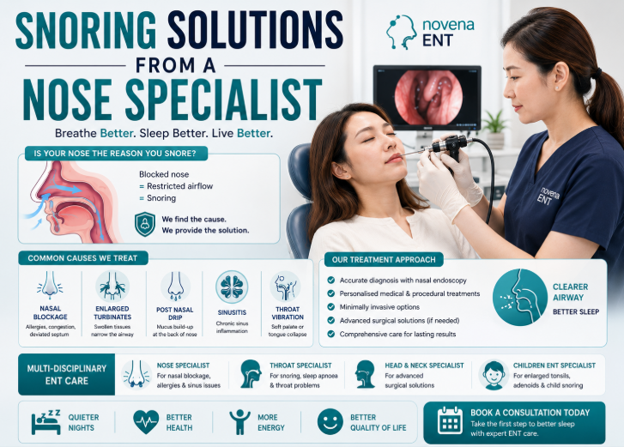
Is Your Nose the Reason You Snore? A Specialist’s View
Snoring is often dismissed as a minor annoyance, but for many people in Singapore, it can signal an underlying issue with nasal airflow. When the nose is blocked—whether from allergies, a deviated septum, or chronic sinusitis—the body works harder to pull air through a narrowed passage. This effort creates the vibration of soft tissues that we recognise as snoring. Seeking a nose specialist Singapore snoring solutions for blocked nasal airway relief is a practical first step toward quieter, more restorative sleep.
The good news is that effective snoring solutions exist without resorting to extreme measures. A specialist can identify the exact location of the blockage and recommend treatments ranging from simple nasal sprays to minor procedures. This article focuses on how a nose specialist addresses snoring caused by nasal airway problems, and when other specialists—such as a throat specialist or a head and neck specialist—may need to be involved.
Key Takeaways:
- A blocked nasal airway is a common cause of snoring, and a nose specialist can diagnose the reason with a simple nasal endoscopy.
- Snoring that includes pauses in breathing may indicate sleep apnoea, which often requires assessment by a throat specialist.
- For chronic snoring that does not respond to medical treatment, a head and neck specialist can offer surgical options.
- Children who snore regularly should be evaluated by a children ENT specialist to rule out enlarged tonsils or adenoids.
- Lifestyle changes, allergy management, and nasal saline rinses are first‑line solutions before any procedure.
How a Nose Specialist Diagnoses the Cause of Snoring
When you visit a nose specialist for snoring, the first step is a thorough history and physical examination. The doctor will ask about your sleep position, alcohol intake, weight changes, and whether you wake up with a dry mouth or headache. They will also look for signs of nasal allergy, such as a runny or stuffy nose, and ask about any post nasal drip—the sensation of mucus trickling down the back of the throat, which often worsens at night.
The key diagnostic tool is nasal endoscopy. A thin, flexible camera is passed gently through the nostril to visualise the nasal passages, the turbinates, and the back of the nose. This allows the specialist to see if there is a deviated septum, enlarged turbinates, nasal polyps, or a narrow nasal valve. In many cases, the cause of snoring is found right there, without needing further tests.
When a Throat Specialist Becomes Involved
Snoring does not always originate in the nose. The soft palate, the uvula, and the back of the tongue can also collapse during sleep, creating vibrations. A throat specialist specialises in conditions of the pharynx and larynx, and they are particularly skilled at evaluating snoring that is loud, irregular, or associated with witnessed pauses in breathing. These pauses may point to obstructive sleep apnoea (OSA), a condition where the airway closes repeatedly during the night, reducing oxygen levels and disrupting sleep. For patients with confirmed OSA, throat specialist Singapore offer sleep apnoea and nocturnal snoring treatments.
If you already see an ENT specialist Singapore at a clinic in Novena, they may arrange a sleep study to measure your oxygen saturation, breathing patterns, and snoring intensity. For mild to moderate sleep apnoea, a throat specialist might recommend an oral appliance that brings the jaw forward, or a trial of continuous positive airway pressure (CPAP). For snoring without apnoea, procedures such as radiofrequency reduction of the soft palate or pillar implants can be performed in the clinic.
Surgical Options from a Head and Neck Specialist
For people who have persistent, loud snoring that does not respond to medical or minor procedural treatments, a head and neck specialist offers more advanced surgical solutions. These are usually reserved for those with significant anatomical abnormalities, such as a very deviated septum, enormous tonsils, or a recessed lower jaw. Surgery is also considered when snoring is linked to moderate or severe sleep apnoea and the patient cannot tolerate CPAP.
A head and neck specialist may perform a septoplasty to straighten the nasal septum, turbinate reduction to shrink swollen tissues, or a uvulopalatopharyngoplasty (UPPP) to remove excess tissue from the throat. These interventions are part of the head and neck specialist Singapore surgical therapy for chronic snoring. The field of otorhinolaryngology (also called otolaryngology) covers these procedures, and the specialist will explain the benefits and risks, including recovery time and possible side effects. At a centre like Novena, you can have a multidisciplinary consultation that involves both a nose specialist and a head and neck specialist in the same visit.
Special Considerations for Children and the Elderly
Snoring in children is not normal. A child who snores regularly may have enlarged tonsils or adenoids, which can block the airway and lead to poor sleep, behavioural issues, and even growth problems. A children ENT specialist will examine the child’s nose and throat, often using a small flexible scope. If the tonsils and adenoids are very large, the recommended treatment may be a tonsillectomy and adenoidectomy, which frequently cures the snoring and improves the child’s quality of life.
Older adults may snore due to age‑related loss of muscle tone in the throat, but also because of nasal issues such as post nasal drip from sinusitis or allergies. A nose specialist can help by prescribing nasal steroid sprays, antihistamines, or saline rinses. For elderly patients who take multiple medications, the doctor will also check for any drugs that might cause nasal dryness or congestion. If giddiness or vertigo accompanies snoring, it is worth mentioning, because inner ear problems can sometimes be linked to sleep‑disordered breathing. An ear specialist clinic Singapore or an ENT doctor Singapore can evaluate these symptoms together.
Practical Nose‑Focused Solutions You Can Try at Home
Before seeing a specialist, several simple measures can reduce nasal snoring. Sleeping on your side rather than your back helps keep the airway open. Using a nasal saline spray before bed clears mucus and moistens dry passages. Over‑the‑counter nasal dilator strips (small adhesive strips placed across the nose) can physically widen the nostrils, reducing airflow resistance. For those with allergies, a daily antihistamine or a prescription nasal steroid spray may be very effective.
If these steps do not work, a nose specialist may offer in‑clinic treatments such as radiofrequency reduction of the inferior turbinates, which shrinks swollen nasal tissues using heat energy. This is a quick procedure performed under local anaesthesia, with little to no downtime. Another option is a minor procedure to correct a deviated septum (septoplasty) if that is the main problem. Ear cleaning Singapore is not directly related to snoring, but if you also have blocked ears or giddiness, the specialist may check your ears as part of a full ENT examination. A clean ear canal can improve overall comfort, even if it does not stop snoring.
Frequently Asked Questions
1. Can a nose specialist completely cure my snoring?
For snoring caused solely by a nasal blockage—such as a deviated septum or swollen turbinates—a nose specialist can often achieve a significant reduction or complete resolution. This is the goal of nose specialist Singapore snoring solutions for blocked nasal airway relief. If snoring also involves the throat, you may need combined treatment with a throat specialist.
2. When should I see a head and neck specialist for snoring?
You should consider a head and neck specialist if your snoring is very loud, you have witnessed breathing pauses, or you have failed non‑surgical treatments such as CPAP or oral appliances. Also, if you have a structural problem like a severely deviated septum or large tonsils that require surgery, a head and neck specialist is the appropriate professional to operate. For advanced cases, a head and neck specialist Singapore, surgical therapy for chronic snoring is the recommended pathway.
3. Is snoring dangerous for a child?
Yes, regular snoring in a child can indicate obstructive sleep apnoea, which may affect growth, learning, and behaviour. A children ENT specialist should evaluate any child who snores most nights, especially if they also have restless sleep, bedwetting, or daytime tiredness. Treatment is usually straightforward and highly effective.
4. Can post nasal drip cause snoring?
Absolutely. Post nasal drip from allergies, sinusitis, or a cold can lead to nasal congestion and swelling of the lining of the nose and throat. This narrows the airway and increases the likelihood of snoring. A nose specialist can treat the underlying cause of the drip—for example, with antihistamines, nasal sprays, or sinus rinses—which often reduces snoring.
5. What is the recovery time after nasal surgery for snoring?
Recovery depends on the procedure. For turbinate reduction or septoplasty performed by a head and neck specialist, most people return to work within a week. You may have some nasal stuffiness, mild bleeding, or crusting for a few weeks. Strenuous activity and heavy lifting should be avoided for about two weeks. The full benefit, including reduced snoring, is usually noticeable after the nasal swelling has completely settled, around four to six weeks after surgery.
References:
- Singapore Ministry of Health. (2021). Clinical Practice Guidelines: Obstructive Sleep Apnoea.
- Tan, L. K., & Goh, D. Y. (2020). Nasal obstruction and snoring in Singaporean adults. Singapore Medical Journal, 61(3), 132-137.
- American Academy of Otolaryngology–Head and Neck Surgery. (2022). Clinical indicators for surgery in snoring and sleep apnoea.
- Novena ENT. (2025). Snoring and sleep apnoea treatments.
Read another Article: Management of Recurring Ear Infections in Kids