
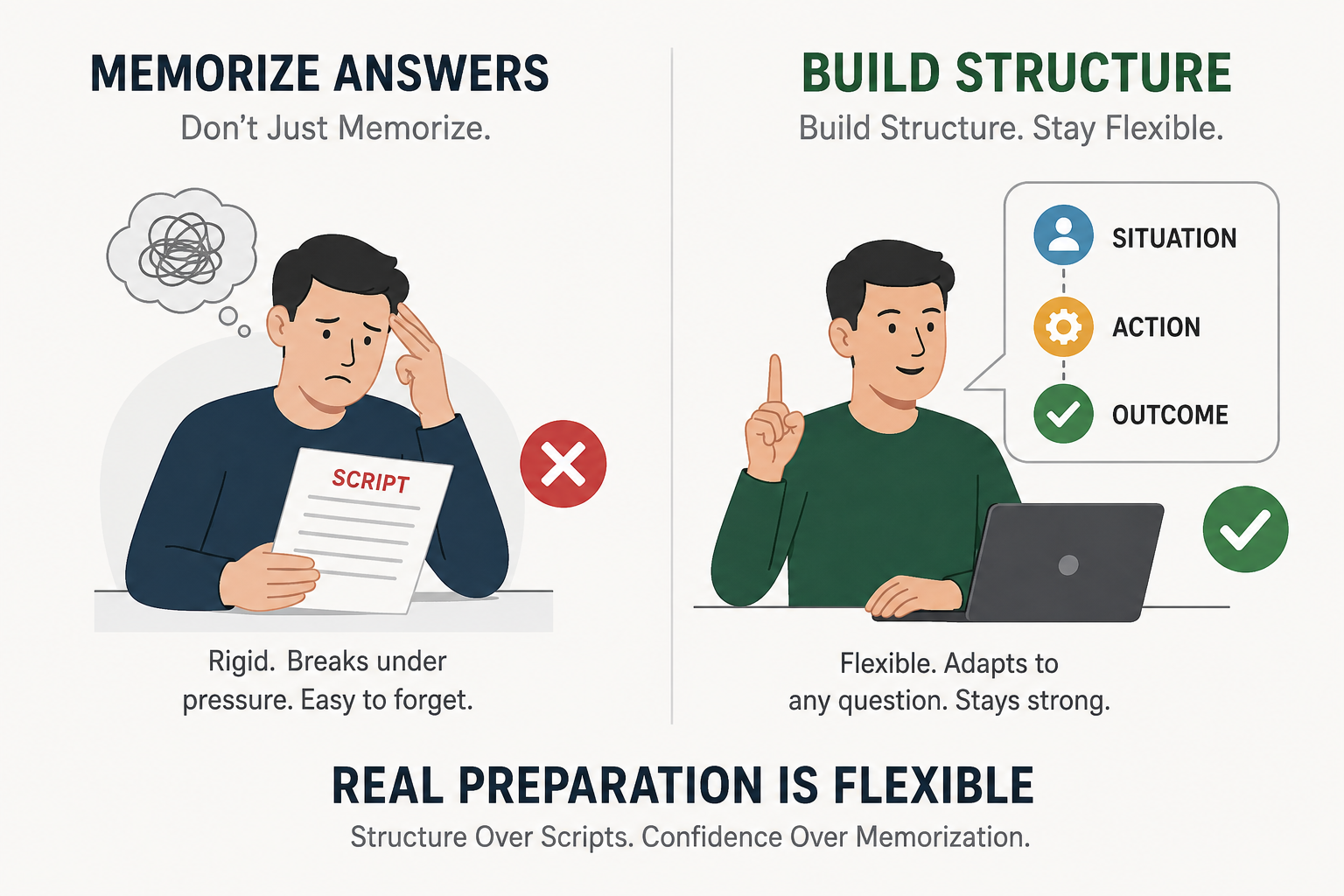
A common approach to interview preparation involves writing out full answers word-for-word and memorizing them ahead of time. It feels thorough, but it tends to backfire the moment a question comes slightly differently than expected — which is almost always, since real interviews rarely match a script exactly. This is one of the more common gaps a structured interview preparation service is built to correct.
Why Memorized Scripts Break Down
A memorized answer is built for one specific phrasing of a question. The moment an interviewer asks a slightly different version — a different angle, an added constraint, a follow-up that wasn't anticipated — the memorized script no longer fits cleanly, and the candidate is left either forcing an ill-fitting answer or freezing while trying to recall the "correct" wording. Either outcome reads as less confident than an answer that was never memorized in the first place.
What Structure-Based Preparation Looks Like Instead
Rather than memorizing exact wording, structure-based preparation focuses on internalizing a flexible shape for each type of answer — situation, action, outcome, for instance — while leaving the specific phrasing to be generated fresh in the moment. This approach survives variation in how a question gets asked, because the underlying structure stays intact even when the specific wording of the question changes.
Why This Distinction Is Hard to Grasp Without Practice
It's easy to understand structure-based preparation in theory and still default back to full memorization in practice, especially under the anxiety of an upcoming interview. Memorizing feels more concrete and controllable, even though it's more fragile. Structure-based preparation requires practicing the skill of generating fresh, on-the-spot phrasing around a fixed shape — a skill that, like most skills, only really develops through repeated practice rather than reading about the distinction.
How Mock Interviews Build This Skill Directly
Real mock interviews, with genuine variation in how questions get phrased and followed up on, are specifically useful here because they force practice with the actual skill needed — adapting a flexible structure to whatever specific version of a question actually gets asked, rather than rehearsing a fixed script that only works if the question matches exactly. Candidates who train this way tend to sound more natural and less rehearsed, precisely because they are not relying on rehearsed wording at all.
Why This Matters More as Interviews Get Less Predictable
As more interviews move toward conversational, less scripted formats, and away from a strict rotation of standard questions, the gap between memorized-script preparation and structure-based preparation becomes more consequential. A candidate prepared only with memorized scripts increasingly finds themselves facing questions that don't match anything they rehearsed, while a candidate trained on flexible structure can adapt regardless of how the question actually gets phrased.
CareerZeno trains candidates specifically in this structure-based approach, building flexible answer frameworks rather than scripts that only work if the interview goes exactly as rehearsed.
Memorizing feels like thorough preparation. Building a flexible structure that survives real variation is what actually holds up in the room.