
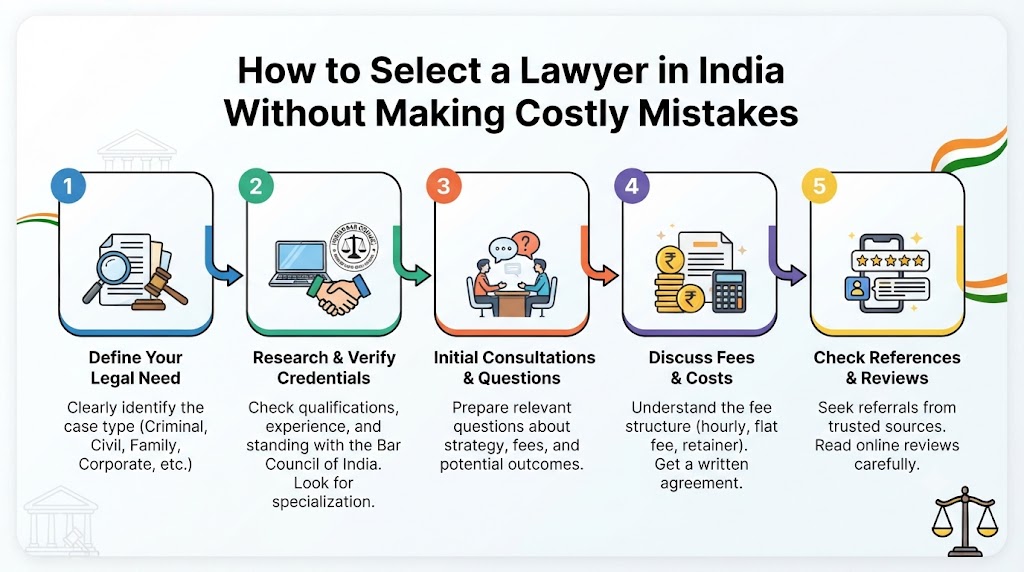
A legal issue can begin unexpectedly. You may receive a legal notice, face a property disagreement, experience online fraud, need help with divorce proceedings, have a business contract concern, or be asked to respond to a police complaint. In such moments, people often search for “lawyer near me” without knowing what type of lawyer they actually need. Finding a lawyer in India should not be a rushed decision based only on advertisements, low fees, or online search rankings. The right legal professional should understand the relevant area of law, communicate clearly, explain the scope of work, and help you understand the legal process without making unrealistic promises. This guide is designed for individuals, families, employees, consumers, property owners, tenants, entrepreneurs, startups, businesses, NRIs, and anyone looking for general legal information. It explains how to identify the right type of legal professional, prepare for a consultation, compare options, and use legal discovery platforms such as WakilSahab responsibly. This article is for general educational and informational purposes only. It is not legal advice, does not create an advocate-client relationship, and cannot guarantee a legal outcome. For guidance related to your own facts and documents, consult a qualified advocate.
Start With the Legal Problem, Not the Lawyer’s Name
The first question is not always “Which lawyer is best?” A more useful question is: “What kind of legal problem am I dealing with?”
Legal matters can involve different laws, procedures, forums, documents, and authorities. A lawyer who is experienced in one category may not be the best person for another. For example, a lawyer handling property documentation may not focus on criminal proceedings, while a corporate lawyer may not regularly handle matrimonial disputes.
Try to describe your issue in one simple sentence before beginning your search.
Examples include:
-
“I received a legal notice from my landlord.”
-
“I want to verify property documents before buying a flat.”
-
“My business partner is refusing to follow our agreement.”
-
“I am dealing with online payment fraud.”
-
“I need information about divorce, maintenance, or child custody.”
-
“A police complaint or FIR may involve me.”
-
“I need help reviewing a business contract.”
A clear starting point makes it easier to find a lawyer in India with relevant knowledge and experience.
Match Your Issue With the Right Lawyer
Legal specialization matters because different professionals commonly work with different types of legal concerns. You do not need to understand every law before consulting a lawyer, but knowing the broad practice area can make your search more focused.
| Legal Issue | Lawyer Type to Explore | Typical Areas of Work |
|---|---|---|
| FIR, bail, police complaint, criminal allegation | Criminal lawyer | Criminal proceedings, bail, complaints, court appearances |
| Divorce, maintenance, custody, family dispute | Divorce or family lawyer | Matrimonial disputes, child custody, maintenance |
| Property purchase, inheritance, land dispute | Property lawyer | Title verification, sale agreements, partition, land disputes |
| Online fraud, impersonation, hacking | Cybercrime lawyer | Cybercrime, digital evidence, identity theft, online fraud |
| Startup, contracts, compliance, employment matters | Corporate lawyer | Business contracts, corporate law, compliance, employment law |
| Consumer complaint, recovery dispute, injunction | Civil or consumer lawyer | Civil disputes, consumer law, recovery matters |
Criminal Lawyer Near Me
A criminal lawyer near me may be relevant when someone is dealing with an FIR, police inquiry, arrest, bail concern, criminal complaint, summons, or allegation of an offence. Criminal proceedings can move quickly and may involve important procedural issues.
If you need a criminal lawyer, collect any notices, complaint copies, summons, FIR details, messages, call records, or documents related to the issue. Avoid discussing sensitive facts publicly or relying on informal social-media opinions. A qualified criminal lawyer can review the facts and explain the process applicable to the situation.
Divorce Lawyer Near Me
A divorce lawyer near me may be useful for matrimonial disputes, separation, divorce proceedings, maintenance, child custody, domestic disagreements, or related family-law concerns.
Family disputes are often emotionally difficult. Before a consultation, prepare a factual timeline of key events, relevant communications, financial information where applicable, and any existing legal papers. A family lawyer can help explain general legal options, documentation needs, and the possible process based on the specific circumstances.
Property Lawyer Near Me
Property disputes can involve land records, title verification, sale agreements, inheritance, partition, tenancy, registration, possession, or construction-related disagreements. A property lawyer near me can be important when local documentation, authorities, courts, or land records are involved.
Do not assume that a property transaction is safe merely because the seller has shown a few papers. A property lawyer may review relevant documents and identify questions that require further verification before a transaction proceeds.
How to Find a Lawyer in India
People search for legal professionals in many ways: recommendations from trusted contacts, local court references, online lawyer directories, professional profiles, legal communities, and location-based searches.
A legal discovery platform can help you search by city, practice area, or legal need. WakilSahab can be used as a starting point to explore lawyers, legal discussions, legal news, and educational legal content. The purpose of such a platform is to help users discover options and gain legal awareness—not to replace a lawyer’s individual review of the matter.
When searching for a lawyer, avoid choosing the first name that appears online. Build a shortlist of two or three suitable legal professionals and compare them thoughtfully.
| Selection Factor | Questions to Ask | Why It Matters |
|---|---|---|
| Practice area | Does the lawyer handle this type of matter? | Relevant expertise can improve the quality of discussion |
| Location | Does the lawyer work in the relevant city or court area? | Local court and procedural familiarity may be useful |
| Communication | Does the lawyer explain matters clearly? | You need to understand your options and next steps |
| Availability | Can the lawyer respond within the required timeframe? | Some matters need prompt attention |
| Consultation method | Is online or in-person consultation suitable? | Helps match practical needs |
| Fees | What is included in the consultation or representation? | Helps avoid misunderstanding later |
Questions to Ask Before Hiring a Lawyer
The first consultation is not only for the lawyer to understand your issue. It is also your opportunity to understand whether the lawyer is suitable for your legal requirement.
Ask clear and respectful questions, such as:
-
Do you regularly handle matters in this practice area?
-
What documents should I bring or share?
-
What is the expected legal process in general terms?
-
Is this a consultation, document review, drafting assignment, or court representation?
-
What professional fees apply, and what does the fee include?
-
Are filing charges, travel expenses, or other expenses separate?
-
How will I receive updates about the matter?
-
Will you personally handle the work or involve another professional?
-
What should I avoid doing while the matter is being assessed?
-
Is there any urgent information or document that I should preserve?
A responsible lawyer may explain uncertainty, request more information, and avoid promising a win. Be cautious if someone guarantees a specific court result or pressures you to make an immediate payment without explaining the scope of work.
Online Lawyer Consultation India: What to Expect
Online lawyer consultation India options can make legal support more accessible, especially for people who are travelling, living outside their home city, managing a business remotely, or seeking an initial discussion before visiting an office.
An online consultation may take place through a phone call, video meeting, email exchange, or another secure communication method. It can be useful for understanding basic legal options, reviewing initial facts, discussing documents, or deciding what type of legal professional may be needed.
| Online Consultation | In-Person Consultation | Suitable Situations |
|---|---|---|
| More convenient across locations | Better for detailed document discussions | Initial advice, remote users, basic review |
| Can reduce travel time | Allows direct face-to-face interaction | Complex documents or sensitive discussions |
| Requires secure digital sharing | Documents can be reviewed physically | Court-related planning or detailed evidence |
| Useful for early-stage legal discovery | Useful where ongoing representation is needed | Depends on the matter’s complexity |
Before an online consultation, prepare a short timeline and place documents in date order. Do not send private information through unknown or unverified channels. Ask the lawyer how documents should be shared and whether there are confidentiality considerations.
Costs and Legal Consultation Considerations
There is no single standard fee for legal services in India. Fees may vary depending on the city, lawyer’s experience, practice area, urgency, complexity, volume of documents, court or tribunal involved, drafting requirements, and whether ongoing representation is required.
For example, a short initial consultation may be different from a detailed contract review, legal notice drafting, property-document review, court filing, bail-related work, or full representation in court proceedings.
Do not assume that the lowest fee is always the best option. At the same time, a higher fee should not be treated as a guarantee of quality or outcome. The goal is to understand what service is being offered and whether it fits your requirement.
Before confirming any engagement, ask about:
-
Consultation fees and duration
-
Scope of legal work
-
Drafting, filing, and documentation charges
-
Court appearance or travel costs
-
Payment structure and invoices
-
Estimated communication process
-
Whether additional work will require separate fees
Written clarity can help both clients and legal professionals maintain a transparent working relationship.
Common Mistakes People Make
One common mistake is waiting until a matter becomes urgent. Delays can sometimes make it difficult to preserve documents, respond to notices, collect evidence, or understand available legal options.
Another mistake is choosing a lawyer only because the office is nearby. A lawyer near me may be convenient, but practice-area relevance should also be considered. A property dispute, criminal complaint, divorce matter, and business contract may require different legal experience.
People also make mistakes by signing legal documents without reading them carefully. Sale agreements, employment contracts, settlement documents, rent agreements, partnership deeds, and notices can have important consequences.
Avoid these mistakes:
-
Relying only on generic free legal advice online India
-
Hiding key facts from the lawyer
-
Sharing sensitive documents on public platforms
-
Ignoring legal notices or court communication
-
Choosing only on the basis of low fees
-
Not asking about the scope of representation
-
Assuming an online profile guarantees suitability
-
Failing to keep copies of documents and payment receipts
Expert Tips for Better Legal Consultations
Prepare before you speak to a lawyer. A well-organised consultation can save time, reduce confusion, and help the legal professional understand the matter faster.
Create a simple timeline that includes dates, names, important conversations, payments, notices, agreements, and events. Keep the timeline factual. Avoid adding assumptions, emotional conclusions, or unsupported claims.
Bring or securely share relevant documents in an organised format. If the matter is about property, include available property papers. If it concerns a business dispute, include contracts, invoices, emails, and payment records. If it concerns cybercrime, preserve screenshots, transaction references, emails, messages, device information, and other digital records.
Be honest about facts that may not support your position. A lawyer needs complete information to assess legal risks responsibly. Withholding material information can lead to poor strategy, incomplete drafting, or unexpected issues later.
Finally, ask the lawyer to explain legal terms in plain language. You should understand the broad purpose of the next step before agreeing to proceed.
Best Practices for Finding Legal Help
Choose a legal professional based on the legal issue, not only on location or popularity. A specialist with relevant experience may be more suitable than a generalist for a complex matter.
Use reliable legal discovery methods. Search lawyer directories, review practice-area information, compare available profiles, and consult more than one professional when the matter is important or unclear.
Maintain confidentiality. Avoid posting detailed allegations, private documents, or personal disputes in public groups. Sensitive materials should be shared only through appropriate and secure channels.
Keep records. Save agreements, legal notices, court papers, emails, bills, screenshots, and consultation notes. Organised records help you communicate more effectively with your lawyer.
Seek a second opinion when appropriate. A second consultation can be useful where the issue involves significant money, family matters, criminal allegations, property rights, or major business decisions. It is not a sign of distrust; it can help you understand complex legal options more clearly.
Why Use WakilSahab for Legal Discovery?
WakilSahab can help users begin their legal search in a more organised way. Rather than relying only on broad online searches, readers can explore legal professionals by practice area and location while also accessing general legal discussions, news, and educational resources.
For example, a person can explore options related to criminal law, family law, property law, cybercrime, civil disputes, or corporate legal services. This can help users understand the type of lawyer they may need before arranging a consultation.
Legal platforms are most useful when used as an awareness and discovery tool. They can help people ask better questions, compare options, and identify relevant legal categories. However, no directory, blog, forum, or profile should be treated as personalized legal advice or a promise of legal success.
Frequently Asked Questions
1. How do I find a lawyer near me?
Start by identifying your legal problem and searching for lawyers by both practice area and location. For example, search for a property lawyer near me, divorce lawyer near me, or criminal lawyer near me. Create a shortlist, review available professional information, and arrange a consultation. The nearest lawyer may not always be the best match, so consider specialization and communication too.
2. How can I find a lawyer in India for a property dispute?
Look for a lawyer whose practice includes property documentation, land disputes, title verification, sale agreements, inheritance, partition, or tenancy matters. Share relevant papers during the consultation, such as agreements, property records, notices, and payment documents. A property lawyer can assess the issue based on the specific documents and facts. Do not rely solely on verbal assurances in a property transaction.
3. When should I hire a criminal lawyer?
You may need a criminal lawyer when an FIR, police inquiry, arrest concern, bail issue, criminal complaint, summons, or criminal allegation is involved. Because criminal proceedings can have serious consequences, it is important to seek qualified legal guidance promptly. Preserve relevant records and avoid discussing sensitive facts publicly. A criminal lawyer can explain the process applicable to your particular situation.
4. When should I consult a divorce lawyer?
Consult a divorce lawyer when you need information about separation, divorce proceedings, maintenance, child custody, matrimonial disputes, or family-related legal concerns. Family matters often involve personal, financial, and emotional considerations. A qualified family-law professional can explain the general legal framework after reviewing your circumstances. Keep relevant communications and documents organised before the consultation.
5. What does a property lawyer do?
A property lawyer may assist with property purchases, title verification, sale agreements, inheritance, partition, tenancy disputes, land disputes, registration concerns, and property-related civil proceedings. The lawyer’s role depends on the engagement. Before signing or paying for a property transaction, obtain appropriate professional review of the available documents. This can help identify questions that require further verification.
6. Is online lawyer consultation India safe?
Online lawyer consultation India can be useful if you use a credible platform or directly contact a verified legal professional. Protect your privacy by confirming the identity of the lawyer, using secure communication methods, and sharing only relevant documents. Ask about fees, confidentiality, and the consultation scope before proceeding. Complex legal matters may still require detailed review or in-person engagement.
7. What does a cybercrime lawyer do?
A cybercrime lawyer may assist with matters involving online fraud, hacking, impersonation, financial scams, identity theft, digital harassment, data theft, or electronic evidence. If you face cybercrime, preserve screenshots, messages, emails, transaction references, URLs, dates, and relevant device details. A lawyer can provide guidance based on the specific facts. Official reporting channels may also be relevant depending on the incident.
8. What does a corporate lawyer in India handle?
A corporate lawyer in India commonly assists startups, founders, businesses, and companies with contracts, company compliance, commercial arrangements, employment matters, intellectual property, shareholder issues, and business disputes. The exact scope depends on the lawyer’s practice and the business requirement. Before consulting, prepare key business documents and clearly explain the commercial objective or issue you need help with.
9. Can I get free legal advice online India?
General legal information is available through educational blogs, forums, public resources, and legal-aid systems. However, free legal advice online India should not be treated as a replacement for personalized legal guidance. Complex matters need review of specific facts and documents. People who may qualify for legal aid can explore official legal-services authorities and relevant government-supported legal-aid channels.
10. How do lawyer directories work?
A lawyer directory India platform helps users search for legal professionals by city, practice area, name, or other available information. It can help you create a shortlist and understand broad areas of legal practice. However, directory information is only the beginning of the selection process. Speak directly with the lawyer, ask questions, and understand fees and scope before engaging them.
11. What should I take to a lawyer consultation?
Take a brief timeline of events, relevant legal notices, agreements, identity documents where necessary, emails, messages, bills, payment records, property papers, court documents, and other material related to the issue. Keep documents organised by date. Do not alter or hide documents. The lawyer may request more information after understanding the concern and reviewing the initial materials.
12. How much does a lawyer consultation cost in India?
Legal consultation costs vary by lawyer, city, practice area, urgency, time required, complexity, documentation, and the type of service requested. There is no single fee that applies to every matter. Ask about the consultation cost in advance and clarify whether document review, drafting, court appearances, or follow-up work will involve additional charges. A transparent discussion helps avoid confusion.
13. Should I take a second legal opinion?
A second legal opinion can be helpful if the matter is complex, high-value, emotionally significant, or unclear. It may help you understand different professional perspectives and ask better questions before deciding how to proceed. Share complete and accurate information with the second lawyer. A second opinion does not guarantee a different answer, but it can support more informed decision-making.
14. How do I know whether a lawyer is suitable?
A suitable lawyer generally has a practice area relevant to your issue, communicates clearly, explains the scope of work, discusses fees transparently, and treats your information professionally. During the consultation, consider whether you understand the explanation and feel comfortable asking questions. Do not expect guarantees. The right fit depends on your legal issue, practical needs, communication preferences, and the lawyer’s relevant experience.
15. What is the difference between legal information and legal advice?
Legal information explains laws, common procedures, legal terms, and broad options. Legal advice is based on a person’s specific facts, documents, objectives, and risks. Blogs and legal platforms can help users learn and prepare for a consultation, but they cannot assess every individual situation. For decisions that may affect legal rights or obligations, consult a qualified lawyer directly.
Conclusion
Legal issues can feel overwhelming, especially when you do not know where to begin. The most practical first step is to identify the broad legal problem and search for a lawyer whose practice area matches that need. Whether you are looking for a criminal lawyer, divorce lawyer, property lawyer, cybercrime lawyer, or corporate lawyer in India, choosing carefully can make your legal journey more organised. Use online legal resources to understand basic terminology, explore relevant practice areas, prepare documents, and create a shortlist of potential legal professionals. Ask clear questions about experience, consultation methods, fees, scope of work, and communication expectations.