
The Himalayas often feel far away when you first arrive in Kathmandu. Busy streets, traffic, and crowded markets make it hard to imagine that peaceful mountain valleys are only a few hours away. But the Langtang Valley Trek changes that quickly.
After a scenic drive north from Kathmandu, the road reaches Syabrubesi, the starting point of one of Nepal’s most rewarding short treks. Within just a couple of days, trekkers walk through forests, cross suspension bridges above rushing rivers, and stand beneath giant snow-covered peaks.
That balance of accessibility, mountain scenery, and local culture is what makes the Langtang Valley Trekking route so appealing. It offers a true Himalayan trekking experience without requiring long domestic flights or several weeks on the trail.
Why Langtang is one of Nepal’s best short treks
Many trekkers choose Langtang because it fits into a shorter travel schedule while still delivering dramatic mountain landscapes. Unlike Everest region treks, which usually begin with a flight to Lukla, Langtang starts with an overland journey from Kathmandu.
The drive itself becomes part of the adventure. Terraced farmland, hillside villages, waterfalls, and river valleys slowly replace the city skyline. As the road climbs higher into the hills near the Tibetan border, the atmosphere changes completely.
Most Langtang itineraries last between 7 and 10 days, making the trek ideal for travelers who want a Himalayan adventure without committing to a long expedition. The route is also less crowded than Everest Base Camp or Annapurna Base Camp, which gives the journey a quieter and more relaxed feeling.
Trekkers often mention how peaceful the trail feels. Instead of long lines of hikers, there are stretches of forest where the loudest sounds come from rivers, birds, or yak bells echoing across the valley.
Forest trails, glaciers, and mountain views
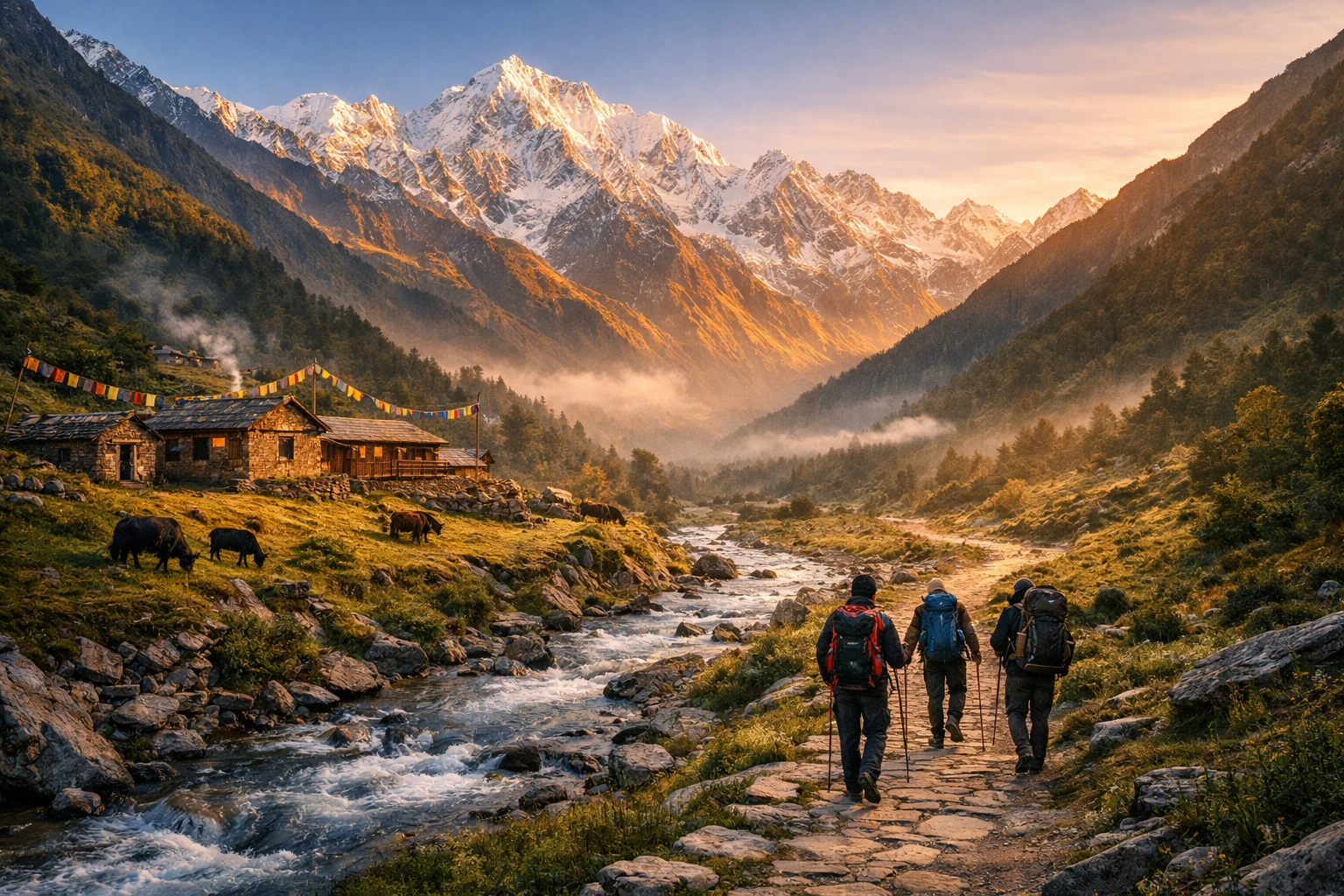
The scenery changes constantly during the trek. Early days pass through dense forests inside Langtang National Park, where bamboo, pine, and rhododendron trees cover the hillsides.
The trail follows rivers through narrow valleys and crosses several suspension bridges decorated with prayer flags. Small tea houses appear along the route, offering simple meals, warm drinks, and places to rest before continuing uphill.
As trekkers gain elevation, the landscape opens into wide alpine valleys surrounded by snow peaks. One of the most memorable places on the route is Kyanjin Gompa, a mountain village sitting beneath towering Himalayan walls.
Mornings in Kyanjin feel unforgettable. Sunlight slowly reaches the slopes of Langtang Lirung while cold mountain air moves through the valley. Yaks graze near stone houses, prayer flags flutter above rooftops, and trekkers gather outside tea houses with cups of hot tea warming their hands.
Many visitors spend an extra day here to hike to nearby viewpoints or glaciers. These shorter acclimatization hikes provide some of the best panoramic views in the Langtang region.
Tamang culture adds something special
The Langtang Valley Trek is not only about mountains. Culture shapes the experience just as strongly as the scenery.
The region is home to the Tamang people, whose traditions are closely connected to Tibetan Buddhism. Along the trail, trekkers pass monasteries, mani walls, spinning prayer wheels, and colorful flags carrying Buddhist prayers into the wind.
Village life feels simple and welcoming. Families run small tea houses where trekkers eat dal bhat beside wood stoves after long walking days. Conversations with local people often become some of the strongest memories from the trip.
Near Kyanjin Gompa, many trekkers visit the local cheese factory, which has been producing yak cheese for decades. It may seem like a small stop, but tasting fresh mountain cheese after days on the trail becomes a surprisingly memorable part of the experience.
Travelers looking for deeper cultural interaction often combine the valley route with the Tamang Heritage & Langtang Valley Trek itinerary. This route includes traditional Tamang villages, local homestays, and opportunities to learn more about mountain lifestyles and customs.
Is Langtang Valley Trek suitable for beginners?
For many travelers, Langtang becomes their first trekking experience in Nepal. The trail is considered moderate, which means beginners with good fitness and preparation can usually complete it comfortably.
Most trekking days involve around 5 to 7 hours of walking. The route includes uphill climbs, rocky sections, and gradual altitude gain, but no technical climbing skills are needed.
Even on shorter treks, altitude should never be ignored. Trekkers can still experience headaches or fatigue as they climb higher into the valley. Walking slowly, drinking enough water, and taking acclimatization seriously all help make the journey safer and more enjoyable.
Spring and autumn are usually the best seasons for first-time trekkers. Spring brings blooming rhododendron forests, while autumn offers clear skies and stable weather conditions.
Many beginners also appreciate the quieter atmosphere in Langtang. The trail feels less commercial than some of Nepal’s more famous trekking routes, which helps create a calmer experience in the mountains.
Why many trekkers choose Langtang over Everest or Annapurna
Everest and Annapurna are legendary trekking regions, but Langtang offers advantages that attract many travelers.
The trek is easier to access from Kathmandu, requires no domestic flights, and usually costs less overall. It also provides more opportunities for quiet moments on the trail and closer interaction with local communities.
Despite being shorter, the scenery still feels dramatic. Snow peaks, glaciers, forests, waterfalls, yak pastures, and Buddhist villages all appear within a relatively compact itinerary.
For travelers who want mountain beauty without huge crowds or complicated logistics, Langtang often feels like the perfect balance.
Final thoughts
The Langtang Valley Trek proves that you do not need weeks in the Himalayas to experience something unforgettable. Just a short distance from Kathmandu, the trail offers peaceful forests, high mountain scenery, rich Tamang culture, and welcoming village life.
Some trekkers arrive expecting Langtang to be a “smaller” trek compared to Everest or Annapurna. They leave surprised by how complete the experience feels. The mountains still feel massive. The valleys still feel remote. And the memories stay long after the trek ends.
With support from the local team at Himalaya Hub Adventure Pvt. Ltd., the journey becomes more than a hike through the Himalayas. It becomes a closer look at Nepal’s mountain culture, landscapes, and everyday life in one of the country’s most beautiful trekking regions.