
Introduction
Modern software teams do not only build applications. They also work with data, pipelines, dashboards, analytics platforms, logs, metrics, machine learning inputs, and business reports. Because of this, data delivery has become as important as software delivery.This is where CDOE – Certified DataOps Engineer becomes important.
CDOE is designed for engineers, managers, and software professionals who want to understand how modern data pipelines are planned, built, automated, monitored, tested, and improved. It helps professionals move from basic data handling to reliable DataOps practices.For working engineers in India and across the world, DataOps is becoming a strong career skill. Companies want faster data delivery, fewer pipeline failures, better governance, and more trust in analytics. A DataOps Engineer helps make this possible.
About CDOE – Certified DataOps Engineer
CDOE focuses on the engineering side of DataOps. It is useful for professionals who work with data pipelines, ETL/ELT systems, data quality, workflow automation, cloud data platforms, monitoring, version control, and team collaboration.It is not only a theory-based certification. The real value of CDOE is that it connects data engineering practices with operational discipline. It helps professionals think about data pipelines the same way DevOps teams think about software delivery: repeatable, testable, automated, observable, and reliable.
Quick Certification Overview
| Area | Details |
|---|---|
| Track | DataOps |
| Level | Engineer / Practitioner |
| Who it’s for | Software Engineers, Data Engineers, DevOps Engineers, Analytics Engineers, Cloud Engineers, Managers |
| Prerequisites | Basic understanding of databases, scripting, cloud, Git, CI/CD, and data workflows |
| Skills covered | Data pipelines, automation, data quality, observability, governance, CI/CD for data, collaboration |
| Recommended order | Start with CDOE, then move toward advanced architecture or management-level certifications |
| Link | CDOE – Certified DataOps Engineer |
What Is DataOps?
DataOps is a modern way of managing data work. It brings together people, process, automation, testing, monitoring, and collaboration so that data can move from source systems to business users in a faster and safer way.
In simple words, DataOps helps teams deliver trusted data continuously.
Just like DevOps improves software delivery, DataOps improves data delivery. It reduces manual errors, improves pipeline reliability, and helps teams respond faster when data breaks or changes.
A good DataOps process usually includes:
- Version control for data code and pipeline logic
- Automated testing for data quality
- Workflow automation
- Monitoring and alerting
- Clear ownership
- Documentation
- Governance and security
- Continuous improvement
For companies using analytics, AI, machine learning, reporting, dashboards, and cloud data platforms, DataOps is no longer optional. It is becoming a core engineering practice.
Why CDOE Certification Matters
Many engineers know how to build scripts or pipelines, but they may not know how to run them reliably in production. A pipeline that works once is not enough. It must work again and again, even when data volume grows, source formats change, or business rules evolve.
CDOE helps professionals build this production mindset.
The certification creates awareness about:
- How data pipelines fail in real environments
- How teams can automate repetitive data work
- How to detect data quality problems early
- How to improve collaboration between data, DevOps, SRE, and business teams
- How to make data delivery measurable and reliable
For managers, CDOE helps in understanding how DataOps can reduce delays, improve reporting trust, and support better decision-making.
For software engineers, it opens a path into data engineering, platform engineering, analytics engineering, and cloud data operations.
Who Should Take CDOE – Certified DataOps Engineer?
CDOE is suitable for professionals who want to build or manage modern data delivery systems.
It is especially useful for:
- Software Engineers moving toward data engineering
- Data Engineers working on pipelines and platforms
- DevOps Engineers supporting data workloads
- SRE Engineers monitoring data platforms
- Cloud Engineers working with data services
- Analytics Engineers building reporting pipelines
- QA Engineers moving into data quality testing
- Technical Leads managing data delivery teams
- Engineering Managers responsible for data reliability
- Freshers with basic programming and database knowledge
The certification is also valuable for professionals who already understand DevOps and want to apply similar automation and reliability principles to data systems.
CDOE Certification Mini-Guide
What It Is
CDOE – Certified DataOps Engineer is an engineer-level certification focused on practical DataOps skills. It helps professionals understand how to design, automate, monitor, and improve data pipelines in real business environments.
It is built for people who want to work with modern data platforms and reliable data delivery practices.
Who Should Take It
This certification is best for software engineers, data engineers, DevOps engineers, cloud engineers, SRE professionals, and managers who want a structured understanding of DataOps.
It is also helpful for beginners who already understand basic databases, Linux, scripting, Git, and cloud concepts.
Skills You’ll Gain
After preparing for CDOE, you should understand:
- DataOps fundamentals and principles
- Data pipeline design and automation
- ETL and ELT workflow concepts
- Data quality checks and validation
- CI/CD practices for data pipelines
- Git-based collaboration for data teams
- Monitoring and observability for pipelines
- Incident handling for data failures
- Data governance basics
- Security and access control awareness
- Cloud data platform concepts
- Team collaboration between engineering and analytics groups
Real-World Projects You Should Be Able to Do After It
After learning CDOE concepts properly, you should be able to work on projects such as:
- Build an automated data pipeline from source to warehouse
- Add data validation checks before loading data
- Create a basic CI/CD process for pipeline code
- Monitor pipeline failures and delays
- Set up alerts for missing, late, or incorrect data
- Version control data transformation logic
- Document pipeline ownership and dependencies
- Create a simple data quality dashboard
- Improve an existing manual reporting workflow
- Support a cloud-based analytics platform
These projects are important because they reflect actual work done in modern organizations.
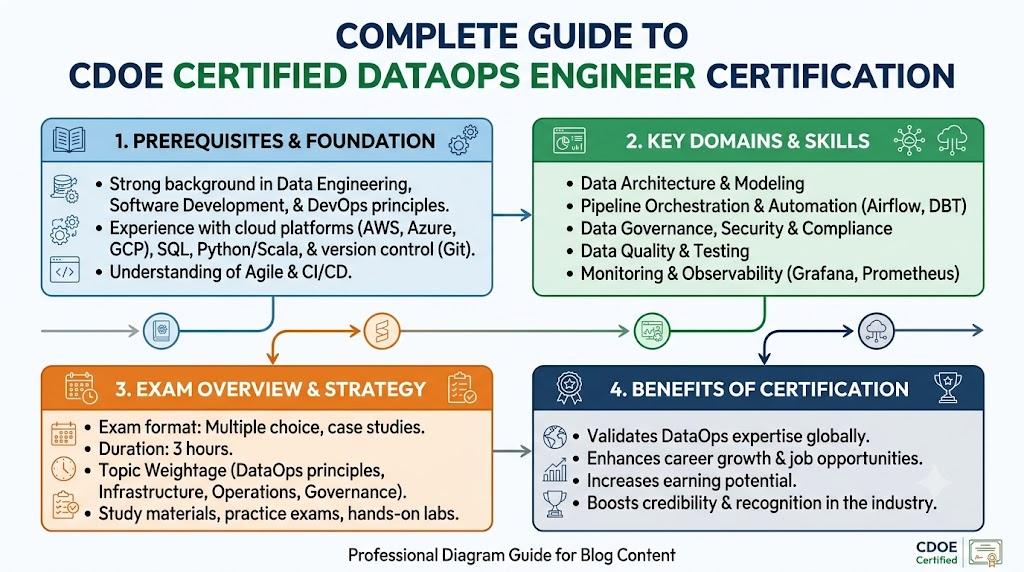
Prerequisites for CDOE
CDOE does not require someone to be a senior data architect. However, basic technical knowledge will make learning easier.
Recommended prerequisites include:
- Basic SQL knowledge
- Basic Python or scripting knowledge
- Understanding of Linux commands
- Basic Git and version control
- Awareness of CI/CD concepts
- Basic database concepts
- Basic cloud knowledge
- Understanding of APIs and file formats
- Interest in data pipelines and automation
Managers do not need to code deeply, but they should understand the flow of data systems, common pipeline problems, and team responsibilities.
Skills Covered in CDOE
Data Pipeline Engineering
A DataOps Engineer must understand how data moves from one system to another. This includes source systems, ingestion, transformation, storage, validation, and consumption.
CDOE helps professionals understand pipeline stages and how to make them reliable.
Automation
Manual data work often leads to delays and mistakes. Automation is a core DataOps skill. Engineers should know how to automate pipeline runs, testing, deployments, monitoring, and recovery steps.
Data Quality
Bad data creates bad business decisions. CDOE focuses on data validation, quality checks, rule-based testing, and early detection of problems.
Observability
Observability means knowing what is happening inside your data systems. A DataOps Engineer should track pipeline status, failure points, delays, volume changes, and data freshness.
Collaboration
DataOps is not only a toolset. It is also a team practice. Data engineers, DevOps engineers, analysts, QA teams, security teams, and business users must work together.
Governance and Security
Data must be handled carefully. Engineers should understand access control, sensitive data handling, audit requirements, and responsible data use.
Preparation Plan for CDOE
Different learners need different preparation speeds. Below are three practical options.
7–14 Days Plan
This is best for experienced engineers who already know DevOps, data pipelines, Git, SQL, and cloud basics.
Day 1–2: Understand DataOps fundamentals and why it is different from traditional data engineering.
Day 3–4: Review data pipeline design, ETL, ELT, orchestration, and automation.
Day 5–6: Study data quality, testing, validation, and monitoring.
Day 7–8: Learn CI/CD concepts for data workflows.
Day 9–10: Review observability, alerting, incident response, and reliability.
Day 11–12: Practice small real-world scenarios.
Day 13–14: Revise, create notes, and attempt mock questions or self-assessment.
30 Days Plan
This plan is best for working professionals who can study for 45–60 minutes daily.
Week 1: Learn DataOps basics, pipeline lifecycle, and team roles.
Week 2: Study ETL/ELT, workflow automation, Git, CI/CD, and deployment basics.
Week 3: Focus on data quality, testing, governance, and monitoring.
Week 4: Build a small project, revise key topics, and prepare for certification.
This is the most balanced plan for software engineers and managers.
60 Days Plan
This plan is best for beginners or professionals changing careers.
Weeks 1–2: Learn SQL, databases, Git, Linux basics, and scripting basics.
Weeks 3–4: Understand data pipelines, data transformation, and workflow automation.
Weeks 5–6: Learn DataOps principles, CI/CD, data quality, and monitoring.
Weeks 7–8: Build hands-on projects, revise concepts, and prepare final notes.
The 60-day plan is slower, but it gives stronger confidence.
Common Mistakes During CDOE Preparation
Many learners prepare only by reading theory. That is not enough. DataOps is a practical discipline.
Common mistakes include:
- Ignoring hands-on pipeline practice
- Learning tools without understanding process
- Not practicing SQL properly
- Skipping Git and version control basics
- Treating DataOps as only data engineering
- Ignoring data quality concepts
- Not learning monitoring and alerting
- Forgetting security and governance basics
- Not understanding team collaboration
- Preparing without a simple real-world project
- Focusing only on certification instead of job skills
The best way to avoid these mistakes is to connect every topic with a real business problem.
Best Next Certification After CDOE
After completing CDOE – Certified DataOps Engineer, the best next step depends on your role.
If you want to grow as a senior technical expert, move toward a DataOps architect-level certification. This path is suitable for professionals who want to design scalable data platforms and enterprise-level data systems.
If you want to lead teams and drive adoption, move toward a DataOps management-level certification. This path is suitable for managers, leads, consultants, and transformation leaders.
A practical learning order can be:
- CDOE – Certified DataOps Engineer
- DataOps Architect-level certification
- DataOps Manager-level certification
This order helps you first build engineering skills, then architecture thinking, and finally leadership capability.
Choose Your Path: 6 Learning Paths
CDOE can support different career paths. The right path depends on your current role and future goal.
1. DevOps Path
If you are a DevOps Engineer, CDOE helps you apply automation, CI/CD, and monitoring concepts to data pipelines.
You should focus on:
- Pipeline automation
- Git-based workflows
- CI/CD for data jobs
- Infrastructure support for data platforms
- Monitoring and alerting
This path is useful for DevOps engineers who support analytics, reporting, or data engineering teams.
2. DevSecOps Path
If you are in DevSecOps, CDOE helps you understand how security applies to data workflows.
You should focus on:
- Data access control
- Secrets management
- Audit trails
- Compliance awareness
- Secure pipeline design
- Sensitive data handling
This path is useful because data pipelines often carry business-sensitive information.
3. SRE Path
If you are an SRE, CDOE helps you bring reliability engineering into data systems.
You should focus on:
- Pipeline SLAs and SLOs
- Data freshness
- Incident response
- Monitoring dashboards
- Alert fatigue reduction
- Root cause analysis
This path is strong for professionals who want to manage reliable data platforms.
4. AIOps/MLOps Path
If you are interested in AIOps or MLOps, DataOps is a strong foundation.
Machine learning and AI systems depend on trusted data. If data is late, broken, duplicated, or poor quality, AI results become unreliable.
You should focus on:
- Data quality for ML pipelines
- Feature data reliability
- Pipeline monitoring
- Automated validation
- Data drift awareness
- Collaboration between data and ML teams
This path is useful for professionals moving toward AI-driven operations or machine learning platforms.
5. DataOps Path
This is the direct path for CDOE learners.
You should focus on:
- End-to-end data pipeline engineering
- Data testing
- Workflow orchestration
- Data governance
- Observability
- Continuous delivery for data
This path is best for Data Engineers, Analytics Engineers, and Software Engineers moving into data platform roles.
6. FinOps Path
FinOps focuses on cloud cost management. Data workloads can become expensive if not managed properly.
CDOE helps FinOps professionals understand where data platform costs come from.
You should focus on:
- Cloud data storage cost awareness
- Compute cost optimization
- Pipeline efficiency
- Resource scheduling
- Data retention practices
- Cost visibility for data workloads
This path is useful for managers and engineers responsible for cloud data spending.
CDOE for Software Engineers
Software Engineers can benefit a lot from CDOE because many modern applications are data-driven.
A software engineer who understands DataOps can work better with data teams. They can design applications that produce clean events, reliable logs, useful metrics, and structured data.
Software Engineers should focus on:
- API-driven data movement
- Event-based data systems
- Database design basics
- Data validation
- Logging and observability
- CI/CD concepts for data pipelines
- Collaboration with analytics teams
This makes them more valuable in product companies, SaaS companies, banking, healthcare, retail, telecom, and cloud-native organizations.
CDOE for Managers
Managers do not always need deep coding skills, but they must understand how data delivery works.
CDOE helps managers understand why reports are delayed, why dashboards break, why data quality issues happen, and why teams need automation.
Managers should focus on:
- DataOps process maturity
- Team ownership
- Delivery timelines
- Quality checkpoints
- Governance
- Cost and reliability
- Cross-team communication
A manager with DataOps knowledge can ask better questions, plan better projects, and reduce operational risk.
CDOE Career Benefits
CDOE can support many job roles, including:
- DataOps Engineer
- Data Engineer
- Analytics Engineer
- DevOps Engineer for data platforms
- Cloud Data Engineer
- Data Platform Engineer
- Data Reliability Engineer
- SRE for data systems
- Technical Lead
- Data Operations Manager
The biggest career benefit is not just the certificate. The real benefit is learning how to build reliable data systems that businesses can trust.
In interviews, DataOps knowledge helps you explain real problems such as pipeline failures, data delays, incorrect reports, governance gaps, and monitoring issues.
List of Top Institutions Helping in Training cum Certifications for CDOE
DevOpsSchool
DevOpsSchool is known for DevOps, DevSecOps, SRE, cloud, automation, and modern engineering training. For CDOE learners, it can help connect DataOps concepts with CI/CD, automation, monitoring, and enterprise DevOps practices. This is useful for software engineers and DevOps professionals moving toward data platform roles.
Cotocus
Cotocus provides technology consulting and training support around automation, DevOps, cloud, and platform engineering. For CDOE preparation, Cotocus can help learners understand how DataOps fits into real enterprise transformation projects. It is useful for professionals who want practical exposure beyond basic theory.
Scmgalaxy
Scmgalaxy has a strong background in software configuration management, DevOps tools, automation, and engineering practices. For CDOE learners, it can help build a strong foundation in version control, release discipline, workflow management, and process automation. These are important skills for reliable DataOps implementation.
BestDevOps
BestDevOps focuses on DevOps learning, modern tools, automation, and practical engineering knowledge. For CDOE learners, it can be helpful in understanding how DevOps principles apply to data pipelines. It is suitable for professionals who want to connect software delivery practices with data delivery practices.
devsecopsschool
devsecopsschool is useful for learners who want to understand security in modern engineering workflows. For CDOE, this matters because data pipelines often include sensitive business data. Learners can benefit by understanding secure access, compliance awareness, secrets handling, and governance in data operations.
sreschool
sreschool focuses on reliability, monitoring, incident response, and operational excellence. For CDOE learners, this is highly relevant because data pipelines also need reliability. It can help professionals understand SLOs, alerts, observability, root cause analysis, and production support for data systems.
aiopsschool
aiopsschool helps learners understand AI-driven IT operations, intelligent monitoring, and automation. For CDOE learners moving toward AIOps or MLOps, this can be useful because reliable data is the foundation of AI systems. It connects DataOps with intelligent operations and automation use cases.
dataopsschool
dataopsschool is the direct provider for CDOE – Certified DataOps Engineer. It focuses on DataOps certifications, training, and learning paths for data engineers, analytics teams, and modern data platform professionals. It is the most directly aligned institution for CDOE preparation.
finopsschool
finopsschool is useful for learners who want to understand cloud cost management and financial operations. Data platforms can create high cloud costs through storage, compute, and pipeline processing. For CDOE learners, FinOps awareness helps in building cost-efficient and responsible data systems.
How to Study CDOE Effectively
The best way to prepare is to combine reading, hands-on practice, and real examples.
Start with the basics of DataOps. Understand why companies need it. Then study pipeline design, automation, testing, and monitoring. After that, build a small project.
A simple practice project can include:
- One data source
- One transformation step
- One storage destination
- One quality check
- One automated workflow
- One monitoring alert
- One short documentation file
This small project will teach more than reading many pages of theory.
Keep your notes simple. Use diagrams. Write down common failures. Practice explaining DataOps in business language, not only technical language.
Conclusion
CDOE – Certified DataOps Engineer is a valuable certification for professionals who want to build reliable, automated, and trusted data systems. It is useful for Software Engineers, Data Engineers, DevOps Engineers, SREs, Cloud Engineers, Analytics Engineers, and Managers.
The certification helps learners understand the real work behind modern data delivery. It covers pipelines, automation, testing, monitoring, governance, collaboration, and reliability.