
If you cannot pay your IRS balance in full, a tax settlement may offer a structured way forward. The right option depends on your income, expenses, assets, liabilities, and financial circumstances.
What Are the Main IRS Tax Settlement Options?
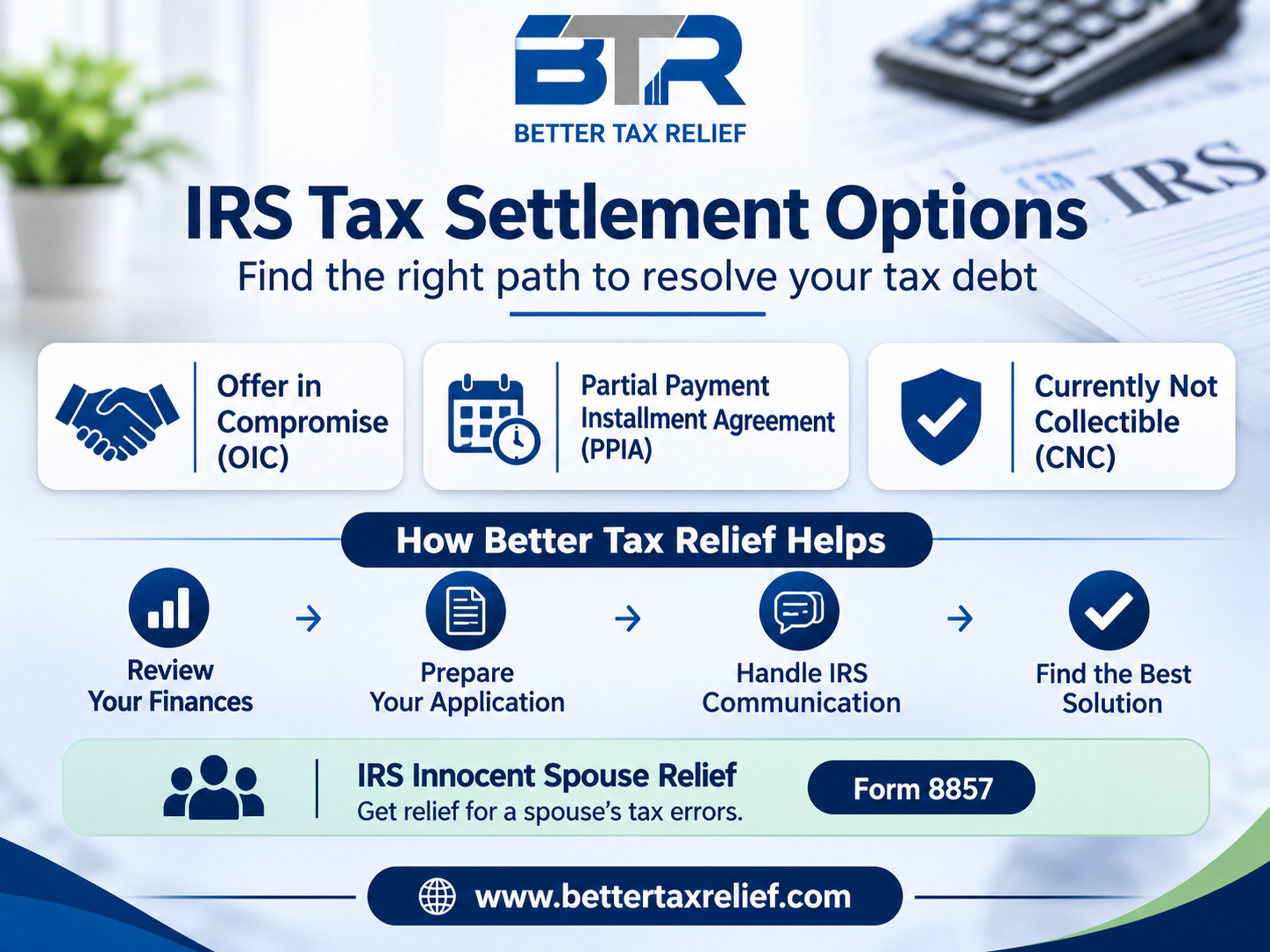
Better Tax Relief highlights three main ways to address IRS tax debt:
Offer in Compromise (OIC): This program allows qualifying taxpayers to settle IRS debt for less than the full amount owed. The IRS considers reasonable collection potential, including income, assets, and allowable expenses. Payment may be a lump sum or a short-term plan. Applicants must be current on required tax filings. Better Tax Relief helps assess eligibility and prepare Form 656 and supporting financial forms.
Partial Payment Installment Agreement (PPIA): A PPIA allows affordable monthly payments that may not cover the full tax debt over time. It may suit someone who cannot pay the full balance but can make a manageable monthly payment.
Currently Not Collectible (CNC): CNC status may pause IRS collection activity when financial hardship prevents a taxpayer from meeting basic living expenses while paying the debt. It pauses collection; it does not erase the balance.
An installment agreement may also be appropriate when predictable monthly payments are a better fit. Each option works differently, so the right choice depends on the taxpayer’s financial picture.
How Do You Choose and Apply for an IRS Tax Settlement?
Review income, expenses, assets, dependents, liabilities, and total tax debt to understand which relief path may fit.
Better Tax Relief assesses the finances, compares options, prepares supporting records, submits the case, and communicates with the IRS.
For an OIC, documentation may include Form 656 and Form 433-A or 433-B, depending on the case. Accurate records help explain the financial information behind the request. There is no universal settlement amount; the potential outcome depends on individual circumstances.
When Does IRS Innocent Spouse Relief Apply?
IRS innocent spouse relief is separate from a standard tax settlement. It may help someone who filed a joint return but should not be held responsible for tax liability caused by a spouse’s or former spouse’s errors or omissions.
Better Tax Relief describes three types: traditional Innocent Spouse Relief, Separation of Liability Relief, and Equitable Relief. Applicants use IRS Form 8857. A review considers the joint return, the applicant’s knowledge, and supporting evidence.
The website notes a deadline connected to IRS collection activity, so timely review matters. Better Tax Relief helps identify the relevant relief type, prepare Form 8857 and supporting evidence, and communicate with the IRS. When tax debt stems from a spouse’s errors, this option may be more relevant than an Offer in Compromise.
IRS Tax Settlement: Frequently Asked Questions
1. Can the IRS settle tax debt for less than the full amount?
Yes. An Offer in Compromise may allow eligible taxpayers to settle for less, based on their financial circumstances.
2. What is the difference between OIC and PPIA?
An OIC settles eligible debt for less than the full amount. A PPIA sets monthly payments that may not cover the full balance.
3. Does Currently Not Collectible status erase tax debt?
No. CNC may pause collection during financial hardship, but it does not eliminate the balance.
4. Who may qualify for IRS innocent spouse relief?
Someone who filed jointly and faces tax debt linked to a spouse’s errors may qualify, depending on the facts and applicable criteria.
5. What forms may an IRS settlement require?
An OIC may require Form 656 and Form 433-A or 433-B, along with supporting financial records.
Get Help Reviewing Your Options
Contact Better Tax Relief for a free, confidential review of your tax debt and financial circumstances. A specialist can explain potential paths and help identify the next step. Call (866) 562-1216 or visit https://bettertaxrelief.com/ .
Conclusion
An IRS tax settlement is not one-size-fits-all. An OIC, PPIA, or CNC status may suit different financial situations. When a joint return and a spouse’s tax errors are involved, IRS innocent spouse relief may be more relevant. Reviewing your circumstances and preparing complete documentation can help you move toward a suitable resolution.