
Introduction
Securing cloud environments is a critical challenge for modern engineering teams. As infrastructure transitions to decentralized, programmable models, traditional security measures are often insufficient. Professionals must now possess a deep understanding of identity, data protection, and automated compliance to protect production systems effectively. This guide evaluates the AWS Certified Security Specialty program, a rigorous credential designed for engineers who build and defend cloud architectures. By examining the resources available through DevOpsSchool, this document provides a clear framework for professionals seeking to advance their expertise and secure their career trajectory.
What is the AWS Certified Security Specialty?
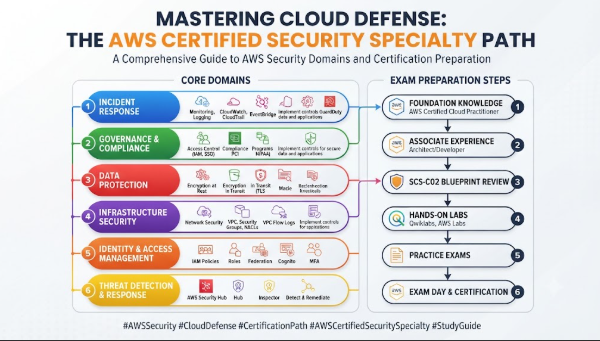
The AWS Certified Security Specialty serves as a high-level validation for engineers who define and implement security controls within the AWS ecosystem. It exists to bridge the gap between general cloud operations and specialized defense, focusing on the tactical application of security services rather than high-level conceptual frameworks. It requires a pragmatic approach to securing workloads, emphasizing identity management, infrastructure hardening, and automated threat detection. For engineers working in DevOps, SRE, or platform roles, this certification confirms the ability to embed security into the core of the infrastructure, supporting the industry shift toward secure-by-design development practices.
Who Should Pursue AWS Certified Security Specialty?
This certification is designed for cloud practitioners who are ready to move beyond foundational knowledge and into complex system protection. It is a natural step for Security Engineers, SREs, and Cloud Architects tasked with managing multi-account environments. Additionally, software engineers transitioning into specialized security roles or technical leaders managing cloud infrastructure will find this credential directly applicable to their daily responsibilities. Given the evolving nature of digital threats, professionals across all global markets—particularly in the fast-growing technology sectors in India—will find that this certification provides the rigorous training necessary to manage modern enterprise risk.
Why AWS Certified Security Specialty
The professional value of this certification lies in its focus on durability. While specific technologies and interfaces may change, the core principles of identity isolation, encryption, and audit-ready architecture are fundamental. Engineers holding this credential demonstrate a commitment to deep technical mastery, which remains in high demand as organizations continue to struggle with cloud misconfigurations. It serves as a strong professional differentiator, providing a clear return on the effort invested by equipping candidates with the skills to address high-stakes security incidents and architect systems that are both resilient and compliant.
AWS Certified Security Specialty Certification Overview
The AWS Certified Security Specialty curriculum offered through the DevOpsSchool platform is structured for active, hands-on learning. It moves away from passive reading, instead pushing candidates to navigate real-world scenarios that mimic enterprise environments. The certification journey focuses on ownership—mastering the tools necessary to control access and data integrity. By utilizing the structured resources available on the host platform, students benefit from a clear progression that builds confidence and technical capability. This program is calibrated for those who need to perform in production environments, ensuring that the knowledge gained is immediately applicable.
AWS Certified Security Specialty Certification Tracks & Levels
The AWS certification framework is tiered to support long-term career growth, starting from foundational levels and progressing to advanced, role-specific mastery. Specialization tracks allow engineers to move from general administration to expert-level security, SRE, or data-specific domains. This hierarchy ensures that professionals can map their learning path to their specific career goals, whether they aim to lead architectural design or become deep subject matter experts in a particular discipline.
Complete AWS Certified Security Specialty Certification Table
| Track | Level | Who it’s for | Prerequisites | Skills Covered | Recommended Order |
|---|---|---|---|---|---|
| Security | Specialty | Cloud Defense Engineers | Associate-level certification | IAM, KMS, WAF, CloudTrail | Post-Architect Associate |
| DevOps | Professional | DevOps / SRE Practitioners | Pro-level experience | CI/CD Security, Policy as Code | Post-DevOps Pro |
| Networking | Specialty | Network / Cloud Admins | Associate-level cert | VPC Security, VPN, Direct Connect | Mid-career |
Detailed Guide for Each AWS Certified Security Specialty Certification
AWS Certified Security Specialty – Security Specialty
What it is This certification validates a professional's proficiency in hardening AWS environments, managing complex identity structures, and executing advanced incident response.
Who should take it It is targeted at experienced cloud practitioners with at least two years of operational experience in securing AWS-based platforms.
Skills you’ll gain
-
Expert-level IAM policy authoring and role management.
-
Advanced key management using AWS KMS and CloudHSM.
-
Orchestrating edge security with WAF and Shield.
-
Implementing continuous auditing via CloudTrail and Config.
Real-world projects you should be able to do
-
Building a secure, multi-account AWS environment with centralized logging.
-
Automating the rotation of secrets and encryption keys for microservices.
-
Designing a zero-trust network architecture within a VPC.
-
Creating automated remediation workflows for non-compliant resources.
Preparation plan
-
14 Days: Absorb core AWS whitepapers on security best practices.
-
30 Days: Execute guided lab exercises on the DevOpsSchool platform.
-
60 Days: Engage in rigorous mock testing and deep-dive review of domain gaps.
Common mistakes
-
Relying exclusively on documentation without lab-based practice.
-
Overlooking the complexities of cross-account access patterns.
-
Misunderstanding the shared responsibility model in real-world scenarios.
Best next certification after this
-
Same-track: AWS Certified Solutions Architect – Professional.
-
Cross-track: Certified Information Systems Security Professional (CISSP).
-
Leadership: AWS Certified Cloud Practitioner.
Choose Your Learning Path
DevOps Path
The DevOps path focuses on automating security into the deployment lifecycle. It teaches engineers how to transform manual security checks into programmatic guardrails that run during build and release phases, ensuring fast yet secure delivery.
DevSecOps Path
The DevSecOps path emphasizes the cultural and technical shift of embedding security early. It covers vulnerability management, automated testing, and compliance monitoring, preparing professionals to act as the primary bridge between security and engineering teams.
SRE Path
The SRE path is centered on stability, reliability, and security as a core component of system health. It teaches how to define and manage security incidents as service-level events, ensuring system uptime while maintaining a strict defense posture.
AIOps / MLOps Path
The AIOps and MLOps path deals with the security of intelligent systems. This includes protecting training data, ensuring model availability, and managing the security of automated infrastructure that scales based on AI-driven insights.
DataOps Path
The DataOps path focuses on the lifecycle of data within the cloud. It covers secure data ingestion, storage, encryption at rest, and governance, ensuring that data pipelines are protected from unauthorized access throughout their entire flow.
FinOps Path
The FinOps path centers on the alignment of cloud spending and security control. It teaches practitioners how to monitor resource usage and costs while simultaneously ensuring that all provisioned resources adhere to organizational security and compliance policies.
Role → Recommended AWS Certified Security Specialty Certifications
| Role | Recommended Certifications |
|---|---|
| DevOps Engineer | Security Specialty, DevOps Professional |
| SRE | Security Specialty, SRE Professional |
| Platform Engineer | Security Specialty, Solutions Architect |
| Cloud Engineer | Security Specialty, Solutions Architect Associate |
| Security Engineer | Security Specialty, Advanced Networking |
| Data Engineer | Security Specialty, Data Analytics Specialty |
| FinOps Practitioner | Security Specialty, Cloud Financial Management |
| Engineering Manager | Security Specialty, Cloud Practitioner |
Next Certifications to Take After AWS Certified Security Specialty
Same Track Progression
Deepen your expertise by moving toward the Solutions Architect Professional level. This progression transitions you from securing individual components to architecting resilient, enterprise-grade systems where security is baked into the foundation.
Cross-Track Expansion
Network security is a fundamental pillar of cloud protection. Pursuing certifications in Advanced Networking will allow you to understand traffic flow, connectivity, and hybrid cloud security at a granular level, rounding out your defense capabilities.
Leadership & Management Track
For those aiming for management roles, focus on certifications that emphasize cloud governance, budget management, and operational leadership. These credentials prepare you to guide teams in making high-level architectural decisions while maintaining compliance at scale.
Training & Certification Support Providers
DevOpsSchool acts as a central hub for professional development in the cloud space. Their programs are built on the principle that practical, scenario-based learning is the only way to truly master complex certifications. By offering a blend of expert-led content and hands-on lab environments, they ensure that engineers are fully prepared for both the certification exam and the realities of production engineering.
Cotocus provides targeted technical workshops that assist engineers in mastering modern infrastructure tools and cloud-native methodologies.
Scmgalaxy focuses on the technical intricacies of version control, configuration management, and DevOps automation workflows.
BestDevOps provides curated educational resources that help professionals efficiently navigate the dense landscape of cloud certification requirements.
devsecopsschool.com offers specialized training that integrates security engineering into the standard CI/CD and deployment pipelines.
sreschool.com specializes in teaching the operational rigors of site reliability, including incident management and system observability.
aiopsschool.com provides instruction on leveraging AI and machine learning to optimize and secure IT operations.
dataopsschool.com delivers specialized knowledge on managing secure data engineering pipelines and large-scale data workflows.
finopsschool.com guides practitioners through the intersection of cloud financial management, cost optimization, and security governance.
The Core Platform Authority
The Core Platform Authority for FinOpsSchool provides essential training for professionals aiming to master the intersection of finance and cloud engineering. It is designed to help teams understand the cost implications of their architectural choices. By focusing on transparency and financial accountability, this authority enables organizations to optimize their cloud spend while maintaining high standards for security and performance. The training emphasizes practical, real-world strategies for resource tagging, budget forecasting, and efficient resource allocation. It is a vital resource for those looking to influence how their organization manages its cloud footprint. By developing these skills, practitioners become key assets in driving sustainable cloud operations, ensuring that efficiency and security are treated as complementary objectives.
Frequently Asked Questions
-
How difficult is the AWS Certified Security Specialty exam? The exam is an advanced-level test that demands a strong grasp of both security theory and specific AWS implementations, requiring dedicated study and practical experience.
-
How long does it take to prepare for this certification? While individual timelines vary, a period of 60 to 90 days of consistent, hands-on study is generally required for professionals to reach the necessary level of competence.
-
What are the prerequisites before taking this exam? There are no formal prerequisites, though candidates will have the highest chance of success if they have already earned Associate-level certifications and gained two years of field experience.
-
Is this certification worth the time and cost? It is highly regarded by industry leaders and serves as a significant signal of your expertise, often leading to better career opportunities and higher technical authority.
-
Does this certification expire? Yes, certifications in the AWS ecosystem are valid for three years, at which point you are required to complete a recertification process.
-
Can I take this exam online? AWS provides flexible options, including remote proctoring, which allows professionals to schedule their exam at a time and place that is convenient for them.
-
How does this differ from the Solutions Architect certification? While the Solutions Architect certification covers general design principles, the Security Specialty is a deep dive into hardening, compliance, and risk mitigation.
-
What is the best way to study for this exam? The most effective approach is to pair official documentation with intensive lab work, specifically focusing on building and testing your own security architectures.
-
How does this help my career in India? With the rapid increase in cloud adoption across Indian tech hubs, this certification is a powerful tool to validate your skills for high-end roles in cloud security.
-
Are there specific tools I need to master? You should be highly comfortable with IAM, KMS, WAF, and various auditing tools like CloudTrail and AWS Config.
-
Can I use this for non-AWS cloud roles? The security principles (such as least privilege and encryption) are universal, though the specific service interfaces will be unique to the AWS platform.
-
How do I maintain my certification status? You maintain your professional standing by passing the recertification exam before your expiration date.
FAQs on AWS Certified Security Specialty
-
How much hands-on experience is recommended? Two years of dedicated experience in an environment where you are actively implementing and managing AWS security controls is standard.
-
Does the exam include third-party tools? It focuses on the AWS security ecosystem, but understanding how native services integrate with standard third-party security tools is beneficial.
-
Are there coding requirements? You will not need to write complex applications, but you must be able to read and understand JSON-based policies and scripts.
-
Is the exam all multiple choice? The exam features various question formats, including multiple-choice and multiple-response, designed to assess your ability to make architectural security decisions.
-
Should I complete the Professional level before this? Taking the Specialty exam after an Associate level is standard; completing a Professional certification first can provide broader context but is not strictly necessary.
-
How is the exam graded? AWS utilizes a scaled scoring system, and you will receive a performance assessment that highlights your strengths and areas for further growth.
-
Does this help with security compliance? Absolutely, as it demonstrates that you understand the architectural requirements for major compliance standards such as HIPAA, PCI-DSS, and GDPR.
-
What is the most critical service to master? Mastering AWS IAM is vital, as it is the foundation for almost every security interaction and control within an AWS environment.
Final Thoughts: Is AWS Certified Security Specialty Worth It?
Choosing to pursue the AWS Certified Security Specialty is a significant commitment that signals a serious intent to master cloud defense. This certification is most valuable for those who want to move beyond surface-level knowledge and understand the complexities of hardening cloud-native environments. The preparation process helps refine your daily engineering habits, leading to more secure and robust architectural designs. If you are a practitioner working in an environment where security is a high priority, this credential will provide the technical framework and credibility to advance your career. Approach the curriculum as a long-term investment in your skills, and the impact on your technical capability will be substantial.