
As India charts its ambitious trajectory toward achieving net-zero emissions by 2070 and fulfilling its enhanced Panchamrit commitments on the global stage, the nation’s energy transition has moved decisively past the drawing board and into high operational gear. While solar, wind, and green hydrogen frequently dominate headline discussions regarding utility-scale power generation, the deep decarbonization of hard-to-abate industrial sectors, heavy transport fleets, and domestic city gas grids requires an equally robust, reliable gaseous fuel strategy. Enter Compressed Biogas (CBG)-a green, renewable energy vector that is rapidly transitioning from a localized environmental remedy to a definitive cornerstone of India’s industrial and macroeconomic architecture.
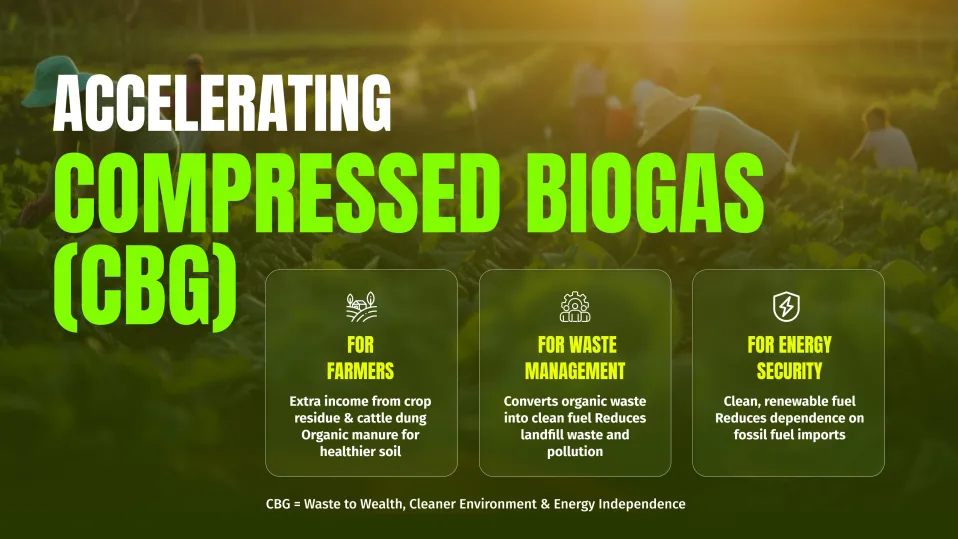
At the PHD Chamber of Commerce and Industry (PHDCCI), through high-level platforms such as the recent Hydrocarbons Summit 2026 hosted at PHD House in New Delhi, our leadership-including Director General Dr. Ranjeet Mehta and prominent industry stakeholders-has consistently maintained that sustainable economic growth must be anchored in resource circularity, economic viability, and inclusive rural empowerment. Deliberating on India’s energy security amid global supply chain disruptions, industry experts at the summit underscored that accelerating the domestic CBG ecosystem presents a unique, cross-sectoral paradigm: a definitive triple win that simultaneously empowers the agricultural community, resolves mounting urban and rural waste crises, and fortifies national energy sovereignty.
-
The Macro Landscape: Scaling Up India’s Bio-Gas Economy
India’s journey with compressed biogas is supported by sweeping regulatory backing and structural policy frameworks designed to reduce fossil fuel import dependencies. The flagship SATAT (Sustainable Alternative Towards Affordable Transportation) scheme, launched by the Ministry of Petroleum and Natural Gas, initially set the ambitious tone for establishing 5,000 CBG plants nationwide. This foundational vision has steadily evolved into a market-driven industrial ecosystem, propelled by the introduction of the statutory Compressed Biogas Blending Obligation (CBO).
The CBO mandates progressive blending of CBG into Compressed Natural Gas (CNG) for transport and Piped Natural Gas (PNG) for domestic and commercial households, starting at 1% for the initial rollout, scaling up to 3% for the current financial year, 4% in the next, and reaching a mandatory 5% threshold by FY 2028–29. According to government and industry tracking, India is firmly on track to meet these progressive milestones, backed by over 210 successfully commissioned plants and hundreds more under various stages of construction and pre-operational clearance.
Market intelligence underscores this rapid commercial expansion. The Indian CBG market, valued at approximately USD 319 million, is projected to surge exponentially to USD 2,419 million by 2032, registering an extraordinary compound annual growth rate (CAGR) of over 33.56%. This growth trajectory is underpinned by institutional funding, priority sector lending recognitions by the Reserve Bank of India (RBI), and dedicated financing windows from premier institutions like the Indian Renewable Energy Development Agency (IREDA) and central financial assistance programs.
-
Win One: Empowering Farmers and Transforming the Rural Economy
For decades, the rural economy has operated within a linear framework characterized by narrow profit margins, absolute dependency on erratic monsoons, and mounting logistical challenges associated with agricultural waste disposal. The commercial scaling of CBG completely alters this economic equation by turning agricultural residue from an environmental liability into a lucrative, recurring commercial asset.
Curbing Stubble Burning and Monetizing Residue
In agrarian heartlands such as Punjab, Haryana, and western Uttar Pradesh, the post-harvest burning of paddy straw has historically choked northern India with severe, seasonal air pollution. State nodal agencies, such as the Punjab Energy Development Agency (PEDA), have spearheaded structural interventions by allocating numerous CBG projects explicitly dependent on paddy straw and local agricultural residue. For instance, PEDA has advanced projects designed to consume millions of tonnes of paddy straw annually once fully commissioned, transforming a hazardous waste product into clean energy.
By establishing long-term, legally binding supply contracts with Farmer Producer Organisations (FPOs) and local biomass aggregators, CBG plant developers create a predictable, steady revenue stream for farmers. Instead of incurring operational costs or facing regulatory penalties for burning crop stubble, farmers now earn supplementary income by commercializing agricultural waste.
The Power of Fermented Organic Manure (FOM)
Beyond gas production, the industrial anaerobic digestion process yields high-grade Fermented Organic Manure (FOM) and Liquid Fermented Organic Manure (LFOM) as critical co-products. Rich in essential organic carbon, micronutrients, and macro-elements, FOM directly addresses the widespread degradation of Indian soils caused by decades of chemical fertilizer overuse.
- Restoring Soil Health: Organic manure revitalizes soil microflora, enhances biological activity, and improves moisture retention capacities.
- Reducing Chemical Dependence: Farmers can substitute expensive, heavily subsidized chemical fertilizers with locally sourced FOM, significantly lowering farm input costs.
- Closed-Loop Agricultural Value Chains: The monetization of FOM-supported by government frameworks like the Market Development Assistance (MDA) scheme offering INR 1,500 per tonne-enhances overall plant economics, ensuring that rural communities retain direct economic value from local waste resources.
For detailed insights into regional bio-energy frameworks and agricultural residue utilization, refer to the Punjab Energy Development Agency Bio-CBG Projects Portal.
-
Win Two: Revolutionizing Waste Management and Fostering a Circular Economy
Urbanization and rapid industrial expansion generate staggering volumes of organic waste daily across the country. Municipal solid waste (MSW), commercial food waste from wholesale markets, cattle dung from large peri-urban dairy complexes, and press mud from sugar mills pose immense environmental and municipal disposal challenges. If left unmanaged, these massive organic waste streams emit uncaptured methane-a greenhouse gas significantly more potent than carbon dioxide in trapping atmospheric heat.
From Linear Disposal to Circular Wealth
CBG technology bridges the gap between public sanitation and clean energy production through controlled anaerobic digestion. Organic materials are broken down by microorganisms in strict absence of oxygen, capturing raw biogas that is subsequently purified to over 90% methane purity and compressed.
- Municipal Solid Waste Integration: Major urban centers under the Swachh Bharat Mission (SBM Urban 2.0) are increasingly adopting decentralized and centralized waste-to-energy models, transforming municipal refuse into high-purity vehicle fuel.
- Dairy Complex Optimization: Large-scale dairy clusters, such as those in the Haibowal and Tajpur dairy complexes in Ludhiana (Punjab), leverage animal manure to feed multi-megawatt equivalent biogas plants, neutralizing pungent odors, preventing groundwater contamination, and generating clean fuel simultaneously.
Industry Perspectives on Waste Valorization
At prominent industry dialogues, such as those organized by PHDCCI and covered widely by platforms like the India Brand Equity Foundation (IBEF) and CEO Insights India, corporate leaders have emphasized that urban gas networks must aggressively integrate waste-derived vectors. Executives from city gas distribution enterprises highlight projects designed to process municipal solid waste directly into pipeline-grade green fuel, proving that effective waste management is a fundamental driver of urban cleanliness and corporate sustainability.
-
Win Three: Fortifying National Energy Security and Decarbonizing Industry
India currently imports a dominant portion of its domestic natural gas and liquefied petroleum gas (LPG) requirements, exposing its macroeconomic stability to global geopolitical volatilities, supply chain bottlenecks, and volatile price shocks. With natural gas targeted to comprise 15% of India’s primary energy mix, scaling domestic renewable gas production is no longer optional-it is an absolute imperative for national sovereignty and economic resilience.
Substituting Fossil Imports with Indigenous Biomethane
Compressed Biogas is functionally identical to fossil-based Compressed Natural Gas (CNG), possessing a comparable calorific value and chemical composition. This allows CBG to be seamlessly injected into existing City Gas Distribution (CGD) pipelines and utilized across commercial vehicle fleets without requiring costly engine modifications.
- Hedging Import Bills: Every cubic meter of CBG produced domestically directly offsets imported liquefied natural gas (LNG) or fossil CNG, preserving foreign exchange reserves.
- Decarbonizing Heavy Transport: City bus fleets, commercial logistics trucks, and municipal delivery networks running on CBG dramatically cut vehicular particulate matter and greenhouse gas emissions.
Hard-to-Abate Industrial Integration
Heavy industries-such as steel, cement, chemicals, and fertilizers-represent the toughest frontiers in the global race to net zero. While direct electrification remains challenging for high-heat thermal processes, substituting fossil natural gas with industrial-grade biomethane offers an immediate, viable decarbonization pathway. Progressive corporate commitments and supportive fiscal regimes, such as excise duty rationalizations and carbon credit monetization frameworks, are steadily transforming CBG from an alternative fuel niche into an institutionalized asset class.
-
Strategic Pillars for Accelerated Deployment
To unlock the full market potential projected through 2032 and overcome initial operational hurdles, stakeholders must execute a synchronized strategy centered around four critical pillars. First, feedstock security is paramount; plant operators must establish enforceable, long-term supply agreements with agricultural aggregators and municipal bodies strictly within a tight 25-kilometer radius to minimize transportation overheads and prevent supply starvation. Second, plant utilization optimization must be prioritized. Industry assessments indicate that while nameplate capacity is expanding rapidly, average operational plant utilization rates must be elevated through standardized pre-treatment technologies, advanced biological monitoring, and robust technical training for plant operators.
Third, robust financial engineering is required, leveraging priority sector lending recognized by the Reserve Bank of India, capital subsidies under the MNRE National Bioenergy Programme (offering up to INR 10 crore per project), and specialized lending windows from institutions like the Indian Renewable Energy Development Agency (IREDA). Finally, expanding commercial channels for by-product monetization-specifically Fermented Organic Manure (FOM) backed by Market Development Assistance-ensures that plant economics remain resilient against gas price fluctuations, completing the circular bio-economy loop.
Review the comprehensive lending criteria and sector guidelines directly on the IREDA Access to Energy Portal. Additional details on national policy frameworks can be explored via the SATAT Overview Portal and the Swachh Bharat Mission Urban 2.0 Advisory on CBG Plants.
Conclusion: The Chamber’s Commitment to a Green Gas Future
The convergence of agricultural empowerment, localized waste valorization, and national energy independence makes Compressed Biogas one of the most transformative public policy and industrial opportunities of our contemporary era. It successfully converts ecological liabilities into economic capital, creates decentralized rural employment, and insulates the national economy from fossil fuel shocks.
At the PHD Chamber of Commerce and Industry (PHDCCI), we remain steadfast in our mission to bridge policy architects, financial institutions, technology providers, and grassroots entrepreneurs. Through continuous high-level dialogues, sustainability summits, and actionable policy advocacy, PHDCCI champions the creation of a vibrant, resilient, and market-driven renewable gas ecosystem. Accelerating CBG is not merely an environmental target-it is the definitive blueprint for a self-reliant, prosperous, and sustainable India.