
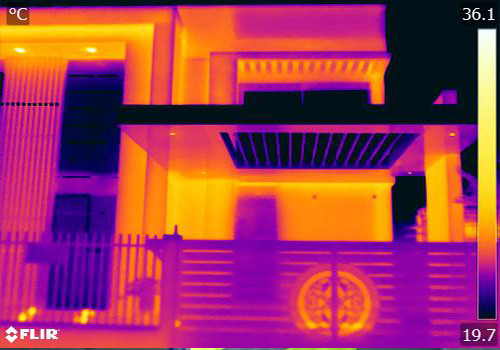
Heat is the first to warn of failure. A poorly connected cable will heat up before it burns out. An overloaded bearing will get hotter before it fails. Moisture will cool down walls compared to dryness. All of this is invisible to our eyes, but thermal imaging will detect all this and more.
How the Camera Works
All objects emit infrared energy. The hotter the object, the more infrared energy it emits. This infrared energy is captured by the camera and converted to different colours visible on the screen, where bright colours represent higher heat and darker colours represent cooler temperatures. You are not touching anything and not interrupting equipment operation. You simply point, inspect, and record results.
Where It Helps Most
Electrical systems are the most frequent application area. Poorly connected cables, overloaded electrical systems, and ageing components inside the panels and switchgear are the primary targets. In terms of buildings, thermal cameras can help locate heat loss, missing insulation, and moisture intrusion. Mechanical teams use thermal imaging cameras on motors, bearings, couplings, and belt drives. Heat exchange systems can be inspected for lining wear, while oil and gas storage tanks can be checked for sediment and insufficient insulation.
A defective panel or an improperly tightened wire will become warmer than others and thus easily noticeable. The same goes for turbines and for any water leakage behind walls or floors. With the use of a drone, people do not have to climb up in order to examine their telecom towers, flare stacks, solar panels, and overhead power lines.
A Brand Professionals Choose from Around the Globe
People from many countries opt for FLIR thermal imaging cameras because they have a reputation for being both highly effective and reliable. The collection of devices offered by the company is diverse. There are handheld cameras for routine patrols, stationary cameras for monitoring essential equipment at all times, firefighting cameras to see through thick smoke, scientific cameras for laboratories, and gas leak detectors.
The latest additions to the lineup include the cloud computing solutions allowing people to send their findings to the managers immediately.
Choosing the Right Model
First comes the application. A rapid walk-through in an industrial setting requires a lightweight, portable device. Continuous surveillance of critical motors requires a fixed-mount system. Now consider picture resolution. High resolution makes it easier to perform distant imaging like that of power lines and storage tanks. Consider the temperature ranges because there is a huge difference between the range required for a furnace and that for an office panel. Also consider lens options and screen visibility with gloves.
Skills Matter Too
A thermal imager can be as good as the operator using it. Proper interpretation of images requires training. Training classes will teach you to properly set emissivity and account for reflections as well as the seriousness of any hot spot. Certification classes, such as category one and category two, equip your staff with the skills to provide a professional and reliable report. Calibration ensures accuracy year after year.
Simple Habits for Better Results
Inspection should be done under normal load because an idle machine could easily conceal its issues. Normal photography should always be taken side by side with infrared photography to make reports easy to interpret. It is necessary to mark each location and indicate the date. The pictures should always be compared with previous ones, and action taken where there is a consistent increase in temperature.
Frequently Asked Questions
1. Can a Thermal imaging camera see through walls?
No. It reads surface temperature only. Still, a cold or warm patch on a wall can point to hidden moisture, missing insulation, or a pipe behind it.
2. Is it useful for home checks?
Yes. It shows drafts, wet spots, weak insulation, and warm wires in a home, so repairs can be planned early.
3. What makes FLIR thermal imaging cameras a popular choice?
They offer a wide range, from handheld to fixed models, plus lenses and software. Many teams also value their clear images and long service life.
4. How much does a camera cost?
Prices vary by detail, features, and use. Entry-level handheld units cost far less than high-end fixed systems, so match the choice to your real needs.
Final Thoughts
Heat issues are simple to solve if detected at an early stage. A thermal imaging camera is what you need to detect them early, and FLIR thermal imaging cameras provide a wide range of solutions for just about any task. Get your hands on the right model, train your personnel and maintain records. Pro Thermal Imaging LLC, operating out of Dubai, provides services of inspection for electrical, mechanical, structural, furnace, solar and tank assets, as well as drone, ultrasound, and acoustic services, reliable thermal cameras, training and support available 24/7. A little scan today will save you days later.