
You've walked through one hundreds of times without realising it.
The invisible barrier at the entrance of a supermarket, hospital, restaurant, or warehouse — that slight pressure you feel as you cross the threshold — that's an air curtain doing its job.
Most people don't know what it is. Many who work near one every day have never had it explained. And procurement managers who are evaluating them often get technical specifications before they understand the basic principle.
So let's fix that. Here is how an air curtain actually works — in plain language, no engineering degree required.
The Simple Version First
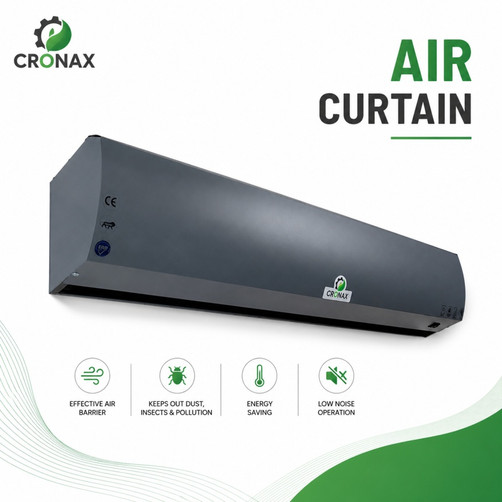
An air curtain is a machine mounted above a doorway that blows a continuous, controlled sheet of high-velocity air straight down across the opening.
That moving air acts as an invisible barrier. Hot air from outside can't push through it to enter the cool interior. Cold air from inside can't escape through it. Insects can't fly through it. Dust and fumes get deflected before they cross the threshold.
And people, forklifts, trolleys, and goods pass through it freely — without touching anything, without pressing a button, without breaking the barrier for more than a fraction of a second.
That's the core principle. Everything else is detail.
What Happens Inside the Unit — Step by Step
Step 1: Air intake. The unit draws in air from the room it's installed in — usually from the indoor side, through intake grilles on the body of the unit. This air is already conditioned — cooled, heated, or at ambient temperature — depending on the application.
Step 2: The fan accelerates the air. Inside the unit, a high-speed fan or blower takes that intake air and accelerates it to the discharge velocity. For commercial applications, this is typically 8 to 12 metres per second. For industrial air curtains serving large openings or high-pressure environments, it's higher — 15 to 25 metres per second.
This velocity is the key number. Too low, and the air stream doesn't reach the floor with enough force to maintain the barrier. Too high and unnecessary energy is consumed. A correctly specified air curtain hits the sweet spot for the door height and the application.
Step 3: Discharge through the nozzle. The accelerated air exits through a wide, flat nozzle that spans the full width of the door opening. The nozzle shapes the air into a flat, uniform sheet — not a series of separate jets with gaps between them. That uniformity is what makes the barrier continuous rather than partial.
Step 4: The air sheet crosses the doorway. The air sheet travels from the nozzle downward across the full height of the opening. It doesn't blow straight down — it angles slightly toward the outdoor side. This angle is deliberate. It compensates for the pressure difference between inside and outside, ensuring the barrier holds rather than being pushed inward by outdoor air pressure.
Step 5: Floor impact and split. When the air stream reaches the floor, it divides. Some deflects outward through the door. Some deflects inward toward the room. The balance between these two directions — controlled by the discharge angle and velocity — determines how effectively the barrier separates the two environments.
Step 6: The barrier restores instantly. When a person or vehicle passes through, they briefly displace the air sheet. The moment they've crossed, the air stream fills back into position. The barrier is restored in a fraction of a second — before any significant air exchange has occurred.
The Physics Behind It — Why It Works
The working principle of an air curtain is based on two physical concepts working together.
Boundary separation. Moving air creates a boundary that resists penetration by slower-moving or stationary air on either side. The faster and more uniform the air sheet, the stronger the boundary. This is why velocity is the critical performance parameter.
Pressure differential management. Indoors and outdoors are rarely at identical air pressure. A heated interior in winter, a cooled interior in summer, or a positively pressurised cleanroom — all create a pressure differential across the doorway that drives air in one direction. The air curtain discharge angle is calibrated to counteract this driving force rather than simply sitting at a neutral 90 degrees to the floor.
Together, these two effects create a barrier that holds against the combined forces of thermal convection, pressure differential, and outdoor airflow — without physically blocking the opening.
What an Air Curtain Blocks — And How Well
Heat and cold. An industrial air curtain can reduce heat infiltration through an open doorway by up to 80% compared to an uncurtained opening. For air-conditioned factories, warehouses, and cold storage facilities, this directly reduces the load on cooling and refrigeration systems.
Insects. Flying insects navigate using air currents. A correctly installed air curtain disrupts the air movement at the entrance in a way that most flying insects can't navigate against. Combined with the physical velocity of the air sheet, this makes air curtains one of the most effective first-line insect barriers for any facility under FSSAI hygiene requirements.
Dust and airborne particulates. The air sheet deflects incoming dust before it crosses the threshold. In Delhi, Ahmedabad, Faridabad, and other high-pollution Indian industrial cities, this effect significantly reduces the particle load entering through active doorways.
Fumes and odours. Air curtains at separation points between production zones — where chemical fumes, paint vapour, or strong odours need to be contained in one area — reduce cross-zone contamination without requiring a physical door.
Noise. The air sheet provides some acoustic attenuation between zones. It's not a soundproofing solution, but it reduces the transfer of machinery noise between adjacent areas — useful in facilities where production noise needs to be separated from quieter packing or quality control zones.
Why Velocity Is Everything
This is the specification that most buyers underestimate — and that most suppliers under-explain.
The air sheet needs to arrive at floor level with sufficient velocity to maintain the barrier. The distance it travels is the full height of the door. As the air travels downward, it loses momentum — friction with the surrounding air, turbulence, the spreading of the sheet as it moves.
A standard commercial air curtain producing 12 metres per second at the nozzle might arrive at floor level with 6 to 8 metres per second in a 2.5 metre high doorway. That's sufficient for ambient commercial applications. It's not sufficient for a large industrial doorway where the door height is 4 or 5 metres, or where a significant temperature differential is driving strong convective air movement.
This is why industrial air curtains run at higher discharge velocities — 15 to 25 metres per second — to ensure that enough velocity remains at floor level to actually maintain the barrier under industrial operating conditions.
Specifying a commercial-grade unit for an industrial doorway is one of the most common reasons air curtains fail to perform as expected. The unit runs. The air moves. But the barrier doesn't hold because the velocity at floor level is insufficient.
Types of Air Curtains — Which One Matches Which Application
Unheated air curtains — the standard for most Indian industrial and commercial applications. No heating element — just controlled airflow. Used for zone separation, insect and dust control, and energy management in non-cold applications.
Heated air curtains — include an electric or hot water heating element that warms the discharge air. Relevant for cold-climate applications in northern India or for entry vestibules that need to stay above freezing.
Industrial high-velocity air curtains — built for large openings, continuous duty cycles, and significant temperature or pressure differentials. Metal blowers instead of plastic. Higher motor ratings. Wider nozzle spans. Used at loading docks, factory entrance gates, and large warehouse entries.
Stainless steel air curtains — for food processing, pharmaceutical, and beverage production areas where the unit itself must be hygienically constructed, cleanable with chemical agents, and resistant to the moisture and cleaning cycles of controlled production environments.
Recessed air curtains — installed flush with the ceiling for clean aesthetic appearance. Used in hospitals, hotels, and premium commercial spaces where a visible unit above the door is not acceptable.
Anti-insect amber units — combine high-velocity airflow with a specific light wavelength that insects find inhospitable. For food facilities, hospitality kitchens, and any FSSAI-audited environment where insect control is a compliance requirement.
Installation — What Gets It Right or Wrong
A correctly specified air curtain installed incorrectly still underperforms.
Mount directly above the door frame. Every centimetre of distance between the nozzle and the top of the door opening reduces the air velocity that reaches floor level. The unit should be as close to the top of the opening as the structure allows.
Match the unit width to the door width. An air curtain that doesn't span the full door width leaves gaps at the edges where unrestricted air exchange continues. The barrier is only as complete as the coverage.
Angle the discharge correctly. The airflow should tilt slightly toward the outdoor side — typically 5 to 15 degrees from vertical. This compensates for the convective forces driving outdoor air inward and ensures the barrier holds rather than being pushed back into the room.
Set the speed correctly for the season. In Indian conditions, an air curtain often needs a higher speed setting in summer (when the temperature differential is larger and convective forces are stronger) than in the cooler months. Variable speed control allows this adjustment.
Cronax Industries — Air Curtain Supplier in India
For businesses looking for an air curtain supplier in India who understands the application behind the product, Cronax Industries is a manufacturer with the technical depth to get the specification right.
What Cronax offers:
- Full range of air curtains — unheated, heated, industrial high-velocity, stainless steel, anti-insect, and recessed configurations for every application
- Correct velocity specification — discharge velocity matched to door height and temperature differential, not just door width
- Indian conditions engineering — motor ratings for continuous duty in Indian temperature and humidity ranges, dust-resistant intake grilles, and UV-stabilised components for sun-exposed installations
- Width coverage matched to opening — no gaps, no partial barriers, full coverage from edge to edge of the actual door width
- Installation guidance — correct mounting height, discharge angle, and speed setting for each application
- After-sales support — maintenance guidance, seasonal speed adjustment, grille cleaning schedule, and service access for units that need attention
As an experienced air curtain supplier in India serving food processing, pharmaceutical, cold storage, logistics, automotive, and commercial clients, Cronax brings the application knowledge that turns a correctly specified unit into a correctly performing one.
The Bottom Line
An air curtain is not complicated equipment. It's a fan that blows air downward across a doorway at the right speed, in the right direction, from the right position.
What makes it work is getting those three variables correct for the specific opening and the specific environment. What makes it underperform is any of those three being off.
Understanding how an air curtain works is the starting point for buying one that actually does what it's supposed to do — and choosing a supplier who can match the specification to the reality of your facility.
Cronax Industries builds air curtains for exactly the environments where that match matters.
Looking for a reliable air curtain supplier in India for your factory, warehouse, food unit, or commercial space? Talk to Cronax Industries about the right industrial air curtain specification for your application.