
In today’s interconnected world, Micro, Small, and Medium Enterprises (MSMEs) stand at the cusp of unprecedented opportunity. For Indian MSMEs, transitioning from serving local markets to competing on the global stage is no longer a distant dream but a strategic imperative for sustainable growth, innovation, and resilience. Organizations like the PHD Chamber of Commerce and Industry (PHDCCI) play a pivotal role in this journey, offering policy advocacy, capacity building, networking, and market access support to empower MSMEs in their internationalization efforts.
This comprehensive strategic blueprint analyzes the changing dynamics of global trade, evaluates cross-border entry models, and provides actionable, data-driven frameworks to help MSMEs successfully scale from local champions to global enterprises.
The MSME Powerhouse: India’s Engine for Growth and Exports
India’s MSME sector is the backbone of the economy, contributing significantly to GDP, employment, and exports. According to data highlighted in the Union Economic Survey 2025-26 via the Press Information Bureau (PIB), the MSME sector serves as a primary driver of the industrial economy, contributing 31.1% to India’s Gross Domestic Product (GDP) and commanding an impressive 35.4% share of total manufacturing output.
More importantly, the sector’s contribution to international trade is growing rapidly. Official trade data released by the Ministry of MSME on KNN India confirms that the share of MSMEs in India’s total merchandise exports climbed to 48.58%. This means nearly half of the country’s physical exports are produced by small and mid-sized enterprises.
High-Growth Export Channels for Small Businesses
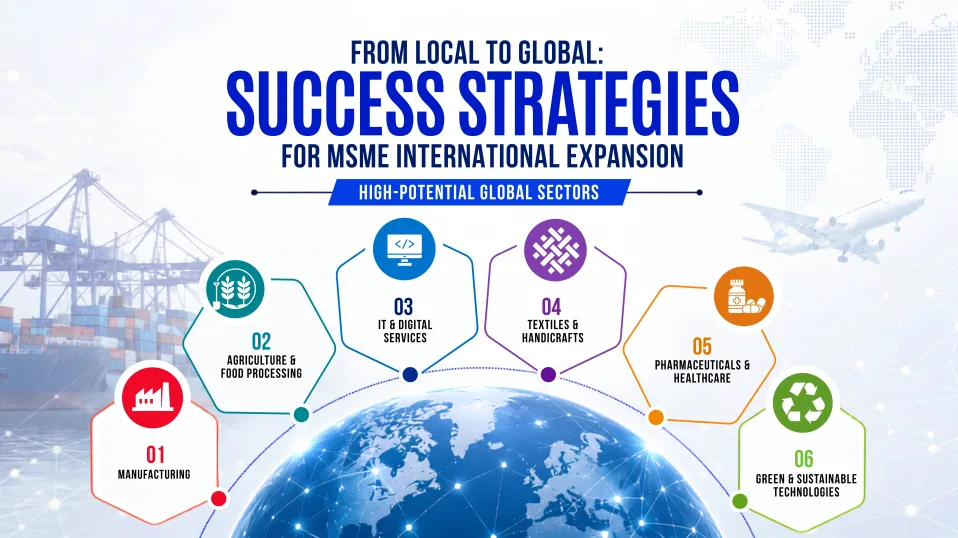
While traditional sectors like gems, jewelry, and handicrafts remain reliable revenue drivers, the export growth observed over the past year is increasingly led by technology-driven and high-value manufacturing verticals:
- Engineering and Fabricated Goods: Advanced component manufacturing, industrial tooling, precision castings, and customized equipment parts.
- Electronics and Sub-assemblies: Micro-components, printed circuit board (PCB) assemblies, and smart-device peripherals, growing at more than 10% year-on-year.
- Technical Textiles and Smart Apparel: High-performance functional fabrics, medical textiles, and protective industrial workwear.
- Agri-Commodities and Marine Processing: Value-added packaged foods, organic food solutions, and premium cold-chain processed marine exports.
Structural Barriers to Cross-Border Trade
Despite clear market opportunities, expanding an enterprise internationally comes with complex structural friction. MSMEs often encounter invisible barriers that can quickly drain their working capital if not managed through careful planning.
The “Dwarfishness” Trap and Scale Constraints
A persistent challenge highlighted in recent trade analyses is the structural “dwarfishness” affecting micro-enterprises. Over 98% of registered units remain categorized as micro-businesses. This lack of initial operational scale leads to a significant productivity gap; on average, smaller units operate at a lower efficiency level relative to large-scale enterprises. Without expanding production volumes and updating manufacturing processes, fulfilling large, recurring international purchase orders becomes a major operational strain.
Extreme Vulnerability to Supply Chain & Price Volatility
Smaller firms lack the bulk purchasing leverage enjoyed by large multinational corporations. When global freight rates fluctuate, container shortages occur, or raw commodity prices spike, MSMEs must absorb these rising overhead costs directly. Fulfilling fixed-price, long-term international supply contracts during sudden inflationary shocks can severely damage net margins, occasionally turning a profitable export order into an operational loss.
Regulatory and Green Compliance Barriers
Modern international trade routes are increasingly governed by non-tariff barriers, strict quality benchmarks, and environmental regulations. A prime example is the European Union’s Carbon Border Adjustment Mechanism (CBAM), along with changing global ESG (Environmental, Social, and Governance) compliance directives.
As noted by trade specialists in The Economic Times coverage of World MSME Day, the global trading environment is undergoing a deep structural shift. Protectionist policies, green regulations, and strict international quality standards frequently challenge smaller factories that run on manual setup operations and lack dedicated, in-house compliance legal teams.
Core Success Strategies for MSME International Expansion
To overcome these entry challenges, businesses can adopt a structured expansion methodology. Moving into international markets should be executed in calculated phases, transforming a localized operation into a resilient global player.
Strategy 1: Data-Driven Market Selection and FTA Optimization
A frequent expansion mistake is trying to enter multiple geographic markets simultaneously without sufficient localized data. Instead, enterprises should focus on two or three strategic target destinations by analyzing specific import demands, tariff structures, and local consumer behavior.
A major advantage for modern exporters is utilizing India’s expanding export network of bilateral and multilateral trade pacts. The recently signed Free Trade Agreement (FTA) with the European Union provides an excellent example. As detailed by Dr. Ranjeet Mehta, CEO and Secretary General of PHDCCI, in an analysis on Awaz The Voice, this landmark trade pact opens direct, low-tariff access to a massive USD 23-trillion European economy across 27 member nations.
By centering expansion plans around active FTAs, businesses can utilize preferential tariff certificates of origin, giving their product pricing an immediate competitive edge over non-FTA manufacturing regions.
Strategy 2: Leveraging Cross-Border E-Commerce for Fast Entry
Traditional international expansion typically required complex networks of overseas distributors, local agents, and expensive foreign sales offices. Today, cross-border e-commerce allows micro and small brands to test international demand with minimal upfront capital.
By listing on global business-to-business (B2B) marketplaces and business-to-consumer (B2C) digital export platforms, a small enterprise can sell directly to global buyers. This digital model simplifies transaction processing, offers secure payment gateways, and provides valuable consumer data. This setup allows manufacturers to refine product features, adjust packaging, and test pricing strategies in real-time before committing to large-scale maritime freight shipments.
Strategy 3: Upgrading Product Quality via Lean Manufacturing
To survive in demanding international markets, a company must match strict global quality standards. A product line that passes domestic requirements may face customs rejections abroad if it fails precise chemical, structural, or environmental safety clearances.
MSMEs should look to adopt advanced manufacturing frameworks, such as the MSME Competitive (Lean) Scheme and Zero Defect Zero Effect (ZED) practices. Implementing lean manufacturing helps eliminate waste, stabilizes assembly line precision, and lowers per-unit production costs.
Upgrading machinery, training shop-floor technicians, and obtaining globally recognized certifications (like ISO, CE, or UL markers) turns quality from an ongoing operational challenge into a core selling point.
Strategy 4: Financing the Pipeline with Structured Trade Finance
Expanding into global markets places unique demands on liquid working capital. While domestic buyers might settle invoices within 30 to 45 days, international transit timelines, customs procedures, and extended cross-border payment structures can extend cash flow cycles up to 90 or 120 days.
To prevent severe cash flow shortages, exporters should balance their funding mix using structured trade finance tools:
- Pre-Shipment / Packing Credit: Low-interest working capital loans provided by commercial banking institutions to finance the purchase of raw materials and pay for packaging against verified international letters of credit.
- Post-Shipment Export Factoring: Selling foreign accounts receivable invoices to specialized financial factors at a minor discount to unlock immediate operating cash flow instead of waiting for long international payment terms to clear.
- Export Credit Insurance Cover: Securing comprehensive risk policies from institutions like the Export Credit Guarantee Corporation (ECGC). This insurance safeguards the business against buyer insolvencies, sudden defaults, or unexpected political disruptions in the destination country.
Strategy 5: Achieving Scale through Collaborative Industrial Clusters
When individual small businesses try to scale globally alone, they often struggle with high logistics overheads and limited production capacities. A highly effective solution is participating in dedicated industrial clusters.
By operating within common production zones- supported by initiatives like the Micro and Small Enterprises- Cluster Development Programme (MSE-CDP)- cooperating firms can share expensive specialized infrastructure. This includes shared toolrooms, testing laboratories, bulk raw-material storage facilities, and consolidated logistics hubs. This collaborative model enables clustered small businesses to pool production capacities, allowing them to confidently bid on major international supply chain tenders that would be too large for any single micro-enterprise to fulfill alone.
Institutional Pillars and Government Support Ecosystem
Entrepreneurs do not have to navigate the path to internationalization alone. The public policy framework offers targeted financial incentives, risk-mitigation schemes, and digital tools designed to simplify the export journey.
The centerpiece of this support architecture is the government’s Export Promotion Mission (EPM), which features a substantial budgetary allocation of ₹25,060 crore extending from FY26 to FY31. As outlined in the official documentation from the Ministry of Commerce & Industry via PIB, this comprehensive mission operates through two specialized pillars designed to build robust export capabilities:
- Niryat Protsahan- focuses on trade finance and credit enhancement to expand access to low-cost institutional trade finance, enhances credit guarantees, and reduces borrow-rate friction.
- Niryat Disha- focuses on export logistics, warehousing, and market access to streamline cross-border transport corridors, provides subsidized international warehousing, and builds market-entry readiness.
Beyond the core Export Promotion Mission, several other digital portals and financial programs help streamline international trade operations:
- The Self-Reliant India (SRI) Fund: A specialized growth capital fund designed to infuse equity financing into viable, high-potential small businesses. Backed by regular budget expansions, the SRI Fund has provided critical equity support to hundreds of expanding enterprises, helping them build the necessary corporate scale for international market entry.
- The MSME Samadhaan & CHAMPIONS Portals: Digital dispute-resolution platforms that monitor and resolve delayed payment issues. This system provides critical working capital protection, ensuring large corporate buyers settle outstanding balances promptly.
- Government e-Marketplace (GeM) & Trade e-Connect: Digital trade portals that integrate market analytics, streamline certificate-of-origin approvals, and connect local manufacturers directly with global public sector procurement teams.
The Strategic Action Plan for MSMEs
For an executive leadership team planning to scale their enterprise internationally, the following sequence provides an actionable operational roadmap:
- Establish Compliance and Digital Foundations: Secure your Import Export Code (IEC) from the DGFT, complete your formal Udyam portal registration, and choose the appropriate Export Promotion Council matching your industry sector.
- Conduct Targeted Market Analysis: Analyze global import databases to isolate two high-demand target countries that share active Free Trade Agreements (FTAs) with India. Evaluate the local pricing structures, duties, and customer preference trends.
- Align Product Quality and Certifications: Audit your manufacturing line using lean practices to remove process errors. Secure necessary international quality certifications (such as CE, FDA, or ISO markers) to ensure smooth customs clearance in your target markets.
- Arrange Trade Financing and Risk Cover: Establish dedicated pre-shipment packing credit lines with your financial institution and secure an ECGC credit insurance policy to safeguard against international buyer default risks.
- Launch Targeted Go-To-Market Channels: Onboard with cross-border B2B digital marketplaces, showcase product lines at specialized international trade exhibitions, and leverage trade networks like PHDCCI to lock in reliable long-term distribution partners.
Conclusion: The Road to Global Leadership
Transitioning an enterprise from local operations to global markets is a demanding journey that requires operational discipline, regulatory compliance, and strategic financial planning. It is a long-term evolution from simply managing an independent factory toward leading an integrated, international organization.
By utilizing current Free Trade Agreements, tapping into digital cross-border e-commerce platforms, enforcing strict lean manufacturing standards, and leveraging institutional programs like the ₹25,060-crore Export Promotion Mission, Indian MSMEs can successfully navigate global trade complexities. Backed by the strategic guidance and trade networks of institutions like PHDCCI, the country’s small business ecosystem is well-positioned to transform local manufacturing excellence into a resilient, globally recognized brand presence.
https://www.phdcci.in/blog/from-local-to-global-success-strategies-for-msme-international-expansion/