
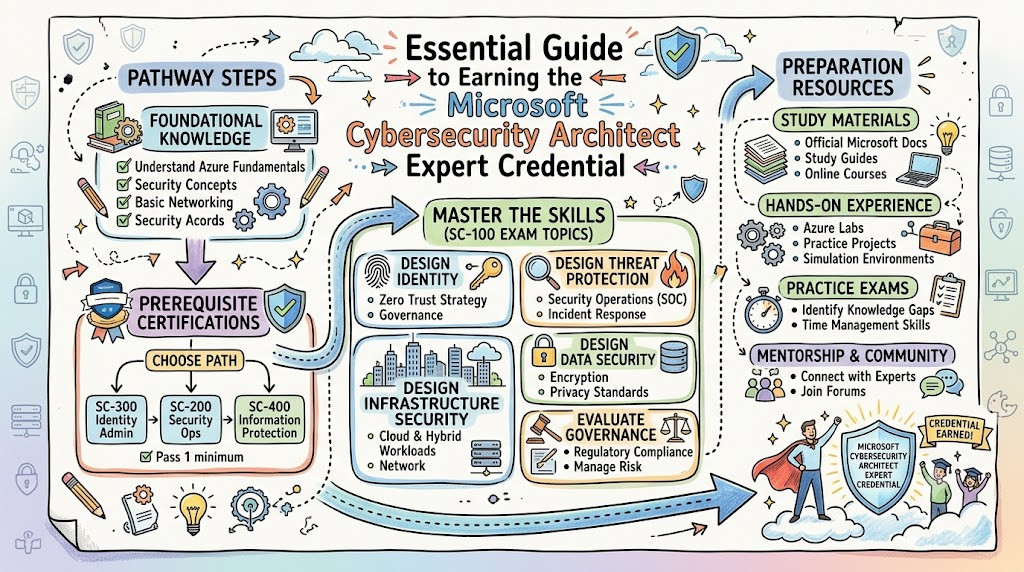
Introduction
The modern enterprise threat landscape demands sophisticated defense architectures that span hybrid infrastructures, multi-cloud environments, and complex identity governance systems. Securing distributed cloud assets against zero-day exploits and ransomware attacks requires structural expertise rather than reactive operational patching. Earning the Microsoft Certified Cybersecurity Architect Expert certification validates an engineer’s capability to design holistic zero-trust strategies and robust security postures. Furthermore, enrolling in structured mentorship through platforms like DevOpsSchool provides the production-focused labs necessary to bridge theoretical knowledge with real-world architectural design.
Over my twenty years in systems engineering and DevSecOps, I have observed numerous security incidents where organizations relied on perimeter firewalls while ignoring internal lateral movement risks. During one critical enterprise migration, an improperly configured identity boundary allowed a compromised service principal to access staging databases. A well-designed zero-trust architecture would have isolated that scope immediately. This comprehensive guide helps cloud engineers, SREs, and security practitioners navigate the expert-level certification path and build resilient enterprise environments.
What is Microsoft Certified Cybersecurity Architect Expert?
The Microsoft Certified Cybersecurity Architect Expert is an advanced credential that proves an engineer's capability to design end-to-end security architectures across hybrid and multi-cloud environments. It validates expertise in implementing Zero Trust principles, managing risk, evaluating governance controls, and designing infrastructure security.
Unlike entry-level cloud security certifications that focus on administrative portals and basic compliance toggles, this expert designation centers on strategic architectural blueprints. Candidates must evaluate real-world trade-offs between system performance, user productivity, and regulatory compliance. The curriculum aligns directly with enterprise workflows by testing threat modeling, identity posture evaluation, continuous threat monitoring, and cross-domain incident response planning.
| Theory | Production Readiness |
| Memorizing default security center settings and policy templates. | Designing custom Azure Policy initiatives mapped to NIST frameworks. |
| Understanding abstract Zero Trust definitions. | Building conditional access policies with automated device risk checks. |
| Knowing basic firewall and network rule mechanics. | Architecting micro-segmented hybrid networks with automated isolation. |
Who Should Pursue Microsoft Certified Cybersecurity Architect Expert?
This credential targets experienced IT professionals who bear strategic responsibility for an enterprise security posture. Cloud architects, senior security engineers, DevSecOps leads, and systems engineers will find direct career application in this material.
-
Experienced Engineers: Cloud administrators and security specialists gain the architectural mindset required to step into principal or lead consulting roles.
-
DevOps and SRE Professionals: Platform engineers learn to embed security boundary constraints directly into Infrastructure as Code (IaC) pipelines without slowing deployment velocity.
-
Engineering Managers and Technical Leads: Managers acquire a structured evaluation framework to communicate technical risk metrics effectively to executive stakeholders.
-
Global and India-Specific Context: Enterprise digital transformation across global markets and tech hubs in Bengaluru, Hyderabad, and Pune has accelerated demand for validated cloud security architects capable of managing cross-border data compliance.
Why Microsoft Certified Cybersecurity Architect Expert is Valuable Today and Beyond
Enterprise cloud adoption has evolved beyond mere migration into deep multi-cloud reliance. Consequently, threat vectors have expanded drastically, placing cloud security at the top of corporate priorities. Industry metrics consistently show that security architects command premier compensation packages due to the rare combination of deep infrastructure knowledge and risk management skills.
+-----------------------------------------------------------------------+
|                 ZERO TRUST ARCHITECTURE BLUEPRINT                     |
+-----------------------------------------------------------------------+
|  VERIFY EXPLICITLY   |   USE LEAST PRIVILEGE   |   ASSUME BREACH     |
|  - Multi-Factor Auth |   - Just-In-Time Access |   - Micro-segmentation|
|  - Device Health     |   - Just-Enough Access  |   - Encrypted Data  |
+-----------------------------------------------------------------------+
                                   |
                                   v
+-----------------------------------------------------------------------+
|               MICROSOFT DEFENDER & PURVIEW GOVERNANCE                 |
+-----------------------------------------------------------------------+
                                   |
                                   v
+-----------------------------------------------------------------------+
|                    AZURE SENTINEL SIEM / SOAR                         |
+-----------------------------------------------------------------------+
Consider a global retail platform handling millions of daily customer interactions across hybrid environments. A sudden credential leakage incident can disrupt order fulfillment completely if lateral access is unrestricted. Implementing a comprehensive cloud security architecture isolates compromised identity tiers, mandates continuous contextual verification, and initiates automated threat mitigation routines within seconds. This resilience protects corporate revenue and reinforces long-term brand trust.
Microsoft Certified Cybersecurity Architect Expert Certification Overview
Achieving this expert status requires passing the primary architectural exam alongside one of its official prerequisite certifications. The assessment evaluates high-level decision-making, scenario-based architecture design, threat modeling, and business continuity integration.
The evaluation process relies heavily on case study questions that present complex enterprise environments, legacy constraints, and strict compliance mandates. Candidates must synthesize these variables quickly to select optimal design decisions. Training models focus on practical architectural exercises, policy drafting, and automated remediation workflow configuration.
Why Choose DevOpsSchool?
DevOpsSchool stands out as an elite training platform delivering production-ready technical education led by industry veterans. The platform provides comprehensive learning paths curated by senior architects with decades of hands-on production experience.
Students gain access to dynamic cloud laboratory environments, real-world architecture blueprints, and guided case study reviews. Rather than relying on simple exam cramming, the training emphasizes deep threat modeling exercises, policy automation techniques, and cross-cloud integration patterns. Graduates emerge fully prepared to design resilient architectures and clear advanced industry certifications.
Microsoft Certified Cybersecurity Architect Expert Certification Tracks & Levels
Mastering cloud security architecture requires a progressive learning strategy that moves from core administration to complex multi-cloud strategy design.
-
Associate Foundation Level: Establishes core operational competence across identity, operational security, and cloud infrastructure administration.
-
Advanced Expert Level: Focuses on evaluating, designing, and optimizing holistic security architectures using Zero Trust principles.
-
Specialization Alignments: Integrates specialized domains including DevSecOps pipeline automation, SRE resilience monitoring, and hybrid data governance.
Moving from an associate administrator to an expert architect demands a systematic framework:
[Phase 1: Operational Mastery]
  --> Administer identities, workloads, and perimeter rules
        |
        v
[Phase 2: Architectural Synthesis]
  --> Evaluate business risk, design Zero Trust boundaries, model threats
        |
        v
[Phase 3: Strategic Automation]
  --> Code security policies, orchestrate SOAR workflows, optimize governance
Complete Microsoft Certified Cybersecurity Architect Expert Certification Table
| Track | Level | Who It’s For | Prerequisites | Skills Covered | Recommended Order |
| Identity & Access | Associate | Identity Administrators, Cloud Engineers | Basic Azure Knowledge | Microsoft Entra ID, Identity Protection, Privileged Access | 1 |
| Operational Security | Associate | Security Operations Analysts | Basic Security Operations | Azure Sentinel, Defender for Cloud, Incident Response | 2 |
| Cloud Infrastructure | Associate | Azure Administrators, Network Leads | Cloud Administration | Virtual Network Security, NSGs, Azure Firewall, Key Vault | 3 |
| Cybersecurity Architecture | Expert | Enterprise Architects, Lead Engineers | Any 1 Associate Certification | Zero Trust Design, Governance, Threat Modeling, Multi-Cloud | 4 |
Detailed Guide for Each Microsoft Certified Cybersecurity Architect Expert Certification
Microsoft Certified Cybersecurity Architect Expert – SC-100
-
What it is: An expert-level certification focused on designing comprehensive security strategy, Zero Trust architecture, data security, and operational resilience across multi-cloud environments.
-
Who should take it: Senior security engineers, cloud architects, technical leads, and DevSecOps practitioners aiming to master enterprise security architecture design.
-
Skills you’ll gain:
-
Design a Zero Trust strategy and architecture.
-
Evaluate Governance Risk Compliance (GRC) technical strategies.
-
Design security infrastructure for hybrid and multi-cloud environments.
-
Formulate data security and application protection strategies.
-
-
Real-world projects & case studies:
-
Designing a Zero Trust identity model for a multi-national banking platform with 50,000 remote endpoints.
-
Building an automated threat detection and SOAR triage workflow using Azure Sentinel for a multi-cloud environment.
-
-
Step-by-step preparation plan:
-
Days 1–14: Deep-dive into Microsoft Cybersecurity Reference Architectures (MCRA) and Zero Trust deployment frameworks.
-
Days 15–30: Practice scenario-based threat modeling, Azure Policy initiatives, and key conditional access architectures.
-
Days 31–60: Work through complex enterprise case studies and evaluate multi-cloud integration patterns.
-
-
Common mistakes:
-
Focusing strictly on Azure administrative portal steps instead of strategic design trade-offs.
-
Neglecting non-Microsoft multi-cloud integration scenarios and legacy hybrid dependencies.
-
Ignoring business continuity, disaster recovery, and compliance reporting constraints in architecture decisions.
-
-
Best next certification after this:
-
Same-track option: Multi-Cloud Security Specializations.
-
Cross-track option: Advanced Cloud Solutions Architect Expert.
-
Leadership option: Certified Information Security Manager preparation.
-
Choose Your Learning Path
DevOps Path
Integrating security into fast-paced continuous integration and continuous deployment pipelines ensures code remains secure prior to release. Software developers and release engineers learn to automate container scanning, dependency checks, and infrastructure code verification directly within deployment workflows.
DevSecOps Path
This track blends strategic security architecture directly into software development pipelines. Practitioners focus on static code analysis, dynamic runtime protection, secrets management, and policy-as-code automation.
SRE Path
Site Reliability Engineers focus on maintaining system availability and resilience during security incidents. This path highlights real-time telemetry monitoring, automated incident response runbooks, threat intelligence correlation, and post-incident forensic analysis.
AIOps Path
Modern security operations produce massive volumes of log telemetry that exceed human monitoring capabilities. Security professionals learn to leverage machine learning models to identify anomalies, reduce alert fatigue, and automate initial threat triage.
MLOps Path
Securing machine learning models requires specialized architectural boundaries around training data pipelines, model registries, and inference endpoints. This track covers data lineage security, feature store encryption, and protection against adversarial attacks.
DataOps Path
Data security architects focus on protecting structured and unstructured data assets across hybrid stores. Engineers learn to design cryptographic key strategies, data loss prevention (DLP) policies, automated data classification, and continuous auditing controls.
FinOps Path
Security tools, log ingestion, and multi-region network inspection firewalls accumulate significant cloud costs. This path helps practitioners balance security controls with cloud financial management, optimizing SIEM ingestion costs without compromising visibility.
Role → Recommended Certifications
| Role | Recommended Certifications |
| DevOps Engineer | Azure Developer Associate, DevSecOps Specialist, Cybersecurity Architect Expert |
| SRE | Azure Administrator Associate, Security Operations Analyst, Cybersecurity Architect Expert |
| Platform Engineer | Azure Solutions Architect Expert, Cybersecurity Architect Expert |
| Cloud Engineer | Network Engineer Associate, Security Engineer Associate, Cybersecurity Architect Expert |
| Security Engineer | Security Operations Analyst, Identity Administrator, Cybersecurity Architect Expert |
| Data Engineer | Data Engineer Associate, Purview Governance Specialist, Cybersecurity Architect Expert |
| FinOps Practitioner | Cloud Financial Management Specialist, Azure Solutions Architect Expert |
| Engineering Manager | Cybersecurity Architect Expert, Governance and Risk Specialist |
Detailed Comparisons: Certification vs. Real-World Experience
Certification Theory vs. Real Production Triage
Theoretical exam preparation covers ideal scenarios where security tools integrate smoothly out of the box. Production engineering, however, presents legacy systems, unpatched third-party applications, and complex organizational resistance.
+-------------------------------------------------------------------------+
|                  THEORY VS. PRODUCTION TRIAGE                           |
+-------------------------------------------------------------------------+
| THEORY                                | PRODUCTION REALITY              |
| Block non-compliant endpoints         | Stagger rollout via audit mode  |
| Enforce strict MFA everywhere         | Configure break-glass access    |
| Isolate workloads immediately         | Balance uptime SLAs vs risks    |
+-------------------------------------------------------------------------+
Architecting production security requires balancing risk against operational friction. Engineers learn when to enforce strict blocking rules versus when to deploy audit-mode monitoring.
Self-Study vs. Instructor-Led Enterprise Bootcamp
Self-study resources offer flexible learning paces but often lack interactive feedback on complex architectural trade-offs. Learners may memorize documentation without understanding real-world implementation nuances.
Instructor-led bootcamps provide direct exposure to veteran mentors who share production battle stories, architectural trade-offs, and enterprise scenarios. Live environments allow candidates to test complex configurations safely under expert guidance.
Next Certifications to Take After Microsoft Certified Cybersecurity Architect Expert
Same Track Progression
Engineers looking to stay within the security architecture domain can specialize further in multi-cloud defense frameworks, advanced threat hunting, and automated compliance engineering.
Cross-Track Expansion
Broaden your expertise by pursuing advanced enterprise cloud architect designations, deep cloud networking credentials, or specialized cloud database administration tracks.
Leadership & Management Track
Engineers moving toward executive roles can transition into strategic positions such as Chief Information Security Officer (CISO), Enterprise Risk Director, or Lead Infrastructure Architect.
Training & Certification Support Providers for Microsoft Certified Cybersecurity Architect Expert
The Core Platform Authority
DevOpsSchool functions as a premier global platform authority for advanced cloud security, platform engineering, and DevSecOps certifications. The institute delivers high-impact, mentor-led programs designed by principal engineers with decades of industry experience. Students engage in production-grade scenario planning, practical threat modeling, and comprehensive lab exercises. Through continuous curriculum updates, direct mentoring support, and career guidance, DevOpsSchool ensures candidates master advanced security architecture concepts and successfully achieve top-tier industry credentials.
DevOpsSchool: This leading educational platform delivers comprehensive career training in cloud security, DevSecOps, and enterprise architecture. Students benefit from interactive live sessions, deep hands-on project labs, and personal guidance from seasoned engineering leaders. The curriculum balances core technical concepts with production-focused scenarios, preparing candidates thoroughly for expert-level industry evaluations.
Cotocus: Cotocus specializes in delivering tailored IT engineering bootcamps and enterprise skill transformation programs. Their training modules emphasize real-world cloud migrations, automated security pipeline integration, and modern infrastructure governance, making complex architectural subjects accessible to ambitious engineers.
Scmgalaxy: Recognized as a community hub for software configuration management and platform engineering resources, Scmgalaxy provides detailed tutorials, study guides, and practical lab documentation. Its specialized learning tracks support professionals advancing their careers in security, cloud operations, and continuous delivery systems.
BestDevOps: BestDevOps offers focused certification prep programs designed to build high-demand skills in cloud security, site reliability, and automation. The platform features practical exercise modules and real-world case studies created by industry practitioners.
devsecopsschool.com: Dedicated specifically to bridging the gap between development teams and security operations, this platform offers targeted courses on policy-as-code, pipeline security scanning, container isolation, and Zero Trust implementation frameworks.
sreschool.com: Focusing on operational resilience and system availability, sreschool.com delivers expert-led training on observability frameworks, fault-tolerant cloud architecture design, disaster recovery planning, and automated incident mitigation strategies.
aiopsschool.com: Designed for engineers navigating the intersection of artificial intelligence and operations, aiopsschool.com provides courses on automated log analysis, machine learning telemetry, threat intelligence automation, and predictive system monitoring.
dataopsschool.com: This platform specializes in training technical professionals on secure data pipeline orchestration, automated compliance controls, data governance frameworks, and cryptographic policy implementation across enterprise multi-cloud environments.
finopsschool.com: Focusing on financial accountability in cloud computing, finopsschool.com provides structured training on balancing security architecture investments, optimizing resource utilization, managing log storage costs, and tracking cloud spend.
Frequently Asked Questions (General)
-
How difficult is the SC-100 Cybersecurity Architect Expert exam?
The exam is highly challenging because it evaluates architectural synthesis and scenario-based decision-making rather than simple memorization.
-
What are the required prerequisites for earning this expert credential?
Candidates must hold at least one prerequisite associate certification, such as the Azure Security Engineer, Security Operations Analyst, Identity Administrator, or DevOps Engineer credential.
-
How long does it take to prepare for this certification?
Most working professionals require approximately 30 to 60 days of consistent study and practical lab work to feel fully confident.
-
Is this expert certification recognized globally by employers?
Yes, global technology companies and enterprise hiring managers recognize this credential as a strong validation of cloud security design capabilities.
-
Can I skip the associate-level certifications and take SC-100 directly?
You can take the SC-100 exam directly, but the final expert credential will not be awarded until you complete an official prerequisite certification.
-
How does this certification impact my career growth and salary prospects?
Earning an expert security credential positions you for lead architect roles, which typically command higher compensation packages due to specialized market demand.
-
What is the primary difference between an associate and an expert certification?
Associate exams focus on operational administration and configuration tasks, whereas expert exams focus on strategic architectural design, risk evaluation, and trade-offs.
-
Is hands-on lab experience strictly required to pass this exam?
Yes, working through real-world scenarios and hands-on lab exercises is essential for answering case study and architecture questions correctly.
-
How often do Microsoft certification exam objectives change?
Microsoft updates exam objective domains periodically to keep pace with evolving cloud services, security threats, and industry practices.
-
Does this certification cover multi-cloud environments outside of Azure?
Yes, the curriculum emphasizes Zero Trust concepts and security strategies that apply across hybrid, on-premises, and multi-cloud platforms.
-
Should software developers pursue this cybersecurity architect credential?
Lead developers and software architects responsible for application security designs will benefit significantly from understanding these architectural boundaries.
-
What passing score is required on the SC-100 assessment?
Candidates must achieve a scaled score of 700 or higher out of 1000 to pass the official examination.
FAQs on Microsoft Certified Cybersecurity Architect Expert
-
Which official prerequisite certification is recommended before taking SC-100?
Choosing the right prerequisite depends largely on your current job role and primary technical focus. The Azure Security Engineer Associate path works best for infrastructure engineers, while the Security Operations Analyst option suits operational leads. Developers and platform leads often choose the DevOps Engineer credential. Selecting a prerequisite that aligns with your daily responsibilities speeds up your overall preparation timeline significantly.
-
How does SC-100 address Zero Trust architecture implementation?
The SC-100 curriculum places heavy emphasis on designing comprehensive Zero Trust architectures across identity, endpoints, applications, networks, data, and infrastructure. Candidates learn to structure explicit verification models, mandate dynamic least-privilege access, and design systems under an assume-breach mindset. You must demonstrate how to integrate conditional access policies with automated threat protection tools across hybrid cloud environments.
-
What role does threat modeling play in the cybersecurity architect exam?
Threat modeling forms a foundational skill tested extensively throughout the SC-100 case study scenarios. Candidates must analyze existing application topologies, identify potential vectors of attack, evaluate security boundaries, and recommend appropriate technical mitigations. You are expected to apply frameworks like STRIDE to systematically identify vulnerabilities and incorporate security controls early in the architectural design lifecycle.
-
How does this credential cover hybrid and multi-cloud security requirements?
Modern enterprises rarely operate entirely within a single cloud, making multi-cloud architecture a core component of this certification. The exam tests your ability to extend security governance, identity federation, and threat monitoring across hybrid data centers and competing cloud platforms. You will evaluate strategies for unified policy management, cross-cloud compliance tracking, and centralized log telemetry collection.
-
How important is data security and compliance governance on this exam?
Data security accounts for a substantial portion of the exam blueprint, requiring deep knowledge of data classification, lifecycle governance, and cryptographic strategy. Candidates must design data loss prevention strategies, manage access keys, and configure automated compliance auditing tools. Understanding how to align technical architectures with international regulatory frameworks is critical for passing the evaluation.
-
What is the best study strategy for mastering the exam case studies?
Navigating case study questions requires systematically analyzing provided business requirements, technical constraints, and security goals before reading the questions. Focus on identifying non-negotiable compliance needs and existing legacy infrastructure limits within the scenario. Practicing scenario-based trade-off analysis helps you evaluate multiple correct technical answers and select the one that best satisfies all constraints.
-
How does SC-100 integrate with Infrastructure as Code and DevSecOps?
The exam evaluates how architects embed security controls directly into automated deployment pipelines using Infrastructure as Code (IaC) templates and policy enforcement tools. You will learn to design automated policy compliance checks that prevent insecure configurations from reaching production environments. This integration ensures that security boundaries scale seamlessly alongside continuous integration and continuous deployment pipelines.
-
How does enrolling in a structured bootcamp help in passing SC-100?
A structured bootcamp provides organized learning paths, guided hands-on exercises, and expert mentorship that self-study materials often lack. Instructors share battle-tested architectural patterns, real-world case study walk-throughs, and valuable insights into exam trick questions. This direct interaction accelerates your learning curve and ensures you build practical architecture skills alongside exam readiness.
Final Thoughts: Is Microsoft Certified Cybersecurity Architect Expert Worth It?
Investing time and energy into earning an expert-level security certification is a significant strategic move for any technical career. In today's cloud engineering environment, building functional infrastructure is no longer enough; systems must be secure by design from day one. This credential validates that you possess both the high-level strategic vision and the technical depth required to protect enterprise assets.
While preparing for the exam demands dedication, the ultimate return on investment comes from the mindset shift it creates. Moving from operational troubleshooting to structural threat modeling transforms how you approach system design. For engineers committed to advancing into senior technical leadership, mastering these security architecture concepts is a highly rewarding pursuit.