
 Introduction
As organizations move more of their operations to the cloud, managing cloud expenses has become a major challenge. Many companies find that their cloud bills are growing faster than expected, often because infrastructure is left running when it is not needed or resources are over-provisioned. To solve this problem, businesses are adopting a practice known as FinOps, which stands for Cloud Financial Operations. FinOps brings engineering, finance, and business teams together so that everyone takes responsibility for the cost of the cloud.
If you want to lead these efforts and help your organization manage its cloud budgets effectively, earning a specialized certification is a great step forward. The Certified FinOps Manager program is designed specifically to teach you how to build a cost-conscious culture, allocate cloud spend accurately, and maximize the business value of every dollar spent on cloud services.
What it is
The Certified FinOps Manager certification is a professional credential that proves your ability to lead, govern, and optimize cloud financial management practices within an organization. It teaches you how to bridge the gap between technical engineering teams and corporate financial departments to ensure cloud investments align with real business goals.
Who should take it
This certification is ideal for professionals who sit at the intersection of technology, finance, and management. You should consider taking this program if you are a:
-
FinOps Practitioners looking to move into a leadership or managerial role.
-
Engineering Managers and Team Leads who want to control infrastructure costs without slowing down software development.
-
Cloud Architects and Lead Engineers who design cloud systems and want to ensure financial efficiency from day one.
-
Finance and Business Analysts who manage corporate IT budgets and need to understand cloud billing data.
-
Product Managers who want to accurately calculate the unit economics and profitability of their cloud products.
Certified FinOps Manager Certification Overview
The Certified FinOps Manager program provides a clear, structured path to mastering cloud financial leadership. The entire educational program is delivered via the official FinOps Manager Training Course available and is fully hosted on the FinOpsSchool website.
The certification is structured in a practical way to ensure you gain usable skills rather than just theoretical knowledge:
-
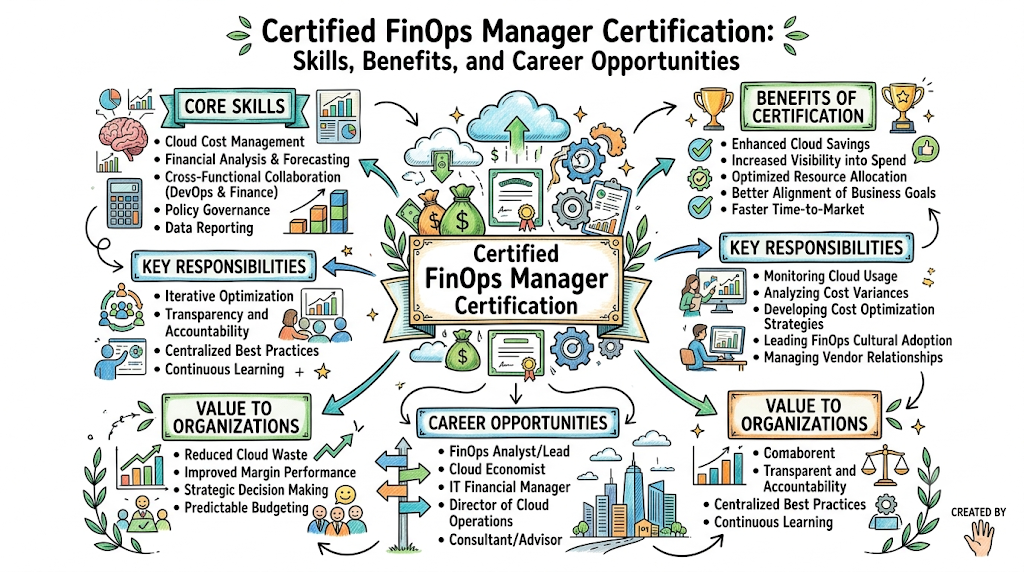
Certification Levels: This is a professional-level managerial credential. It sits above foundational practitioner certifications and focuses heavily on governance, policy enforcement, team collaboration, and financial strategy.
-
Assessment Approach: To earn your certification, you will undergo a comprehensive evaluation. This includes answering multiple-choice and multiple-answer questions in a formal exam environment. Additionally, you will complete practical assignments and real-world project tasks during your training to prove your hands-on capability.
-
Ownership and Structure: The curriculum is owned and continually updated by FinOpsSchool in collaboration with cloud cost experts. The structure is broken down into easy-to-follow modules that guide you through cloud billing deep dives, cost allocation strategies, forecasting, and cross-functional team management.
Skills you'll gain
-
Cloud Financial Governance: Learn how to create and enforce cloud budgets, financial guardrails, and compliance workflows.
-
Cost Allocation & Tagging: Master the art of designing complex tagging schemas and account structures to assign costs to specific teams, products, or departments.
-
Forecasting and Budgeting: Develop the ability to analyze historical usage data and build accurate predictive models for future cloud spend.
-
Cross-Functional Leadership: Learn how to build a shared language between engineers who launch resources and finance teams who pay the bills.
-
KPI & Metric Definition: Discover how to track and report on unit economics, cloud efficiency metrics, and return on investment (ROI) for executive leaders.
-
Tooling Evaluation: Gain the skills to evaluate, select, and integrate enterprise FinOps platforms and cloud-native cost tools.
Real-world projects you should be able to do after it
-
Design a Cloud Chargeback and Showback Framework: Set up a system that provides complete visibility into cloud spend, mapping raw billing files directly to specific corporate business units.
-
Establish an Organization-Wide Tagging Policy: Create and implement automated governance rules that identify, tag, or flag untagged cloud infrastructure automatically.
-
Build an Executive FinOps Dashboard: Create multi-cloud financial dashboards using reporting tools to present spending trends and cost anomalies to stakeholders.
-
Formulate a Cloud Cost Optimization Playbook: Write a clear, step-by-step guide for engineering teams detailing when and how to scale down, rightsize, or schedule off-hours shutdowns for non-production environments.
Common mistakes
-
Treating FinOps Only as a Cost-Cutting Exercise: Believing that FinOps is just about slashing budgets, rather than understanding that its true goal is to maximize business value and drive revenue growth through efficient cloud usage.
-
Ignoring the Engineering Culture: Trying to force strict financial rules on developers without explaining the context, which can slow down software deployment and create friction between teams.
-
Relying Entirely on Manual Tracking: Attempting to manage complex, multi-cloud bills using basic static spreadsheets instead of deploying automated tracking and cloud-native monitoring tools.
-
Poor Data Allocation Foundations: Jumping straight into advanced cost forecasting before establishing a clean, reliable resource tagging strategy across all cloud environments.
Best next certification after this
Once you have mastered the management and governance side of cloud financial operations with this credential, the best next step to elevate your skills to the highest strategic level is the Certified FinOps Architect program. The architect certification focuses on designing complex, highly technical cloud infrastructures that are financially optimized by default from the moment they are built.
Complete Topic Name Certification Table
To see how the Certified FinOps Manager fits into the broader ecosystem of modern enterprise IT infrastructure tracks, explore the comprehensive certification structure below:
Choose your path
Modern technology management requires different specialized skills depending on your long-term career focus. You can select from these 6 core learning paths to build your expertise:
-
DevOps Path: Focuses on speed and agility by breaking down walls between software development and IT operations through automated pipelines.
-
DevSecOps Path: Integrates security practices directly into the automated software delivery pipeline from the very beginning.
-
SRE (Site Reliability Engineering) Path: Applies software engineering principles to operations tasks to ensure large-scale systems are highly reliable and scalable.
-
AIOps/MLOps Path: Combines artificial intelligence and machine learning operational practices to automate system monitoring and manage data models efficiently.
-
DataOps Path: Focuses on improving the quality, speed, and governance of data delivery and data pipelines across the enterprise.
-
FinOps Path: Centers on the financial management, governance, and optimization of cloud infrastructure costs to drive maximum business value.
Role → Recommended certifications mapping
The following table aligns specific professional IT roles with the exact certifications needed to succeed in those career paths:
| Professional Role | Recommended Primary Certification | Secondary/Supporting Certification |
| DevOps Engineer | Certified DevOps Professional | Certified DevSecOps Engineer |
| SRE | Certified SRE Practitioner | Certified DevSecOps Architect |
| Platform Engineer | Certified DevOps Architect | Certified SRE Practitioner |
| Cloud Engineer | Certified Cloud Specialist | Certified FinOps Engineer |
| Security Engineer | Certified DevSecOps Leader | Certified SRE Practitioner |
| Data Engineer | Certified DataOps Professional | Certified MLOps Engineer |
| FinOps Practitioner | Certified FinOps Manager | Certified FinOps Architect |
| Engineering Manager | Certified FinOps Manager | Certified DevOps Leader |
Top Training & Certification Institutions
If you are looking for professional training and guidance to prepare for the Certified FinOps Manager certification, several reputable educational platforms offer excellent resources. DevOpsSchool is widely recognized as a premier destination for cloud and infrastructure learning, providing comprehensive schedules and expert mentorship. Along with them, platforms like Cotocus, Scmgalaxy, and BestDevOps offer specialized courses that cover cloud financial management fundamentals. Additionally, niche online academies like Devsecopsschool, Sreschool, Aiopsschool, Dataopsschool, and Finopsschool focus entirely on their respective domains, ensuring that you receive targeted, high-quality preparation designed by active industry practitioners.
Next certifications to take
Depending on how you wish to grow your career after becoming a certified manager, you can choose one of three distinct paths:
-
Same-Track Advanced Growth: Stay within the financial management space and pursue the Certified FinOps Architect credential to deepen your technical optimization design skills.
-
Cross-Track Expansion: Expand your engineering management capabilities by taking the Certified SRE Practitioner or Certified DevSecOps Leader courses to better understand reliability and security governance.
-
Leadership Focus: Aim for executive organizational roles by pursuing an enterprise-focused Certified DevOps Leader or Cloud Infrastructure Director program to oversee multi-department digital transformations.
FAQs
-
What is the primary role of a Certified FinOps Manager?
A Certified FinOps Manager is responsible for leading the cloud financial management practice within a company. They establish governance rules, ensure cloud costs are allocated accurately to the right departments, create budget forecasts, and help engineering and finance teams work together harmoniously.
-
Does this certification require advanced programming skills?
No, advanced programming skills are not a prerequisite. While having a basic understanding of cloud infrastructure, cloud services, and general technical workflows is helpful, this certification focuses more on financial management, governance, policies, and strategic leadership.
-
How long is the Certified FinOps Manager training course?
The training course typically spans several weeks, depending on whether you choose a live online cohort or a self-paced learning format. The comprehensive curriculum is designed to give you ample time to absorb the concepts and complete the practical projects.
-
What is the format of the official certification assessment?
The official evaluation consists of a professional examination featuring multiple-choice and multiple-answer questions. Your practical participation, assignments, and real-world project tasks completed during the training program also form a core part of the overall certification review.
-
Can finance professionals take this certification program?
Yes, this program is highly beneficial for corporate finance analysts, budget managers, and procurement professionals who handle IT budgets. It provides them with the technical context needed to understand cloud billing data and collaborate effectively with engineers.
-
What tools will I learn about during the preparation for this certification?
You will learn about cloud-native cost management tools like AWS Cost Explorer, Azure Cost Management, and Google Cloud Billing. You will also get an overview of popular enterprise third-party FinOps platforms such as Apptio Cloudability, CloudHealth, and Kubecost.
-
How does FinOps differ from standard IT asset management?
Traditional IT asset management deals with fixed, long-term costs like physical servers and software licenses. FinOps handles the variable, consumption-based spend of the cloud, where costs change in real-time based on live engineering decisions and automated resource usage.
-
What are cloud efficiency metrics or unit economics?
Unit economics in FinOps means measuring cloud spend against a specific business outcome rather than looking at the total bill in isolation. For example, instead of tracking total cloud cost, a manager tracks the "cloud cost per active user" or "infrastructure cost per transaction completed."
-
Is the Certified FinOps Manager credential recognized globally?
Yes, because cloud cost optimization is a major priority for enterprises worldwide, this credential is recognized across the global tech sector. It validates that you understand standard cloud financial operating models used by modern multinational organizations.
-
How often is the certification curriculum updated?
The training modules and certification guidelines are regularly monitored and updated by FinOpsSchool to reflect changing cloud billing structures, new multi-cloud governance tools, and updated best practices emerging from the global FinOps community.
Why Choose Finopsschool?
Choosing FinOpsSchool for your professional training ensures that you receive high-quality education built explicitly around modern cloud financial operations. The platform offers a complete learning ecosystem, featuring lifetime access to a modern Learning Management System (LMS), comprehensive training notes, and ready-to-use interview preparation kits to help you advance your career. Their training sessions are interactive, practical, and led by industry experts who bring real-world cloud consulting experience into the virtual classroom. Furthermore, FinOpsSchool provides ongoing technical support to its alumni, meaning you can stay connected with experts and peers long after you have successfully passed your examination and earned your credential.
Conclusion
Managing cloud expenses is no longer just an administrative task; it is a critical business strategy. Organizations need leaders who can look at a complex cloud bill and transform that data into actionable business value. Earning your Certified FinOps Manager certification proves that you possess the exact blend of financial acumen, governance skills, and technical understanding required to run a highly efficient cloud practice. By taking this step, you position yourself as a valuable asset to any modern enterprise, ensuring your team can continue to innovate rapidly in the cloud while maintaining complete financial clarity.