
A simple test reveals more about a resume's effectiveness than almost any checklist: hand it to a stranger with no context, give them ten seconds, and ask what the person is actually good at. Most self-written resumes fail this test — not because the experience is weak, but because the value never gets stated plainly enough for an outsider to summarize quickly. This is precisely the gap professional resume writing services are built to close.
Why This Test Exposes What Checklists Miss
Standard resume advice — use action verbs, keep it to one page, avoid passive voice — can all be followed perfectly and still produce a resume that fails the stranger test. A resume can be technically well-formatted and still communicate nothing specific enough for someone unfamiliar with the work to summarize back. The test cuts through surface-level polish and asks a more direct question: does this resume actually make its point, or does it just look professional while saying very little?
Why Self-Written Resumes Tend to Fail This Test
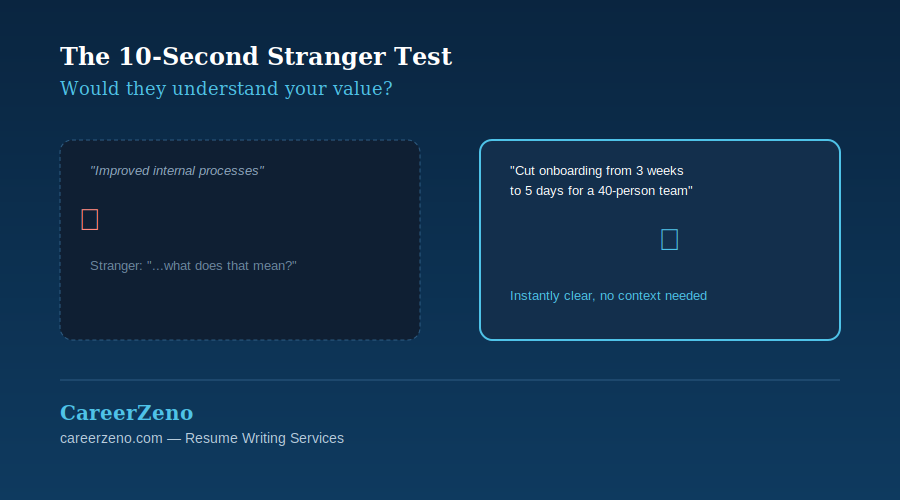
Anyone deeply familiar with their own work fills in gaps automatically without realizing it. A phrase like "improved internal processes" makes complete sense to the person who did the work, because they know exactly what was improved and by how much. A stranger reading the same phrase has no such context, and the sentence effectively says nothing measurable at all. This is the core failure mode: writers assume shared context that a reader simply doesn't have.
What Passing the Test Actually Requires
A resume that passes the stranger test tends to lead every major point with a concrete, specific claim — a number, a scope, a clear before-and-after. "Improved internal processes" becomes "Reduced onboarding time from three weeks to five days for a 40-person team." The second version requires no outside context to understand its value; a stranger reading it in isolation immediately grasps what happened and why it mattered.
How Professional Writing Closes the Gap
A resume writer's core job is essentially playing the role of that stranger — reading each line with zero assumed context and asking what's actually being communicated. This outside perspective catches exactly the gaps a self-written resume can't see, because the writer already knows what they meant, even when the words on the page don't fully say it.
The resulting document usually doesn't grow longer. If anything, replacing vague claims with specific ones tends to tighten a resume, since specific language is often more efficient than the hedged, generic phrasing it replaces.
Why This Standard Is Worth Holding a Resume To
Recruiters functionally are the strangers this test describes — they have no prior context on a candidate's work and only a few seconds to form an impression. A resume built to pass the stranger test is, by design, built for exactly the conditions under which it will actually be read.
CareerZeno apply this exact standard, making sure every major claim on a resume would make sense — and land — even to someone with zero prior context on the work behind it.
A resume that only makes sense to the person who wrote it isn't really finished yet, no matter how polished it looks.