
The rapid advancement of drone technology has transformed industries ranging from logistics and agriculture to surveillance and defense. However, the increasing use of unmanned aerial vehicles (UAVs) has also introduced new security challenges. Unauthorized drones can be used for espionage, smuggling, unauthorized surveillance, or even attacks on critical infrastructure. As a result, governments, military organizations, and private enterprises are investing heavily in technologies capable of detecting and neutralizing these aerial threats.
Two of the most widely adopted counter-drone approaches are drone interceptors and drone jammers. While both are designed to stop hostile drones, they operate in fundamentally different ways and are suited for different operational environments. Understanding these differences is essential when selecting the right solution.
Understanding Drone Jammers
Drone jammers are electronic devices that disrupt the communication signals between a drone and its operator. By interfering with radio frequency (RF) or GPS signals, they force the drone to either land, return to its launch point, or lose control, depending on its programming.
This type of anti drone system is commonly used to protect restricted areas such as airports, government facilities, military bases, and public events where unauthorized drone activity could pose a significant security risk.
Advantages of Drone Jammers
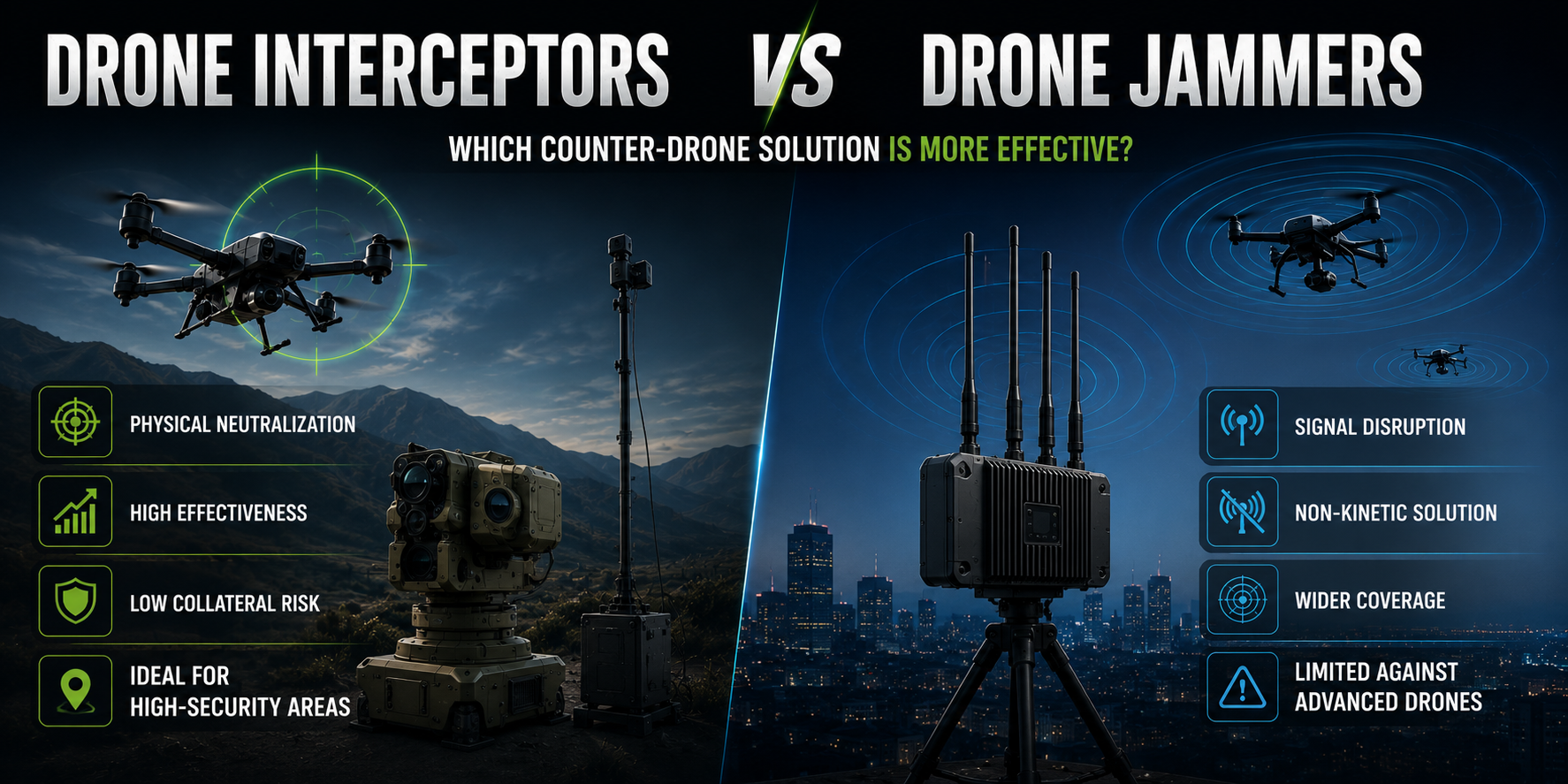
One of the biggest strengths of drone jammers is their ability to respond quickly. They can disable multiple commercially operated drones without causing physical damage, making them an effective non-kinetic solution. They are also relatively easy to deploy in fixed security installations.
However, drone jammers have limitations. Many autonomous drones can continue their missions even after communication signals are disrupted. Additionally, RF jamming may interfere with nearby communication networks and is subject to strict regulatory controls in many countries.
Understanding Drone Interceptors
Unlike jammers, drone interceptors physically engage hostile drones. These interceptor drones use advanced radar, artificial intelligence, and tracking systems to identify, pursue, and neutralize aerial threats.
Some interceptor systems deploy nets to safely capture drones, while others are designed for controlled collision or other physical interception methods. Because they do not rely on signal disruption, they remain effective against autonomous drones operating without continuous communication links.
A modern counter drone system based on interception provides highly precise threat neutralization while minimizing interference with surrounding electronic infrastructure.
Advantages of Drone Interceptors
Drone interceptors offer several advantages over traditional electronic countermeasures. They provide highly accurate targeting, can recover hostile drones for forensic analysis, and remain effective against autonomous or GPS-independent UAVs.
Their physical interception capability also reduces the likelihood of unintended interference with civilian communication systems, making them suitable for sensitive operational environments.
The primary challenges include higher deployment costs, more complex operational requirements, and the need for sophisticated tracking systems.
Comparing Drone Interceptors and Drone Jammers
Although both technologies serve the same purpose, their effectiveness depends largely on the nature of the threat.
Drone jammers excel in situations where commercial drones rely heavily on communication signals. They offer rapid response and can neutralize multiple targets without physical engagement.
Drone interceptors, on the other hand, provide greater accuracy and are capable of defeating advanced autonomous drones that electronic jamming cannot stop. They also enable operators to safely recover hostile drones for intelligence gathering or legal investigations.
Rather than choosing one technology over the other, many security agencies are now integrating both into layered defense strategies.
The Rise of Integrated Counter-Drone Defense
Modern security requirements demand comprehensive protection rather than relying on a single technology. Today's anti drone technology combines radar, electro-optical sensors, artificial intelligence, RF detection, drone jammers, and interceptor drones into a unified defense network.
This multi-layered approach allows operators to detect threats early, classify drone behavior, select the most appropriate response, and neutralize threats with minimal collateral impact.
Integrated systems significantly improve response times while increasing overall mission success rates.
Choosing the Right Solution
Selecting the appropriate counter-drone capability depends on several operational factors.
Organizations responsible for airports, military installations, energy facilities, border security, and critical infrastructure should evaluate the nature of expected threats, environmental conditions, legal regulations, and response requirements before deployment.
For environments where communication interference must be minimized, interceptor-based systems often provide superior performance. Conversely, facilities requiring rapid area denial against conventional drones may benefit from jammer-based technologies.
An effective anti drone defense system should always be selected based on mission objectives rather than relying on a one-size-fits-all approach.
Divyania's Commitment to Advanced Counter-Drone Technologies
As drone threats continue to evolve, organizations require advanced counter-drone technologies to detect, track, and neutralize unauthorized UAVs effectively. Divyania focuses on developing advanced security solutions that address emerging aerial threats through innovative drone defense technologies.
With expertise in anti drone systems, counter UAV solutions, and intelligent threat detection technologies, Divyania delivers reliable solutions designed to enhance aerial security, improve threat response, and support critical infrastructure protection.
Conclusion
The growing use of drones has made effective counter-drone capabilities an essential component of modern security strategies. Drone jammers provide rapid electronic disruption, while drone interceptors deliver precise physical neutralization, particularly against autonomous aerial threats.
Instead of viewing these technologies as competitors, organizations increasingly recognize the value of combining both within comprehensive anti drone solutions that integrate detection, tracking, identification, and response. As drone technology becomes more sophisticated, layered counter-drone defense systems will remain the most effective approach for protecting military assets, public infrastructure, and critical facilities against evolving UAV threats.