
Standards compliance is what separates credible double block and bleed valve manufacturers from suppliers offering look-alike products. Because a DBB valve is frequently the sole barrier between a live process and a work crew performing hot work, confined space entry, or equipment isolation, procurement and engineering teams need a working understanding of the standards landscape before evaluating any manufacturer's claims.
EEMUA 182: The Core DBB Design Specification
EEMUA Publication 182, issued by the Engineering Equipment and Materials Users' Association, is the specification most directly written for integral block and bleed valve manifolds connected to pipework. It covers configuration, connections, design, materials, fire safety, testing, and marking requirements specific to DBB and block-and-bleed manifolds, and it is commonly cited as a baseline requirement by operators in upstream and downstream oil and gas projects. Double block and bleed valve manufacturers who reference EEMUA 182 on their datasheets should be able to produce design verification reports, not just a stamped logo.
API 6D and ISO 14313: Pipeline Valve Design Basis
For larger DBB valves used in pipeline and process isolation duty, API 6D (harmonized internationally with ISO 14313) governs general design, materials, and inspection requirements for pipeline valves, including the double block and bleed function definition itself. Manufacturers supplying into pipeline, gathering station, or metering skid applications should demonstrate API 6D design qualification alongside EEMUA 182 conformance, since the two specifications address overlapping but distinct aspects of valve integrity.
ASME B16.34: Pressure-Temperature Ratings
Every DBB valve body, regardless of design variant, must carry pressure-temperature ratings consistent with ASME B16.34. This standard defines the allowable pressure classes across material groups and temperature ranges, and it underpins flange dimensional compatibility with connecting pipework per ASME B16.5. Buyers should cross-check the manufacturer's published pressure-temperature charts against the actual body material grade being supplied, since ratings vary significantly between carbon steel, low-temperature carbon steel, and stainless or duplex alloys.
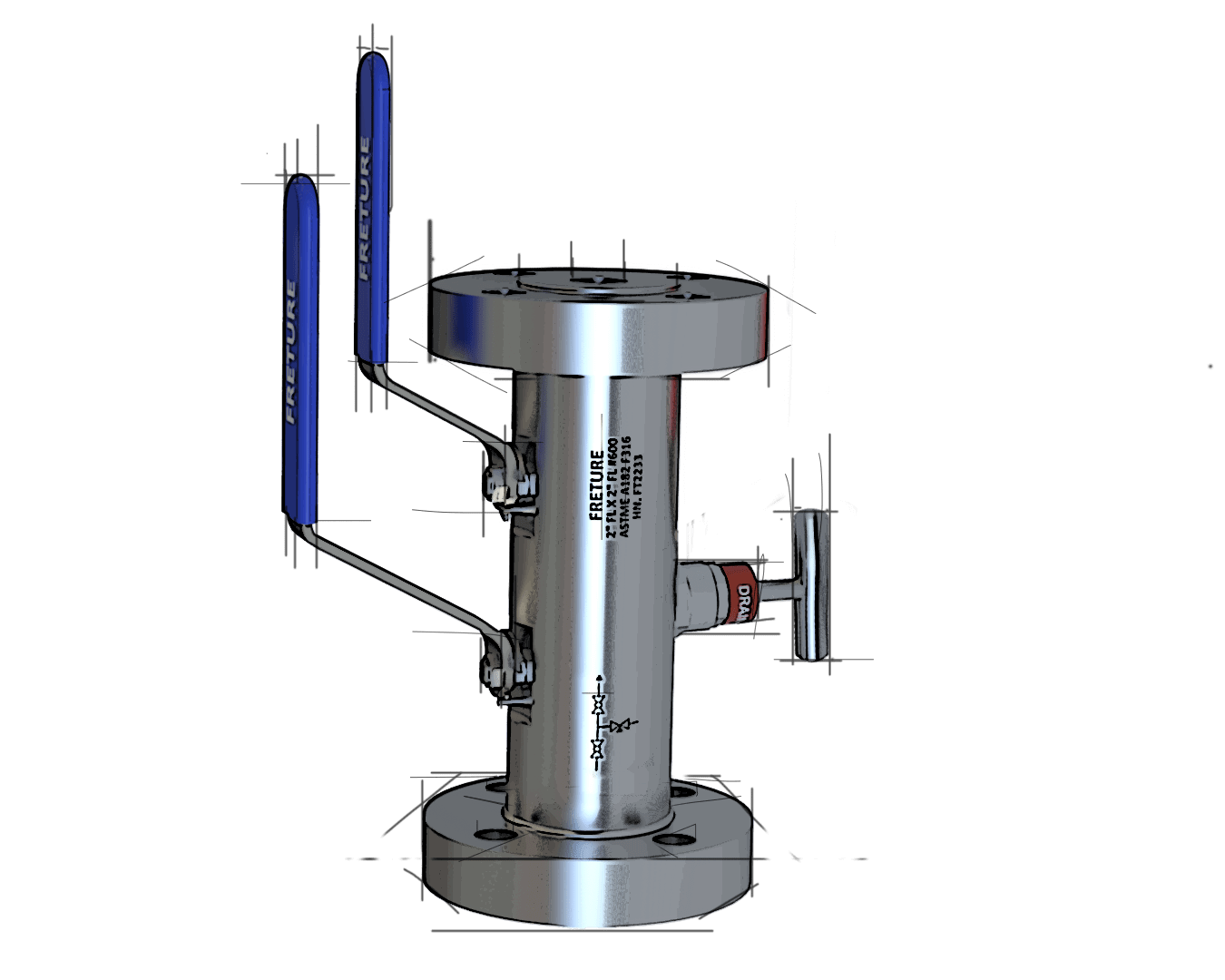
API 598: Valve Inspection and Test Requirements
API 598 governs the shell, seat, and backseat testing procedures applied to valves before shipment, including acceptable leakage rates for both liquid and gas testing media. For double block and bleed valve manufacturers, API 598 testing must be performed independently on each isolating element, since the entire premise of DBB functionality is that either seat can independently hold full differential pressure while the cavity is vented to confirm zero bypass.
Fire-Safe and Fugitive Emission Qualification
Where DBB valves serve hydrocarbon or other flammable process duty, fire-safe design qualification to API 607 or API 6FA demonstrates that the valve will maintain acceptable sealing performance through a defined fire exposure and cool-down cycle. Separately, fugitive emission testing to ISO 15848-1 verifies stem packing and body seal performance against prescribed leakage classes over thousands of operating cycles — increasingly a mandatory requirement on refinery and petrochemical projects targeting low-emission operation.
Material Standards for Sour and Corrosive Service
For sour gas, produced water, and other H2S-bearing services, NACE MR0175 (harmonized with ISO 15156) governs material selection to prevent sulfide stress cracking. Double block and bleed valve manufacturers supplying into upstream and gas processing applications should offer NACE-compliant trim and body material options without altering the fundamental DBB sealing geometry that EEMUA 182 and API 6D require.
Reading a Manufacturer's Compliance Statement Correctly
A trustworthy compliance statement lists each applicable standard against the specific test or design element it governs, supported by traceable certificates: mill test reports for raw material, NDT records, hydrostatic and pneumatic test certificates, and where relevant, third-party witness or inspection agency sign-off. Vague references to "international standards" without specific standard numbers and test data are a signal to ask further questions before proceeding.