
Introduction
In the modern landscape of cloud-native architecture, Kubernetes has established itself as the standard for orchestrating containerized workloads. For software developers and platform engineers, the Certified Kubernetes Application Developer (CKAD) credential serves as the primary benchmark for technical authority. This certification validates the capability to design, build, and deploy robust applications within a Kubernetes ecosystem. By training through devopsschool, professionals gain the practical expertise required to move beyond basic container awareness and into the realm of enterprise-grade application management. This guide explores the strategic value of the certification and how it functions as a catalyst for professional growth.
What is the Certified Kubernetes Application Developer (CKAD)?
The CKAD is a performance-oriented certification designed specifically for the application lifecycle. Unlike infrastructure-focused credentials that prioritize cluster stability and node health, the CKAD focuses on the developer’s role: writing manifests, managing configuration, orchestrating services, and debugging workloads. It exists because "knowing" Kubernetes is not the same as "operating" it; the exam environment forces candidates to resolve real-world deployment challenges in a live, time-limited Linux terminal. By centering on hands-on tasks, it ensures that certified professionals possess the muscle memory and technical intuition to keep microservices running smoothly in production.
Who Should Pursue Certified Kubernetes Application Developer (CKAD)?
This certification is essential for anyone whose daily responsibilities involve shipping software to a containerized environment. This includes:
-
Software Developers: Those looking to package and deploy their applications with higher reliability.
-
DevOps Practitioners: Engineers aiming to standardize their CI/CD pipelines through well-defined Kubernetes manifests.
-
Site Reliability Engineers (SREs): Those who need to troubleshoot application-level issues or optimize system performance.
-
Cloud Architects: Managers and leads who need a deep understanding of what can—and cannot—be achieved within a Kubernetes deployment.
Why Certified Kubernetes Application Developer (CKAD) is Valuable
The industry has moved toward a model where Kubernetes is the primary interface for cloud infrastructure. Holding the CKAD credential is a clear signal to employers that you can navigate this complexity without reliance on trial and error. It offers significant career longevity because the fundamental primitives of Kubernetes—such as Pods, Services, and Deployments—remain constant despite the rapid evolution of external tooling. Furthermore, as organizations struggle to find qualified talent, certified individuals gain a distinct advantage in both recruitment and salary negotiation, backed by the credibility of a performance-based validation.
Certified Kubernetes Application Developer (CKAD) Certification Overview
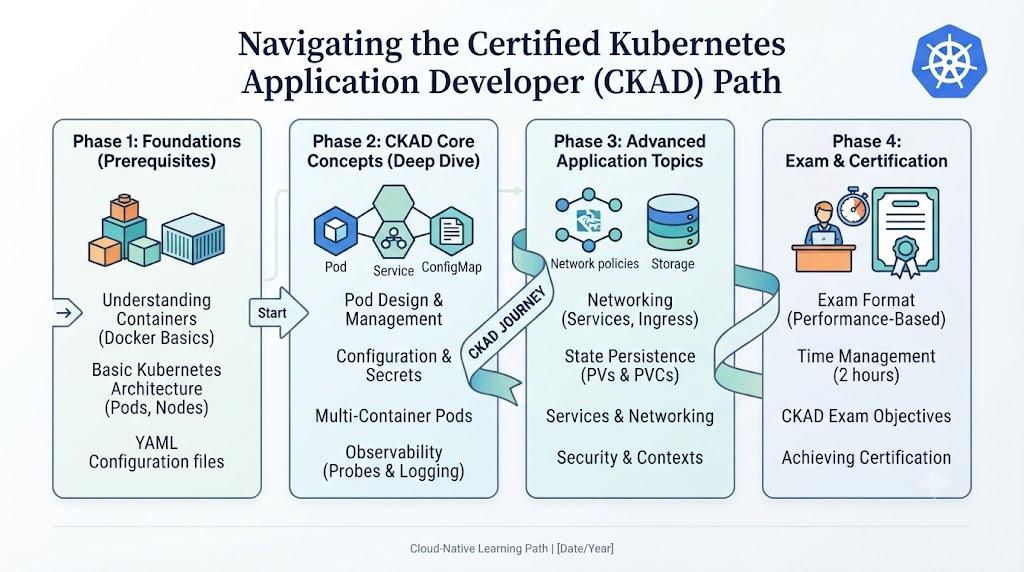
The certification is an initiative of the Cloud Native Computing Foundation (CNCF), with training programs provided by industry partners like devopsschool. It is a purely terminal-based assessment; you are evaluated on your ability to complete specific tasks on a remote cluster. Because there are no multiple-choice questions, the exam requires you to be efficient with imperative commands and quick to navigate the official Kubernetes documentation. The assessment is divided into several domains, testing everything from basic resource definition to complex multi-container pod design and security contexts.
Certified Kubernetes Application Developer (CKAD) Certification Tracks & Levels
The Kubernetes certification roadmap is generally split into functional tiers:
-
Foundational Tier: Focuses on the basics—running containers, managing simple pods, and understanding namespaces.
-
Professional Tier: The CKAD level—covers the full lifecycle, including rolling updates, configuration management, and networking.
-
Advanced/Specialist Tier: Moves beyond development into the realms of security (CKS) and cluster administration (CKA).
Complete Certified Kubernetes Application Developer (CKAD) Certification Table
| Track | Level | Who it’s for | Prerequisites | Skills Covered |
| Core Kubernetes | Foundation | Junior Devs | Linux/Docker Basics | Pods, Namespaces, basic CLI |
| Application Dev | Professional | DevOps/SRE | Core Kubernetes | Deployments, ConfigMaps, Secrets |
| Advanced Security | Specialist | Security Pros | Professional Level | RBAC, Network Policies, Image Security |
Detailed Guide for Each Certified Kubernetes Application Developer (CKAD) Certification
Certified Kubernetes Application Developer (CKAD) – Professional
What it is
The industry-standard validation for developers building and managing Kubernetes-native applications.
Who should take it
Anyone writing code that targets a Kubernetes cluster or managing the configuration of such applications.
Skills you’ll gain
-
Defining multi-container pod designs (e.g., sidecars).
-
Managing state via Persistent Volumes and Claims.
-
Implementing readiness and liveness probes to ensure uptime.
-
Debugging cluster-wide network and configuration errors.
Real-world projects you should be able to do
-
Executing a zero-downtime rolling update.
-
Injecting secret configurations into a running pod environment.
-
Creating automated CronJobs for background maintenance tasks.
-
Configuring Ingress rules to route external traffic to your services.
Preparation plan
-
0–14 Days: Master imperative kubectl commands to reduce reliance on manual YAML editing.
-
15–30 Days: Practice labs focusing on troubleshooting and debugging existing deployments.
-
31–60 Days: Perform full-length timed mock exams to optimize your speed.
Common mistakes
-
Spending too much time on a single complex task instead of flagging it for later.
-
Neglecting to check the namespace before executing commands.
-
Relying on memory rather than learning to search official documentation effectively.
Best next certification after this
-
Same-track: Certified Kubernetes Administrator (CKA).
-
Cross-track: Certified Kubernetes Security Specialist (CKS).
Choose Your Learning Path
DevOps Path
This path focuses on the "glue" that holds modern systems together. You will learn to use Kubernetes as a platform to automate deployment cycles, ensuring that your application updates are frequent, predictable, and resilient.
DevSecOps Path
Here, the focus shifts to hardening. You will learn to apply Security Contexts, use Network Policies to enforce micro-segmentation, and manage Service Accounts to implement the principle of least privilege.
SRE Path
SRE is about reliability under stress. This path teaches you to design for failure, optimize resource requests and limits to prevent noisy-neighbor syndrome, and master the logs to perform rapid incident response.
AIOps Path
This emerging path explores using machine learning to monitor cluster health. You will learn how to feed Kubernetes logs into AIOps pipelines to predict failures before they impact your users.
MLOps Path
Focuses on deploying and managing machine learning models. You will master how to expose GPU resources to containers and manage large, static datasets via specialized Kubernetes volumes.
DataOps Path
DataOps is for those managing stateful workloads. You will focus on the persistence layer, learning to orchestrate distributed databases and handle data replication within the cluster.
FinOps Path
This path centers on the economics of the cloud. You will learn how to monitor resource consumption and implement autoscaling policies that align infrastructure costs with actual application demand.
Role → Recommended Certified Kubernetes Application Developer (CKAD) Certifications
| Role | Recommended Certifications |
| DevOps Engineer | CKAD, CKA |
| SRE | CKAD, CKA, CKS |
| Platform Engineer | CKAD, CKA |
| Cloud Engineer | CKAD, CKA |
| Security Engineer | CKAD, CKS |
| Data Engineer | CKAD, Data Architecture |
| FinOps Practitioner | CKAD, FinOps |
| Engineering Manager | CKAD, Strategy Certs |
Next Certifications to Take After Certified Kubernetes Application Developer (CKAD)
Same Track Progression
Advance your cluster-level knowledge with the CKA, which covers the control plane, etcd storage, and node-level configurations.
Cross-Track Expansion
Expand your scope to include container security and supply chain integrity by pursuing the Certified Kubernetes Security Specialist (CKS).
Leadership & Management Track
For those aiming for CTO or Architect roles, focus on multi-cluster orchestration, hybrid cloud strategy, and organizational governance.
Training & Certification Support Providers
The Core Platform Authority
devopsschool : is a leading training institution that emphasizes an immersive, lab-based approach to professional development. Their methodology focuses on the realities of production environments, ensuring that learners are equipped to manage the day-to-day operational challenges of a Kubernetes-heavy stack. With a focus on the developer’s lifecycle, they provide a comprehensive curriculum that bridges the gap between basic container knowledge and expert-level application orchestration. Their mentors are industry veterans who prioritize practical troubleshooting and command-line efficiency, making them an ideal partner for those seeking to earn their CKAD credential with a focus on long-term mastery.
Cotocus: offers specialized training that integrates cloud-native design patterns into everyday developer workflows, emphasizing efficiency and performance.
Scmgalaxy : provides training focused on the automation of deployment pipelines, which is a critical skill for any developer working within modern Kubernetes environments.
BestDevOps: is a curator of technical best practices, offering instruction that helps teams adopt a culture of shared responsibility and automated operational excellence.
devsecopsschool.com: focuses exclusively on the security layer, teaching engineers how to defend their Kubernetes workloads against evolving threats.
sreschool.com: specializes in the reliability side of the house, offering labs that stress-test your ability to maintain uptime and recover from failures.
aiopsschool.com: is a leader in modern AI-integrated monitoring, preparing engineers to use predictive analytics within their infrastructure.
dataopsschool.com: focuses on the management of stateful applications, which is essential for data engineers who need to deploy storage-heavy workloads.
finopsschool.com: teaches the financial stewardship of infrastructure, helping engineers build cost-efficient deployments that satisfy both business and technical needs.
Frequently Asked Questions (General)
-
Is the exam suitable for those new to Linux? The exam requires a solid grasp of Linux basics, as it is conducted entirely within a command-line environment.
-
How long should I prepare? Consistency is key. A dedicated study of 4–6 weeks, involving daily lab practice, is generally enough for most professionals.
-
Are there age limits for the exam? No, the exam is open to anyone with the required technical knowledge and the ability to meet the proctoring requirements.
-
Can I skip the course and just take the exam? Yes, you can register for the exam independently, but structured training significantly improves your pass rate.
-
Does the certification focus on a specific cloud? No, it is vendor-neutral, ensuring that the skills are transferable across AWS, GCP, Azure, and on-premises environments.
-
Is there a physical component to the exam? No, it is a remote, online proctored exam where you share your screen with a proctor.
-
How does the renewal process work? Certifications are typically valid for three years, after which you can renew by retaking the exam or completing continuing education credits.
-
Is it worth it if I already have years of experience? Yes, it acts as a formal validation that quantifies your practical Kubernetes skills for recruiters and hiring managers.
-
What happens if my internet fails? The proctoring service typically has a procedure for such events; however, it is advised to have a reliable backup connection.
-
Are the practice labs provided by training sites identical to the exam? They are designed to be similar to help you get used to the interface and pressure.
-
Do I need to be a developer to pass? The name says "Developer," but the skills are equally applicable to any technical role that interacts with Kubernetes pods.
-
Can I take the training and exam in a language other than English? The official exam is primarily in English, so most training programs are conducted in English to ensure familiarity with technical terminology.
FAQs on Certified Kubernetes Application Developer (CKAD)
-
What is the most important command to know? kubectl—everything else is a variation of using this tool effectively.
-
Do I need to know Python or Go? Not to pass the exam, but understanding the basics of JSON/YAML is non-negotiable.
-
How much time per question? You have roughly 6–7 minutes per task; pace yourself accordingly.
-
Should I use an IDE? The exam environment is a basic terminal; get comfortable with text-based editors like vi or nano.
-
Can I use aliases? Yes, you are encouraged to use aliases like k for kubectl to save time.
-
Is the difficulty static? No, tasks vary in complexity, so prioritize the easier ones first.
-
Does it cover Service Mesh? Only at a conceptual level; you will not be asked to configure complex meshes like Istio.
-
How does it test security? Through Security Contexts and Service Account permissions; focus on those areas.
Final Thoughts
Earning the CKAD is a commitment to professional excellence in the cloud-native era. It validates that you can move beyond theory and deliver code that is not only functional but also resilient and maintainable in a real production cluster. If you are looking to advance your career and gain a deeper, more confident understanding of how applications behave at scale, this certification is a highly recommended investment. It is an objective signal of your technical capability that will pay dividends in your future projects and career transitions.