
Censuring Ignorance, and its People.

Index:
al-Muqaddimah
al-Naqḍ ʿalā al-Jahl wa al-Buhtān
- Taʿrīf al-ʿIlm wa al-Jahl
- Manāshiʾ al-Jahl
- ʿAwāqib al-Jahl
Ibṭāl Aʿdhār al-Juhhāl al-Ashrār
Kashf Shubuhāt al-Mutajāhilīn
al-Khātimah
• al-Muqaddimah •
In the Name of Allāh, the Most Merciful, the Bestower of Mercy.
All praise belongs to Allāh, the Most High, the Oft-Forgiving, the Almighty, the Subduer; vast in favour and excellence, abundant in generosity and gracious bestowal; the One who guided whom He willed from His servants to the light of Islām, turned them by His favour away from the paths of error and illusions, made disbelief, wickedness, and disobedience hateful to them, opened for whomever He intended good the doors of knowledge, understanding, and certainty, and made the final outcome belong to the people of piety, truthfulness, and firm establishment.
And I bear witness that there is no deity worthy of worship except Allāh alone, without any partner, the testimony of a servant who hopes through it for salvation and divine pleasure, and asks his Lord through it for success and excellence. And I bear witness that Muḥammad is His servant and Messenger, the truthful, the trustworthy, and the clear sincere adviser; may Allāh send prayers upon him, and upon his family, and all of his companions.
To proceed:
Allāh created the creation for His worship alone, and He did not leave them neglected without guidance or clarification. He sent messengers, revealed books, established clear proofs, and raised among the people scholars who explain the truth and repel falsehood. The foundation of this guidance is knowledge, and the greatest of all knowledge is the knowledge of Allāh, His names, His attributes, and His right upon His servants, which is that He be singled out in worship. Opposite to this light is the darkness of ignorance, which the Qurʾān and Sunnah have condemned in many places, and which the early generations warned against with severe words and fearful hearts.
ʿIlm in the speech of the Arabs and in the Sharʿi usage is firm knowledge that clarifies the truth, distinguishes guidance from misguidance, and produces correct understanding and correct action. Opposite to this is jahl, which is not only the absence of knowledge, but also acting without insight, foolishness, and transgression that springs from blindness of the heart. Jahl is also the opposite of ḥilm, which is forbearance and respecting the rights of others. So jahl can be that a person does not know, and it can be that he knows but acts as if he does not know, following desire, pride, or heedlessness. In both cases, ignorance is from which many branches of misguidance grow.
In every time and place, ignorance has been the door through which shirk, kufr, bidʿah, and major sin enter into the lives of people. However, in the age in which we live, ignorance has taken on an even more dangerous form. It is not only that people are ignorant of the fundamentals of their religion, while the Qurʾān is recited among them, translations are widespread, and access to knowledge is easier than ever. Rather, a second calamity has appeared, which is that ignorance itself has been turned into a claimed excuse for everything, even for matters which the earlier generations regarded as clear kufr and major shirk that no sane Muslim can be excused from knowing. So you hear people saying, regarding the most serious violations of Tawḥīd and the greatest nullifiers of Islām, that the person is excused because he did not know, or that the time is different, or that the people are weak, or that speaking firmly about these issues divides the ummah and causes hardship.
This misuse of “ignorance” as a shield has led to the destruction of clarity in ʿaqīdah, the lowering of the status of knowledge, and the emboldening of those who mix truth and falsehood in the name of mercy and lenience. Many have started to imagine that Islām is only feelings, slogans, and general intentions, while the clear boundaries of what is Islām and what is kufr, what is Tawḥīd and what is shirk, what is Sunnah and what is bidʿah, are left blurred and undefended. This is a betrayal of the path of the Salaf, who were the most fearful of misguidance and the most severe in warning against causes that lead to destruction in the Hereafter.
This article, Dhamm al-Jahl, clarifies the reality of ignorance from the Book and the Sunnah upon the understanding of the Salaf. It gathers the foundations of the subject and arranges them in a clear path, so that the reader recognizes what jahl is, how it takes root, how it spreads, and where it leads, and so that the truth is not diluted by slogans that soften what Allāh and His messenger made severe.
It will define the meanings of knowledge and ignorance, in the language of the Arabs, and the matters of religion, then it will show the origins upon which ignorance forms in the servant’s belief, speech and actions. It will further expose the causes that produce it, and keep it alive, such as turning away from knowledge, or preferring ease over effort, blind following, placing tradition over revelation, and so on. It will aim to refute and challenge the principles and excuses upon which the ʿĀdhiriyyah and Madākẖilah use to excuse every mushrik or kāfir “imām”, and to not use the books of the Salaf as their source of knowledge.
It will then aim to clarify the matters upon which the masses are ignorant of, or differ among. It will bring evidences on the takfīr of the Ashāʿirah, the takfīr of those who do Taʾwīl regarding the Ṣifāt of Allāh, Individual Takfīr (a topic that many scholars have misguided the public to be only for those who are scholars), the proof of big Imāms who were abandoned for their mistakes, and takfīred even with no sign of them holding to status or praise, the proofs that refute the excuse of ignorance, and blind following. Then a response to those who use the argument of precedence in takfīr to suspend takfīr, and last but not least, a clarification for those whom seek knowledge.
I write this too as a reminder to my own soul, which is surrounded by causes of ignorance, negligence, and misguidance, and which is weak except by the mercy of Allāh. Then I hope it will be a benefit to whoever reads it, whether he is at the beginning of seeking knowledge or has already taken some of its share. Whoever finds in this article something right and in agreement with the Book of Allāh and the Sunnah of His messenger upon the understanding of the Salaf, then that is from Allāh alone and His bounty. Whoever finds in it error or deficiency, then that is from myself and from the Shayṭān, and I ask Allāh to forgive it and to guide me to correct it. And indeed, over every possessor of knowledge is one more knowing.
I ask Allāh, the Lord of the mighty throne, to make this article sincere for His face, free from showing off and seeking reputation, and to place it among the deeds that are accepted in the scale on the Day of Judgment. I ask Him to protect us from ignorance, from dying upon misguidance, and from being pleased with ourselves while He is displeased with us. I ask Him to make us among those who listen to the speech and follow the best of it. Indeed, He is able to do all things, and He is the best disposer of affairs.
• Taʿrīf al-ʿIlm wa-l-Jahl •
In everyday life, we rely on words whose meanings we assume and generally understand. We are able to organize our thoughts, convey our intentions, and communicate positions through language with little difficulty. This process usually functions smoothly because the terms being used are familiar and their meanings are defined.
This ease breaks down when unfamiliar words are introduced or when commonly used terms are left undefined. In such cases, communication shifts from clarity to assumption. A single term may carry multiple meanings, and speakers may use the same word while intending different concepts. When this happens, disagreement is no longer over substance but over language itself. Ignorance of a term, or carelessness in defining it, produces confusion that is often mistaken for disagreement.
So, understanding this requires that knowledge and ignorance be defined at the outset. Examining how these terms were used in early Arabic clarifies how they were later understood by the early Muslims, since the religion of Allāh and His Messenger ﷺ was revealed in that language.
◈ Ibn Manẓūr said in [Lisān al-ʿArab - vol. 3, p. 229]
Jahl: jahl is the opposite of ʿilm (knowledge). One says: “So-and-so jahilahu” (he was ignorant of it), with the verbal nouns jahlan and jahālah; and “he jahila ʿalayhi” (he acted ignorantly toward him, or treated him with ignorant conduct). Tajāhala: he displayed ignorance, according to Sībawayh. Al-Jawharī said: Tajāhala means he acted as though he were ignorant, while he was not; and istajhalahu means he considered him ignorant, and it is also used in the sense of treating him as insignificant. Tajhīl: to ascribe ignorance to someone; and one says: “So-and-so jahila ḥaqqa so-and-so” (he was ignorant of, or failed to recognize, the right of so-and-so), “So-and-so jahila ʿalayya” (he behaved ignorantly toward me), and “he jahila this matter” (he did not know it).
Jahālah: to do an act without knowledge. Ibn Shumayl said: “So-and-so is jāhalu of so-and-so,” meaning: more ignorant of him, or ignorant concerning him.
[...]
al-Majhalah: whatever drives you into jahl. From this is the ḥadīth: “A child causes miserliness, cowardice, and ignorance.” In another ḥadīth: “You certainly act ignorantly, and you are miserly, and you are cowardly,” meaning that children push fathers into ignorant behavior through play and indulgence, out of guarding their feelings; each of these words is discussed in its own place.
◈ ar-Rāghib al-Aṣfahānī said in [al-Mufradāt fī Gharīb al-Qurʾān - p. 209]:
Ignorance (al-jahl) is of three types:
The first: The soul being devoid of knowledge. This is the foundation. Some theologians (mutakallimūn) have made this (type of ignorance) a meaning that necessitates actions outside of the proper order, just as they made knowledge a meaning that necessitates actions that conform to the proper order.
The second: Believing something to be other than what it actually is.
The third: Doing something contrary to how it ought to be done, regardless of whether one holds a correct or corrupt belief about it — such as one who deliberately abandons the prayer. To this type refers His saying, the Exalted: "They said: 'Do you take us in mockery?' He [Mūsā] said: 'I seek refuge with Allāh from being among the ignorant (al-jāhilīn)'" (Sūrah al-Baqarah 2:67). Thus He made the act of mockery a form of ignorance. And He said, mighty and majestic: "Then verify, lest you harm a people out of ignorance (bijahālah)" (Sūrah al-Ḥujurāt 49:6).
Sometimes "the ignorant" (al-jāhil) is mentioned by way of blame — and that is the most common. And sometimes not by way of blame, as in: "The ignorant (al-jāhil) would think them wealthy because of their modesty" (Sūrah al-Baqarah 2:273) — meaning: one who does not know their condition, not meaning the one characterized by blameworthy ignorance.
Al-majhal (that which induces ignorance): It refers to a matter, a land, or a trait that leads a person to believe something to be other than what it actually is.
"And the wind made the branch appear ignorant (istajhalat al-rīḥ al-ghuṣn):" It moved it vigorously, as if it caused it to engage in ignorance. That is a fine metaphor.
ʿIlm: Among the Attributes of Allāh, Exalted and Majestic, are al-ʿAlīm (the All-Knowing), al-ʿĀlim (the Knower), and al-ʿAllām (the One of vast, perfect knowledge). Allāh, Exalted and Majestic, said: “Verily, your Lord is the All-Knowing Creator.” And He said: “All-Knower of the unseen and the seen.” And He said: “You are the All-Knower of the unseen.” So He is Allāh, the Knower of what was and what will be before it comes to be, and of what will be and what has not been yet, before it ever comes to be. He has never ceased being Knowing, and He will always remain Knowing of what was and what will be. Nothing at all is hidden from Him on earth or in the heaven. Glorified and Exalted is He. His knowledge encompasses all things, their inward and outward, their minute and their great, in the most complete manner possible.
ʿAlīm: It is on the pattern faʿīl, one of the intensive forms. It is permissible to call a human being ʿalīm if Allāh has taught him a branch of knowledge, as Yūsuf said to the king: “Verily, I am a good keeper, knowledgeable.” And Allāh, Exalted and Majestic, said: “It is only those who have knowledge among His slaves that fear Allāh.” So He, Exalted and Majestic, informed that among His slaves are those who fear Him, and that they are the scholars. Likewise, the description of Yūsuf, peace be upon him: he was knowledgeable regarding the affair of his Lord, that He is One and that there is nothing like unto Him, in addition to what Allāh taught him of the interpretation of dreams, by which he would judge about unseen matters. So he was knowledgeable in what Allāh taught him.
Al-Azharī narrated from Saʿd ibn Zayd, from Abū ʿAbd al-Raḥmān al-Muqriʾ, regarding His saying, Exalted is He: “And verily, he was endowed with knowledge because We had taught him”: he said, “endowed with action in accordance with what We had taught him.” I said, “O Abū ʿAbd al-Raḥmān, from whom did you hear this?” He said, “From Ibn ʿUyaynah.” I said, “That is enough for me.”
It is also narrated from Ibn Masʿūd that he said: “Knowledge is not by the abundance of narration, rather knowledge is by awe and fear [of Allāh].” Al-Azharī said: what he said is supported by the saying of Allāh, Exalted and Majestic: “It is only those who have knowledge among His slaves that fear Allāh.” And some of them said: “The scholar is the one who acts upon what he knows.” He said: this supports the statement of Ibn ʿUyaynah.
al-ʿIlm: the opposite of al-jahl (ignorance). One says: ʿalima ʿilman, and ʿalima (he knew) himself. And a man is ʿālim or ʿalīm, from a people who are ʿulamāʾ (scholars), in both usages.
[...]
Ibn Jinnī said: since knowledge may be described of someone after practicing it and after long attachment to it, it becomes as if it were an innate disposition, and it is not like that at the beginning of his entering into it. If it were so at the start, he would be mutaʿallim (a learner), not ʿālim (a scholar). So when it came to be like an innate trait, it moved into the sense of ʿālim being like ʿalīm, so they gave it its broken plural and said ʿulamāʾ. Then they analogized its opposite to it and said juhalāʾ just as they said ʿulamāʾ, and ʿulamāʾ became like ḥulamāʾ (the forbearing), because knowledge brings forbearance to its possessor. In that same way, they used fāḥish and faḥshāʾ, since obscenity is among the types of ignorance and is opposite to forbearance.
As for what was mentioned about knowledge in the religion of Allāh:
◈ al-Imām Muḥammad ibn Idrīs al-Shāfiʿī said in his [ar-Risālah, p. 357-359]:
“So a speaker said to me: What is knowledge, and what is obligatory upon people regarding knowledge?
So I said to him: Knowledge is two knowledges:
A. Knowledge of the generality, such that it does not suffice for an adult, not overcome in his mind [i.e. not mentally unstable] to be ignorant of it.
He said: And like what?
I said: Like the five prayers, and that upon people for Allāh is the fast of the month of Ramaḍān, and the pilgrimage to the House if they are able, and zakāh in their wealth, and that He has forbidden them: fornication, killing, theft, wine, and whatever is in the meaning of this from what He charged the servants to understand, and to act upon, and to give from themselves and their wealth, and to refrain from it, from what He has forbidden them from it.
And this entire category is from knowledge found textually in the Book of Allāh ﷻ, and found generally among the people of Islām, their commoners transmit it from those who passed from their commoners, narrating it from the Messenger of Allāh ﷺ, and they do not dispute in its narration, nor its obligation upon them. And this is the general knowledge in which error is not possible, neither from report nor interpretation, and dispute is not permissible in it.
He said: So what is the second face?
B. I said to him: What comes upon the servants from the branches of the obligations, and whatever is singled out by it from the rulings and other than them, from what there is no text of the Book of Allāh ﷻ in, nor in most of it a text of Sunnah. Even if, in something of it, there is a Sunnah, then it is only from the reports of the specialists [i.e. those who are learned, or have knowledge], not the reports of the generality [meaning the general public], and what of it bears interpretation, and is supplemented by analogy (qiyās).”
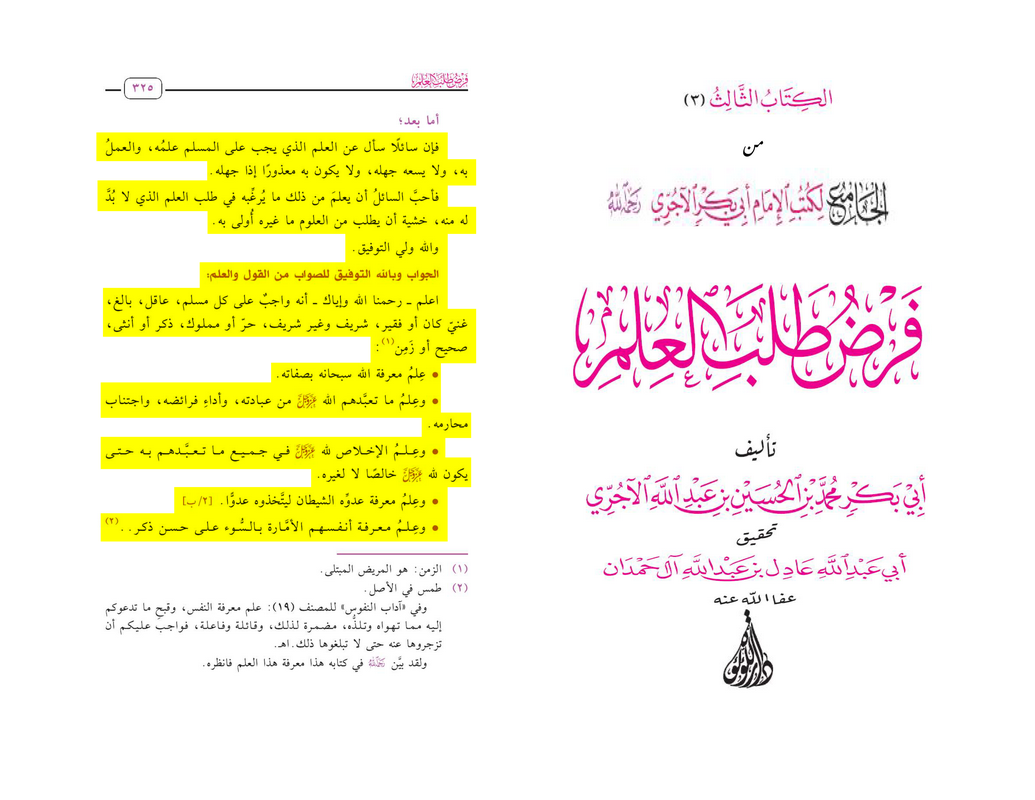
◈ And al-Imām Abū Bakr Muḥammad ibn al-Ḥusayn al-Ājurrī said regarding knowledge for which there is no excuse by ignorance and interpretation:
“So indeed a questioner asked about the knowledge which it is obligatory upon the Muslim to know, and to act upon, and he is not allowed to be ignorant of it, and he is not excused if he is ignorant of it. So the questioner loved to know from that what would make him desire seeking the knowledge that he must have, out of fear that he would seek from the sciences that which something else is more deserving. And Allāh is the Guardian of granting success.
The answer, and with Allāh is granting success to what is correct of speech and knowledge:
Know, may Allāh have mercy upon us and upon you, that it is obligatory upon every Muslim: sane, adult, whether rich or poor, noble and not noble, free or enslaved, male or female, healthy or chronically ill:
A. Knowledge of knowing Allāh, Glorified is He, by His attributes.
B. Knowledge of what Allāh ﷻ has obligated them with of His worship, performing His obligations, and avoiding His prohibitions.
C. Knowledge of sincerity to Allāh ﷻ in all that He obligated them with, so that it becomes purely for Allāh ﷻ, not for other than Him.
D. Knowledge of knowing his enemy Shayṭān, so that they take him as an enemy.
E. Knowledge of knowing their own souls that command to evil, upon good remembrance.”
📓 Farḍ Ṭalab al-ʿIlm - p. 1 [I couldn't find the book on Shāmilah]
◈ And he said:
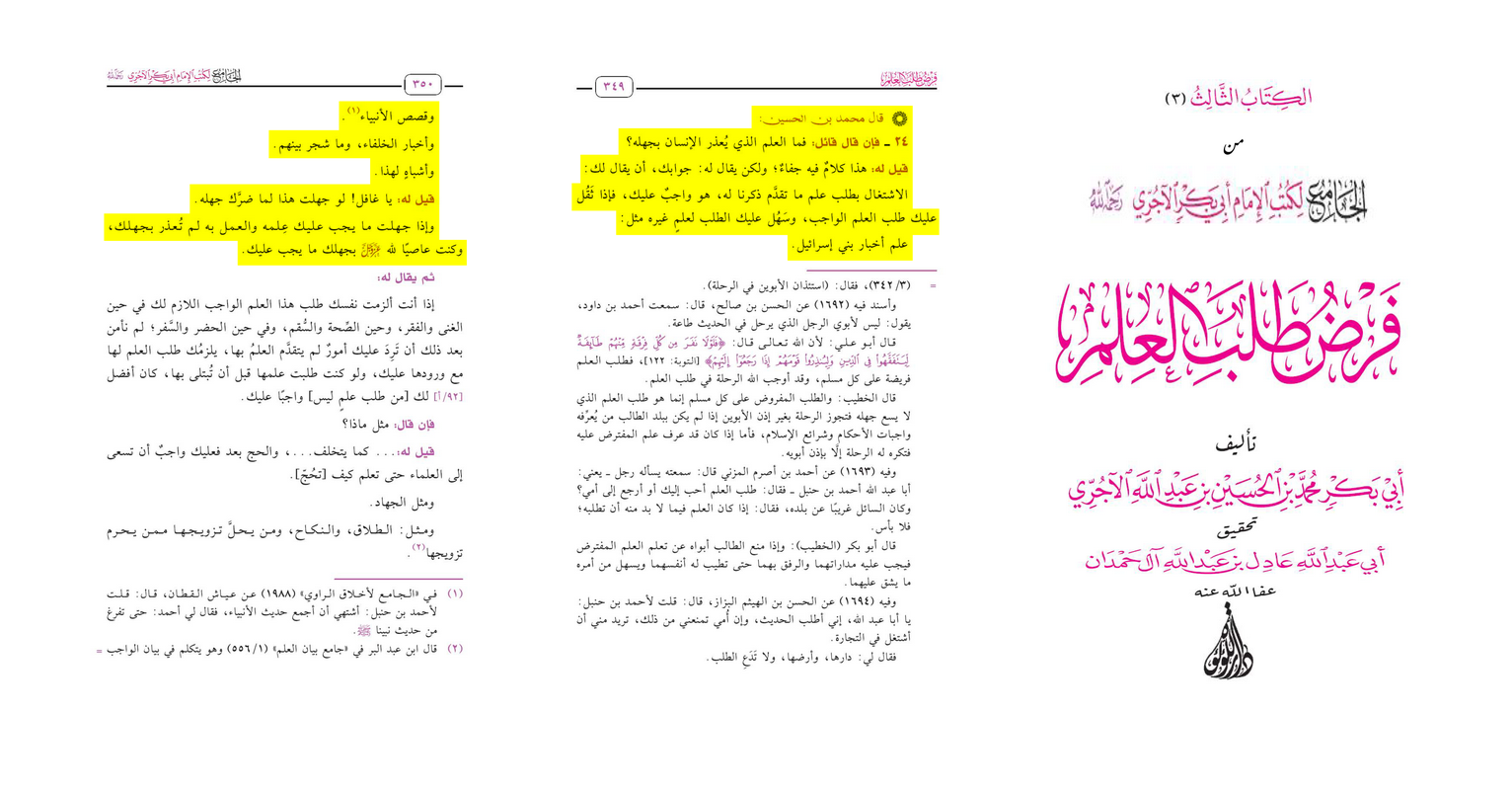
“So if someone says: Then what is the knowledge that a person is excused due to his ignorance of it?
It is said to him: This is speech in which there is harshness, but it is said to him: Your answer: that it be said to you: Occupying yourself with seeking the knowledge that we previously mentioned is obligatory upon you.
So if seeking the obligatory knowledge becomes heavy upon you, and seeking other than it becomes easy upon you, such as: knowledge of the reports of the Children of Israel, and the stories of the prophets, and the reports of the caliphs, and what occurred among them, and things similar to this.
It is said to him: O heedless one! If you were ignorant of this, its ignorance would not harm you. But if you are ignorant of what is obligatory upon you to know and to act upon, you are not excused due to your ignorance, and you would be disobedient to Allāh ﷻ by your ignorance of what is obligatory upon you.”
📓 Farḍ Ṭalab al-ʿIlm - p. 24
• Manāshiʾ al-Jahl •
In every time and place, ignorance in religion (especially in terms of ʿaqīdah) does not appear out of nowhere. It is built, piece by piece, brick by brick, from the way a person learns, who they learn from, how they think, and what they want. One of the starting points of ignorance to sprout is when a person stops seeing the Qurʾān and Sunnah as the authorities of the religion [i.e. stop going to them as primary sources for any sort of issue].
They might still quote verses from the Words of Allāh عز وجل and narrations of the Prophet ﷺ, but in their heart they have chosen their position to be other than the one of the Prophet ﷺ, and his noble followers because of cultural norms, or comfort upon misguidance or identity, or the aesthetic look or sound of their position [e.g. like Muslims who commit kufr to become Christian to put the cross in their online bio, or do whatever they please, etc.] and to solidify their choice they go find proof for it, which they can't. This inherently creates a person who speaks a lot on matters while still having the attribute of ignorance in them, because the evidence no longer guides them, it is just used by them.
Another major origin of ignorance being built is people wanting answers regarding religion without wanting to do the learning. They will take snippets of lectures, or posts and arguments, then talk about those same issues as if they have learned it. The problem here is not just the laziness but also the absent foundation that keeps one safe from making mistakes. They don't know how to tell the difference between what is a foundation, what is a side issue, what is strong and what is weak, what is clear and what needs careful handling, and what is actually proof against someone's explanation. In matters of ʿaqīdah, this is especially dangerous because you cannot build the correct belief off of random pieces, you need the entire picture, the foundation upon which your beliefs will stand and guide you.
Then comes the issue of taking knowledge from the wrong doors, or wrong doers. If someone is gifted with intellect by Allāh, what they take their knowledge from shapes how they use that intellect. Say, for example that person takes ʿaqīdah from people who have twisted ideologies, or from Kalām (Philosophy) and argument-heavy approaches, they not only pick up conclusions and twisted positions—but also habits: how to judge texts, what to reject, what to explain, and what to treat like a "problem." Over time, that person may still speak on religious topics, but their mind has been brainwashed substantially and now produces ignorance even when they may think they are careful.
One of, if not, the worst cases of the birth of ignorance comes from the taqlīd (blind following) of family, culture or a group. A person might defend certain beliefs mainly because they are aware of the fact "this is what my people are upon," not because they actually know the reasoning behind them or the proofs that support them. When belief becomes tied to being apart of a group, correction of it feels like a betrayal to them. Then even if the proof is clear, the person resists changing because doing so will cost them their status, their friends, family, or even their respect. This is one of the worst types of ignorance because it can remain in a person for years, not because they lack access to knowledge—no, but rather because the social price of learning the truth to them feels too heavy, and so they doom themselves.
And last but not least, the mother of all sources of ignorance in matters of ʿaqīdah is language weakness. Remember, O servants of Allāh, that the Qurʾān and Sunnah were revealed in Arabic. Translations may help, but they may also hide important meaning. If someone does not understand the basics of Arabic and its wording, they can miss what a sentence clearly implies, or misunderstand how the Salaf understood certain phrases. A person can read a translation and feel confident, but still be wrong because the original wording carries details the translation may not fully showcase. And in matters of ʿaqīdah, those details may lead to serious errors.
• ʿAwāqib al-Jahl •
The consequences of ignorance in the religion begin with the most basic collapse, and from the most serious of them: the corruption of the one's worship of Allāh, the Exalted. When a person does not learn what Allāh, the Most High, has commanded, nor how the Messenger ﷺ taught worship, he begins to treat what he found people upon, along with his own desires and actions, as though they are proof that it is acceptable worship. From there, he follows his inclinations and slips into shirk, or into that which leads to it, while thinking that he is upon the religion. The greatest consequence of this is that false worship becomes normal to him, because he never learned the lines that separate Tawḥīd from shirk and Sunnah from bidʿah.
◈ Allāh, the Exalted said in [al-Kahf - verse 103-104]:
قُلْ هَلْ نُنَبِّئُكُم بِٱلْأَخْسَرِينَ أَعْمَـٰلًا ١٠٣
ٱلَّذِينَ ضَلَّ سَعْيُهُمْ فِى ٱلْحَيَوٰةِ ٱلدُّنْيَا وَهُمْ يَحْسَبُونَ أَنَّهُمْ يُحْسِنُونَ صُنْعًا ١٠٤
“Say: Shall we inform you of the greatest losers in deeds? { 103 } Those whose effort is lost in this worldly life while they think that they are doing good.” { 104 }
◈ And He, the Exalted said in [al-Aʿrāf - verse 28]:
وَإِذَا فَعَلُوا۟ فَـٰحِشَةًۭ قَالُوا۟ وَجَدْنَا عَلَيْهَآ ءَابَآءَنَا وَٱللَّهُ أَمَرَنَا بِهَا ۗ قُلْ إِنَّ ٱللَّهَ لَا يَأْمُرُ بِٱلْفَحْشَآءِ ۖ أَتَقُولُونَ عَلَى ٱللَّهِ مَا لَا تَعْلَمُونَ ٢٨
And when they commit an indecency, they say: "We found our forefathers upon it, and Allāh has commanded us with it.” Say, "Indeed Allāh does not command immorality. Do you say about Allāh that which you do not know?" { 28 }
بَلِ ٱتَّبَعَ ٱلَّذِينَ ظَلَمُوٓا۟ أَهْوَآءَهُم بِغَيْرِ عِلْمٍۢ ۖ فَمَن يَهْدِى مَنْ أَضَلَّ ٱللَّهُ ۖ وَمَا لَهُم مِّن نَّـٰصِرِينَ ٢٩
In fact, the wrongdoers merely follow their desires with no knowledge. Who then can guide those Allāh has left to stray? They will have no helpers. { 29 }
And from the most dangerous consequences of ignorance in the religion is speaking about Allāh that which you do not know, or attributing to Him that which has no basis in the Qurʾān, or the Sunnah of His Messenger ﷺ. This includes inventing meanings, giving explanations without proof, and speaking with certainty in matters where one has not returned to revelation and the understanding of the Salaf. It is also to describe the religion with statements that have no evidence, then present those statements as if they are guidance, so the listener begins to think that these claims are part of Islām itself, when in reality they are only the speech of a person who did not fear Allāh in what he uttered.
Therefore, the jāhil fills his speech with confidence, issues fatāwā with no understanding, and describes the Mighty Lord in ways he has no proof for, and turns his insolent and foolish guesses into religious claims. And the dangerous part of this is that the confidence of the jāhil can make those who are simple-minded and easily manipulated see it as knowledge. There are people who test speech by its delivery, boldness and how "certain" the speaker sounds, not by the evidence they bring, or the truth they call to. So the jāhil, empty of proof or not, can still appear to the weak-minded as if he is a person of knowledge, and they take his words, defend it, and call to it, and treat his weak opinions as if it is religion, and thus his ignorance is now not only confined to him, but rather turned into a disease that takes not only himself into Hellfire, but also them.
◈ And He, the Most Knowledgeable, and may He be Exalted, said in [al-Baqarah - verse 169]:
إِنَّمَا يَأْمُرُكُم بِٱلسُّوٓءِ وَٱلْفَحْشَآءِ وَأَن تَقُولُوا۟ عَلَى ٱللَّهِ مَا لَا تَعْلَمُونَ ١٦٩
He [the Shayṭān] only incites you to commit evil and indecency, and to claim against Allāh what you do not know. { 169 }
قُلْ إِنَّمَا حَرَّمَ رَبِّىَ ٱلْفَوَٰحِشَ مَا ظَهَرَ مِنْهَا وَمَا بَطَنَ وَٱلْإِثْمَ وَٱلْبَغْىَ بِغَيْرِ ٱلْحَقِّ وَأَن تُشْرِكُوا۟ بِٱللَّهِ مَا لَمْ يُنَزِّلْ بِهِۦ سُلْطَـٰنًۭا وَأَن تَقُولُوا۟ عَلَى ٱللَّهِ مَا لَا تَعْلَمُونَ ٣٣
Say, “My Lord has only forbidden open and secret indecencies, sinfulness, unjust aggression, associating ˹others˺ with Allāh ˹in worship˺—a practice He has never authorized—and attributing to Allāh what you do not know.” { 33 }
وَلَا تَقْفُ مَا لَيْسَ لَكَ بِهِۦ عِلْمٌ ۚ إِنَّ ٱلسَّمْعَ وَٱلْبَصَرَ وَٱلْفُؤَادَ كُلُّ أُو۟لَـٰٓئِكَ كَانَ عَنْهُ مَسْـُٔولًۭا ٣٦
Do not follow what you have no ˹sure˺ knowledge of. Indeed, all will be called to account for ˹their˺ hearing, sight, and intellect. { 36 }
وَمِنَ ٱلنَّاسِ مَن يُجَـٰدِلُ فِى ٱللَّهِ بِغَيْرِ عِلْمٍۢ وَيَتَّبِعُ كُلَّ شَيْطَـٰنٍۢ مَّرِيدٍۢ ٣
˹Still˺ there are some who dispute about Allah without knowledge, and follow every rebellious devil. { 3 }
◈ And He, the Exalted, said in [Āl ʿImrān - verse 7]:
هُوَ ٱلَّذِىٓ أَنزَلَ عَلَيْكَ ٱلْكِتَـٰبَ مِنْهُ ءَايَـٰتٌۭ مُّحْكَمَـٰتٌ هُنَّ أُمُّ ٱلْكِتَـٰبِ وَأُخَرُ مُتَشَـٰبِهَـٰتٌۭ ۖ فَأَمَّا ٱلَّذِينَ فِى قُلُوبِهِمْ زَيْغٌۭ فَيَتَّبِعُونَ مَا تَشَـٰبَهَ مِنْهُ ٱبْتِغَآءَ ٱلْفِتْنَةِ وَٱبْتِغَآءَ تَأْوِيلِهِۦ ۗ وَمَا يَعْلَمُ تَأْوِيلَهُۥٓ إِلَّا ٱللَّهُ ۗ وَٱلرَّٰسِخُونَ فِى ٱلْعِلْمِ يَقُولُونَ ءَامَنَّا بِهِۦ كُلٌّۭ مِّنْ عِندِ رَبِّنَا ۗ وَمَا يَذَّكَّرُ إِلَّآ أُو۟لُوا۟ ٱلْأَلْبَـٰبِ ٧
He is the One Who has revealed to you ˹O Prophet˺ the Book, of which some verses are precise, they are the foundation of the Book, while others are elusive.1 Those with deviant hearts follow the elusive verses seeking ˹to spread˺ doubt through their ˹false˺ interpretations—but none grasps their ˹full˺ meaning except Allāh. As for those well-grounded in knowledge, they say, “We believe in this ˹Quran˺—it is all from our Lord.” But none will be mindful ˹of this˺ except people of reason. { 7 }
◈ And He, the Exalted, said in [Yūnus - verse 36]:
وَمَا يَتَّبِعُ أَكْثَرُهُمْ إِلَّا ظَنًّا ۚ إِنَّ ٱلظَّنَّ لَا يُغْنِى مِنَ ٱلْحَقِّ شَيْـًٔا ۚ إِنَّ ٱللَّهَ عَلِيمٌۢ بِمَا يَفْعَلُونَ ٣٦
Most of them follow nothing but ˹inherited˺ assumptions. ˹And˺ surely assumptions can in no way replace the truth. Allāh is indeed All-Knowing of what they do. { 36 }
From the consequences of ignorance is that it breaks a person’s discipline in the religion and makes him careless in acting upon it. So he becomes negligent with the prayer, slow to repent, weak in self-restraint, and accustomed to spiritual ruin without even feeling its weight. And once the prayer becomes light in his sight, the rest of the religion becomes even lighter after it. In worldly life, this turns him into an easy target for stress, temptation, and desires, because there is no longer enough faith in him to restrain him from falling.
أُو۟لَـٰٓئِكَ ٱلَّذِينَ أَنْعَمَ ٱللَّهُ عَلَيْهِم مِّنَ ٱلنَّبِيِّـۧنَ مِن ذُرِّيَّةِ ءَادَمَ وَمِمَّنْ حَمَلْنَا مَعَ نُوحٍۢ وَمِن ذُرِّيَّةِ إِبْرَٰهِيمَ وَإِسْرَٰٓءِيلَ وَمِمَّنْ هَدَيْنَا وَٱجْتَبَيْنَآ ۚ إِذَا تُتْلَىٰ عَلَيْهِمْ ءَايَـٰتُ ٱلرَّحْمَـٰنِ خَرُّوا۟ سُجَّدًۭا وَبُكِيًّۭا ۩ ٥٨
فَخَلَفَ مِنۢ بَعۡدِهِمۡ خَلۡفٌ أَضَاعُواْ ٱلصَّلَوٰةَ وَٱتَّبَعُواْ ٱلشَّهَوَٰتِۖ فَسَوۡفَ يَلۡقَوۡنَ غَيًّا ٥٩
Those were ˹some of˺ the prophets who Allah has blessed from among the descendants of Ādam, and of those We carried with Nūḥ ˹in the Ark˺, and of the descendants of Ibrāhīm and Isrāʾīl, and of those We ˹rightly˺ guided and chose. Whenever the revelations of the Most Compassionate were recited to them, they fell down, prostrating and weeping. { 58 }But they were succeeded by generations who neglected prayer and followed their lusts and so will soon face the evil consequences. { 59 }
And from the clearest end-results of ignorance is regret after the time for benefit has passed. A person comes to realize that he could have listened, reflected, and changed, but instead turned away from guidance, persisted upon falsehood, and neglected what would have saved him. This regret may begin in the worldly life through wasted years, repeated sins, and stubborn persistence, but its full reality appears in the Hereafter, when the people of misguidance wish to return after the door has been closed.
◈ Allāh, the Exalted, said in [al-Anʿām, verse 27]:
وَلَوْ تَرَىٰٓ إِذْ وُقِفُوا۟ عَلَى ٱلنَّارِ فَقَالُوا۟ يَـٰلَيْتَنَا نُرَدُّ وَلَا نُكَذِّبَ بِـَٔايَـٰتِ رَبِّنَا وَنَكُونَ مِنَ ٱلْمُؤْمِنِينَ ٢٧
If only you could see when they will be detained before the Fire! They will cry, “Oh! If only we could be sent back, we would never deny the signs of our Lord and we would ˹surely˺ be of the believers.” { 27 }
◈ And He, the Exalted, said in [Ibrāhīm, verse 44]:
وَأَنذِرِ ٱلنَّاسَ يَوْمَ يَأْتِيهِمُ ٱلْعَذَابُ فَيَقُولُ ٱلَّذِينَ ظَلَمُوا۟ رَبَّنَآ أَخِّرْنَآ إِلَىٰٓ أَجَلٍۢ قَرِيبٍۢ نُّجِبْ دَعْوَتَكَ وَنَتَّبِعِ ٱلرُّسُلَ ۗ أَوَلَمْ تَكُونُوٓا۟ أَقْسَمْتُم مِّن قَبْلُ مَا لَكُم مِّن زَوَالٍۢ ٤٤
And warn the people of the Day when the punishment will overtake ˹the wicked among˺ them, and the wrongdoers will cry, “Our Lord! Delay us for a little while. We will respond to Your call and follow the messengers!” ˹It will be said,˺ “Did you not swear before that you would never be removed ˹to the next life˺?”{ 44 }
◈ And He, the Exalted said in [Maryam, verse 39]:
وَأَنذِرْهُمْ يَوْمَ ٱلْحَسْرَةِ إِذْ قُضِىَ ٱلْأَمْرُ وَهُمْ فِى غَفْلَةٍۢ وَهُمْ لَا يُؤْمِنُونَ ٣٩
And warn them ˹O Prophet˺ of the Day of Regret, when all matters will be settled, while they are ˹engrossed˺ in heedlessness and disbelief. { 39 }
◈ And He, the Exalted said in [al-Furqān, verse 27]:
وَيَوْمَ يَعَضُّ ٱلظَّالِمُ عَلَىٰ يَدَيْهِ يَقُولُ يَـٰلَيْتَنِى ٱتَّخَذْتُ مَعَ ٱلرَّسُولِ سَبِيلًۭا ٢٧
And ˹beware of˺ the Day the wrongdoer will bite his nails ˹in regret˺ and say, “Oh! I wish I had followed the Way along with the Messenger! { 27 }
◈ And He, the Exalted said in [as-Sajdah, verse 12]:
وَلَوْ تَرَىٰٓ إِذِ ٱلْمُجْرِمُونَ نَاكِسُوا۟ رُءُوسِهِمْ عِندَ رَبِّهِمْ رَبَّنَآ أَبْصَرْنَا وَسَمِعْنَا فَٱرْجِعْنَا نَعْمَلْ صَـٰلِحًا إِنَّا مُوقِنُونَ ١٢
If only you could see the wicked hanging their heads ˹in shame˺ before their Lord, ˹crying:˺ “Our Lord! We have now seen and heard, so send us back and we will do good. We truly have sure faith ˹now˺!” { 12 }
◈ And He, the Exalted said in [az-Zumar, verses 56-58]:
أَن تَقُولَ نَفْسٌۭ يَـٰحَسْرَتَىٰ عَلَىٰ مَا فَرَّطتُ فِى جَنۢبِ ٱللَّهِ وَإِن كُنتُ لَمِنَ ٱلسَّـٰخِرِينَ ٥٦
أَوْ تَقُولَ لَوْ أَنَّ ٱللَّهَ هَدَىٰنِى لَكُنتُ مِنَ ٱلْمُتَّقِينَ ٥٧
أَوْ تَقُولَ حِينَ تَرَى ٱلْعَذَابَ لَوْ أَنَّ لِى كَرَّةًۭ فَأَكُونَ مِنَ ٱلْمُحْسِنِينَ ٥٨
so that no ˹sinful˺ soul will say ˹on Judgment Day˺, ‘Woe to me for neglecting ˹my duties towards˺ Allah, while ridiculing ˹the truth˺.’ { 56 }Or ˹a soul will˺ say, ‘If only Allah had guided me, I would have certainly been one of the righteous.’ { 57 }Or say, upon seeing the torment, ‘If only I had a second chance, I would have been one of the good-doers.’{ 58 }
◈ And He, the Exalted said in [al-Mulk, verse 10]:
وَقَالُوا۟ لَوْ كُنَّا نَسْمَعُ أَوْ نَعْقِلُ مَا كُنَّا فِىٓ أَصْحَـٰبِ ٱلسَّعِيرِ ١٠
And they will lament, “If only we had listened and reasoned, we would not be among the residents of the Blaze!”
◈ And He, the Exalted said in [an-Naba’, verse 40]:
إِنَّآ أَنذَرْنَـٰكُمْ عَذَابًۭا قَرِيبًۭا يَوْمَ يَنظُرُ ٱلْمَرْءُ مَا قَدَّمَتْ يَدَاهُ وَيَقُولُ ٱلْكَافِرُ يَـٰلَيْتَنِى كُنتُ تُرَٰبًۢا ٤٠
Indeed, We have warned you of an imminent punishment—the Day every person will see ˹the consequences of˺ what their hands have done, and the disbelievers will cry, “I wish I were dust.”1
◈ And He, the Exalted said in [al-Fajr, verses 23-24]:
وَجِا۟ىٓءَ يَوْمَئِذٍۭ بِجَهَنَّمَ ۚ يَوْمَئِذٍۢ يَتَذَكَّرُ ٱلْإِنسَـٰنُ وَأَنَّىٰ لَهُ ٱلذِّكْرَىٰ ٢٣
يَقُولُ يَـٰلَيْتَنِى قَدَّمْتُ لِحَيَاتِى ٢٤
and Hell is brought forth on that Day—this is when every ˹disbelieving˺ person will remember ˹their own sins˺. But what is the use of remembering then?They will cry, “I wish I had sent forth ˹something good˺ for my ˹true˺ life.”
So let the servant beware, for from the consequences of persistent ignorance and turning away is a regret that comes after the closing of the door, when neither excuses benefit nor wishing to return avails.
Allāh is the One Whose help is sought, and with Him is success.
• Ibṭāl Aʿdhār al-Juhhāl al-Ashrār •
Each excuse is examined at the level of its underlying principle, its claimed restrictions, and its necessary consequences, so it becomes clear that many of these claims rest on no recognized basis and no legally operative description, but instead amount to taʿallul and iʿrāḍ, not excusable jahl.
Right off the bat, this excuse narrows down to the claim that religious obligation and accountability are suspended by one's status as a layman or non-student of knowledge. In essence, this claim asserts that lack of scholarly status constitutes a legally operative description that delays or negates obligation.
But, the claim that one's status as a layman suspends obligation must either be general or restricted. If it is general, then it applies to ALL who are not students of knowledge, which necessarily means that the majority of the Ummah is exempt from accountability, and religious obligation is bound only to the scholars, and that the revelation that was revealed was, in fact, not intended for all of the Ummah.
If, however, the claim is restricted, then the restriction requires proof. Who limited this suspension to certain matters and not others, by what evidence and upon what criterion was it restricted? That is the issue. You will not find anywhere in the Book of Allāh عز وجل, or in the Sunnah of His Messenger ﷺ, or in the books of the Salaf any such restriction. So, a restriction without proof is arbitrary, and an arbitrary restriction has no weight in the religion of Allāh.
Moreover, the category of "layman" is not a legally operative description in the Sharīʿah. Obligation was not conditioned to be of those with scholarly status, or with a degree, but rather with intellect, and capacity. The Sharīʿah recognized childhood, insanity, and coercion to be operative descriptions; it did not recognize lay status as one of them, so that means it has no place in the Sharīʿah either. This is supported by the quote from ash-Shāfiʿī earlier in the first chapter.
In sooth, this principle is, in simple words, turning away from learning, or seeking knowledge (Iʿrāḍ ʿan al-taʿallum), and that is done willingly, and any sin done willingly is blameworthy upon its doer.
❝ They are Imāms ❞
Let's do the same as done with the previous. The claim that errors in ʿaqīdah are excused due to one's status as an "imām" must likewise be either general or restricted. If it is general, then no imām may ever be takfīred, no grave error attributed to one of standing, and every dispute would be settled by status rather than evidence. Truth would become lesser to rank, and refutation of individuals would be rendered illegitimate whereever reputation is present. This consequences invalidates the claim by necessity.
If the claim is restricted, then the restriction itself requires proof. Which imāms are exempt from the application of takfīr, and which are not? Is exemption based on seniority, number of followers, or historical legacy? And who determines these boundaries? And on top of this, where in the Book of Allāh عز وجل and the Sunnah of His Messenger ﷺ, and the books of the Salaf did they mention the principle of exempting one from takfīr. Thus restriction here is also invalidated and is arbitrary, to say the least, therefore it collapses.
And, imāmate in knowledge is also not a legally operative description that alters rulings of belief. The Sharīʿah did not attach the suspension of takfīr to scholarly status, length of study [or life spent in being a scholar], or service to the religion. Takfīr, where it applies, is tied to the nature of the statement, or act and its ruling in the Sharīʿah, not to the identity of the one who commits it. To treat imāmate as a shield against takfīr is to introduce a description to which the Sharīʿah attached no legal effect.
Lastly, this excuse contradicts the very logic by which takfīr is denied. If imāms are excluded from rulings that apply to others solely due to their status, then this is preferential exemption. And if disbelief is denied on the basis of authority rather than evidence, then takfīr is no longer a legal judgment but a discretionary favor. Authority, however, does not redefine truth, nor does rank alter the ruling of speech or action. Thus this excuse negates itself and cannot stand in any formulation.
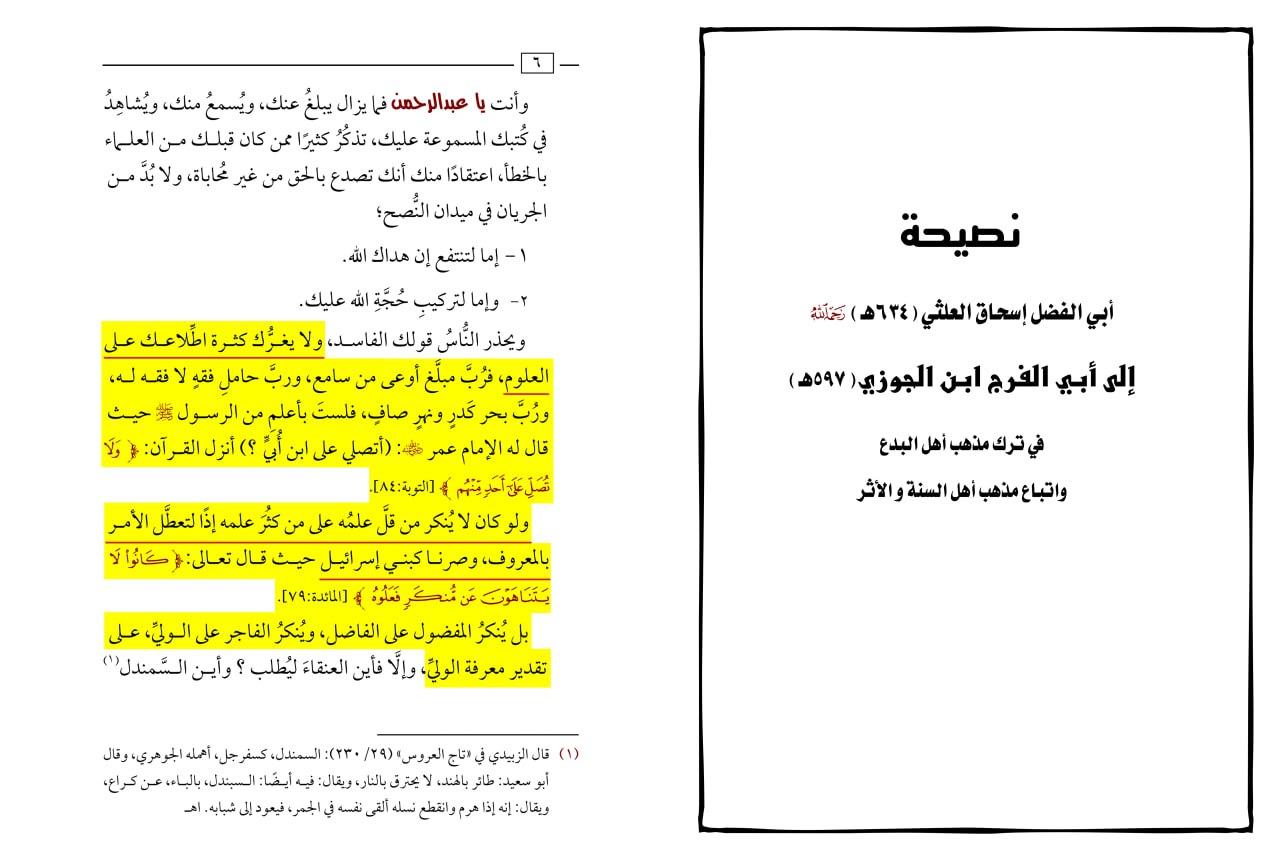
◈ Abū al-Faḍl Isḥāq al-ʿAlthī said in his letter to Ibn al-Jawzī al-Ashʿarī:
Let not the abundance of your knowledge of the sciences deceive you, for perhaps one who conveys [a message] is more understanding than one who hears [it], and perhaps one who carries fiqh has no understanding (fiqh) of it, and perhaps a sea is turbid while a river is clear. You are not more knowledgeable than the Messenger ﷺ, when Imām ʿUmar, may Allāh be pleased with him, said to him: “Do you pray over Ibn Ubayy (the hypocrite)?” The Qurʾān was then revealed: {And never pray over any of them}. [Qurʾān 9:84]
If it were not permissible for one of lesser knowledge to object to one of greater knowledge, then the command of enjoining good and forbidding evil would be nullified, and we would become like the Children of Isrāʾīl, about whom Allāh said: {They did not forbid one another from the evil they did}. [Qurʾān 5:79]
Rather, the lesser in rank may denounce the virtuous, and the sinner may denounce the walī, based upon the walī's degree of knowledge.
📔 Naṣīḥat al-ʿAlthī - p. 6
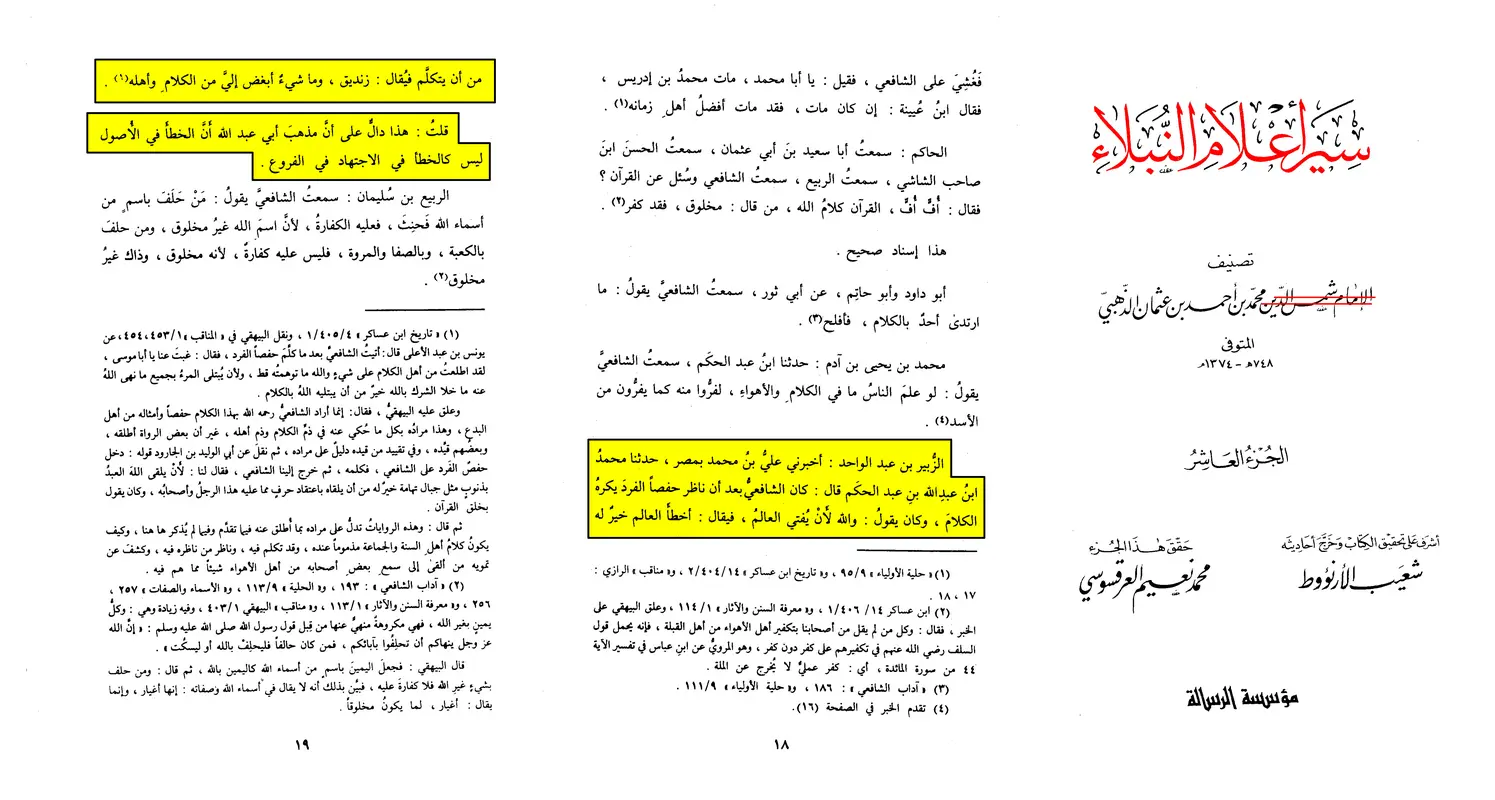
◈ And related to this is what Imām ash-Shāfi‘ī, may Allāh have mercy on him, said:
"By Allāh, for a scholar to issue a fatwā and for it to be said, 'The scholar erred,' is better for him than for him to speak and for it to be said, 'He is a heretic (zindīq).' And there is nothing I detest more than kalām and its people."
◈ And al-Dhahabī commented:
"This indicates that the position of Abū ‘Abd Allāh (i.e., al-Shāfi‘ī) is that error in matters of fundamental creed (uṣūl) is not like error in ijtihād in matters of furū‘ (i.e fiqh)."
📓 Siyar A‘lām al-Nubalā’ - vol. 10, p. 19
❝ But so-and-so praised them... ❞
This claim is worse than the previous one, as it's used as a basis to refrain from takfīr, and it must either be general or restricted, as mentioned before. If it is general, then any statement, or act that entails disbelief is annulled because praise becomes the exemption that blocks the ruling whenever it would otherwise apply, so that disbelief is treated as a ruling reserved for the majority while prominent and "praised" figures are effectively protected by their reputation. In that case, it turns takfīr from a legal judgment tied to speech and action into a discretionary courtesy tied to reputation. The consequence is that it is the nullification of the ruling itself.
If, however, it is restricted, then the restriction is prue arbitrariness unless proven. Which praise blocks takfīr and which does not? Does it block it forever, or only until a certain point? WHO decides when the praise is "enough" to override explicit contradiction of the fundamentals? And what is done when other scholars criticize, retract, or oppose the praiser? Praise cannot be the judge of who is performed takfīr upon and who is not. If the excuse needs another authority to rescue it every time it is challenged, then it is an escape device.
Besides, praise is not a legally operative description in the Sharīʿah. Praise is a report of perceived good of someone at a time. It does not convert falsehood into truth, nor does it alter the ruling of an utterance or act. To treat praise as a shield against takfīr is to assign praise a legislative power it does not hold. The ḥukm sharʿī does not rise and fall with commendations/praise, and disbelief does not become “not disbelief” because someone once spoke well of the person before he uttered it.
Thus, this excuse contradicts the very meaning of praise. Praise is for conformity to the truth, not a guarantee against later deviation, and not a pass to violate foundations without judgment. If praise blocks the application of takfīr in its proper place, then every statement can be protected by a prior compliment, and the religion’s boundaries are erased by testimonials. Therefore, “so-and-so praised them” has no standing as a barrier against takfīr as a ruling, and invoking it in that role is itself a corrupt principle, which is of course used, by corrupt people.
❝ The Books of the Salaf are Hard. ❞
Whoever proceeds with this claim argues that the books of knowledge are difficult, and that he is not qualified to understand them, and he makes that an excuse that drops obligation and permits remaining upon ignorance. But this claim, if treated as a general principle, necessarily entails corrupt consequences that cannot be avoided.
If the difficulty of books and lack of qualification were an excuse for abandoning learning, it would necessarily follow that learning itself is not obligatory, since what is beyond the capacity of the unqualified is not obligatory upon him. And if the obligation to learn falls, then the obligation to act falls, because there is no action without knowledge. This would entail the collapse of commanding and forbidding, the nullification of the meaning of clarification, and the total disabling of the function of calling to the truth.
And if it is said that this excuse applies only to some issues and not others, then it is said to him: Who set this boundary, and by what measure did you distinguish between what requires understanding and what falls away on the pretext of difficulty, and was this distinction known from the Salaf or indicated by any proof. If not, then it is mere arbitrary preference with no evidence.
Then it is also said to him: Whoever claims that the books are difficult has already judged them to be difficult, and one does not judge a thing except after knowing it. So either he has known them and understood enough from them to judge them, in which case his excuse is invalidated, or he has not known them at all, so how did he judge something he never examined. Thus he becomes one who claims ignorance while affirming knowledge at the same time, and this is an unavoidable contradiction with no exit.
And it is said to him also: The Companions and the Followers were not born scholars, nor did they begin with specialization. Rather, they learned and then understood. They were addressed before getting to the level they were at, and were obligated before their in-depth understanding. If lack of qualification were a barrier to obligation, them being addressed would not be valid, them being taught would not make sense, and proof would not be established against them.
And it is said to him as well: This claimant does not operate by this principle in his worldly affairs. He learns what he needs for his livelihood, and he engages with what is difficult for him until he understands it, and he does not make ignorance an excuse to abandon what he wants. So when he singled out the religion alone with the claim of difficulty, it becomes known that the cause is not difficulty, but will and choice.
So it is established that this claim, if generalized, nullifies the religion; if restricted, becomes arbitrary without proof; and if examined, contradicts itself. It is neither a valid excuse nor an established doubt. Rather, it is using “ignorance” as a shield after the path to knowledge has been made available, and avoiding learning while claiming inability.
So whoever clings to it after clarification is not excused, but one who turns away by choice, and he has moved from a claim of ignorance to what it necessarily entails.
An excuse I personally despise, and I ask Allāh to curse whoever uses these to brainwash the sincere:
❝ What are the rules/conditions of takfīr, tabdīʿ, etc? ❞
This excuse, when stripped of its outward form, returns to the claim that takfīr and tabdīʿ cannot be spoken of, affirmed, or even applied unless one has first passed through a prior technical discussion of shurūṭ and mawāniʿ, and that merely establishing that a certain saying is kufr, or that the ʿaqīdah of X sect is kufr is not enough, but rather one must first suspend the matter and delay it behind a barrier of questions.
Thus the one uses this excuse does not begin by discussing whether the statement, belief or action in question is actually kufr or bidʿah, but instead shifts the discussion immediately to conditions like a donkey with no brains, as though mentioning conditions by itself were sufficient to invalidate the ruling on that person despite their saying, or at least to indefinitely postpone it.
As I said before, a claim such as this must either be general or restricted.
If it is general, then it means that no ruling of takfīr or tabdīʿ can ever be established merely by the presence of kufr or bidʿah in a statement, action, or belief, until a separate and detailed inquiry into EVERY POSSIBLE obstruction or impediment has first been completed. And if that is their principle, then they have in reality suspended the rulings of kufr and bidʿah altogether, because no person will ever be free, in their eyes, from some possible excuse to be imagined, and from that some hidden interpretation to be proposed, some claim of ignorance to be suggested or some inseen facted to be invented. Thus the ruling will never descend from theory to application. In that case, their principle does not regulate takfīr and tabdīʿ, but rather abolishes them.
And if this claim is restricted, then the restriction requires proof. Which cases require that prior technical inquiry, and which do not? Which forms of kufr and bidʿah are clear enough to be ruled upon without delay, and which are hidden enough to require investigation? Who established this boundaary, and where is its proof in the Book of Allāh, the Sunnah of the Prophet ﷺ, and the speech of the Salaf? For merely saying "there are conditions" does not answer the issue, because the dispute is not over whether conditions exist in some sense, but rather over WHERE they belong, WHEN they are discussed, and WHETHER they are being placed in their proper place or being used as a shield against the ruling itself. In that case, an unrestricted appeal to "conditions" is useless unless its legal place is established.
The foundation here is not that the ruling upon the statement, belief, or action is always one thing, while the ruling upon the person is always another, as though there was a necessary separation between the two in every case. Rather, this is said only in matters where such a distinction is actually established, and relevent. As for making it into some universal principle, then this is false, becausae it leads to the suspension of the rulings of kufr and bidʿah in clear matters under the excuse of technical caution.
For there are issues in which the affair may involve teaching the ignorant and clarifying what was hidden from him, such as some matters that are not manifest to everyone. But from this it does not follow that every issue is treated in this manner, nor that every person who utters kufr is to be treated as though his case were automatically deferred into a separate discussion of conditions and impediments. Rather, if a person utters a statement of kufr, then he is judged by what he uttered, unless there is something recognized in the Sharʿ that alters the ruling in that particular case. So the aṣl is attachment of the ruling to its cause, not suspension of the ruling until endless secondary questions are exhausted.
Thus, the appeal to “conditions” becomes futile when used in this unrestricted way. For what is the use of invoking conditions in every case, if their practical function is only to prevent the ruling from ever taking effect? Such a usage does nothing but nullify the rulings altogether. And this is the reality of many who raise this excuse. They do not mention conditions in order to place them in their proper place, but in order to make them a barrier against every ruling they dislike, or fear acting out.
So it is said to them, those filthy ʿĀdhiriyyah: if the utterance is kufr, then what is the basis for withholding the ruling from the one who uttered it? Is there a specific impediment present, established by proof, or are you merely repeating the word “conditions” as a excuse? There is a great difference between one who points to a real, legally relevant impediment in a particular case, and one who uses the language of shurūṭ and mawāniʿ as a means of general suspension.
And this is why their method collapses. Because they take exceptional cases, or cases in which teaching may be relevant, and then expand them until they swallow the clear cases as well. So the one who falls into manifest kufr is treated like the one who erred in a subtle matter, and the one who openly utters falsehood is treated like the one whose issue is hidden and in need of explanation. By this expansion, the boundaries of the religion are erased, and the distinction between clear kufr and obscure error is lost.
❝ What are the rules/conditions of jarḥ? ❞
As for one of the most useless, most witless, most shameless, and most despicable excuses, then it is the statement: “What are the rules of jarḥ?” when this is said in response to the jarḥ of an individual given by the imāms of this affair, the pillars of this religion, and the recognized authorities in jarḥ and taʿdīl.
For this question, in such a place, is very rarely the speech of one who seeks understanding. Nor is it usually the question of one who desires to learn the principles of jarḥ wa taʿdīl and place them in their proper station. Rather, it is most often the refuge of the defeated, the excuse of the confused, and the final scapegoat of the one who cannot repel the jarḥ itself, so he flees from the actual speech of the imāms into a fog of procedure, hoping that vagueness will accomplish for him what proof could not.
He does not answer the jarḥ. He does not expose an error in it. He does not identify a violated principle. He does not even reconcile the speech of the nuqqād. He does not bring a stronger opposing judgment. He does not do anything by which a man of knowledge would recognize that he has entered the field of serious discussion. Rather, he merely raises a cloud of empty words: “What are the rules of jarḥ?” Thus he imagines that by uttering the name of principles, he has become one of their people, when in reality he has only exposed that he has no answer to the jarḥ itself.
And this excuse, when stripped of its outer shell, returns to a thoroughly corrupt meaning. Its reality is that the speech of the imāms is not to be received in the place where it belongs, but is instead to be detained, suspended, and subjected to the satisfaction of those who came after them, including the jāhil, the ḥizbī [partisan], the half-educated, and the one whose greatest qualification is merely that he is emotionally unwilling to accept the fall of the one being criticized. Thus the balance is overturned: the people whose speech should be received become the ones being interrogated, and the people who should be interrogated become the ones pretending to judge.
And if this is not corruption, then corruption has no meaning.
For if they mean by this statement that no jarḥ is accepted until every listener independently verifies all of its detailed principles and conditions for himself, then they have demolished the whole science from its foundation. For the discipline of jarḥ wa taʿdīl was not built upon every latecomer reinventing it for himself, nor upon every novice auditing the judgments of the imāms as though he were their equal. Rather, it was built upon returning the matter to its people, and upon knowing the rank of the people of this science, and upon receiving their judgments in the place where such judgments are to be received.
So if every jarḥ must now stand trial before every uninstructed objector, and if the word of the imām is to remain suspended until some late fool feels inwardly satisfied, then the science itself has been emptied of its purpose. In that case, the statements of Aḥmad ibn Ḥanbal, Yaḥyā ibn Maʿīn, Muḥammad ibn Ismāʿīl al-Bukhārī, Abū Ḥātim, Abū Zurʿah, Abū Dāwūd, al-Nasāʾī, and those like them become nothing more than historical adornments, cited for decoration but not obeyed when they become inconvenient. And this is precisely what many of these people want, even if they are too cowardly to say it openly.
And if they mean that the speech of the imāms may be resisted whenever a person is not personally content with it, then this is even uglier. For then truth is no longer determined by knowledge, precision, and inherited discernment, but by emotions. If the criticism lands upon one whom they love, they become theologians of procedure. If it lands upon one whom they hate, they suddenly forget every “rule” they had been chanting a moment earlier.
And it should be said plainly that many of those who utter this phrase do not even know the rules they are invoking. They have not studied them in any disciplined way. They have not traced the usages of the nuqqād [critics]. They have not examined the ranks of jarḥ. They have not learned when jarḥ is accepted, when it is weighed, when it is explained, when it is preferred, and how the speech of the imāms is understood in context. They are like beggars who have stolen the clothing of judges, imagining that garments can confer rank. Their tongues move with borrowed words, but their minds remain empty of their realities.
This is why they almost never proceed beyond the excuse itself. They do not say: this jarḥ is rejected because it is mubham [obscure or unnamed narrator in the chain] and is opposed by a stronger detailed taʿdīl. They do not say: this wording from this particular imām carries such-and-such technical force according to his known usage. They do not say: here the critic was opposed by those more knowledgeable in the specific narrator. They do not say anything of substance. Rather, they merely hover around the phrase “the rules of jarḥ” like flies around a rotting corpse, mistaking noise for argument and vagueness for depth.
And from the clearest signs of their humiliation is that they imagine the mere existence of rules is enough to weaken a judgment. But rules do not weaken anything merely by existing. One must show that they were violated. The lawfulness of trade is not nullified merely because trade has rules. The validity of prayer is not overturned merely because prayer has conditions. The reliability of a judgment is not broken merely because jarḥ has principles. Rather, one must identify the specific rule, show its relevance, and establish that it was indeed breached in this particular case. As for merely crying out, “What are the rules?” then this is not the speech of one presenting knowledge, but of one trying to frighten the simple-minded away from inherited judgment.
So it is said to such a person: produce the violated rule, if you are truthful. Name it. Explain it. Apply it. Show us where the imām erred. Show us where the jarḥ broke from its accepted course. But if you cannot do this, then your question is nothing but a confession of impotence.
Indeed, if this diseased method were accepted, then no jarḥ would remain upon anyone. Every weak narrator would find defenders. Every deviant would find protectors. Whenever the imāms speak, these people would rush forward, not to understand the jarḥ, but to suffocate it beneath endless objections, endless delays, and endless hypothetical caveats. Thus the door of insight would be closed, and the people would be left wandering among the names of men, unable to distinguish the sound from the broken, the trustworthy from the accused, and the upright from the corrupted.
And what makes this excuse even filthier is that it is so often selective. They do not use it as a principle. They use it as a medicine administered only to who their heart leans towards. Let jarḥ fall upon their imām, and suddenly they become absolute guardians of methodological precision. But let jarḥ fall upon one whom they dislike, and they become bold, hasty, and utterly untroubled by nuance. Thus their concern is not justice, but loyalty. Not truth, but partisanship. Not the preservation of a science, but the preservation of names. They do not defend principles. They defend their emotional attachments.
So the translation of their excuse is this: “Do not let the speech of the imāms reach the one I have attached myself to.”
And that is the true meaning of much of this performance.
It is especially disgraceful when this objection is raised against the jarḥ of the great imāms of the religion by people who have not even reached the threshold of this discipline. What has such a person gathered? What has he compared? Which books of ʿilal has he understood? Which usages of the critics has he mastered? Which narrator has he traced through the statements of the early authorities? Which technical distinction has he absorbed until it became second nature to him? Usually none of this. He resembles a child who has found the tools of a craftsman and now imagines himself a master merely because he can name the instruments.
Then he stands before the judgments of the imāms with the posture of an examiner, when in reality he would not even qualify as a student in their gatherings.
So let the matter be returned to its proper place. The rules of jarḥ exist, yes. But they exist to preserve the discipline, not to provide every partisan and every fool with a procedural curtain behind which he may hide whenever jarḥ becomes painful to bear. They are applied by knowledge, not by sentiment. They are invoked with precision, not with theatrical vagueness. They are used to clarify the judgments of the imāms, not to neutralize them by the objections of those beneath them.
Therefore, the one who answers the jarḥ of the pillars of the religion by saying, “What are the rules of jarḥ?”, while unable to identify a single violated rule in that specific case, has not defended anyone, has not clarified anything, and has not entered the field of serious discussion. He has only exposed his ignorance, advertised his bias, and humiliated himself before those who can still distinguish between inheritance and imitation, between knowledge and posing, and between a man who understands a science and a fool who merely hides behind its vocabulary.
...فَمِلَّةَ إِبْرَاهِيمَ فَٱسْلُكْ سَبِيلَهَا
Then follow the path of the religion of Ibrāhīm...
...هِيَ ٱلْعُرْوَةُ ٱلْوُثْقَىٰ لِأَهْلِ ٱلتَّقَرُّبِ
It is the firmest bond for those seeking nearness [to Allāh]...
...فَعَادِ ٱلَّذِي عَادَىٰ وَوَالِ ٱلَّذِي لَهُ
So oppose those he opposed and ally those he allied...
...يُوَالِي وَأَبْغِضْ فِي ٱلْإِلَٰهِ وَأَحْبِبِ
And in Allāh's cause, hate [whom He hates] and love [whom He loves]...
The Kufr and Takfīr of the Ashāʿirah
First, we will begin by looking at the statements of their scholars regarding Kẖalq al-Qurʾān.
◈ Their Imām, al-Juwaynī, said in [Maʿraḍ ar-Radd ʿalā al-Muʿtazilah]:
The meaning of their statement, meaning the Muʿtazilah, "These expressions are the Speech of Allāh," is that they are His creation. We do not deny that they are the creation of Allāh, but we refrain from calling the Creator of speech "a speaker by it." We have agreed on the meaning, then after agreeing we disputed regarding what to name it.
◈ And the Mushrik, Abū al-Ḥasan al-Āmidī said in [Ghāyat al-Marām fī ʿIlm al-Kalām]:
We, meaning the Ashāʿirah and the Muʿtazilah, are unanimously agreed that the ‘real Qurʾān’ is not the miracle of the Messenger. Rather, the dispute is about a matter beyond that: what is that ‘real Qurʾān’? We say: it is the meaning of existing in the self...
◈ And he said in the [next page]:
...provided that you do not dispute that what the Messenger brought, of ordered letters and segmented sounds, is a miracle for him, and that it is called ‘Qurʾān’ and ‘speech,’ and that it is not eternal. The dispute is only about what those expressions indicate: is it an eternal, pre-eternal attribute, or not?
◈ And al-ʿAḍud al-Ījī, the Jahmī Kāfir, said in [al-Mawāqif fī ʿIlm al-Kalām]
And the Muʿtazilah said: "[It is] sounds and letters that Allāh creates in something other than Himself, such as the Preserved Tablet, or Jibrīl, or the Prophet, and it is originated." We do not deny this, but we affirm something beyond that, namely the meaning subsisting in the self, and we claim that it is other than the expressions.
And he also said: "If you understand this, then know that what the Muʿtazilah say, namely the creation of sounds and letters and their being originated and subsisting, we say it too, and there is no dispute between us and them regarding that.”
◈ And al-Bājūrī, the Zindīq, to have said in [Sharḥ Jawharat al-Tawḥīd]:
In sum: every apparent text from the Book and the Sunnah that indicates the origination (creation) of the Qurʾān is interpreted as referring to the recited wording, not to the inner speech. However, it is not permissible to say "the Qurʾān is created" except in the context of teaching, as has preceded.
And to verify that this is what the Zindīq said, he says other statements in the [page before].
Second, their opposition of Ahl al-Sunnah in Īmān and agreement of the Jahmiyyah.
The Ashāʿirah believe that Īmān is just belief in the heart, even if he didn't speak the word of Tawḥīd and didn't do any action with the limbs. So they agreed with the Jahmiyyah in their definition of Īmān that it is belief in the heart only without speech and action.
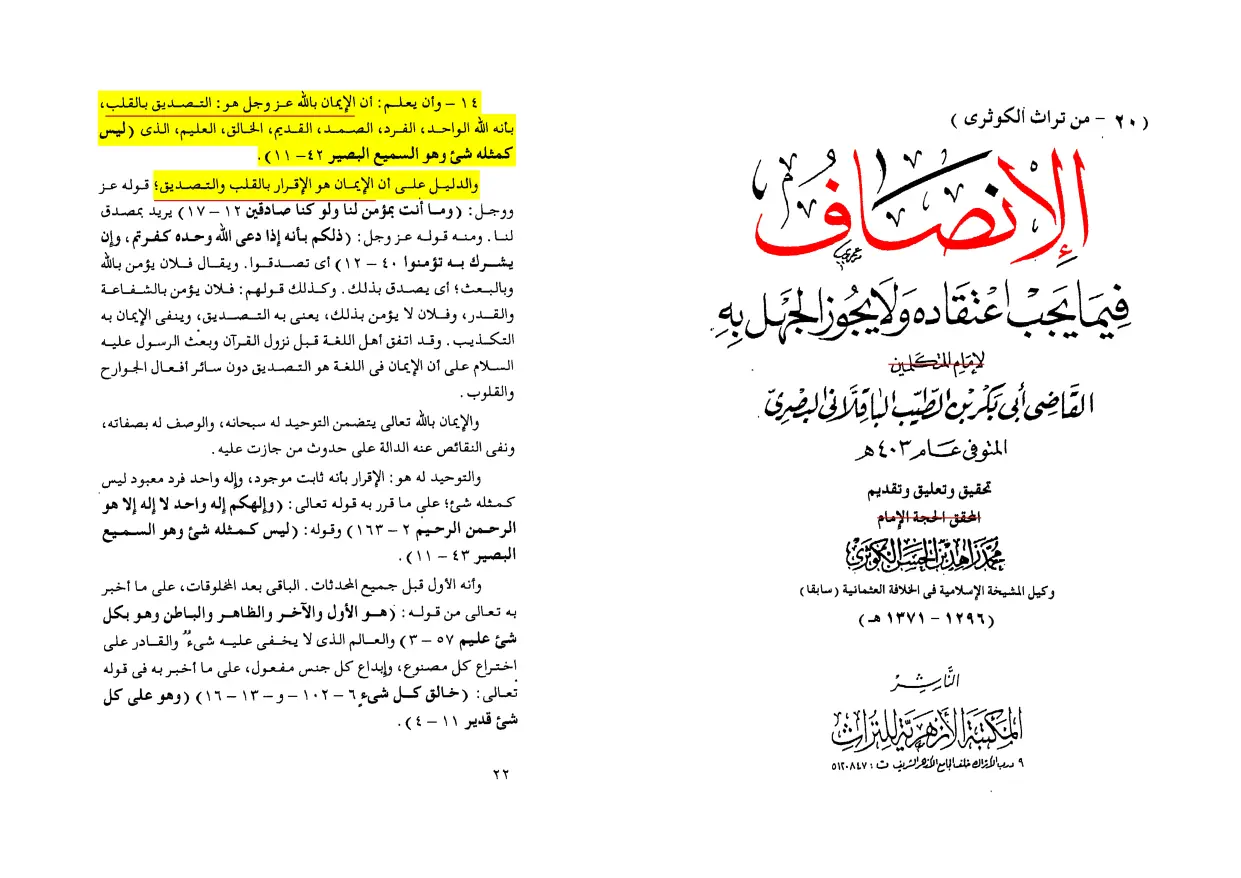
◈ Their scholar Abū Bakr al-Bāqillānī said:
14 - And that he knows that Īmān in Allāh - Glorified and Exalted - is belief in the heart, that He is the One, the Singular, the Self-Sufficient, the Eternal, the Creator, the All-Knowing, whom there is nothing like Him and He is the All-Hearing, the All-Seeing.
And the proof that Īmān is affirmation in the heart and belief..
📓 al-Inṣāf - p. 22
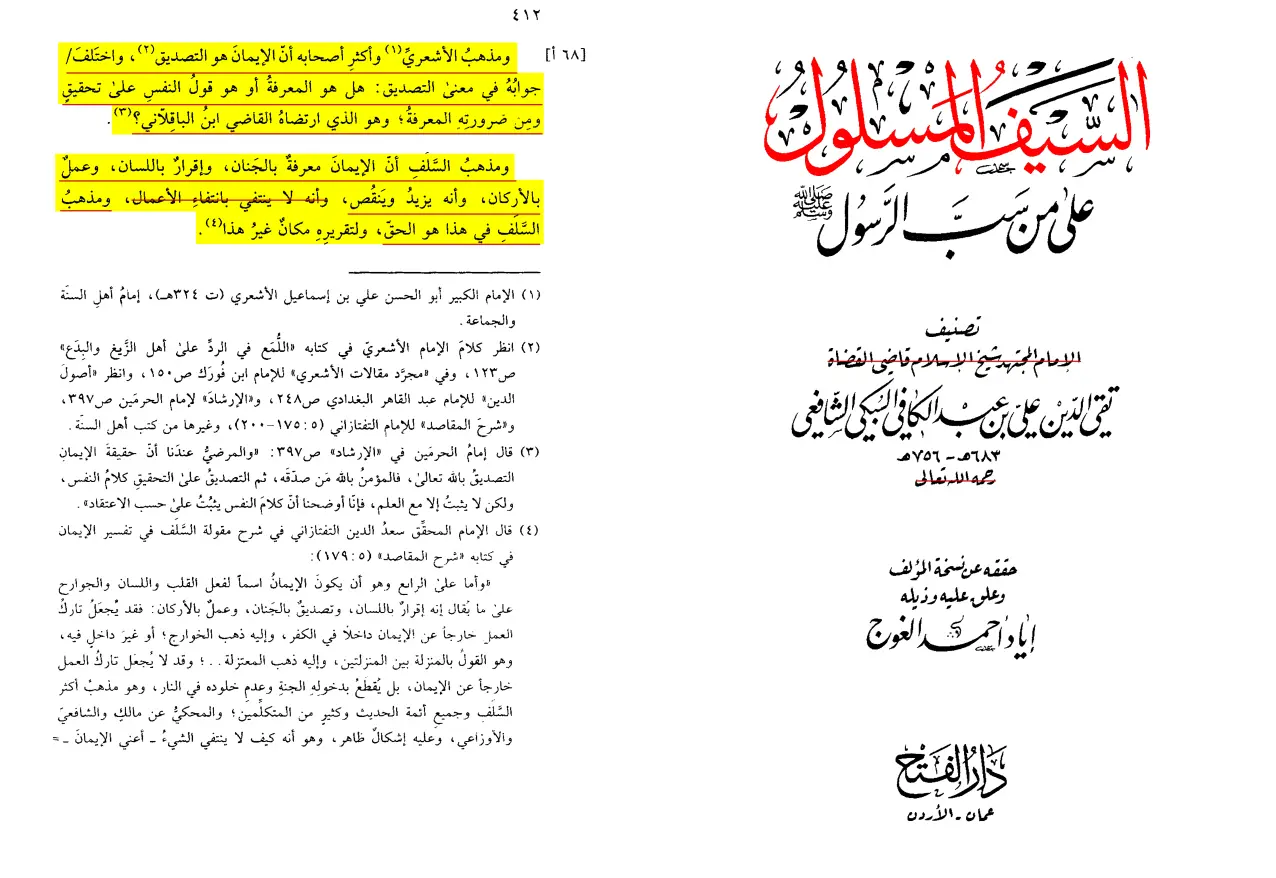
◈ as-Subkī said:
And the maḏhab of al-Ashʿarī and most of his companions is that Īmān is belief (taṣdīq), and his answer differed to what is the meaning of taṣdīq, is it knowledge (maʿrifah) or is it the inner statement (qawl an-nafs) of made with conviction, which necessarily entails knowledge, and it is what al-Qāḍī Ibn al-Bāqillānī favored.
And the maḏhab of the Salaf is that Īmān is knowledge with the heart, affirmation with the tongue, and action with the limbs, and that it increases and decreases,and that it isn't negated with the negation of the actions(this is false), and the maḏhab of the Salaf is the truth.
📓 as-Sayf al-Maslūl - p. 412
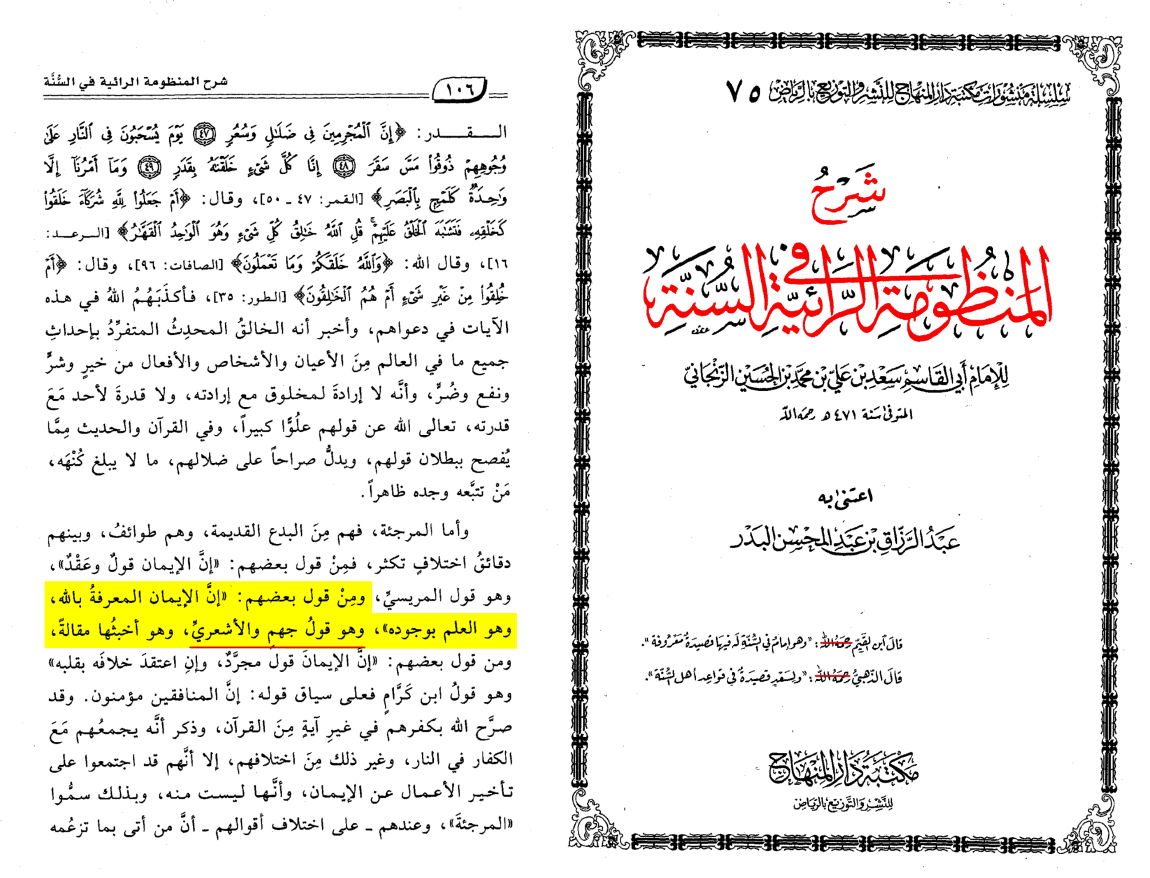
And from the speech of some of them (meaning the Murjiʾah): “Verily Īmān is knowledge of Allāh, and it is knowledge of His existence”, and it is the statement of Jahm and al-Ashʿarī and it is the most vile of statements.
Precedence regarding the Takfīr of Ashāʿirah
◈ Abū al-Fidāʾ al-Muʿayyad said in [al-Mukẖtaṣar fī Akhbār al-Bashar - vol. 2, p. 90]:
"al-Ash’arī displayed his madhhab and clarified it, and his speech became among the most widespread, spreading across the land, and most of the Ḥanābilah consider him a kāfir and deem his blood and the blood of anyone who agrees with him permissible."
◈ Ibn al-Mibrad said in [Jamʿ al-Juyūsh - p. 107]:
Abū al-‘Abbās Aḥmad ibn Muḥammad al-Nahāwandī was a great Imām. Abū ‘Alī al-Ḥaddād mentioned his significant status and that he was opposed to the people of kalām and takfīred the Ashʿarīs.
◈ And he also said in [Jamʿ al-Juyūsh - p. 151]:
Abū al-Muẓaffar al-Tirmidhī, Ḥabāl ibn Aḥmad, the Imām of the people of Tirmidh, avoided them and testified that they are guilty of zandaqah.
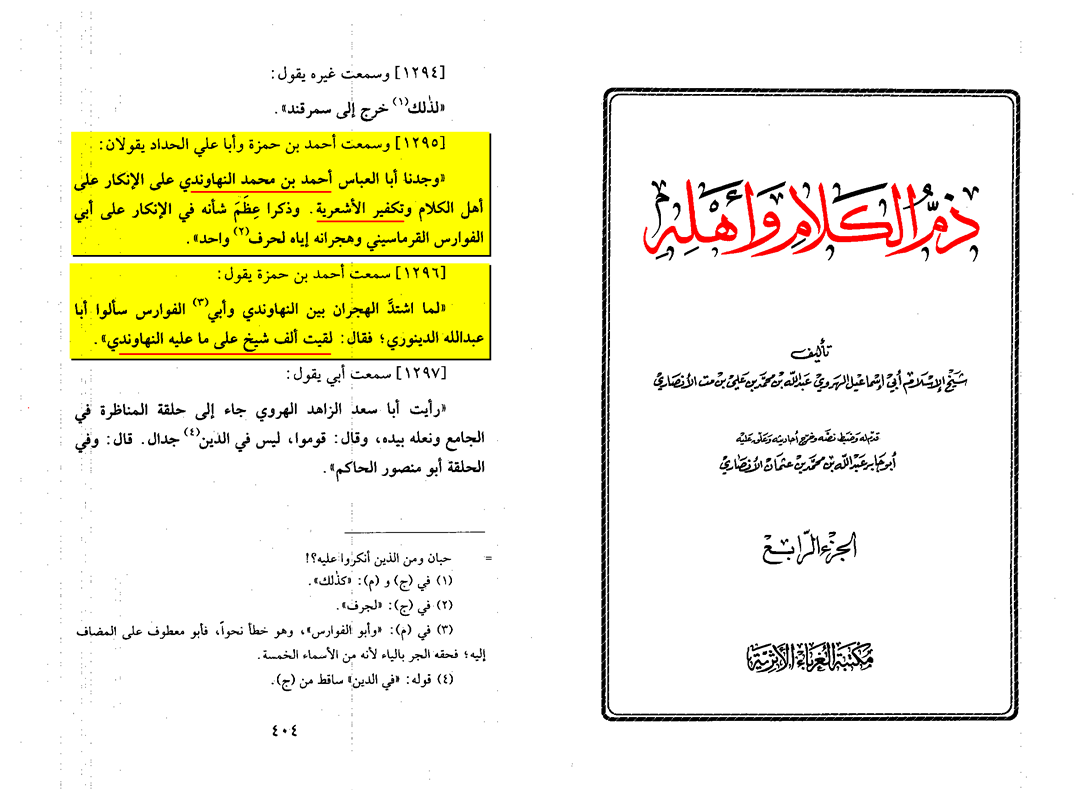
◈ Abū Ismāʿīl al-Harawī said in [Dhamm al-Kalām wa-Ahlihi - vol. 4, p. 404]:
I heard Aḥmad ibn Ḥamzah and Abū ‘Alī al-Ḥaddād saying: "We found Abū al-‘Abbās Aḥmad ibn Muḥammad al-Nahāwandī condemning the people of kalām and takfīring the Ash’arīs."
I heard Aḥmad ibn Ḥamzah say: When the estrangement between al-Nahāwandī and Abū al-Fawāris intensified, they asked Abū ‘Abd Allāh al-Dīnawarī, who said, "I have met a thousand shaykhs who are upon the same path as al-Nahāwandī."
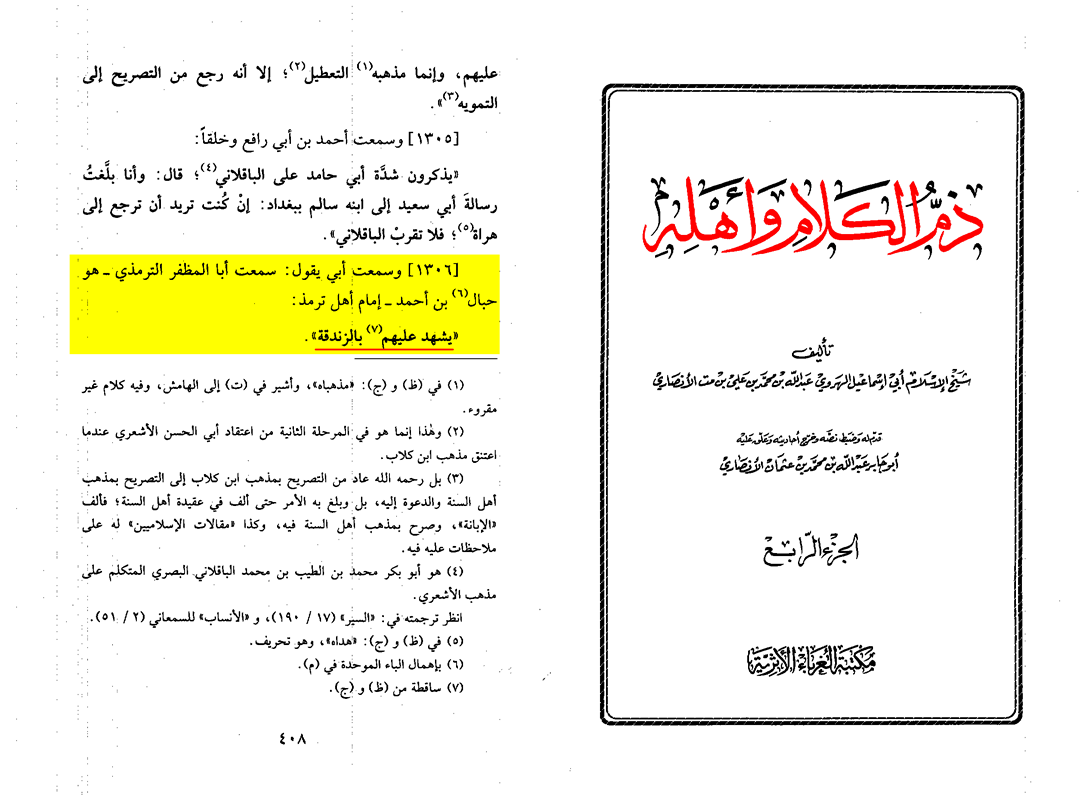
◈ And he said in [Dhamm al-Kalām wa-Ahlihi - vol. 4, p. 408]:
I heard my father say: I heard Abū al-Muẓaffar al-Tirmidhī (Ḥabāl ibn Aḥmad) the Imām of the people of Tirmidh, "testifying that they are guilty of zandaqah."
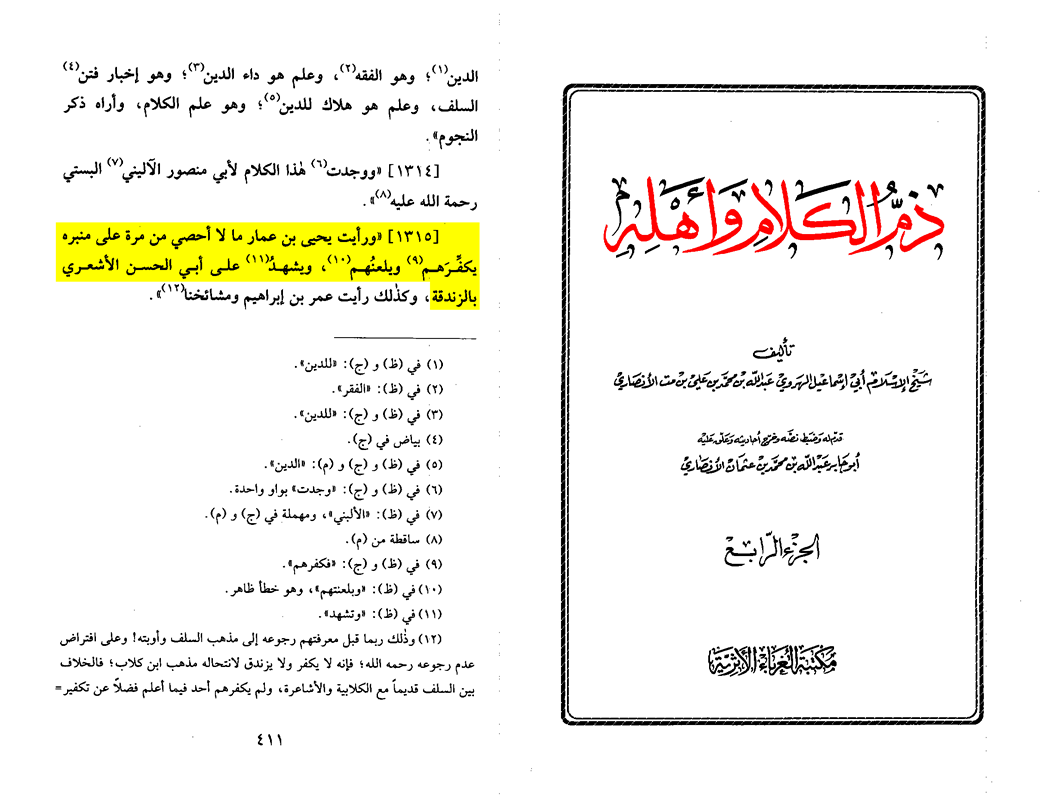
◈ And he said in [Dhamm al-Kalām wa-Ahlihi - vol. 4, p. 411]:
I saw Yaḥyā ibn ‘Ammār more times than I can count on his minbar takfīr them, curse them, and testify that Abū al-Ḥasan al-Ash’arī was guilty of zandaqah.
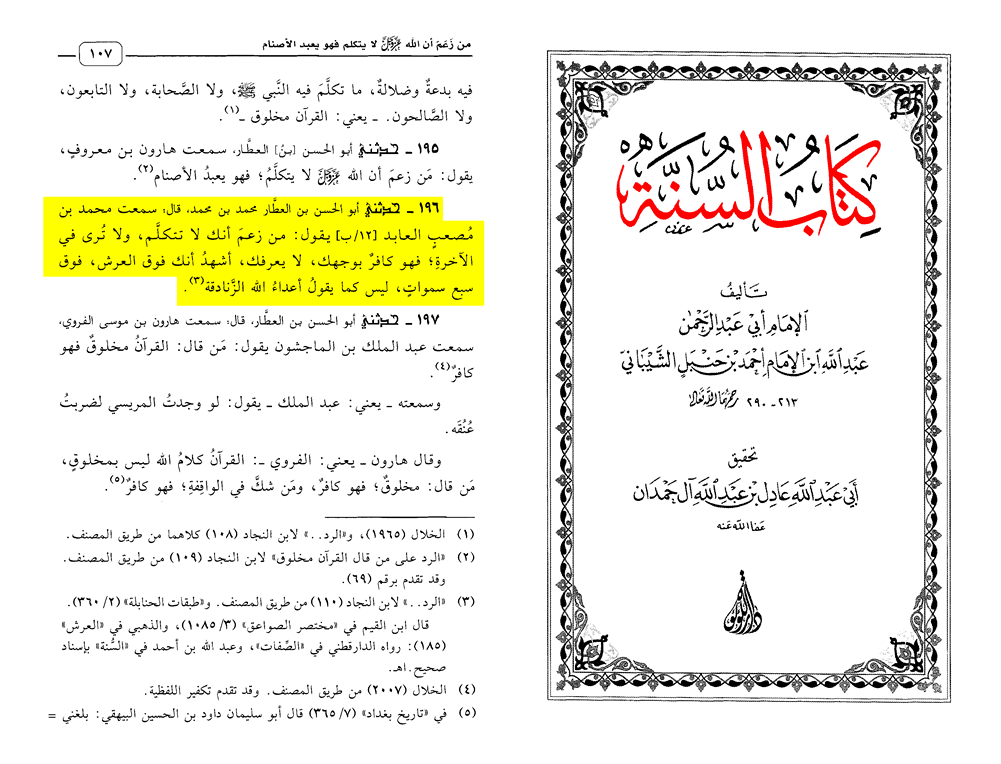
◈ al-Imām ʿAbd Allāh ibn Aḥmad ibn Ḥanbal - narrated in his [as-Sunnah - p. 107]
It was narrated to us by Abū al-Ḥasan ibn al-ʿAṭṭār, Muḥammad ibn Muḥammad. He said: I heard Muḥammad ibn Muṣʿab al-ʿĀbid say: “Whoever claims that You do not speak, and that You will not be seen in the Hereafter, has disbelieved in You and does not know You. Allāh is above the Throne, above six heavens, not as the enemies of Allāh, the Zanādiqah, say.”
Takfīr of the one who performs Taʾwīl of the Ṣifāt of Allāh, and claims to do Tanzīh
Know that Ahl as-Sunnah were extremely severe on the Muʾawwilah of the attributes, those who called their distortion Tanzīh of Allāh and called affirming the attributes Tashbīh and Tajsīm.
And the one who follows the statements of Ahl as-Sunnah wa-l-Jamāʿah in their denial of the people of Taʾwīl would find them attributing these people to the Jahmiyyah for the true speech of the Jahmiyyah is based upon Takdhīb and Taʿṭīl of the texts.
◈ Ibn Taymiyyah al-Ḥarrānī said in [Darʾ Taʿāruḍ al-ʿAql wa-al-Naql - vol. 6, p. 343]
And for this reason, the ʿuqalāʾ with pure Fiṭrah would judge in accordance with this necessary principle, even before they were aware that there are those in existence who deny it and oppose it. Most of those with pure Fiṭrah, when it is mentioned to them the statement of the deniers, would hasten to deem them ignorant and takfīr them. Some of them do not believe that a rational person would utter such a thing, due to the evidence of this principle to them, and its firm establishment in themselves. They would thus attribute anyone who opposes it to madness, until they encounter such statements in their books or hear them from one of them.
He said in The Ten Nullifiers of Islam: “The third: whoever does not declare the polytheists to be disbelievers, or doubts their disbelief, or deems their religion correct, then he is a disbeliever.” So what, then, is the case with doubting the disbelief of the Jahmiyyah, the enemies of Allāh and His Messenger, those who deny the Creator and negate the attributes of His perfection and the descriptions of His majesty?
◈ Ibn Rajab reported Ibn Mandah to have said in [Dhayl Ṭabaqāt al-Ḥanābilah, vol. 1, p. 31]
Taʾwīl, according to the people of Ḥadīth, is a type of Takdhīb.
al-Marrūḏī said: I asked Abā ʿAbdillāh - Aḥmad ibn Ḥanbal - about ʿAbdullāh at-Taymī? He said: he's truthful, and I wrote from him things from al-Raqāʾiq, but it was reported that he mentioned the narration of laughter (الضحك), so he said: like the plant when it laughs (إذا ضحك), and this is the speech of the Jahmiyyah.
Abū Ḥafṣ ʿUmar ibn Muḥammad ibn Rajāʾ narrated to us. Abū Naṣr ʿIṣmah ibn Abī ʿIṣmah narrated to us. He said: Abū Ṭālib narrated to us. He said: I heard Abū ʿAbd Allāh [Aḥmad ibn Ḥanbal] saying:
Whoever says Allāh created ʾĀdam in the image of ʾĀdam then he is a Jahmī, and which image did ʾĀdam have before He created him?!
The apparent and hidden meanings of the Qurʾān indicate what we have described, and we are content with the revelation without needing Taʾwīl. Both the general masses and the scholars know it. No one does Taʾwīl of it except a disbeliever in it, who hides his disbelief through his interpretation (Ta’wil).
And Allāh the Exalted and Glorified has mentioned in more than one place in His Book: the hand, and the hearing and the sight, so the Jahmiyyah did Taʾwīl of these ʾĀyāt, and they explained them in a way other than how the people of knowledge explained, and they said: Indeed, Allāh didn't created ʾĀdam with His hand, and they said: the meaning of al-Yad (hand) here is: power (Quwwah).
And the Muslim is required to affirm knowledge of Allāh's attributes by following and submitting to what came, so if someone is ignorant of this knowledge to the extent that he says: I only describe what Allāh has stated, but I do not know its meanings, until it leads him to saying the meaning of the statement of the Jahmiyyah: the hand is the favor, and he uses as evidence the verse: {Do they not see that We have created for them from what Our hands have made, grazing livestock, and [then] they are their owners?} [Yā-Sīn: 71] and similar to that, then they have strayed from the straight path. This is the pure speech of the Jahmiyyah, as they claim to believe in all the attributes of Allāh, yet they distort their meanings from the way Allāh described Himself, to the point they say: the meaning of: {He is the All-Hearing, the All-Seeing} [Ash-Shūrā:11] The All-Hearing is the All-Seeing and the All-Seeing is the All-Hearing, and they make "a hand"...◈ On the [next page]:
..."a blessing" and similiar to that, they distort it from its way, for they are indeed the Muʿaṭṭilah.
There are many more narrations regarding the takfīr of Taʾwīl from the Salaf, as these signify that they actually did. In case you do not know, the following are the descriptions of who I have cited.
148. al-Dārimī, ʿUthmān ibn Saʿīd ibn Khālid ibn Saʿīd.
al-Imām, al-ʿAllāmah, al-Ḥāfiẓ, an-Nāqid, the Sẖaykẖ of those lands, Abū Saʿīd al-Tamīmī, al-Dārimī, al-Sijistānī, the author of al-Musnad al-Kabīr and other compilations.
He was born shortly before the year two hundred, and he traveled through the regions seeking ḥadīth. He heard from Maryam, Muslim ibn Ibrāhīm, ʿAbd al-Ghaffār ibn Dāwūd al-Ḥarrānī, Sulaymān ibn Ḥarb, Abū Salamah al-Tabūdhakī, Nuʿaym ibn Ḥammād, ʿAbd Allāh ibn Ṣāliḥ the scribe of al-Layth, Muḥammad ibn Kathīr, Musaddad ibn Musarhad, Abū Tawbah al-Ḥalabī, ʿAbd Allāh ibn Rajāʾ al-Ghuddānī, Abū Jaʿfar al-Nufaylī, Aḥmad ibn Ḥanbal, Yaḥyā ibn Maʿīn, ʿAlī ibn al-Madīnī, Isḥāq ibn Rāhawayh, Farwah ibn al-Maghrāʾ, Abū Bakr ibn Abī Shaybah, Yaḥyā al-Ḥimānī, Sahl ibn Bakkār, Abū al-Rabīʿ al-Zahrānī, Muḥammad ibn al-Minhāl, al-Haytham ibn Khārijah, and many others, in the Ḥaramayn [the 2 Masjids], al-Shām, Egypt, Iraq, al-Jazīrah, and the lands of the non-Arabs.
He authored a book in refutation of Bishr al-Marīsī and a book in refutation of the Jahmiyyah, both of which we have transmitted.
He took the science of ḥadīth and its hidden defects from ʿAlī, Yaḥyā, and Aḥmad, surpassed the people of his time, was devoted to the Sunnah, and insightful in debate.
Those who narrated from him include: Abū ʿAmr Aḥmad ibn Muḥammad al-Ḥīrī, Muḥammad ibn Ibrāhīm al-Ṣarrām, Muʾammal ibn al-Ḥusayn, Aḥmad ibn Muḥammad ibn al-Azhar, Muḥammad ibn Yūsuf al-Harawī, Abū Isḥāq ibn Yāsīn, Muḥammad ibn Isḥāq al-Harawī, Aḥmad ibn Muḥammad ibn ʿAbdūs al-Ṭarāʾifī, Abū al-Naḍr Muḥammad ibn Muḥammad al-Ṭūsī the jurist, Ḥāmid al-Raffāʾ, Aḥmad ibn Muḥammad al-ʿAnbarī, Abū al-Faḍl Yaʿqūb al-Qarrāb, and many others from the people of Herāt and Nīsābūr.
al-Ḥākim said: I heard Muḥammad ibn al-ʿAbbās al-Ḍabbī say: I heard Abū al-Faḍl Yaʿqūb ibn Isḥāq al-Qarrāb say: “We have not seen the like of ʿUthmān ibn Saʿīd, nor did ʿUthmān see the like of himself. He took adab from Ibn al-Aʿrābī, jurisprudence from Abū Yaʿqūb al-Buwayṭī, and ḥadīth from Ibn Maʿīn and Ibn al-Madīnī, and he advanced in these sciences, may Allāh have mercy on him.”
Abū Ḥāmid al-Aʿmashī said: “I have not seen among the traditionists the like of Muḥammad ibn Yaḥyā, ʿUthmān ibn Saʿīd, and Yaʿqūb al-Fasawī.”
◈ And adh-Dhahabī said in [Siyar ʿAlām an-Nubalāʾ - vol. 13, p. 440]:
132 - at-Tirmiḏhī, Muḥammad ibn ʿĪsā ibn Sawrah ibn Mūsā ibn ad-Ḍaḥḥāk.
It was said that he is Muḥammad ibn ʿĪsā ibn Yazīd ibn Sawrah ibn al-Sakan: al-Ḥāfiẓ, al-ʿAlam, al-Imām, al-Bāriʿ, Ibn ʿĪsā al-Sulamī, at-Tirmidhī, aḍ-Ḍarīr, the author of al-Jāmiʿ and the book al-ʿIlal, and other works.
They differed regarding him: it was said that he was born blind, but the correct view is that he lost his sight in his old age, after his travels and his writing down of knowledge.
He was born around the year 210 AH.
He traveled, and heard ḥadīth in Khurāsān, Iraq, and the Two Sanctuaries, but he did not travel to Egypt or al-Shām.
He narrated from: Qutaybah ibn Saʿīd, Isḥāq ibn Rāhawayh, Muḥammad ibn ʿAmr al-Sawwāq al-Balkhī, Maḥmūd ibn Ghaylān, Ismāʿīl ibn Mūsā al-Fazārī, Aḥmad ibn Manīʿ, Abū Muṣʿab al-Zuhrī, Bishr ibn Muʿādh al-ʿAqdī, al-Ḥasan ibn Aḥmad ibn Abī Shuʿayb, Abū ʿAmmār al-Ḥusayn ibn Ḥurayth, the long-lived narrator ʿAbd Allāh ibn Muʿāwiyah al-Jumaḥī, ʿAbd al-Jabbār ibn al-ʿAlāʾ, Abū Kurayb, ʿAlī ibn Ḥujr, ʿAlī ibn Saʿīd ibn Masrūq al-Kindī, ʿAmr ibn ʿAlī al-Fallās, ʿImrān ibn Mūsā al-Qazzāz, Muḥammad ibn Abān al-Mustamlī, Muḥammad ibn Ḥumayd al-Rāzī, Muḥammad ibn ʿAbd al-Aʿlā, Muḥammad ibn Rāfiʿ, Muḥammad ibn ʿAbd al-ʿAzīz ibn Abī Rizmah, Muḥammad ibn ʿAbd al-Malik ibn Abī al-Shawārib, Muḥammad ibn Yaḥyā al-ʿAdanī, Naṣr ibn ʿAlī, Hārūn al-Ḥammāl, Hannād ibn al-Sarī, Abū Hammām al-Walīd ibn Shujāʿ, Yaḥyā ibn Aktham, Yaḥyā ibn Ḥabīb ibn ʿArabī, Yaḥyā ibn Durust al-Baṣrī, Yaḥyā ibn Ṭalḥah al-Yarbūʿī, Yūsuf ibn Ḥammād al-Maʿnī, Isḥāq ibn Mūsā al-Khaṭmī, Ibrāhīm ibn ʿAbd Allāh al-Harawī, and Suwayd ibn Naṣr al-Marwazī.
Thus, the earliest (highest) of what he had are the narrations of Mālik, the two Ḥammāds, al-Layth, and Qays ibn al-Rabīʿ. And he goes down in levels until, in fact, he narrated much from al-Bukhārī, and from the companions of Hishām ibn ʿAmmār and the like.
Those who narrated from him include: Abū Bakr Aḥmad ibn Ismāʿīl al-Samarqandī, Abū Ḥāmid Aḥmad ibn ʿAbd Allāh ibn Dāwūd al-Marwazī, Aḥmad ibn ʿAlī ibn Ḥasnowayh the Qurʾān-reciter, Aḥmad ibn Yūsuf al-Nasafī, Asad ibn Ḥamdawayh al-Nasafī, al-Ḥusayn ibn Yūsuf al-Farabri, Ḥammād ibn Shākir al-Warrāq, Dāwūd ibn Naṣr ibn Suhayl al-Bazdawī, al-Rabīʿ ibn Ḥayyān al-Bāhilī, ʿAbd Allāh ibn Naṣr (the brother of al-Bazdawī), ʿAbd ibn Muḥammad ibn Maḥmūd al-Nasafī, ʿAlī ibn ʿUmar ibn Kulthūm al-Samarqandī, al-Faḍl ibn ʿAmmār al-Ṣarrām, Abū al-ʿAbbās Muḥammad ibn Aḥmad ibn Maḥbūb (the transmitter of al-Jāmiʿ), Abū Jaʿfar Muḥammad ibn Aḥmad al-Nasafī, Abū Jaʿfar Muḥammad ibn Sufyān ibn al-Naḍr al-Nasafī al-Amīn, Muḥammad ibn Muḥammad ibn Yaḥyā al-Harawī al-Qarrāb, Muḥammad ibn Maḥmūd ibn ʿAnbar al-Nasafī, Muḥammad ibn Makkī ibn Nūḥ al-Nasafī, Musabbiḥ ibn Abī Mūsā al-Kājarī, Makhūl ibn al-Faḍl al-Nasafī, Makkī ibn Nūḥ, Naṣr ibn Muḥammad ibn Sabrāh, al-Haytham ibn Kulayb al-Shāshī the ḥāfiẓ (the transmitter of al-Shamāʾil from him), and others.
And his shaykh Abū ʿAbd Allāh al-Bukhārī wrote from him. So al-Tirmidhī said, in the ḥadīth of ʿAṭiyyah from Abū Saʿīd: “O ʿAlī, it is not lawful for anyone to enter a state of major ritual impurity in the mosque other than me and you” — Muḥammad ibn Ismāʿīl heard this ḥadīth from me.
◈ And adh-Dhahabī narrated in [Siyar ʿAlām an-Nubalāʾ - vol. 16, p. 529]:
389. Ibn Baṭṭah: ʿUbayd Allāh ibn Muḥammad ibn Muḥammad al-ʿUkbarī.
Al-Imām, al-Qudwah, al-ʿĀbid, al-Faqīh, al-Muḥaddith, Shaykh al-ʿIrāq: Abū ʿAbd Allāh ʿUbayd Allāh ibn Muḥammad ibn Muḥammad ibn Ḥamdān al-ʿUkbarī al-Ḥanbalī, Ibn Baṭṭah, the author of al-Ibānah al-Kubrā in three volumes.
He narrated from: Abū al-Qāsim al-Baghawī, Ibn Ṣāʿid, Abū Dharr ibn al-Bāghandī, Abū Bakr ibn Ziyād al-Naysābūrī, Ismāʿīl al-Warrāq, al-Qāḍī al-Maḥāmilī, Muḥammad ibn Makhlad, Abū Ṭālib Aḥmad ibn Naṣr al-Ḥāfiẓ, Muḥammad ibn Aḥmad ibn Thābit al-ʿUkbarī; and he traveled in mature age, hearing from ʿAlī ibn Abī al-ʿAqab in Damascus, from Aḥmad ibn ʿUbayd al-Ṣaffār in Ḥimṣ, and a group of others.
Those who narrated from him include: Abū al-Fatḥ ibn Abī al-Fawāris, Abū Nuʿaym al-Aṣbahānī, ʿUbayd Allāh al-Azharī, ʿAbd al-ʿAzīz al-Azajī, Aḥmad ibn Muḥammad al-ʿAtīqī, Abū Isḥāq al-Barmakī, Abū Muḥammad al-Jawharī, Abū al-Faḍl Muḥammad ibn Aḥmad ibn ʿĪsā al-Saʿdī, and others. The last person to narrate from him by ijāzah was ʿAlī ibn Aḥmad ibn al-Busrī.
ʿAbd al-Wāḥid ibn ʿAlī al-ʿUkbarī said: “I have not seen among the shuyūkh of ḥadīth, nor among others, anyone of a finer outward appearance than Ibn Baṭṭah, may Allāh have mercy on him.”
Al-Khaṭīb said: Abū Ḥāmid al-Dalwī narrated to me: When Ibn Baṭṭah returned from his travels, he remained devoted to his home for forty years. He was not seen in a marketplace, nor seen breaking his fast except on an ʿĪd. He was persistent in commanding what is right. No report of a reprehensible matter reached him except that he would change it.
Abū Muḥammad al-Jawharī said: I heard my brother al-Ḥusayn say: I saw the Prophet, peace and blessings be upon him, in a dream, and I said: “O Messenger of Allāh, the madhāhib have become confusing to me.” He said: “Hold fast to Ibn Baṭṭah.” So I awoke, put on my clothes, then went up to ʿUkbarā. I entered, and Ibn Baṭṭah was in the masjid. When he saw me, he said to me: “The Messenger of Allāh spoke the truth. The Messenger of Allāh spoke the truth.”
Al-ʿAtīqī said: Ibn Baṭṭah died, and he was one whose supplication was answered, in Muḥarram of the year 387 AH.
Ibn Baṭṭah said: “I was born in the year 304 AH. My father had partners in Baghdad, and one of them said to him: ‘Send your son to Baghdad to hear ḥadīth.’ He said: ‘He is small.’ He said: ‘I will carry him with me.’ So he carried me with him, and I came, and there was Ibn Manīʿ with ḥadīth being read to him.
As for using tanzīh as an excuse:
◈ Allāh, the Exalted, said in [al-Kahf - verse 104]:
[They are] those whose effort is lost in worldly life, while they think that they are doing well in work.
◈ Aṭ-Ṭabarī said:
While they think that they are doing well in work: This means that they believe they are obeying Allāh by their actions and striving in what He has commanded His servants to do. This is one of the strongest proofs against the claim of those who say that no one disbelieves in Allāh except with deliberate intent to do so after knowing His oneness, for Allāh, Exalted is His mention, has informed about these people whose characteristics He described in this verse, that their efforts in this world were in vain, even though they believed they were doing good, He also informed that they are the ones who disbelieved in the signs of their Lord. If the claim of those who argue that no one disbelieves in Allāh except from where he knows, then these people whom Allāh described as thinking they were doing good should have been rewarded for them, however, the truth is contrary to what they claimed, and Allāh, Glorified is His praise, has declared them to be disbelievers and has rendered their deeds void.
📖 Tafsīr aṭ-Ṭabarī - vol. 15, p. 428-429.
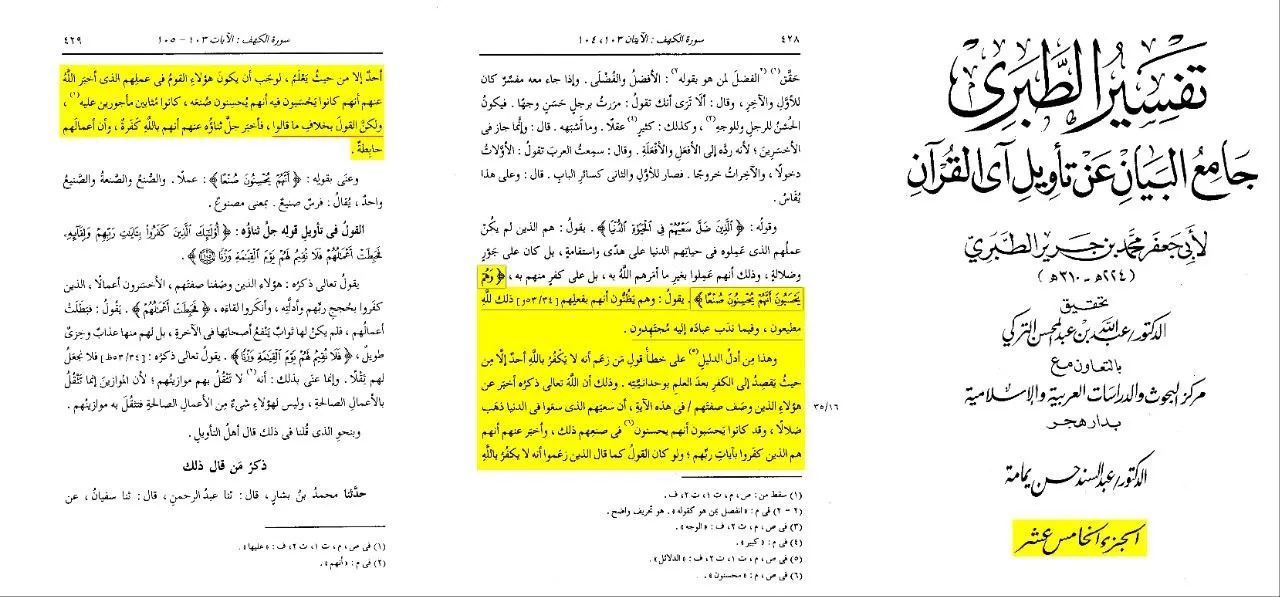
◈ I say:
This applies to the Jahmiyyah and the Ashāʿirah who rejected the Attributes of our Lord, the Mighty and Majestic, with the intention of glorifying Allāh and transcending Him beyond having "defects" (Exalted is Allāh from what they say of Him), and stripping Him of what He affirmed for Himself, the Mighty and Majestic.
◈ al-Imām Ahl as-Sunnah Aḥmad ibn Ḥanbal said in [ar-Radd ʿalā al-Jahmiyyah - p. 95-97]:
He (Jahm ibn Ṣafwān) found three ambiguous verses in the Qurʾān: His statement: {There's nothing like Him} [Ash-Shūra:11], {He is Allāh in the Heavens and on the earth} [Al-Anʿām:3], {No vision encompasses Him and he encompasses all visions} [Al-Anʿām:103]. So he built the foundation of His speech upon these Āyāt and he interpreted the Qurʾān in other than his Taʾwīl, and rejected the Aḥādīth of the Messenger of Allāh ﷺ, and he claimed that he who describes Allāh with what He described Himself with in his Book or which His Messenger reported from Him, is a Kāfir and he is from the Mushabbihah.
◈ al-Imām al-Barbahārī said in [Sharḥ as-Sunnah - p. 125]
If you hear the man saying: “Verily we exalt Allāh”, when he hears the narrations from Messenger of Allāh ﷺ, then know that he is a Jahmī. He wants to reject the narration of the Messenger of Allāh ﷺ, and he denies the narrations of the Messenger of Allāh ﷺ with this phrase, and he claims to honor Allāh and exalt Him when he hears the Ḥadīth of Ruʾyah, and the Ḥadīth of descent, and other than it.
◈ al-Imām Ibn Baṭṭah said in [al-Ibānah al-Kubrā - vol. 3, p. 302]:
So the wicked cursed Jahmī rejected all of that and denied it, and he said: Verily Allāh has never spoken, and He doesn't speak, and he claimed that his Lord is like the mute, deaf, lifeless, stone that was worshipped by [the people of] the Jāhiliyyah, it doesn't hear nor see, nor utter, nor benefit, nor harm. Despite this, he claims that he seeks to exalt Allāh and to raise Him above resemblance to the children of Ādam.
◈ Muḥammad ibn ʿAbd al-Wahhāb said:
And the Mutakallimūn from those who claim al-Islām, but Allāh misguided them from knowing al-Ilāh (i.e its meaning), and it was mentioned from al-Ashʿarī and those who followed him: He is al-Qādir, and that Ulūhiyyah is al-Qudrah (the power/ability). If we accept that, then it is the meaning of “lā ilāha illa-Llāh”, then Satan took control of them, and they believed that Tawḥīd could only be achieved by denying the attributes, so they denied them and called those who affirmed them “Mujassimah”.
And Ahl as-Sunnah have responded to them with a lot of evidences, from them: that Tawḥīd is only achieved by affirming the attributes, and that the meaning of al-Ilāh is the one who is worshipped, so if He was - Exalted - distinguished by it from all His creations, and this was a correct description, the one who attributes it to Him does not lie for this indicates the attributes, and it indicates the great knowledge and the great power, and these two attributes are the foundation of all attributes, just like He - Exalted - said: “It is Allāh who has created seven heavens and of the earth, the like of them. [His] command descends among them so you may know that Allāh is over all things competent and that Allāh has encompassed all things in knowledge.” [aṭ-Ṭalāq:12]
If Allāh has denied the worship of one who does not possess the ability to benefit or harm His servants, it is known that this entails knowledge of the needs of His worshipers, whether they are human or animal.
It also requires the ability to fulfill their needs, complete mercy, complete kindness, and other attributes. So, whoever denies the attributes is a Muʿaṭṭil, and the Muʿaṭṭil is worse than a polytheist. For this reason, the Salaf used to name the writings regarding the affirming of the attributes “Kutub at-Tawḥīd”, and al-Bukhārī ended his “Ṣaḥīḥ” with it, he said: “Kitāb at-Tawḥīd” then he mentioned the attributes, chapter by chapter.
The essence of the matter is that the Mutakallimūn say: Tawḥīd is only complete by denying the attributes. So Ahl as-Sunnah said: at-Tawḥīd is only complete by the affirmation of the attributes, and your Tawḥīd is Taʿṭīl, for this reason, this statement by some of them led to the denial of the Lord - blessed and exalted - as is the way of Ibn ʿArabī, Ibn al-Fāriḍ, and groups of people whose numbers are known only to Allāh.
The Salaf clarified that worship, if it is to be entirely directed to Allāh and not to any of the created beings, cannot occur except through the affirmation of the attributes and actions. It thus becomes clear that the one who denies the attributes denies the essence of Ulūhiyyah, though he may not realize it. It also becomes clear that whoever sincerely bears witness that there is no deity worthy of worship except Allāh must affirm the attributes and actions.
📖 ad-Durar as-Saniyyah - vol. 1, p. 112But the most astonishing thing is that their great leader [meaning al-Ashʿarī] thought that al-Ulūhiyyah was merely the ability (to create), and that the meaning of the statement “lā ilāha illa-Llāh” is: “No one has the power to create except Allāh.”
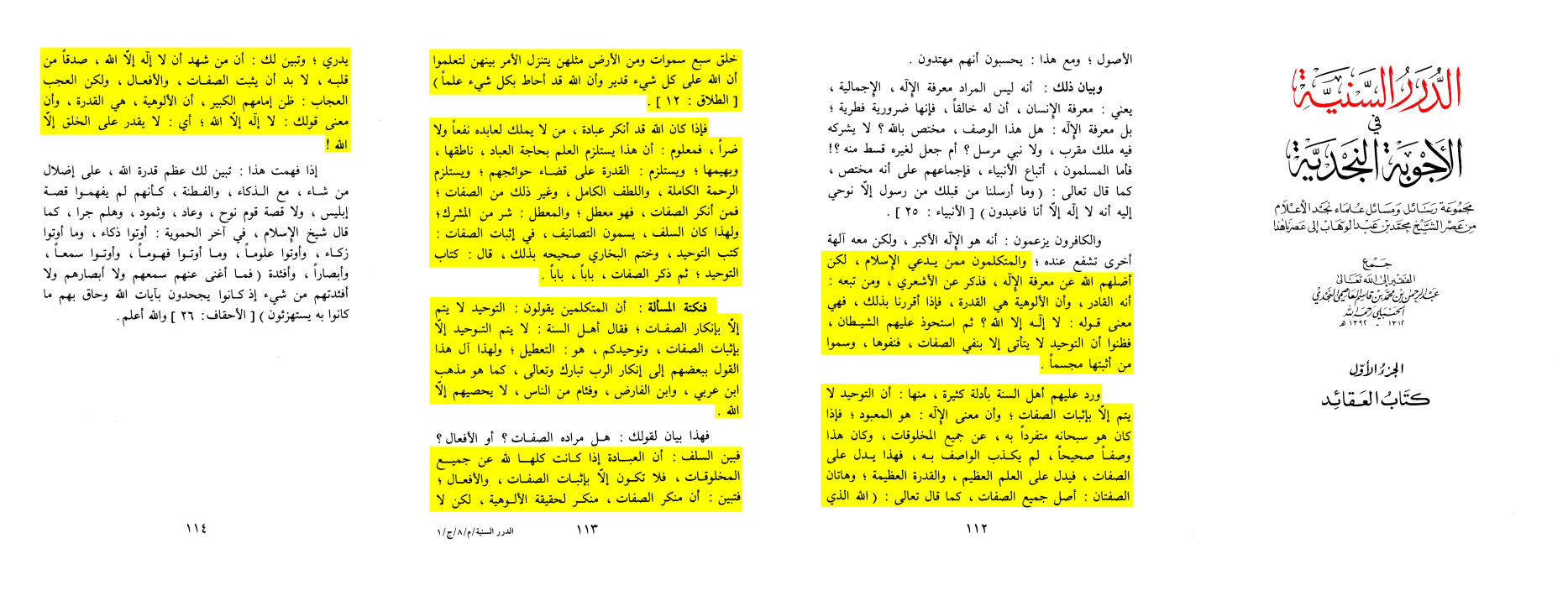
Evidence on Takfīr al-Muʿayyan
◈ Abū Saʿīd ad-Dārimī said in [ar-Radd ʿalā al-Jahmiyyah - p. 183]:
The opposer who debated me said: "I meant an explicit, stated wording that declares the Jahmiyyah disbelievers by their very name, whereas what you have narrated from ʿAlī رضي الله عنه concerns the zanādiqah."
So I said: "The zanādiqah and the Jahmiyyah are one and the same in their affair. They return to a single meaning, a single intent, and a single aim. No people are more alike to a people than they are to one another. Rather, every class and kind is only likened..."
◈ In the [next page]:
"...to its own class and kind. It has occurred that some Qur’ān would come down specifically concerning a particular matter, yet it would be general regarding whatever resembles it and is like it.
And Jahm, and the companions of Jahm, did not appear in the time of the Companions of the Messenger of Allāh and the Kibār of the Tābiʿīn, such that a specific, explicit report would be narrated from them about it by name. Had they been among them openly manifesting their views, they would have been killed, just as ʿAlī رضي الله عنه killed the zanādiqah who appeared in his era. They would have been killed just as the people of apostasy were killed.
Do you not see that al-Jaʿd ibn Dirham made some of his view public in the time of Khālid al-Qasrī, and he claimed that Allāh did not take Ibrāhīm as an intimate friend, and did not speak to Mūsā directly. So Khālid slaughtered him in Wāsiṭ on the Day of Sacrifice, in the presence of the Muslims who were there, and no critic found fault with him for it, and no attacker spoke against him. Rather, they deemed that action good and judged it correct.
Likewise, if these people had appeared in the time of the Companions of the Messenger of Allāh and the Kibār of the Tābiʿīn, their only path with those people would have been killing, like the path taken with the people of heresy, just as ʿAlī رضي الله عنه killed those of them who appeared in his era and burned them.
And some of them appeared in Madīnah in the days of Saʿd ibn Ibrāhīm ibn ʿAbd al-Raḥmān ibn ʿAwf, and so they advised the governor of Madīnah at that time to kill him.
And it is sufficient for an intelligent person, as proofs for declaring them disbelievers, what we have explained from the Book of Allāh regarding them, and what we have narrated concerning it from ʿAlī and Ibn ʿAbbās رضي الله عنهما, and what we have explained of the clarity of their disbelief and the foulness of their madhāhib one thing after another.”
◈ ʿAbdullāh ibn Aḥmad said:
Aḥmad ibn Ibrāhīm narrated to me: Yaḥyā ibn Yūsuf az-Zimmī narrated to me and said:
I was present with ʿAbdullāh ibn Idrīs when a man said to him: O Abā Muḥammad. In front of us are people who say: Verily the Qurʾān is created. So he said: From the Jews? He said: No. He said: Then from the Christians? He said: No. He said: Then from the Majūs? He said: No. He said: Then from who? He said: From the Muwaḥḥidīn. He said: They have lied. These are not Muwaḥḥidūn, they are Zanādiqah. Whoever claims that the Qurʾān is created, has verily claimed that Allāh the Mighty and the Majestic is created. And whoever claims that Allāh the Exalted is created, has verily committed kufr. These are Zanādiqah, these are Zanādiqah.
📓 Kitāb as-Sunnah - n° 29
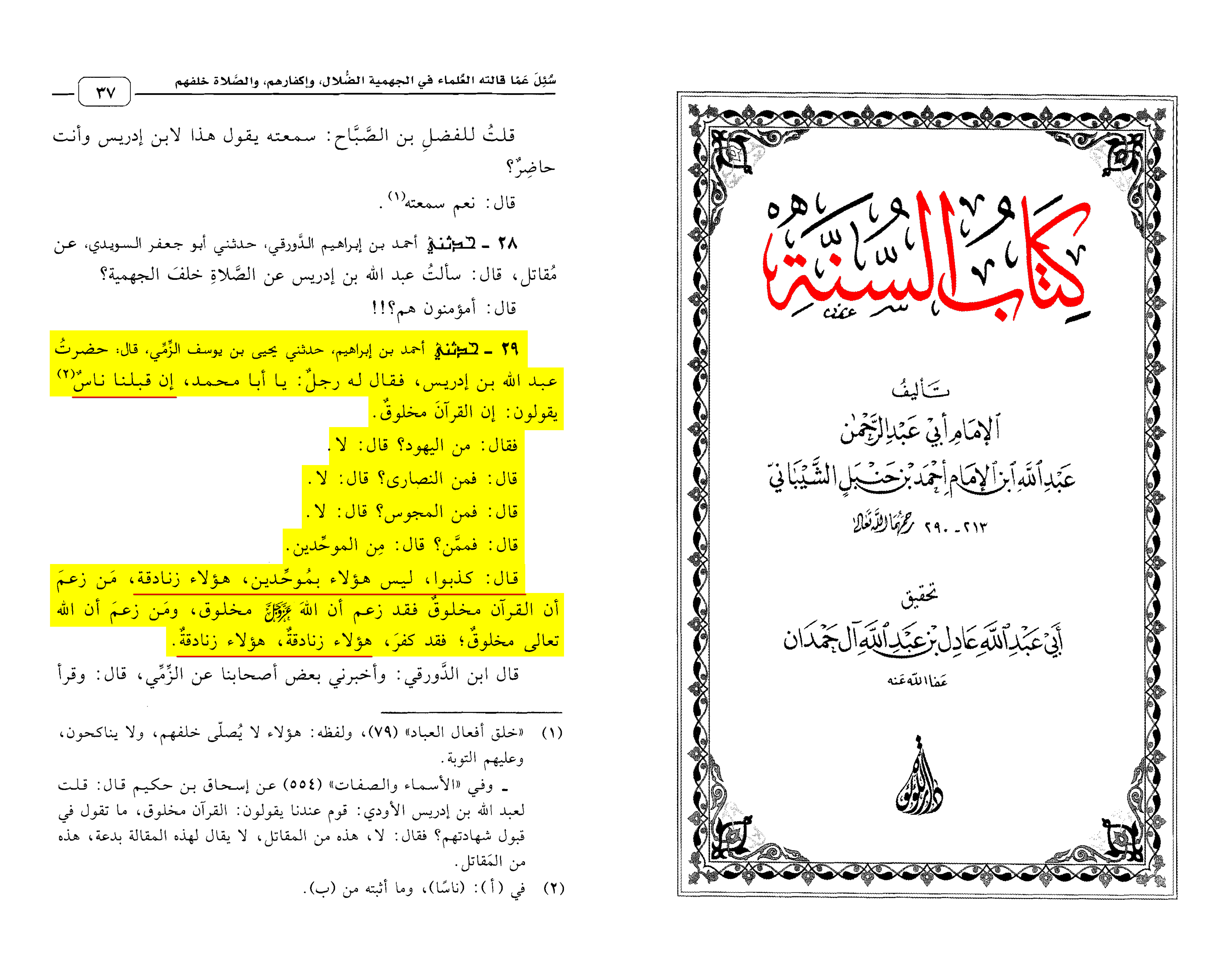
◈ ʿAbdullāh ibn Aḥmad said:
Muḥammad ibn Isḥāq aṣ-Ṣāġānī narrated to me, he said: ʿUbaydullāh ibn Yūsuf ibn al-Ḥajjāj al-Jubayrī narrated to us: Fiṭr ibn Ḥammād ibn Abī ʿUmar aṣ-Ṣaffār narrated to us and said:
I asked Muʿtamir ibn Sulaymān and said: O Abā Muḥammad, an Imām of a people says: The Qurʾān is created, should I pray behind him? So he said: He ought to be beheaded. Fiṭr said: And I asked Ḥammād ibn Zayd and said: O ʾAbā Ismāʿīl, we have an Imām who says: The Qurʾān is created, should I pray behind him? He said: Praying behind a Muslim is more beloved to me. And I asked Yazīd ibn Zurayʿ and said: O Abā Muʿāwiyah an Imām of a people says: The Qurʾān is created, should I pray behind him? He said: No, and no karāmah [to him].
📓 Kitāb as-Sunnah - n° 42
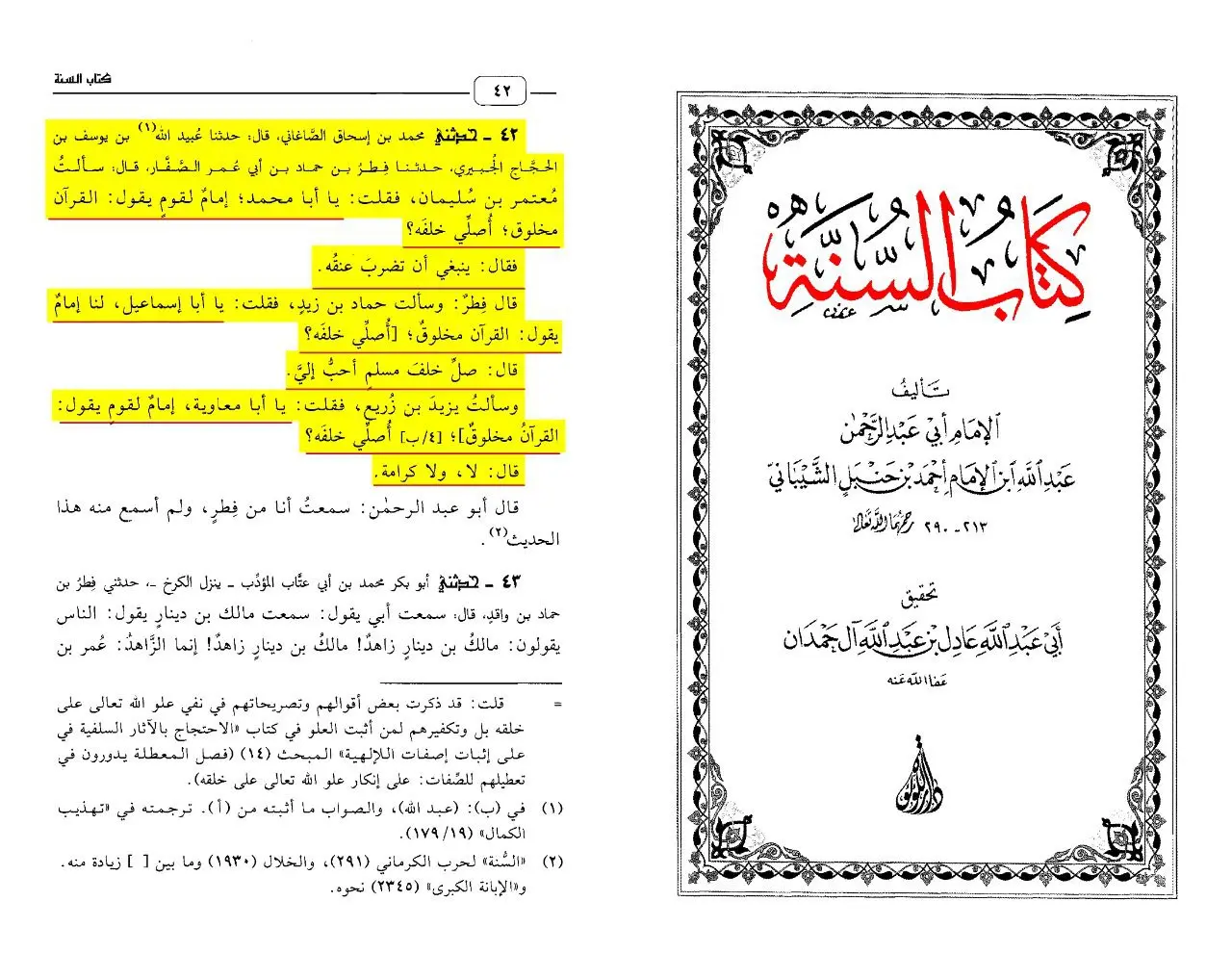
◈ ʿAbdullāh ibn Aḥmad said:
Hārūn ibn ʿAbdillāh al-Ḥammāl narrated to me: Ibrāhīm ibn Ziyād Sabalān narrated to us, he said: I heard ʿAbd ar-Raḥmān ibn Mahdī say:
If I had any authority, I would stand on the bridge, and no one from the Jahmiyyah would pass by me except that I would ask him about the Qurʾān. Then if he said: It is created, I would strike his head and throw it in the water.
📓 Kitāb as-Sunnah - n° 47
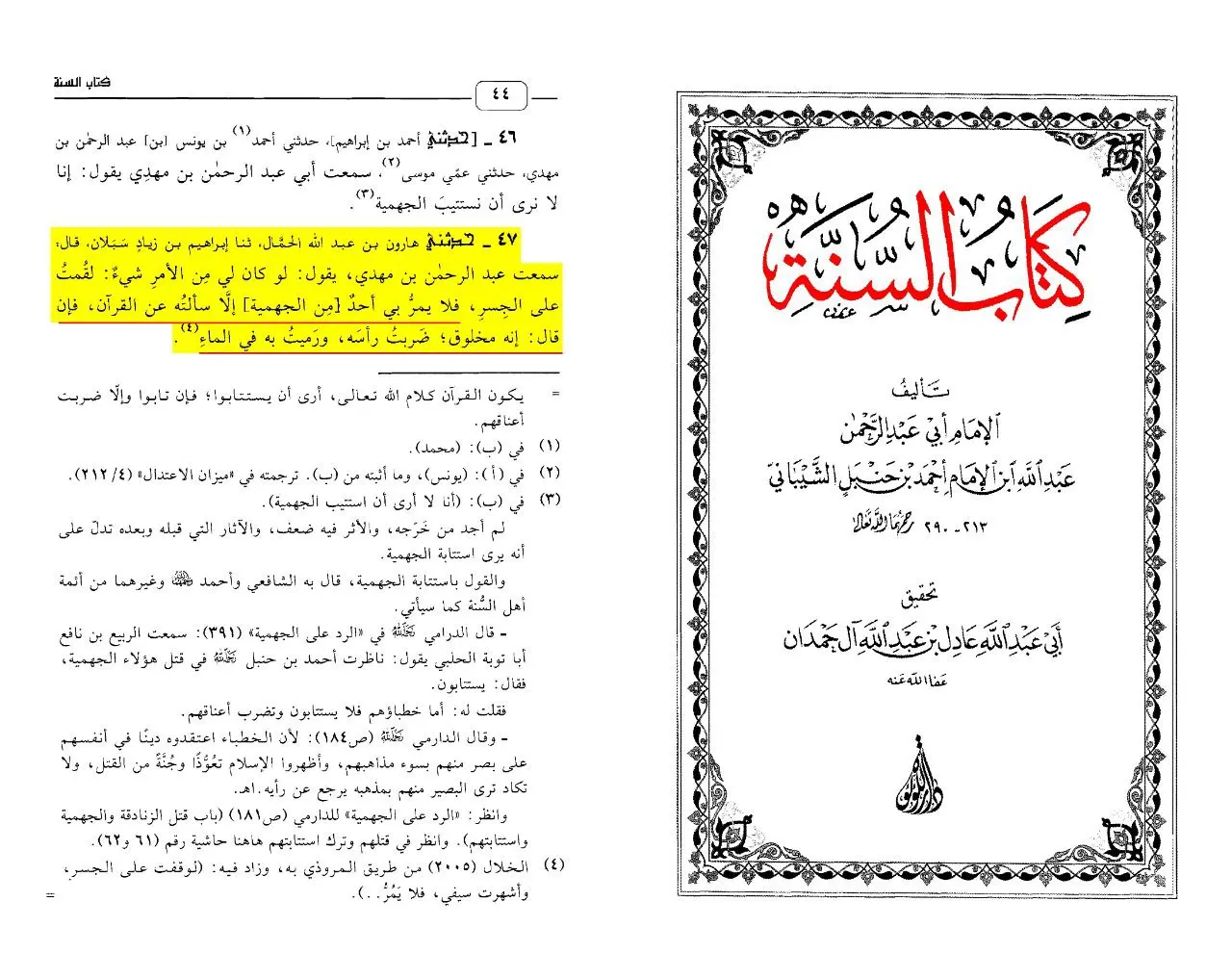
◈ ʿAbdullāh ibn Aḥmad said:
Aḥmad ibn Ibrāhīm ad-Dawraqī narrated to me: Muḥammad ibn Nūḥ al-Maḍrūb, from Masʿūd al-Qāḍī:
I heard Harūn, Amīr al-Muʾminīn saying: It has reached me that Bishr al-Marīsī claims that the Qurʾān is created. By Allāh, if He lets me get my hands on him, I will kill him in a way that I have never killed anyone ever before.
📓 Kitāb as-Sunnah - n° 78
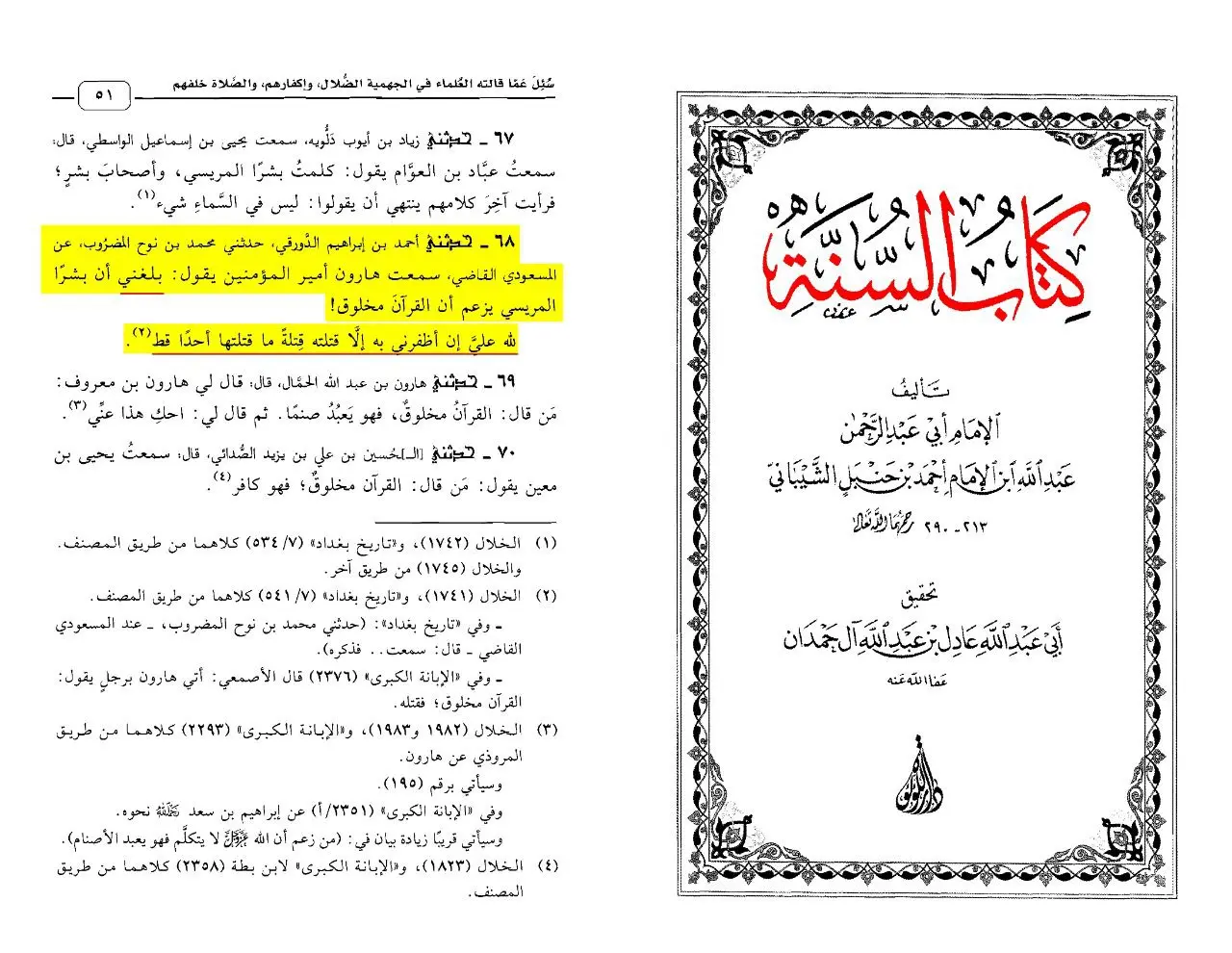
◈ ʿAbdullāh ibn Aḥmad said:
Abū al-Ḥasan Ibn al-ʿAṭṭār Muḥammad ibn Muḥammad narrated to me, he said: I heard Yaḥyā ibn Abī Qatīfah as-Sarrāj, he said:
We were with [Sufyān] Ibn ʿUyaynah when the people became disordered around him, so Ibn ʿUyaynah said: What is this? They said: Bishr has arrived. He said: What does he say? They said: He says the Qurʾān is created. He said: Bring him to me and bring me two witnesses so I can order the governor to behead him.
📓 Kitāb as-Sunnah - n° 200
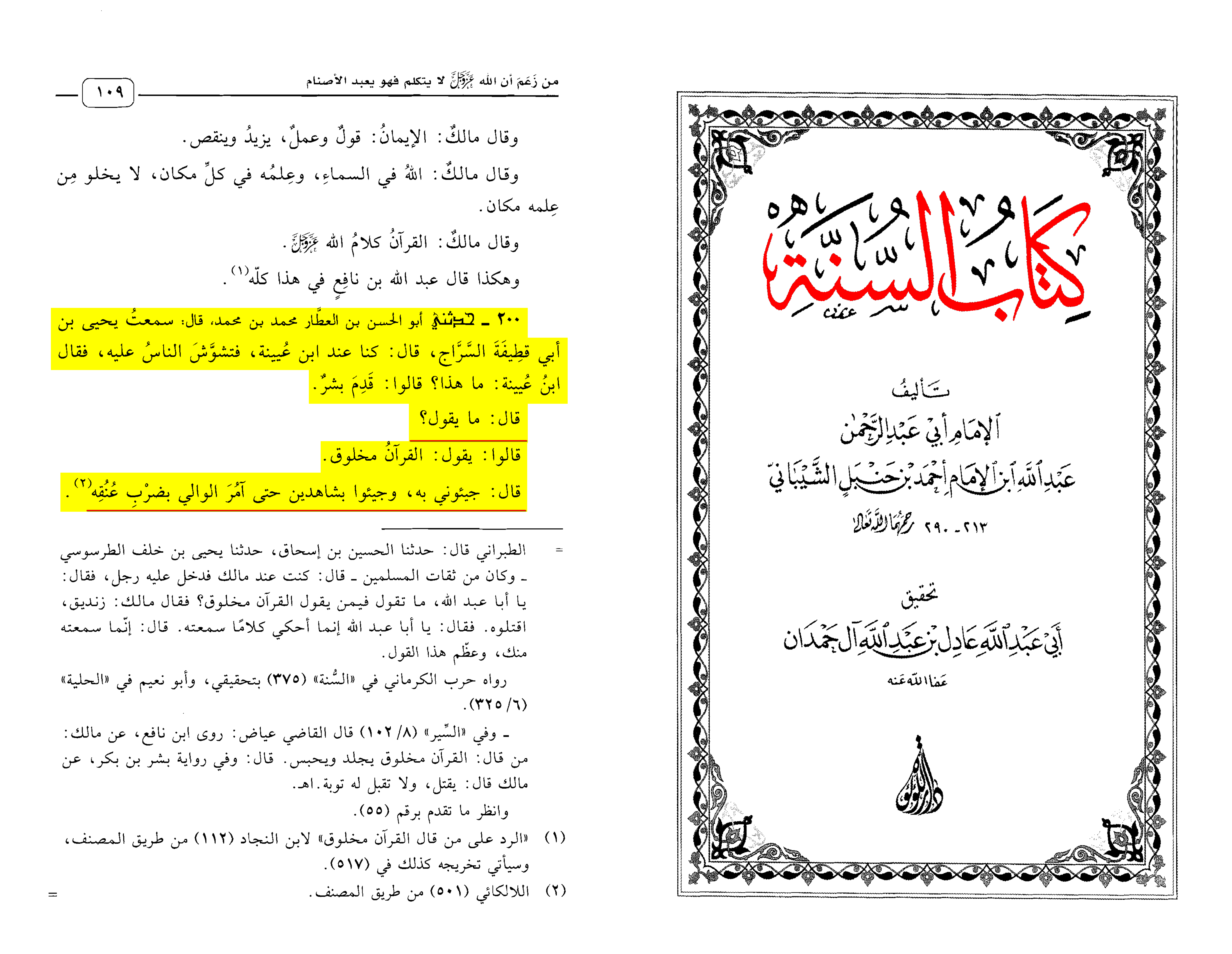
◈ ʿAbdullāh ibn Aḥmad narrated with two authentic chains from Ḥammād ibn Abī Sulaymān that he said:
Go to the Kāfir - meaning Abā Ḥanīfah - and say to him: If you say: The Qurʾān is created, then don't come near us.
And he said:
Are you not astonished by Abī Ḥanīfah, he says: The Qurʾān is created. Say to him: O Kāfir O Zindīq!!
📓 Kitāb as-Sunnah - n° 225 and n° 227
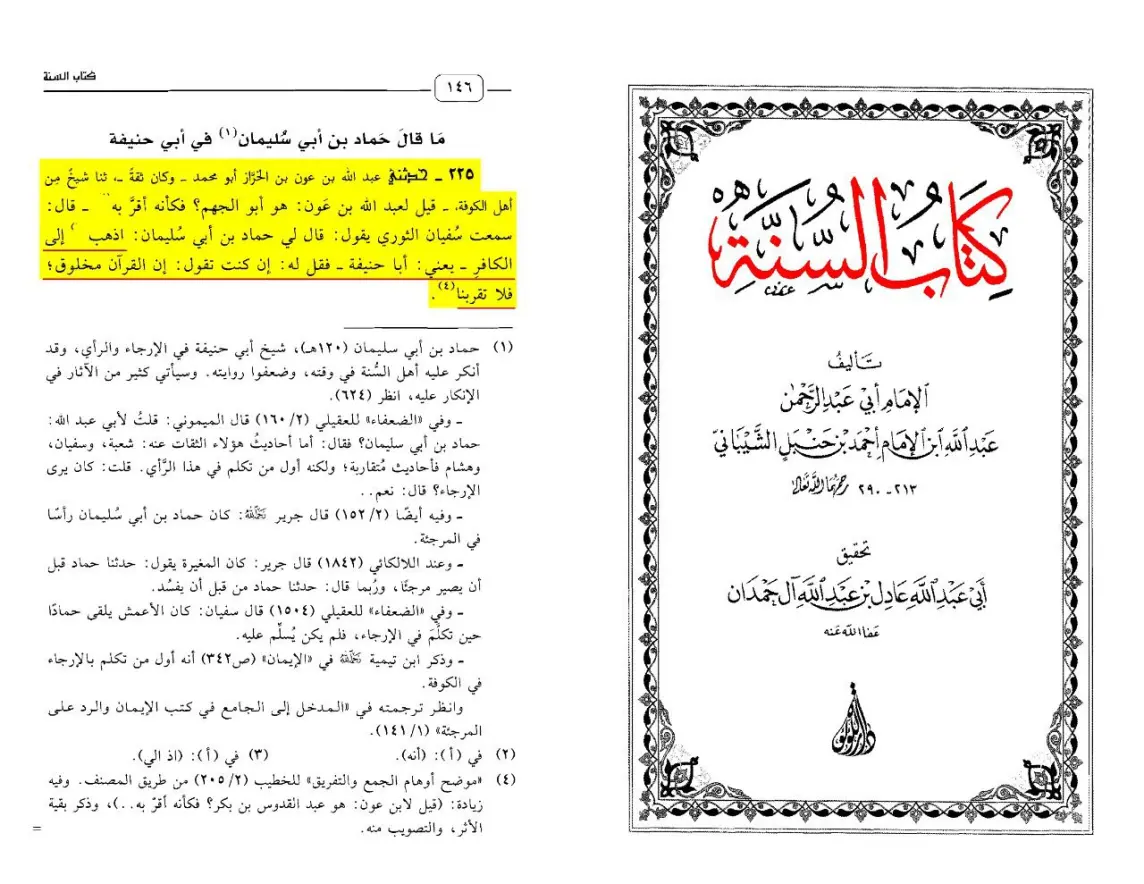
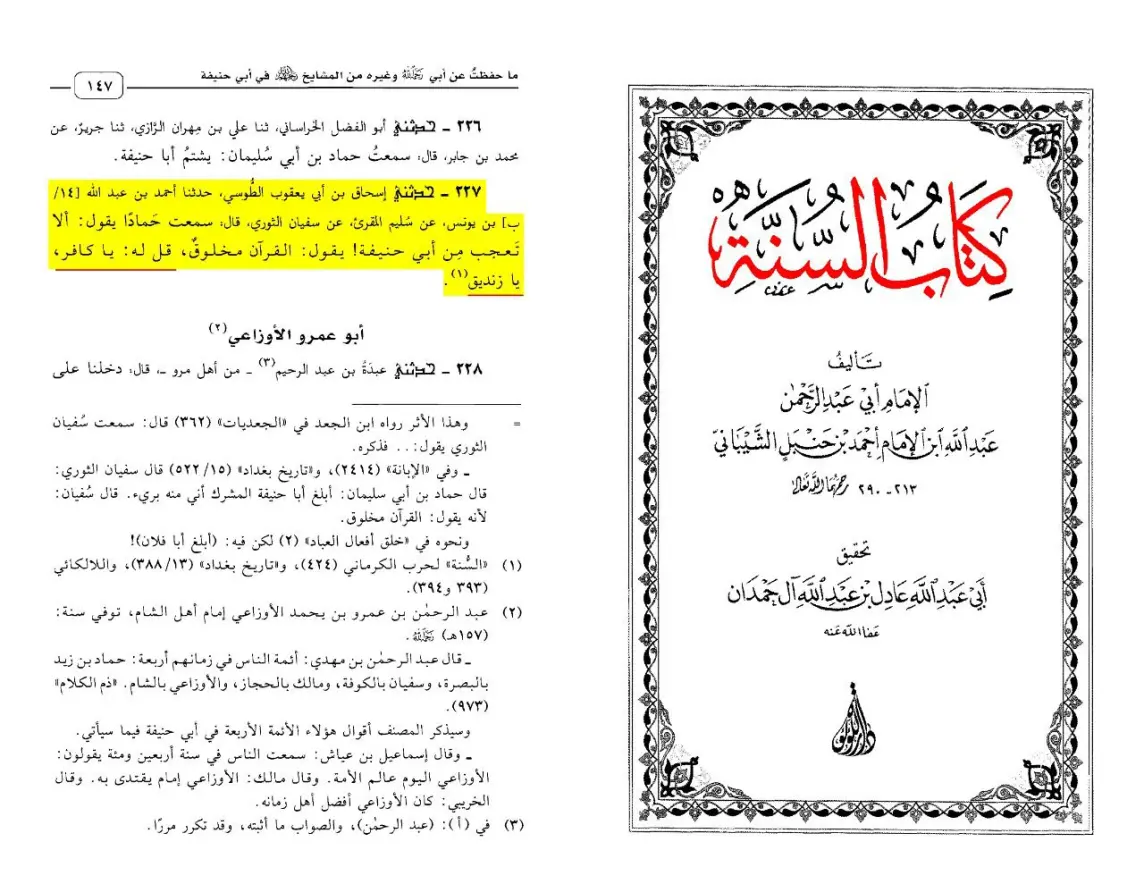
◈ al-Lālakāʾī narrated:
ʿAbd ar-Raḥmān mentioned, he said: Muḥammad ibn Aḥmad al-Baġdādī narrated to us, he said: Yaʿqūb ibn Dīnār narrated to us from ʿAbdillāh ibn Nāfiʿ aṣ-Ṣāʾigh, he said:
I said to Mālik ibn Anas: Verily some people in ʿIrāq say: The Qurʾān is created. So he withdrew his hand from my hand and didn't talk to me during ẓuhr, nor ʿaṣr, nor maghrib, then when ʿishāʾ came, he said to me: O ʿAbdallāh ibn Nāfiʿ, where did you get this speech from?! You threw in my heart a thing which is the disbelief. The man of this speech is to be killed without being asked to repent.
📓 Sharḥ Uṣūl al-Iʿtiqād Ahl as-Sunnah wa-l-Jamāʿah - vol. 1, p. 393
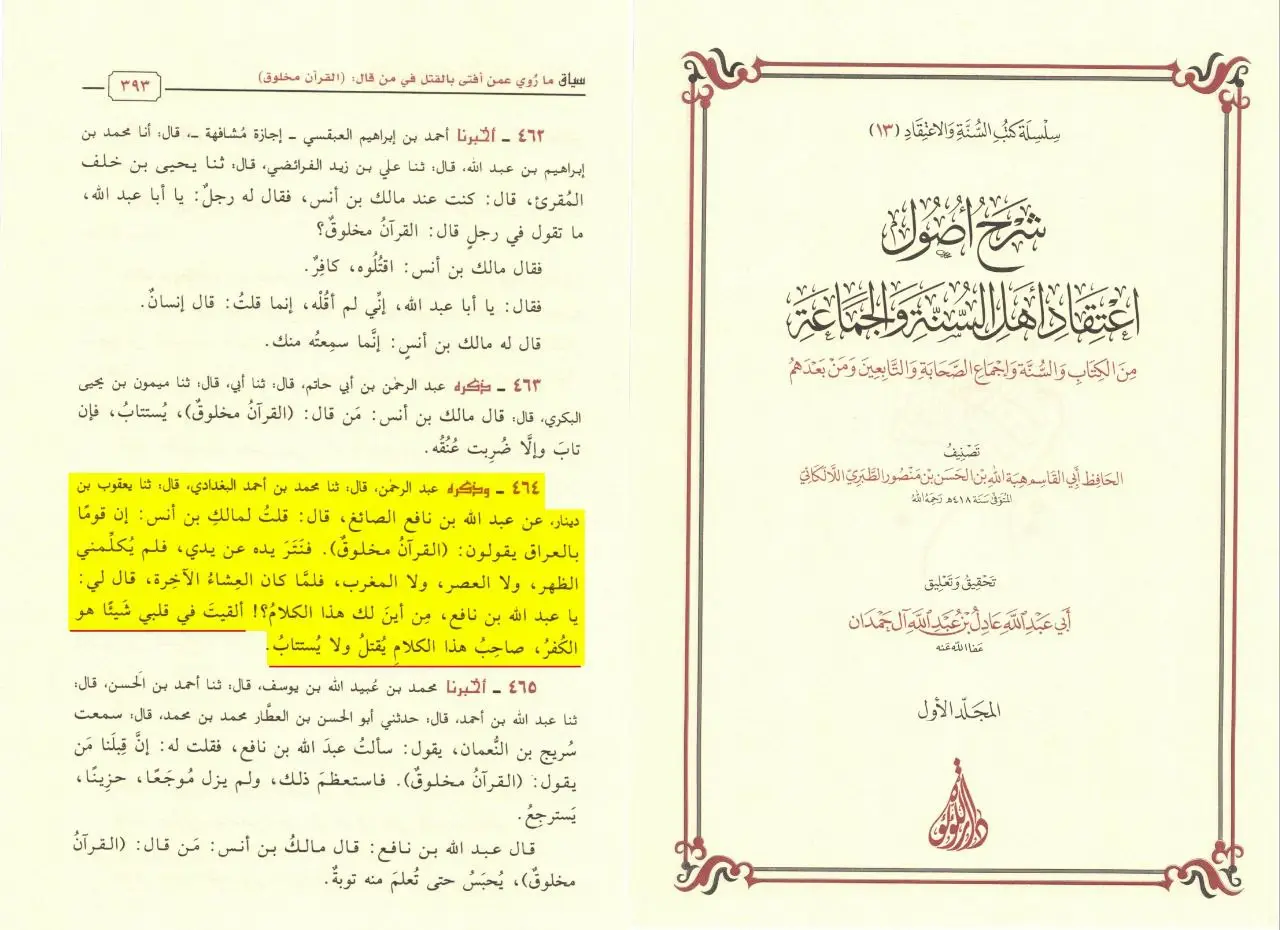
◈ Al-Khallāl narrated:
al-Marrūḏī reported to us, he said: It was said to Abī ʿAbdillāh: Do you know from Yazīd ibn Hārūn, on the authority of Abī al-ʿAṭūf, on the authority of Azī az-Zubayr, from Jābir: If it will be stable in its place then you will see Me, and if it won't be stable then you will not see Me, neither in the dunyā nor the ākhirah?
So Abū ʿAbdillāh became extremely angry, until it was clear on his face, and he was sitting and the people were around him, so he took his sandals and wore them.
And he said: May Allāh disgrace this one! This should not be written! And he rejected that Yazīd ibn Hārūn reported or narrated it.
And he said: This is a Jahmī, this is a Kāfir, may Allāh disgrace this wicked one, whoever says: Verily Allāh will not be seen in the ākhirah, he is a Kāfir.
Muhannā said: I asked Aḥmad about Abī al-ʿAṭūf? He said: A Jazarī, abandoned in ḥadīth.
And Abū Dāwūd said about him: His name is Jarrāḥ ibn Minhāl.
📓 al-Muntakhab min al-ʿIlal - n° 173
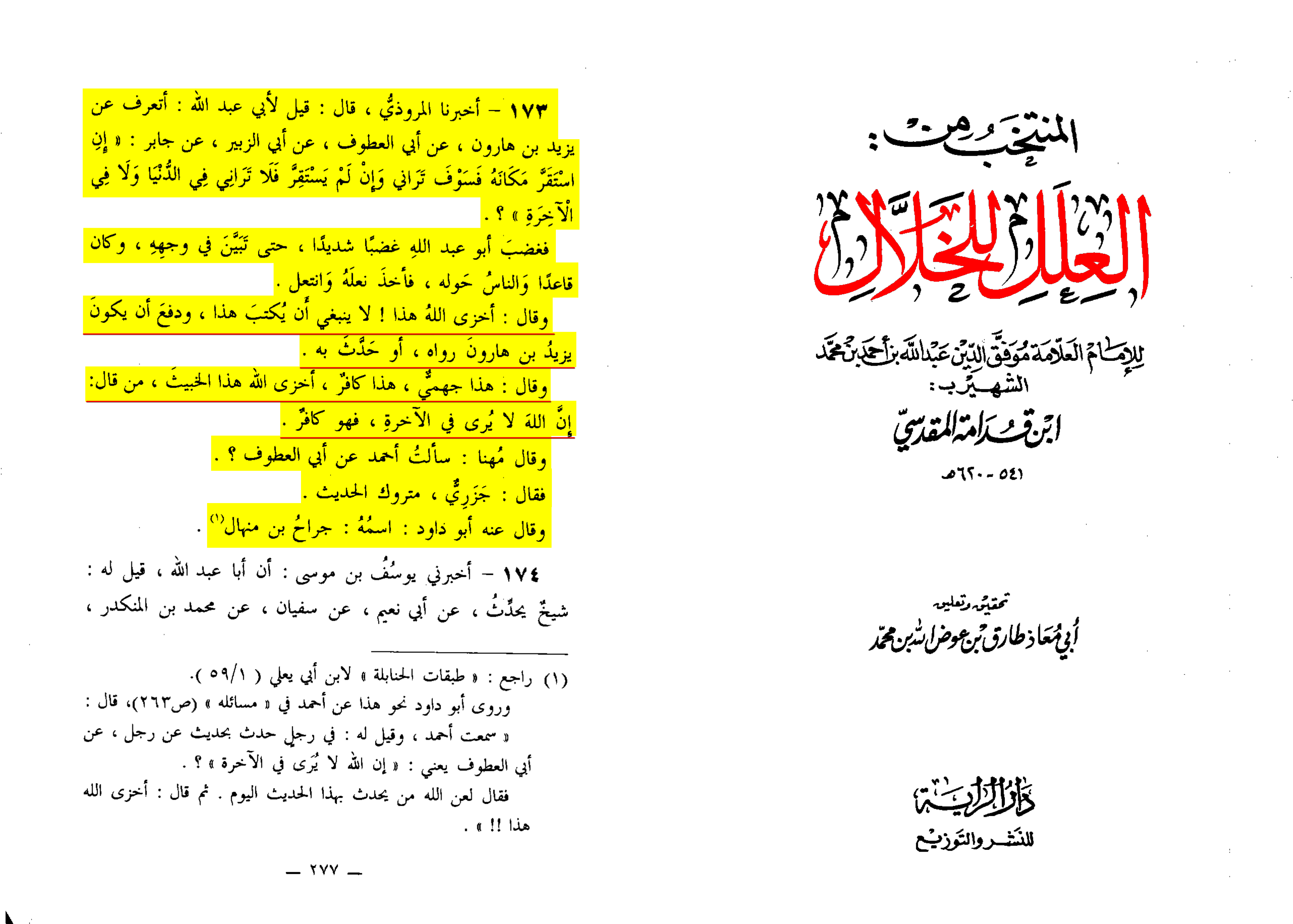
Evidences on big scholars who were abandoned for mistakes in ʿAqīdah.
The Salaf and Ahl al-Ḥadīth used to be severe upon the one who falls into a mistake in ʿAqīdah and the Sunnah, and they would abandon him or make tabdīʿ on him and warn from him, and this lasted for a great period of time until around the fourth century. But now, the kufr and bidʿah is just a mistake, rather it is ijtihād which he is rewarded for! And these scholars of evil made up principles and preventatives and conditions to excuse the leaders of misguidance and the innovators.
Today, whoever sticks to the manhaj of the Salaf in these issues is called an extremist Ḥaddādī.
And Allāh is the One Whose help is sought.
These are some examples of the Salaf abandoning big names for falling into a mistake, without excusing them nor looking into their virtues and status.
Ḥammād ibn Abī Sulaymān (d. 120h), one of the biggest jurists of ʿIrāq but he became a Murjiʾ.
◈ Abū Jaʿfar al-ʿUqaylī said:
Muʿādh ibn al-Muthannā reported to us, saying: My father reported to us, saying: I heard Ibn ʿAwn say: Ḥammād [ibn Abī Sulaymān, the teacher of Abū Ḥanīfah] was among our companions until he innovated what he innovated.
My father said: Meaning what he said regarding Irjāʾ.
Mūsā ibn Hārūn reported to us, saying: Mujāhid ibn Mūsā reported to us, saying: Muʿādh ibn Muʿādh reported to us from Ibn ʿAwn, and he mentioned Ḥammād ibn Abī Sulaymān, so he said: He was among our companions until he innovated what he innovated - meaning in Irjāʾ.
📔 Kitāb aḍ-Ḍuʿafāʾ - vol. 1, p. 327
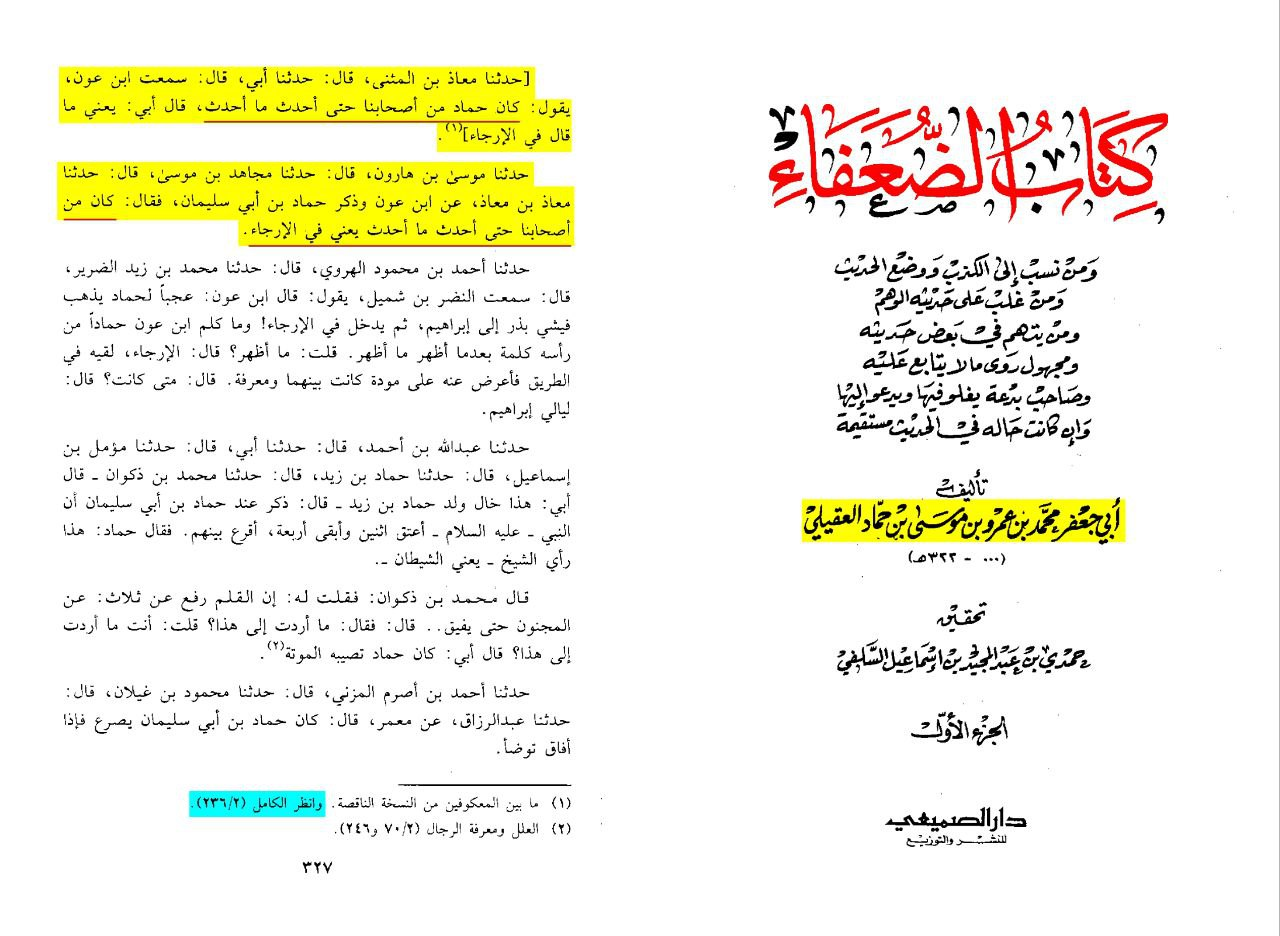
◈ Ibn Abī Ḥātim narrated:
Aḥmad ibn Sinān al-Wāsiṭī narrated to us: Abū ʿAbd ar-Raḥmān al-Muqriʾ narrated to us: Warqāʾ narrated to us from al-Mughīrah, he said:
When Ibrāhīm passed away, al-Ḥakam and his companions sat with Ḥammād until he innovated what he innovated. Al-Muqriʾ said: Meaning Irjāʾ.
📔 Kitāb al-Jarḥ wa-t-Taʿdīl - vol. 3, p. 164
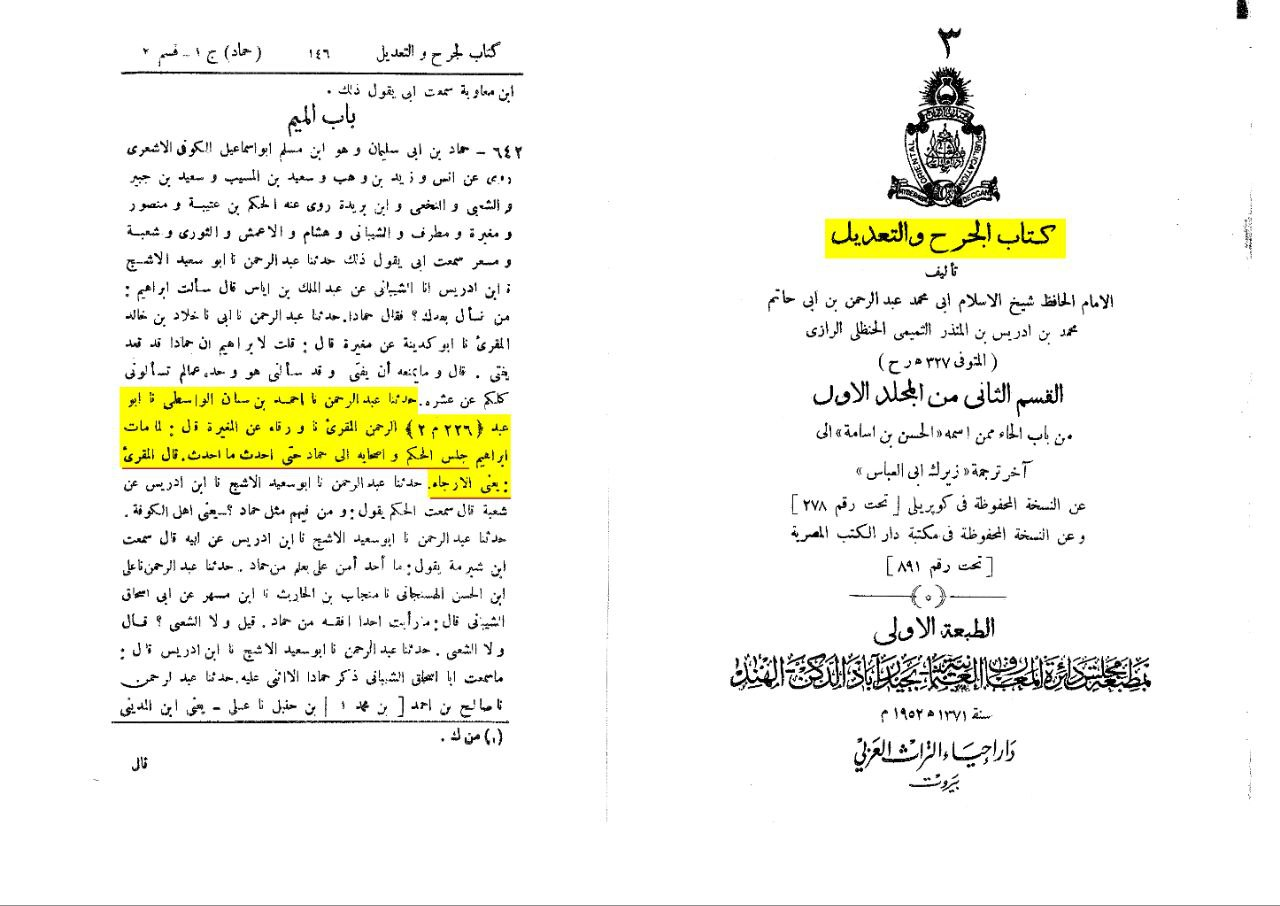
◈ Ibn Saʿd said:
ʿUbaydillāh ibn ʿUmar reported to us from Ḥammād ibn Zayd, he said:
When Ḥammād ibn Abī Sulaymān came to us in Baṣrah, Ayyūb did not go to him so we did not go to him, he said: And when Ayyūb doesn't go to someone, we don't go to him. He said: Layth ibn Abī Sulaym came to us, and Ayyūb went to him so we went to him.
📔 At-Ṭabaqāt al-Kubrā - vol. 7, p. 210
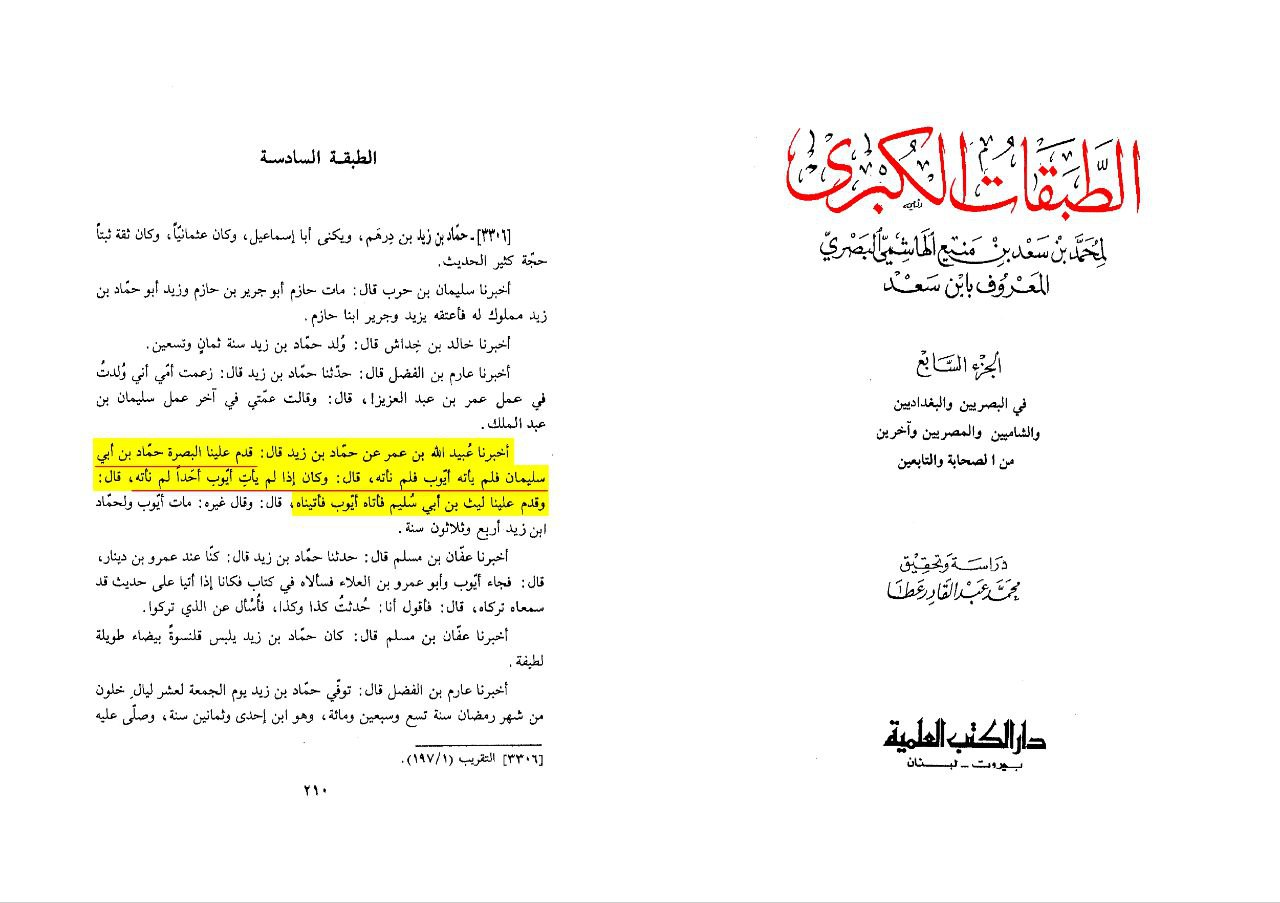
Misʿar ibn Kidām (d. 153h), one of the zuhhād and among the scholars of ʿIrāq, he agreed with Ahl al-Ḥadīth in Īmān but denied istithnāʾ.
◈ Ibn Ḥibbān said:
I heard Aḥmad ibn Muḥammad ibn Yaḥyā say: I heard Muḥammad ibn ʿAmmār say: I heard Abū Nuʿaym say: I heard Sufyān ath-Thawrī say: Īmān increases and decreases.
I asked: What do you say, O Abā Nuʿaym?
He looked at me with an intense gaze and then said: I say as Sufyān says.
Indeed, Misʿar ibn Kidām died, he was among the best of them, and Sufyān and Sharīk were witnesses (i.e., alive), yet they did not attend his funeral.
📚 Kitāb ath-Thiqāt - vol. 9, p. 138
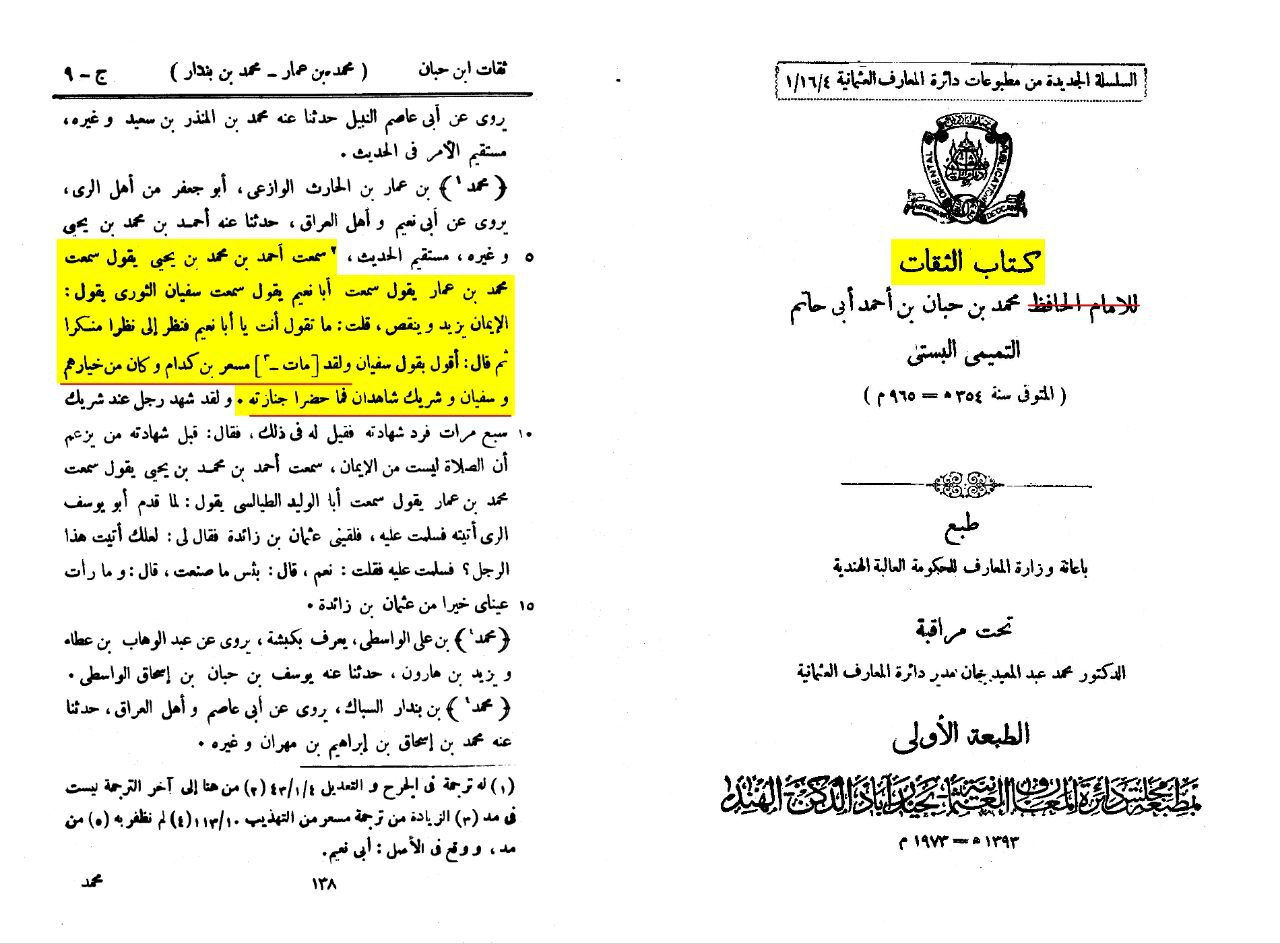
Bishr ibn as-Sariyy (d. 196h), he was from the wuʿʿāḍ and he was a Mutqin in ḥadīth but he spoke ambiguous words about ruʾyah and he was accused of being a Jahmī and they abandoned him.
◈ Ibn ʿAdiyy said:
Ibn Abī ʿIṣmah narrated to us: Abū Ṭālib Aḥmad ibn Ḥumayd narrated to us: I heard Aḥmad ibn Ḥanbal say:
Bishr ibn as-Sariyy was a man from the people of Baṣra and he later settled in Makkah. He heard around one thousand ḥadīth from Sufyān, and we heard from him then he mentioned the ḥadīth: {Radiant. Looking at their Lord.} So he said: I don't know what this is. What's this? So al-Ḥumaydī and the people of Makkah pounced on him and made him hear harsh words. Then he apologized, but it was not accepted from him, and people turned away from him afterward. When I came to Makkah the second time, he used to come to us, but nothing was written from him. So he began to be gentle (with us), but nothing was written from him.
📔 al-Kāmil fī Ḍuʿafāʾ ar-Rijāl - vol. 2, p. 449
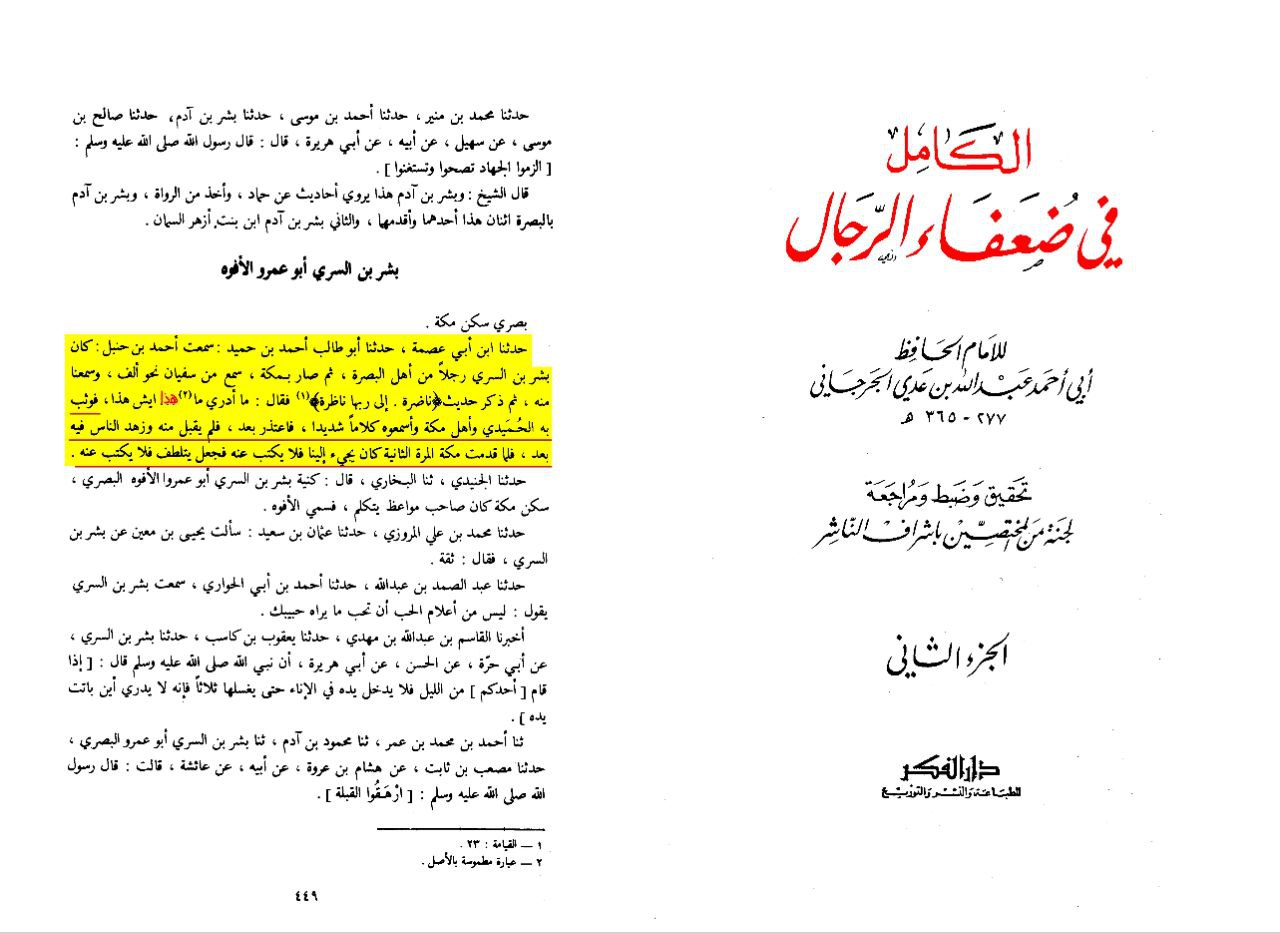
al-Ḥasan ibn ʿĪsā an-Naysabūrī, Abū ʿAlī (d. 239h), he was a Christian then he converted to Islām and studied under Aḥmad and Ibn al-Mubārak and became a noble Muḥaddith but he didn't say Īmān decreases.
◈ Ibn Ḥajar reported:
→ [Abū al-ʿAbbās] As-Sarrāj said:
When he arrived in Baġdād, some of Aṣḥāb al-Ḥadīth boycotted him because of his statements about Īmān. Later, they gathered before him and told him: Explain your position to us.
He said: Īmān is speech and action.
They asked: Does it increase and decrease?
He said: I have two teachers, Ibn al-Mubārak and Ibn Ḥanbal. ʿAbdullāh used to say it increases, but stops regarding decrease. As for Aḥmad, if he says it decreases, I say what he says.
They then brought Aḥmad's handwriting [stating]: It increases and decreases.
Al-Ḥasan said: It is my view.
So they were pleased with that and wrote from him.
◈ I say:
This represents the stark contrast of the sincerity and seriousness the early Muslims held over the ones of our time. They boycotted him over Īmān, whereas now you are boycotted if you call out any issue of a supposed scholar.
📔 Tahdhīb at-Tahdhīb - vol. 2, p. 315
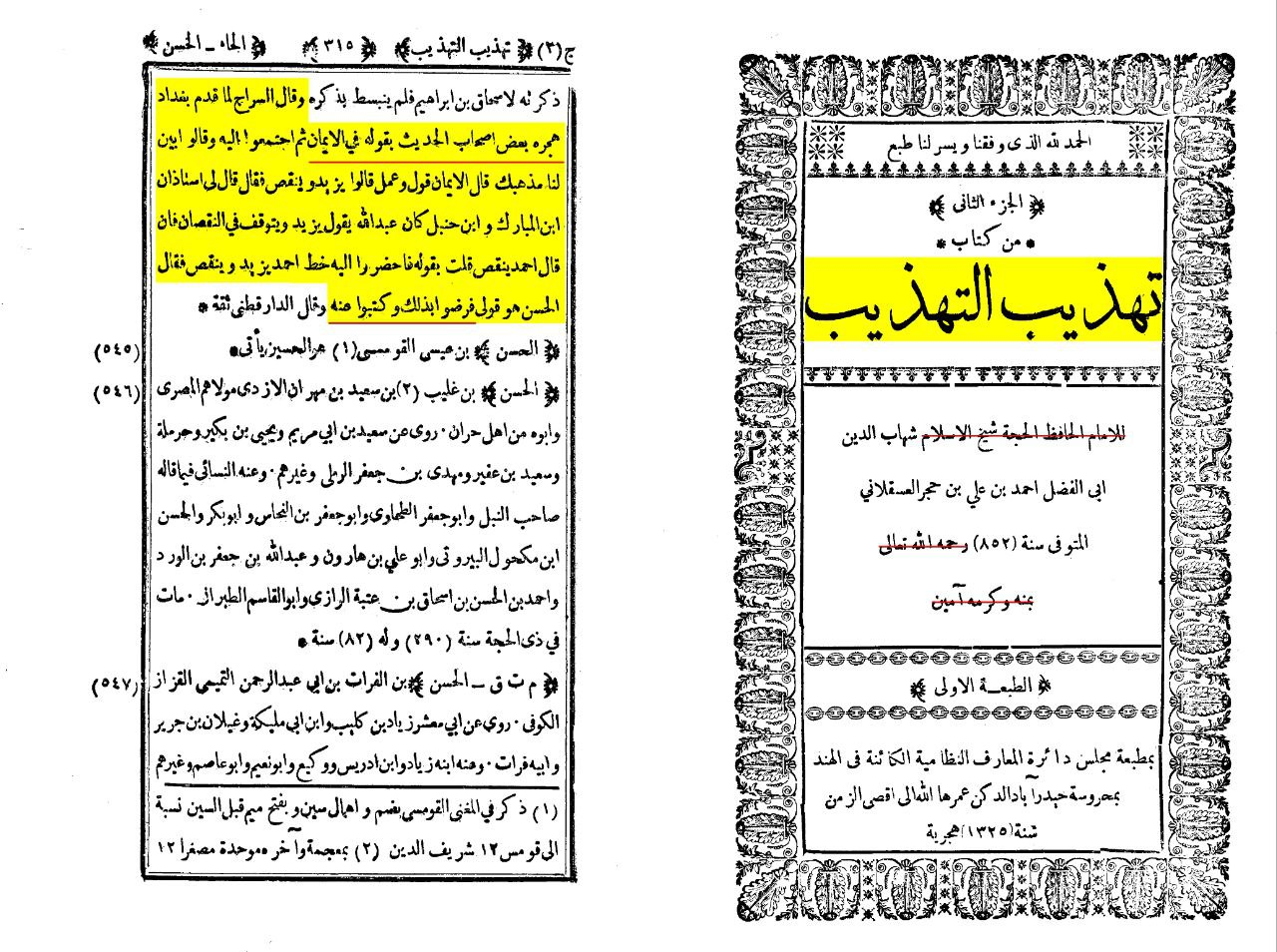
Al-Ḥasan ibn ʿAlī al-Ḥulwānī (d. 242h), one of the Ḥuffāẓ and he was very knowledgeable in ʿilm ar-rijāl, but he didn't perform takfīr on the Wāqifah.
◈ Al-Khaṭīb said:
Abū Bakr al-Barqānī said: I read upon Bishr ibn Aḥmad al-Isfarāyīnī, Abū Sulaymān Dāwūd ibn al-Ḥusayn al-Bayhaqī said to you:
It has reached me that al-Ḥulwānī al-Ḥasan ibn ʿAlī said: I do not perform Takfīr upon the one who stops regarding the Qurʾān, so they left his knowledge.
Abū Sulaymān then said: I asked Abū Salamah ibn Shabīb about the knowledge of al-Ḥulwānī, he said: It is thrown into the latrine. Then Abū Salamah said: Whoever does not testify for the disbelief of a Kāfir then he is a Kāfir [himself].
📔 Tārīkh Baġdād - vol. 8, p. 352
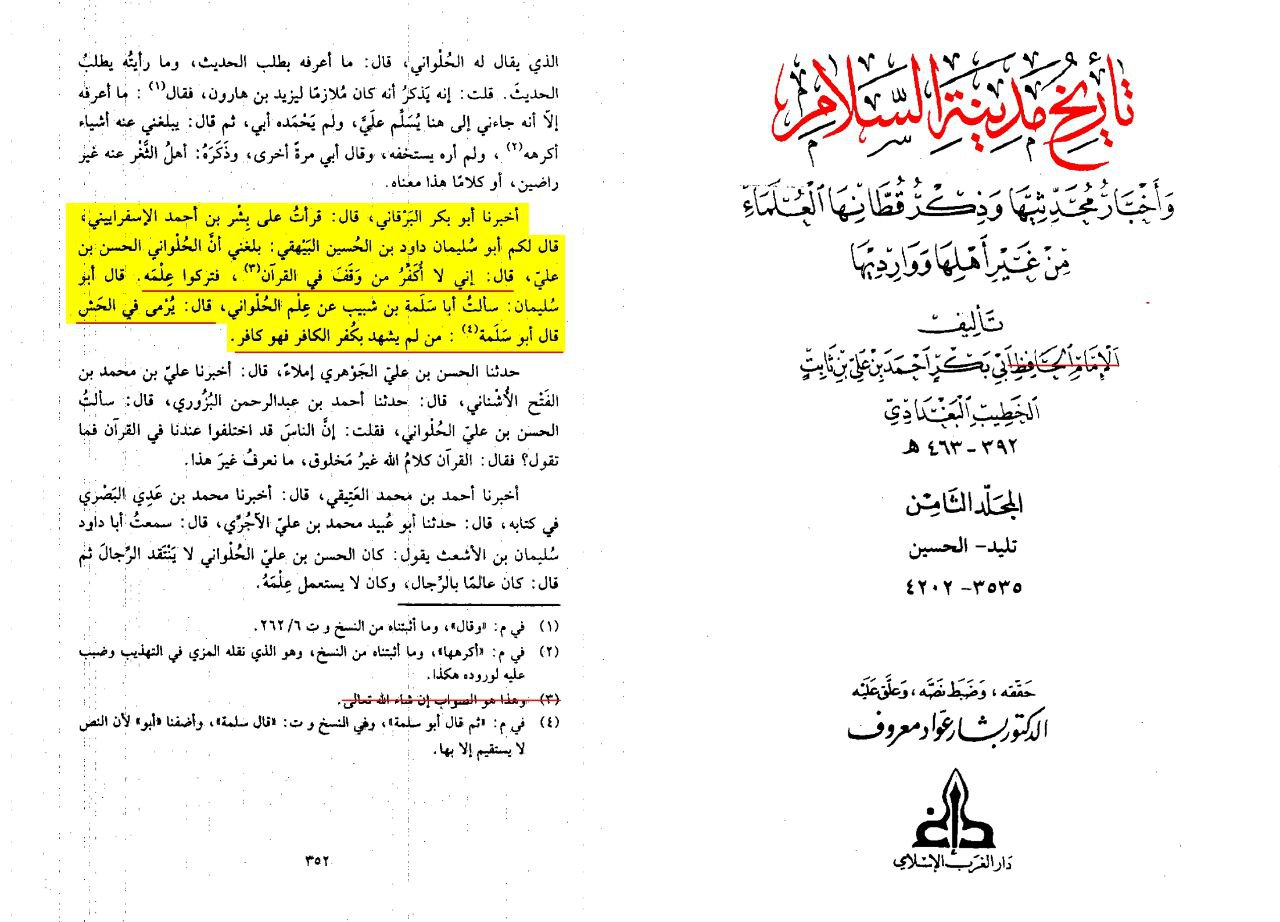
Isḥāq ibn Abī Isrāʾīl (d. 246h), one of the Muḥaddithīn and Ḥuffāẓ but he became a Wāqifī.
◈ Ibn Abī Ḥātim said:
715 - Isḥāq ibn Ibrāhīm ibn Abī Isrāʾīl
He narrated from Ḥammād ibn Zayd, Jaʿfar ibn Sulaymān, and ʿAbd al-Wāḥid ibn Ziyād.
I heard my father [Abū Ḥātim] say this, and say: I wrote from him, but then he did waqf in the Qurʾān (meaning he didn't say it's created nor uncreated), so we stopped taking his narrations. People abandoned him until I would pass by his mosque and find him alone, no one would approach him, after the people had turned to him with one accord (lit. as one neck).
📔 Kitāb al-Jarḥ wa-t-Taʿdīl - vol. 2, p. 210
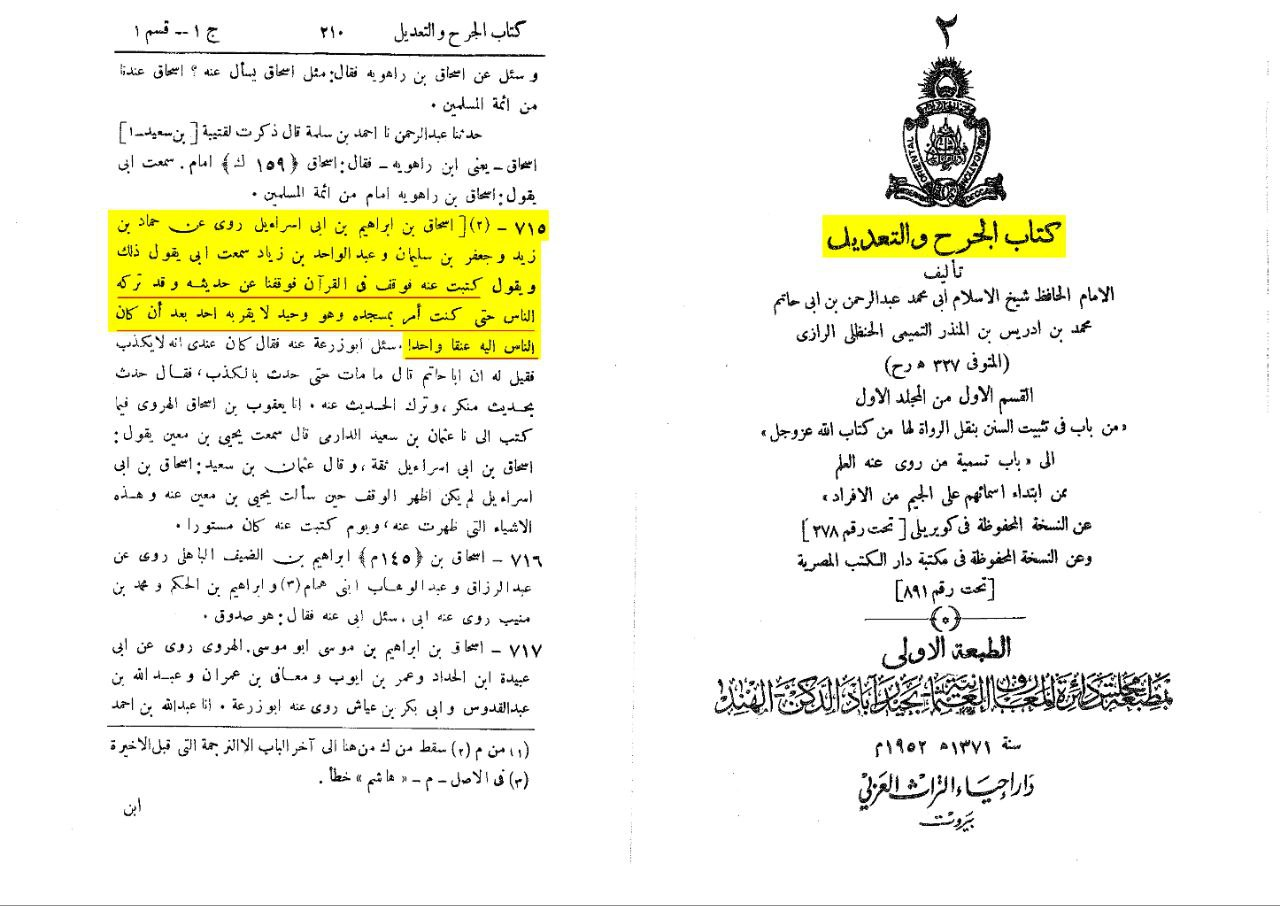
Muḥammad ibn Ismāʿīl al-Bukhārī (d. 256h), an Imām in ḥadīth and the author of the most authentic book after the Qurʾān, he was accused of being a Lafẓī (and he's free from it) but adh-Dhuhlī didn't care (even though he told people to take ḥadīth from him) and still abandoned him when the report reached him.
◈ Ibn Abī Ḥātim said:
1086 - Muḥammad ibn Ismāʿīl al-Bukhārī, Abū ʿAbdillāh.
My father and Abū Zurʿah heard from him, but then abandoned his ḥadīth when Muḥammad ibn Yaḥyā al-Naysābūrī wrote to them that he had openly declared among them that his lafẓ of the Qurʾān is created.
📔 Kitāb al-Jarḥ wa-t-Taʿdīl - vol. 7, p. 1086
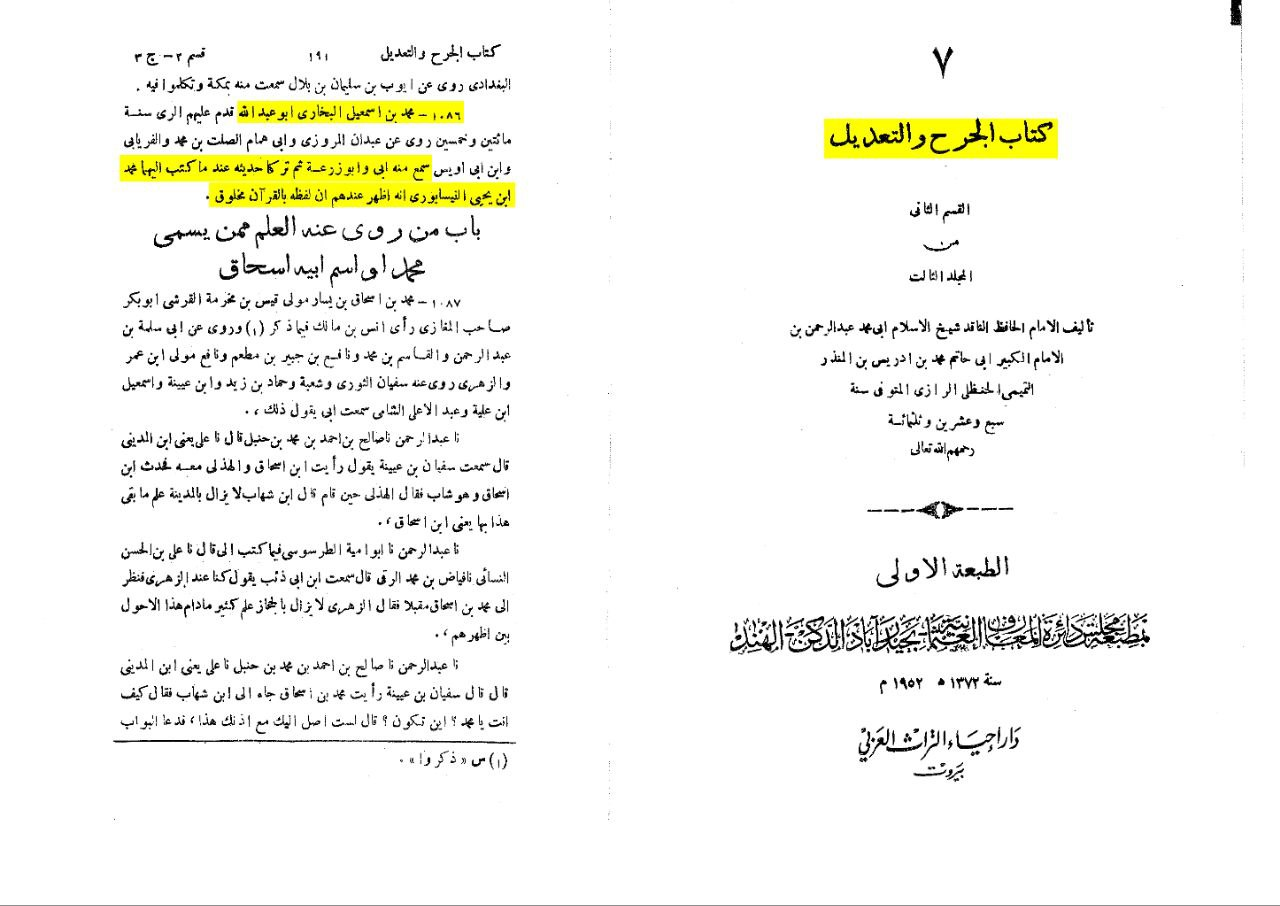
Abū Ḥātim Ibn Ḥibbān al-Bustī (d. 354h), the author of the Ṣaḥīḥ and a scholar of jarḥ and taʿdīl, he denied ḥadd, so how did the Ḥanābilah treat him?
◈ Abū Ismāʿīl al-Harawī said:
[1292] I asked Yaḥyā ibn ʿAmmār about Abī Ḥātim ibn Ḥibbān al-Bustī: Did you see him?
He said: How haven’t I seen him while we kicked him out of Sijistān?!
He had a lot of knowledge but he didn’t have a strong religion. He came to us and he denied ḥadd, so we kicked him from Sijistān.
📔 Dhamm al-Kalām - vol.4, p. 402-403
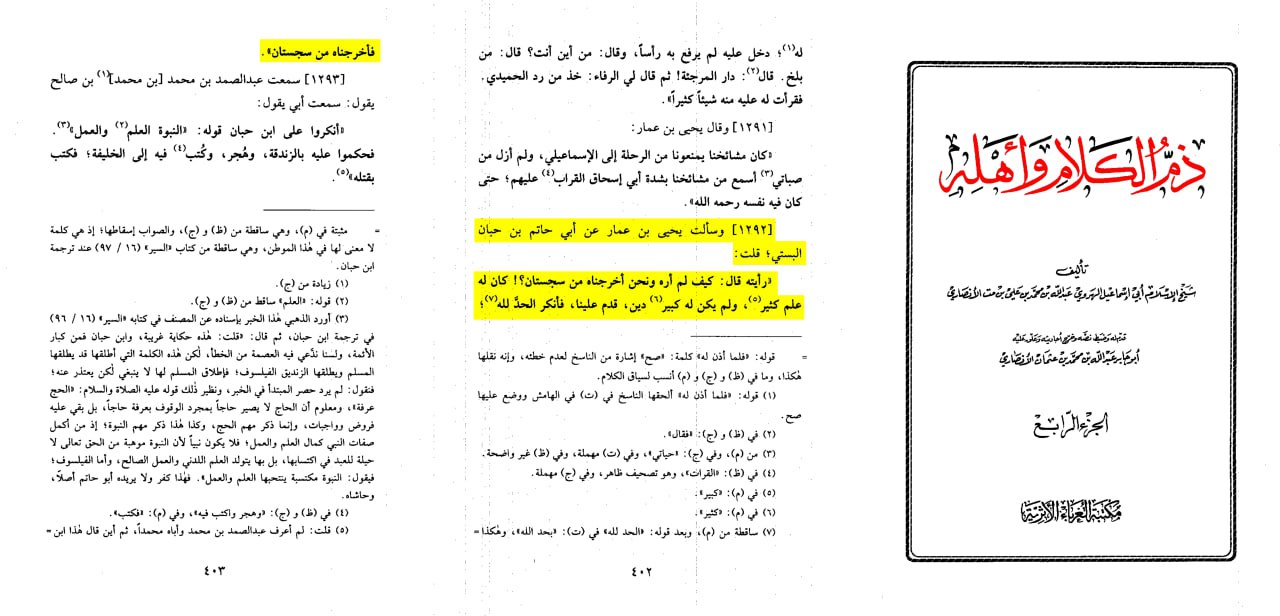
Definition and evidences regarding the excuse of Ignorance.
◈ I say:
Before entering into the evidences regarding the excuse of ignorance, it is necessary to clarify what is meant by it, because many people confuse between the existence of ignorance and the Sharʿī ruling placed upon the ignorant person.
Ignorance itself is one thing, and excusing the ignorant person is another thing. A person may be ignorant, mistaken, heedless, or confused, yet that does not automatically mean he is excused before Allāh in every matter. The excuse of ignorance is a Sharʿī ruling applied to a specific person in a specific circumstance. So the question is not merely: “Was this person ignorant?” Rather, the question is: “Does this ignorance remove blame from him in this issue, in this condition, after considering whether the proof reached him?”
Know, may Allāh guide us and you, that ignorance is not self-excusing. No one is excused merely by claiming ignorance. The excuse, when it exists, comes through Sharʿī considerations, such as the message not reaching the person, the person being newly entered into Islām, the person being far removed from the lands of Muslims, or the issue being from hidden detailed matters that require explanation. As for the foundation of the religion, the worship of Allāh alone and abandonment of major shirk, then this is the very meaning of entering Islām.
In the issue of major shirk, the proof is the message of Islām itself. Whoever the message of Islām has not reached, and whoever lived in a place where the Qurʾān was absent, the Sunnah was unknown, and the call of the Messengers did not reach him, then his ruling in the dunyā is according to what is apparent from him, while his affair in the Ākhirah is with Allāh, and Allāh judges between His servants with justice. As for the one who claims Islām, pronounces the two testimonies, lives among Muslims, has access to the Qurʾān, hears the call to Tawḥīd, and knows that the religion of Muḥammad ﷺ is built upon worshipping Allāh alone, then he has no excuse in directing worship to other than Allāh.
Tawḥīd is not a hidden branch that requires long investigation before a person becomes bound by it. It is the foundation of the religion, the root of the daʿwah of the Messengers, the meaning of Lā ilāha illa Allāh, and the first obligation upon the servant. The proofs for it from fiṭrah, reason, and revelation are from the clearest proofs. So when Islām reaches a person, the command to worship Allāh alone reaches him, and the prohibition of worshipping other than Allāh reaches him.
Major shirk is from the clearest matters of the religion. The obligation to abandon it is inseparable from the obligation to accept Islām. For this reason, ignorance in this matter is not treated like ignorance of a detailed issue in fiqh. It is a failure in the very foundation for which the creation was created and for which the Messengers were sent.
As for ignorance in detailed matters, then it may be considered. A person may be excused for ignorance in a matter of prayer, purification, fasting, inheritance, trade, or other branches, especially if he is newly entered into Islām, grew up far from knowledge, or had no access to those who could teach him. That is a separate issue. The discussion here is major shirk and the foundation of Tawḥīd.
And the proof for this foundation is abundant.
◈ Abū al-Ḥasan Muqātil ibn Sulaymān al-Balkhī said in [Tafsīr Muqātil - vol. 3, p. 168]:
Regarding His saying, Exalted is He: {And whoever calls upon, along with Allāh} meaning: whoever describes (or attributes), {along with Allāh, another god for which he has no proof} [al-Mu’minūn: 117], meaning: he has no proof for his kufr, and no excuse on the Day of Resurrection.
◈ Abū Zakariyyāh Yaḥyā ibn Sallām al-Baṣrī said in [Tafsīr Yaḥyā - vol. 1, p. 420]
His statement, {And whoever invokes, along with Allāh, another god for which he has no proof} [al-Muʾminūn: 117], means: he has no proof for it.
[This is from the] Tafsīr of Mujāhid.
And Qatādah used to say: “He has no clear proof for it, in the sense that Allāh never commanded him to worship a god besides Him.”
◈ And he said [Tafsīr Yaḥyā - vol. 1, p. 421]:
The statement of Ibn ʿAbbās رضي الله عنهما and al-Ḥasan [al-Baṣrī] regarding His saying: {And whoever calls upon, along with Allāh, another god for which he has no proof} [al-Mu’minūn: 117] is: throughout the entire Qur’ān, he has no argument. And the statement of Qatādah, throughout the entire Qur’ān, regarding His saying: {for which he has no proof} [al-Mu’minūn: 117] is: he has no clear evidence.
◈ ʿAbd Allāh ibn Aḥmad narrated in [al-Sunnah - n° 957]:
My father narrated to me, Mu’ammal narrated to us, ʿUmar ibn Muḥammad narrated to us, he said: I heard Sālim saying: Ibn ʿUmar رضي الله عنهما said:
“Whoever claims that along with Allāh there is a creator (originator), or a judge, or a provider who possesses for himself harm or benefit, or death or life, or resurrection, then Allāh will raise him on the Day of Resurrection: with his tongue made mute, his sight blinded, his deeds made scattered dust, the means cut off for him, and he will be cast on his face into the Fire.”
◈ Abū ʿUbayd al-Qāsim ibn Sallām said in [Gharīb al-Ḥadīth - vol. 4, p. 260 [in the PDF], but vol. 3, p. 368 [on Shāmilah]]
“An excuse is only accepted for the one who has only recently accepted Islām, who does not know Islām nor its laws, and who has not lived in lands inhabited by Muslims. As for one who is...”
◈ In the [next page]:
not like that, then he is not to be believed, and the ḥadd is carried out upon him."
◈ Abū ʿUbayd al-Qāsim ibn Sallām narrated in [Faḍāʾil al-Qurʾān - p. 151]:
Kathīr ibn Hishām narrated to us, from Jaʿfar ibn Burqān, from Ṣāliḥ ibn Mismār, who said:
“It has reached us that the Messenger of Allāh recited this verse: {O mankind, what has deceived you concerning your Generous Lord} [al-Infiṭār: 6], and he said: His ignorance.”
◈ Abū al-Muẓaffar as-Samʿānī said in his [Tafsīr - vol. 4, p. 168]:
And His statement, {But if they strive to make you associate with Me that of which you have no knowledge, then do not obey them}, means: do not obey them in disobedience to Me. And it is well known from the Prophet ﷺ that he said, “There is no obedience to any created being in disobedience to the Creator.”
And His statement, {that of which you have no knowledge}, was only phrased this way because all shirk comes from ignorance, for the one who truly knows does not associate partners with Allāh in worship.
◈ Abū Saʿīd ad-Dārimī said in [Naqḍ ʿalā al-Marīsī - vol. 2, p. 840]:
“Woe to you, O objector! Did you not claim that, in tawḥīd, nothing is acceptable except what is correct? So do you feel secure that attempting an answer amid these blind confusions will not drag you into error in tawḥīd, when error in it is disbelief? Then where are you with respect to yourself, regarding what you have urged others to plunge into, and whatever resembles it?”
◈ Ibn Abī Ḥātim narrated in [at-Tafsīr al-Musnad - n° 7163]:
My father narrated to us, Abū Ṣāliḥ [Kātib al-Layth) narrated to us, Muʿāwiyah [ibn Ṣāliḥ] narrated to me, from ʿAlī [ibn Abī Ṭalḥah], from Ibn ʿAbbās (d. 67 AH) regarding His saying: {and whomsoever it reaches}, meaning: whoever this Qur’ān reaches, then it is for him a warner from among mankind.
◈ I say:
This means that whoever the Qurʿān reaches, then there is no excuse or proof for that individual.
◈ Abū Jaʿfar aṭ-Ṭabarī narrated in [Jāmiʿ al-Bayān - vol. 9, p. 182]:
Hannād narrated to us, he said: Wakīʿ narrated to us, and Ibn Wakīʿ narrated to us, he said: my father narrated to us, from Mūsā ibn ʿUbaydah, from Muḥammad ibn Kaʿb al-Quraẓī (108 AH) regarding His saying, Exalted is He: {that I may warn you with it and whomsoever it reaches}, he said: whoever the Qur’ān reaches, it is as though he saw the Prophet ﷺ, then he recited: {and whomsoever it reaches. Do you then bear witness}.
◈ And he narrated in [Jāmiʿ al-Bayān - vol. 9, p. 183]:
Ibn Wakīʿ narrated to us, he said: Ḥumayd ibn ʿAbd al-Raḥmān narrated to us, from Ḥasan ibn Ṣāliḥ, who said: I asked Layth, “Is there still anyone left to whom the daʿwah [call] has not reached?” He said: Mujāhid used to say, “Wherever the Qurʾān reaches, it is a caller and a warner.” Then he recited: {That I may warn you thereby and whomever it reaches. Do you indeed bear witness...?}
◈ ʿAbd ar-Razzāq aṣ-Ṣanʿānī said in his [Tafsīr - n° 781]:
From Maʿmar [ibn Rāshid], from Qatādah (117 AH) regarding His saying, Exalted is He: {that I may warn you with it and whomsoever it reaches}, that the Prophet ﷺ said: Convey from Allāh. So whoever a verse from the Book of Allāh reaches, then the command of Allāh has reached him.
◈ ash-Shāfiʿī said in [Tafsīr al-Imām ash-Shāfiʿī - vol. 3, p. 1461]:
If Allāh had not sent down any proof against His creation except this sūrah, it would have sufficed them. People are heedless of this sūrah.
◈ And he said in [al-Umm - vol. 7, p. 280]:
I say: as long as the Book and the Sunnah exist, then the excuse of the one who heard them is cut off, except by following them.
◈ Abū ʿAbdullāh ibn Baṭṭah al-ʿUkbarī said in [al-Ibānah al-Kubrā - vol. 3, p. 293]:
Indeed, when the proof is in the Book of Allāh عز وجل and the Sunnah of His Messenger عليه الصلاة والسلام, then there remains for one who opposes them no proof except through slander, and persistence upon denial and deviation, and preferring desire, and following the people of deviation and blindness.
We do not expel anyone from the people of the qiblah from Islām until he rejects a verse from the Book of Allah, or rejects something from the narrations of the Messenger of Allah, or sacrifices to other than Allah, or prays to other than Allah.
If he does any of these, it becomes obligatory upon you to declare him outside of Islām. If he does none of that, he is a believing Muslim in name but not in reality.
And Allāh is the One Whose help is sought, with Him is guidance, and success.
Refutation of the excuse regarding blind following.
◈ Abū Jaʿfar aṭ-Ṭabarī said in [Jāmiʿ al-Bayān - vol. 21, p. 231] regarding the saying of Allāh:
{This is a troop rushing in with you: no welcome for them. Indeed, they will burn in the Fire. They will say: Rather, no welcome to you. You brought this upon us, so what an evil settlement. They will say: Our Lord, whoever brought this forward for us, then increase him in double punishment in the Fire.} [Ṣād: 59–61]
◈ aṭ-Ṭabarī said:
"The statement regarding the interpretation of His saying, Exalted is He: {They will say: Our Lord, whoever brought this forward for us, then increase him in double punishment in the Fire}. This also is the statement of the troop rushing in against the tyrants. They used to be followers of the tyrants in the world. He, Glorified is His praise, says: and the followers said: {Our Lord, whoever brought this forward for us}, meaning: whoever brought it forward for them in the world by calling them to the deed that obligates for them the Fire which they are entering, and the dwelling whose residence they have taken within it. And by their saying {this} they mean: the punishment which we have entered. {So increase him in double punishment in the Fire} meaning: they say: so multiply for him the punishment in the Fire beyond the punishment..."
◈ In the [next page]:
“...that he is in within it. This also is from the supplication of the followers against those who were followed.”
◈ Abū Muḥammad al-Rāzī said in [at-Tafsīr al-Musnad - vol. 1, p. 277] regarding the saying of Allāh:
{When those who were followed will disown those who followed, and they will see the punishment, and all ties will be cut off for them. And those who followed will say: If only we had a return, then we would disown them as they disowned us. Thus Allāh will show them their deeds as regrets upon them, and they are not to be brought out of the Fire.} [al-Baqarah: 166–167]
◈ Abū Muḥammad al-Rāzī (d. 327 AH) said:
“Muḥammad ibn Yaḥyā narrated to us, al-ʿAbbās ibn al-Walīd informed us, Yazīd informed us, Saʿīd narrated to us, from Qatādah: regarding His saying: {When those who were followed disown…}, he said: They are the tyrants, the leaders, and the heads in evil and shirk. {from those who followed} and they are: the followers and the weak. And it was narrated from ʿAṭā’, and al-Rabīʿ ibn Anas, something similar to that.”
◈ Muqātil ibn Sulaymān said in his [Tafsīr - vol. 3, p. 715] regarding the saying of Allāh:
{And when they dispute in the Fire, the weak will say to those who were arrogant: Indeed, we were followers of you, so can you avail us of any portion of the Fire? Those who were arrogant will say: Indeed, we are all in it. Indeed, Allāh has judged between the servants.} [Ghāfir: 47–48]
◈ He said:
"Then He informed about their disputation in the Fire, so He said: ...
◈ On the [next page]:
{And when they dispute in the Fire}, meaning: they argue. {So the weak will say}, and they are the followers, {to those who were arrogant} from īmān, and they are the leaders: {Indeed, we were followers of you} in your religion. {So can you}, O company of leaders, {avail us of any portion of the Fire} because we followed you? {Those who were arrogant will say}, and they are the leaders, to the weak: {Indeed, we are all in it}, us and you. {Indeed, Allāh has judged}, meaning: decreed, {between the servants}. We have been made to descend to our dwellings in the Fire, and you have been made to descend to your dwellings in it.”
◈ ʿAbd ar-Razzāq aṣ-Ṣanʿānī said in [al-Muṣannaf - vol. 10, p. 290]:
“Maʿmar informed us, from Yaḥyā ibn Abī Kathīr, from ʿUrwah ibn al-Zubayr, from ʿAbdullāh ibn ʿAmr, who said: I testify that the Messenger of Allāh ﷺ said: ‘Indeed Allāh does not take away knowledge by snatching it away, but rather He takes away the scholars with their knowledge, until when no scholar remains, people take ignorant leaders. They are asked, so they give answers, and they go astray and lead others astray.’”
◈ Abū ʿAbdullāh Muḥammad ibn Ismāʿīl al-Bukhārī narrated in [Ṣaḥīḥ al-Bukẖārī - vol. 9, p. 51]:
“Muḥammad ibn al-Muthannā narrated to us; al-Walīd ibn Muslim narrated to us; Ibn Jābir narrated to us; Busur ibn ʿUbaydillāh al-Ḥaḍramī narrated to me that he heard Abā Idrīs al-Khawlānī, that he heard Ḥudhayfah ibn al-Yamān say:
‘The people used to ask the Messenger of Allāh ﷺ about good, and I used to ask him about evil, fearing that it avoided me. So I said: O Messenger of Allāh, we were in jāhiliyyah and evil, then Allāh brought us this good. Is there, after this good, evil?’ He said: ‘Yes.’ I said: ‘And is there, after that evil, good?’ He said: ‘Yes, but in it is turbidity.’ I said: ‘And what is its turbidity?’ He said: ‘People who guide by other than my guidance. You will recognize (some things) from them and you will reject (some things).’ I said: ‘Then is there, after that good, evil?’ He said: ‘Yes: callers at the gates of Hell. Whoever responds to them, they will throw him into it.’ I said: ‘O Messenger of Allāh, describe them to us.’ He said: ‘They are from our own people, and they speak with our language.’ I said: ‘So what do you command me if I live to see that?’ He said: ‘Stick to the Jamāʿah of the Muslims and their imām.’ I said: ‘And if they have no Jamāʿah and no imām?’ He said: ‘Then withdraw from all of those sects, even if you must bite onto the root of a tree, until death reaches you while you are upon that.’”
◈ Abū Dāwūd Sulaymān ibn Ashʿath as-Sijistānī narrated in his [Kitāb az-Zuhd - p. 140]:
“Abū Ṣāliḥ al-Anṭākī narrated to us, he said: Abū Isḥāq al-Fazārī narrated to us, from al-Aʿmash, from Salamah ibn Kuhayl, from Abī al-Aḥwaṣ, who said: I heard ʿAbdullāh ibn Masʿūd saying:
‘Indeed the matter reaches its end, and indeed the most possessing of deeds by it are their endings. And you are in the endings of deeds. So let not any man among you imitate his religion from a man: if he believes, he believes, and if he disbelieves, he disbelieves. So if you must do so, then follow some of those who have already died, for indeed the living are not safe from temptation.’”
◈ Last but not least, from the letter of the Messenger of Allāh ﷺ, where he said:
“In the name of Allāh, the Most Merciful, the Especially Merciful. From Muḥammad, the Messenger of Allāh, to Heraclius, the great one of the Romans. Peace upon whoever follows guidance. To proceed: I invite you with the call of Islām: accept Islām and you will be safe; accept Islām and Allāh will give you your reward twice. And if you turn away, then upon you is the sin of the Arīsiyyīn¹. And {O People of the Book, come to a word that is just between us and you: that we worship none but Allāh} up to His saying: {Bear witness that we are Muslims}.”
¹ The followers and the weak.
📒 [al-Muṣannaf of ʿAbd al-Razzāq]
📒 [Ṣaḥīḥ al-Bukhārī]
Response to the argument, "Who preceded you to the takfīr of..."
From the arguments of the Mudajjanah ʿĀdhiriyyah, a principle they came up with, that tabdīʿ or takfīr can't be performed upon anyone except if a scholar preceded you to it. Then they built upon this principle that whoever applies the rulings of the Salaf upon an individual then he has opposed the ijmāʿ of "the Ummah" on praising him and accepting him. And opposing this supposed ijmāʿ means that it's falsehood to apply such rulings on him.
This can be responded to in many ways:
1) This principle is built upon a false aṣl. Absence of evidence isn't evidence of absence. For example, the Qubūriyyah argue that the "Ummah", from the 9th to the 12th century, agreed on performing tawassul, istighāthah and other Shirkiyyāt until Muḥammad ibn ʿAbd al-Wahhāb came!
- So we say to these Mudajjanah: “Do you claim that the Ummah has agreed upon Shirk?”
- They will say: “No, it didn't.”
- We say: “This is the lāzim of your speech, you built your argument upon absence of evidence being an evidence of absence. Bring us, then, a name of a man who rejected this Shirkiyyāt and called it Shirk in the 11th and 12th century before Muḥammad came!”
- If they say: “Absence of knowledge of someone who rejected doesn't necessitate that no one did.”
- We say: “Likewise, absence of knowledge of someone performing tabdīʿ or takfīr upon certain individuals doesn't necessitate that no one has even done it before. Just like the argument of the Qubūriyyah was refuted, your argument has also been refuted. Just because we can't find anyone performing tabdīʿ or takfīr upon someone, that isn't a proof that they're free from that or that rulings can't be applied upon them.”
2) We can respond to their question by saying:
“Who preceded you to asking “who preceded you?” The rulings of tabdīʿ and takfīr aren't derived from precedence or popularity, show me this in the books of Fiqh? If 10000 man performed tabdīʿ upon al-Bukhārī because of lafẓ, for example, and then we find in his books something contrary to their claim, their tabdīʿ is rejected. Likewise, if it is established from an individual that he believed in Kufr or Bidʿah, people's silence upon it doesn't matter, what matters is the burhān not precedence.”
3) The question: “Who preceded you?” implies that not knowing anyone who agrees with our opinion means that no one had it, thus ignorance was made a proof for negation, this is falsehood. The principle is that, the negator must bring proof, just like the affirmer must bring proof.
4) This question is asked to someone who innovates something in the religion while no one preceded him to it, not to someone who spoke about individuals with jarḥ or taʿdīl, these things are established by proofs not by mere precedence. If someone came to the judge and told him that so-and-so commited zinā, and the judges asks him for his proof, the man wouldn't say: “So-and-so preceded me to this.” Rather if he doesn't bring the witnesses, he and the person who preceded him are to be lashed for qadhf. Likewise, if someone came to the judge and told him that a man commited theft and he brings witnesses, the judge wouldn't say: “Who preceded you to this?” Same thing in tabdīʿ and takfīr, these rulings aren't established by precedence but rather by sharʿī proofs.
5) The scholars, even with their difference in the shurūṭ and mawāniʿ of takfīr, never mentioned that from the conditions of takfīr is bringing someone who preceded to that.
Thus, we flip the tables and ask this ʿĀdhirī Mudajjan: “Who preceded you to making this a condition for takfīr?”
a) If he says that no one did then he has refuted himself.
b) If he says that scholars preceded him then we tell him to bring his evidence and they will not find any.
And the statement of Aḥmad they cling to: “Beware of speaking about a matter in which you don't have an Imām.” This is regarding giving fatāwā and aḥkām sharʿiyyah which don't have a basis from the Book or the Sunnah or a narration from the Salaf which backs it up. This is what Aḥmad disliked. As for Aḥmad, then he himself performed tabdīʿ and takfīr upon individuals which no one has preceded him to, like al-Karābīsī, ash-Sharrāk, Abū Thawr, etc.
6) This principle necessitates tasalsul.
- If we ask them: “Who preceded you to this thing?”
- They would say: “Scholar X did.”
- We would respond: “And who preceded him to it? If you stop at scholar X and accept his opinion then you have refuted your own argument, because you have accepted the opinion of someone who doesn't have a preceeder, and if we continue to ask you who preceded the second and the third and the fourth.. until we reach the first one to have that opinion, this would imply tasalsul.”
Note: If someone says: “I only want a scholar who agrees with you, not mere precedence.”
- It is said: “Then your principle has been refuted, because you have made the criterion for accepting an opinion is that a scholar has said it, therefore, if there was a contemporary scholar who agrees with us, you would have accepted it, but because you have ruled that we aren't scholars, this means you have rejected our opinion because you believe that we aren't fit to have such opinions, not that our proof for it is weak. Thus, you must change your principle to: 'Did a scholar have this opinion?'”
- So we say to you: “Why do you want a scholar having our opinion?””
- If they say: “I want to follow him.”
- It is said: “Therefore, you're a muqallid, these topics aren't for blind-following donkeys, we want to speak with the people of istidlāl, not the people of taqlīd. And your Shaykh Ibn al-Qayyim said in his Nūniyyah:
والعلم معرفة الهدى بدليله
ما ذاك والتقليد مستويان
And knowledge is recognising guidance by its proof,
That and blind-following are no equal.”
Note: If they say: “I have made this principle to establish ijmāʿ, because it is a ḥujjah, thus if you don't bring someone who opposed it, your opinion is rejected since it opposes ijmāʿ.”
- It is said: “How can you claim ijmāʿ regarding a matter that is related to an individual? Do you know what is an ijmāʿ? How is it established? And upon what it is based? The ijmāʿ in the definition of the Uṣūliyyīn is the agreement (ittifāq) of the mujtahidīn of the Ummah of Muḥammad ﷺ after his death, in an era, upon a sharʿī religious ruling which is derived from a text. Is al-Jahmawī a masʿalah dīniyyah?
A similiar shubhah was used against the Salaf themselves when they performed takfīr upon the Jahmiyyah and they said that there isn't a naṣṣ from the Qurʾān or the Sunnah or the speech of the companions mentioning the Jahmiyyah by name and excommunicating them. The response was by rejecting this principle and establishing proofs of their disbelief from general verses and narrations, not by the mentioning of the name. [See first quote under Evidences regarding Takfīr al-Muʿayyan]”
7) There are scholars who criticised Ashʿarīs which their criticism isn't related by anyone. Take, for example, Sulaymān ibn Saḥmān, he said:
If you understand this, then this man called ash-Shihāb ar-Ramlī, if he is among those known for knowledge, for I do not know his actual condition, he is of the same kind as as-Subkī and his like: the extremists who write treatises permitting and sanctioning polytheism, claiming that this is part of venerating the Messenger and venerating the prophets and saints. This is due to their ignorance and failure to grasp religious realities and the foundations of rulings.
They have no standing of truth in the worlds, nor were they among the practicing scholars; thus there is no valid proof in their statements. {And he for whom Allāh has not appointed light—for him there is no light.} [Qurʾān 24:40] Then, even if ash-Shihāb ar-Ramlī were among the people of virtue, knowledge, worship, and the leading figures in fiqh, piety, and asceticism, he would still have erred in what he said and intended, and called to the worship of other than Allah. This necessitates his disbelief and apostasy.
📔 Aṣ-Ṣawāʿiq ash-Shihābiyyah - p. 119
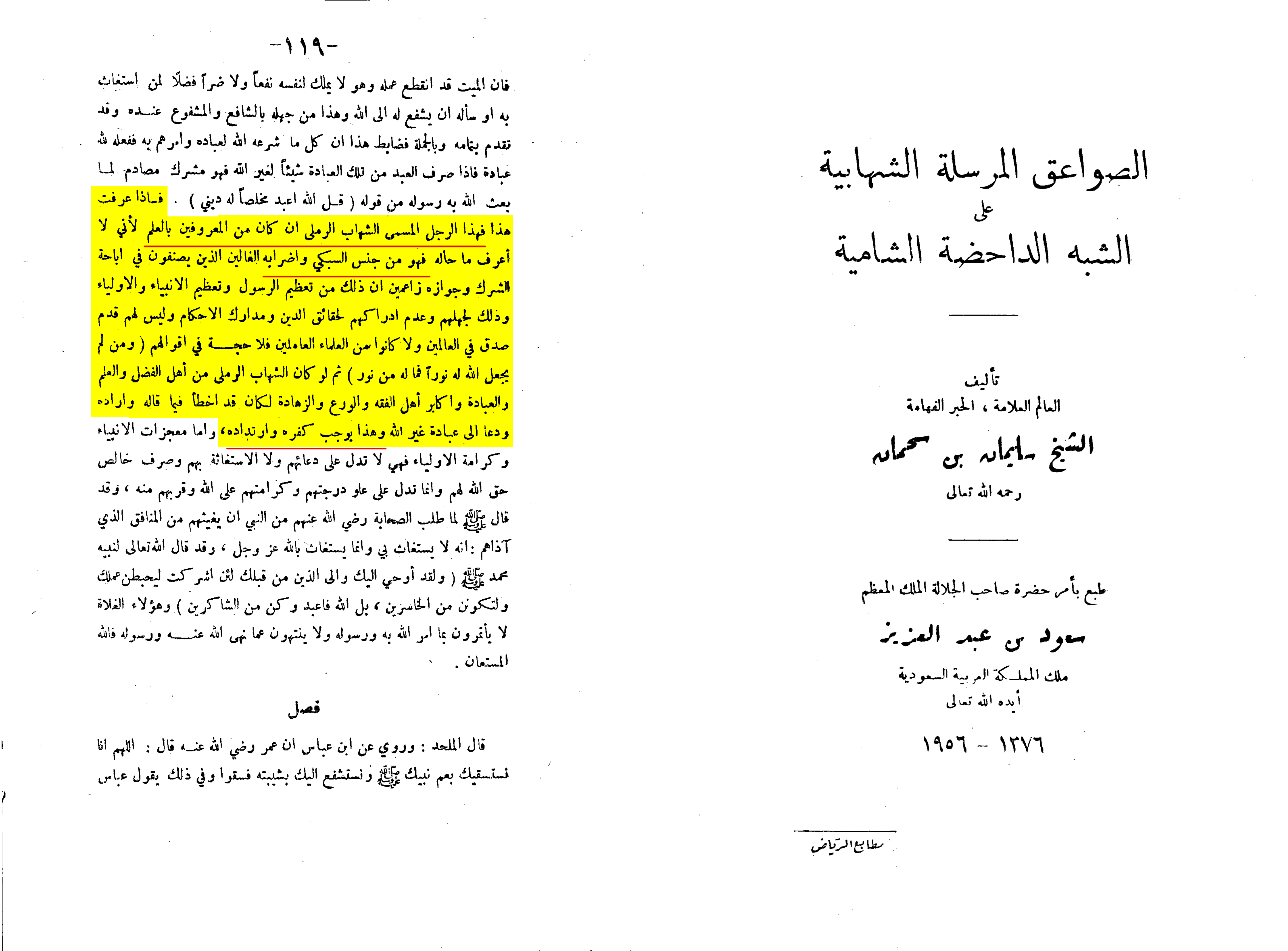
◈ And he said:
Ibn Ḥajar al-Makkī, may Allāh deal with him justly, is among the extremists (al-ghālīn) regarding the righteous and among the slanderers of the Imāms of the Muslims: those who purified the worship of tawḥīd for Allāh, Lord of the Worlds, and struggled for Allāh against those who deviated from the path of the believers: {And whoever opposes the Messenger after guidance has become clear to him and follows other than the way of the believers, We will give him what he has chosen and land him in Hell—what an evil destination!} [Qurʾān 4:115] {And he for whom Allāh has not appointed light—for him there is no light.} [Qurʾān 24:40] One whose condition and statements are thus is truly unworthy of attention.
📔 Aṣ-Ṣawāʿiq ash-Shihābiyyah - p. 128
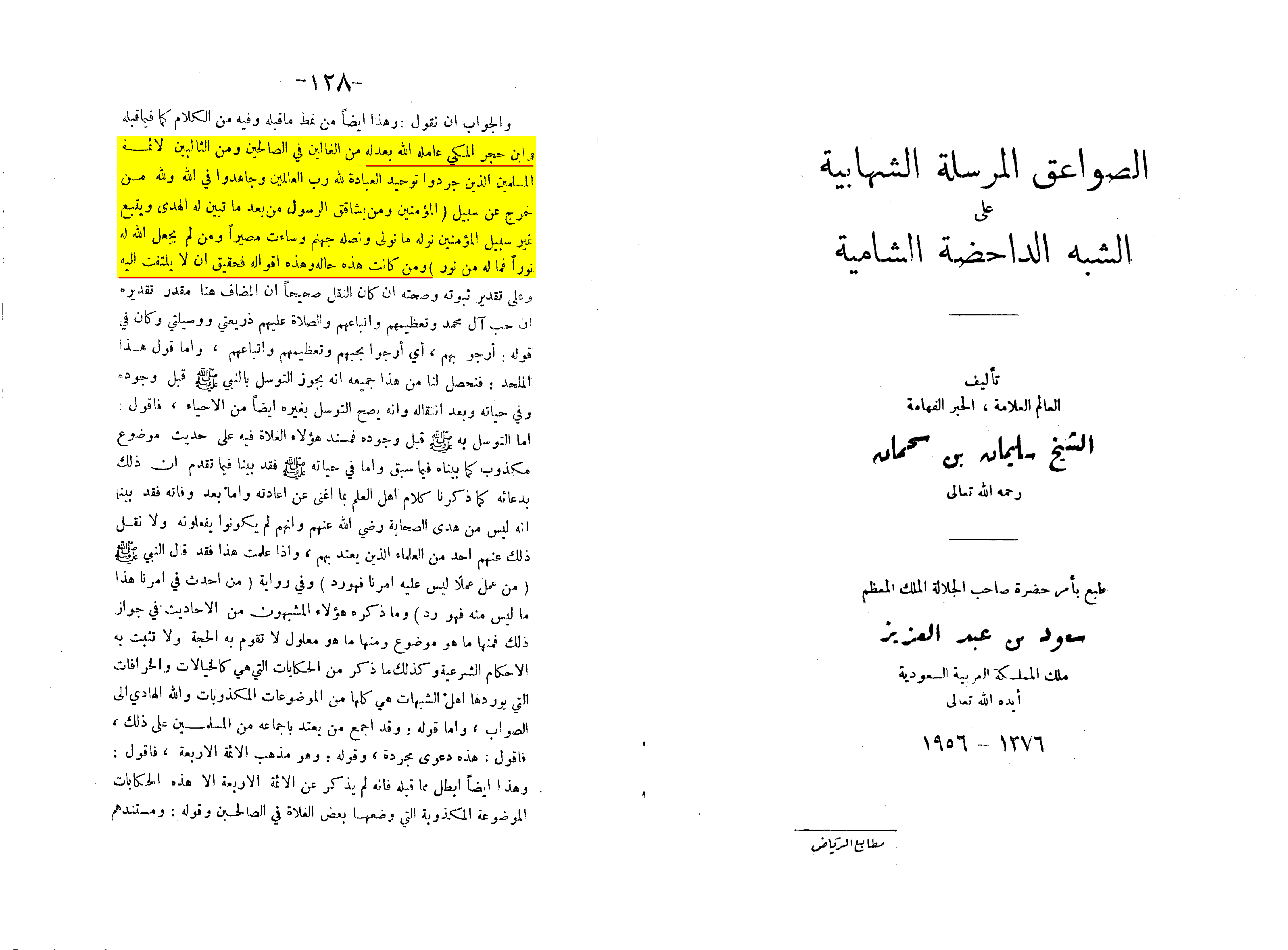
No one from the scholars ever used the principle against Sulaymān, nor against Ibn Taymiyyah when he said what he said about al-ʿIzz, al-Juwaynī and al-Ghazālī.
8) These people contradict themselves when we bring scholars who performed takfīr or tabdīʿ upon Abū Ḥanīfah, Ibn Ḥazm, as-Subkī, al-Haytamī, and others. They don't care about their principle when it comes to these individuals and their likes. Rather they start discussing whether what is attributed to them is true, if the proof was established upon them, and if what they fell into requires takfīr or tabdīʿ.
9) Their principle can be discussed by saying to them: “Did an-Nawawī, Ibn Ḥajar, as-Suyūṭī, al-Qurṭubī, and other than them, fall into bidaʿ mukaffirah?”
a) If they say: “No.”, then they either don't know their beliefs and so they are taught. Or they know their beliefs (like denying ʿUluww, etc) but they don't believe that's disbelief, and therefore they are Kuffār even according to their Mudajjan teammates.
b) If they say: “Yes.”
- Then we ask them: “Who preceded you to saying that an-Nawawī and the others fell into disbelief??”
- If they say: “Because the scholars have an agreement that whoever has those beliefs has fallen into disbelief.”
- It is said: “And your opponent says the same thing regarding the matter of judging individuals.”
10) Who preceded us to applying rulings upon the scholars of the Rāfiḍah like al-Kulaynī and other than them? You will, mostly, not find a lot of scholars performing takfīr upon them individually. Can we make up an ijmāʿ on their Islām based on that?
If they say yes, then how does that make sense when a lot of scholars believe in the distortion of the Qurʾān, that the twelve Imāms have attributes of Rubūbiyyah, wilāyah takwīniyyah, and other than that? So the principle is false from the beginning, it's built upon the delusion that anyone who falls into a nullifier, he should be excommunicated by name in some book, otherwise he's a Muslim. So do these people have a problem with those who perform takfīr upon these Rāfiḍah? Can it be said to them not to talk about masāʾil which we don't have an Imām in?
The clarification to those whom seek knowledge.
It has become widespread among those whom attribute knowledge to themselves that they believe the knowledge of the Khalaf and the Muʿāṣirīn to be superior to the knowledge of the Salaf. This delusion has spread so deeply that even those who call themselves “Salafī” or “Atharī” fall into it. If you were to ask them what the Salaf did in such-and-such a matter, they would bring you the saying of a contemporary. And if you were to ask them what the Salaf actually said, they would admit they do not know, yet still claim the name Salafī. What Salafī is this?
However, those who claim affiliation with the Salaf are, in reality, nothing but a scattered group burdened with errors, as they rely on Ibn Taymiyyah and misinterpreted quotes from the Najdīyyah. And as a result, many of the youth came to think that the path of the Salaf consists only of a few quotations, or a few scholars, and that they do not differ among themselves.
And among them are people who in fact, know and love the Salaf, and see evil in opposing them; yet they turn away due to the false argument that their speech was difficult to understand, that the Muʿāṣirīn are more articulate with their words, or advanced in their understanding, or that those who “represent” the Salaf today are the official institutional figures for the later generations. And so, you will see these same people become preoccupied with the words and knowledge of the Khalaf.
The same people will then say the Salaf were harsh in takfīr, or that they erred in such and such matter, or that they were ignorant regarding this, or wrong regarding that; that their ijmāʿ was false, the reports from them weak, or that they themselves are not even a ḥujjah—saying whatever serves their desires.
But no! By Allāh, the Magnificent, if all the scholars of the Khalaf, and the Muʿāṣirīn were gathered today, and their knowledge was compared to the Salaf, it would not equate to even 1 of them, and there were thousands of them.
Know that the Salaf were those whom the Messenger of Allāh ﷺ called the best of the people who claim Islām. They were the ones whom we were told to take from, and follow, as they were the closest to the best of creation. They learned directly, and were guided by the grace and mercy of the Most Merciful.
◈ The Prophet ﷺ said [here]:
“The best of people are my generation, then those who follow them, then those who follow them.”
It is outrageous to assume that merely because so-and-so refuted a certain group or belief, they are automatically elevated above those who established this religion. Know that our religion stands upon the labor of the Salaf, their endurance, their sacrifice, and their unwavering resolve to make it easy for those may come later. It is by their effort that this religion was preserved, and by their consensus and discussions that we find our ease today.
In fact, even their own scholar agrees on this, and has spoken on the consensus of the Salaf, yet what do the people of desires do except deny?:
◈ Ibn ʿUthaymīn said in [Sharḥ ʿAqīdah al-Wāsiṭiyyah li-Ibn ʿUthaymīn]:
“His statement: ‘The consensus that can be precisely defined is that which was upon the righteous Salaf, for after them differences increased and the Ummah spread.’
Meaning: the consensus that can be accurately identified and comprehended is that which was upon the righteous Salaf, the first three generations: the Companions, the Tābiʿīn, and those who followed them.
The author then explained this by saying: ‘For after them differences increased and the Ummah spread,’ meaning that disagreements multiplied due to the abundance of desires, as people divided into groups, and not all of them sought the truth, so opinions diverged and statements varied.
‘And the Ummah spread’, meaning that encompassing them all became among the most difficult of matters.
Thus Ibn Taymiyyah is saying: whoever claims consensus after the righteous Salaf, the first three generations, then his claim of consensus is invalid, for the consensus that can be precisely established is only that which was upon the righteous Salaf. Can consensus exist after disagreement? We say: there is no consensus while a prior disagreement exists, and there is no consideration for disagreement that arises after a valid consensus has already been established.”
◈ Abū Jaʿfar an-Naḥḥās said in [al-Nāsikh wa-l-Mansūkh]:
“If one of the later people speaks about the meaning of a Qurʾān verse when the speech of the early scholars on it has already preceded, and he goes against what they said, his statement is not to be regarded, nor is any notice paid to his opposition.”
◈ al-Awzāʿī was reported to have said in [al-Ḥujjah fī Bayān al-Maḥajjah]:
“Cling to the āthār of those who came before, and beware the opinions of men, even if they adorn them with fine speech, for the matter will become clear, and you will be upon a straight path.”
◈ ʿUmar ibn ʿAbd al-ʿAzīz, may Allāh have mercy on him, was reported to have said in [Sharḥ Uṣūl Iʿtiqād Ahl al-Sunnah wa-l-Jamāʿah]:
“The Messenger of Allāh ﷺ, and the authorities after him established Sunnahs. Adhering to them is an affirmation of the Book of Allāh, a completion of the obligations of Allāh, and a strength upon the religion of Allāh. Whoever acts upon them is guided. Whoever seeks support through them is granted support. Whoever opposes them has followed other than the path of the believers, and Allāh, exalted is He, will leave him to what he has chosen.”
◈ Abū al-Dardāʾ said was reported to have said in [Sharḥ Uṣūl Iʿtiqād Ahl as-Sunnah wa-l-Jamāʿah]:
“You will not go astray so long as you adhere to the athar.”
Meaning: Whenever you adhere to the athar, you are completely far from misguidance.
◈ With an authentic chain, ʿAbdullāh ibn Masʿūd was reported to have said in [Kitāb az-Zuhd li-l-Imām Aḥmad]:
“Follow, and do not innovate; for you have indeed been sufficed. Every innovation is misguidance.”
“O people, learn, for one of you does not know when he will have need of it.”
“O Abū ʿAbd al-Raḥmān, what do you think of a man who recites the Qurʾān upside down?”
“That is a heart turned upside down.”
“Indeed, the best thing by which the muṣḥaf is adorned is its recitation in truth.”
Exalted is Allāh, for indeed we live in the time where knowledge is being taken away. People rely on the statements of those who haven’t even read the books of the Salaf, and excuse those whom have left Islām, and are lenient in every matter, even the great matter of shirk.
• al-Khātimah •
Glory be to the Most High, the Supreme. To Him belongs all majesty and glorification. I bear witness that there is no deity worthy of worship except Allāh, all guidance from Him is opened, rather, it is a clear opening. And I bear witness that Muḥammad is the best of His creation, His servant and His messenger, the devoted one, the sincere advisor. May my Lord send prayers upon him as long as the wind blows, and grant him peace, a peace that remains and does not fade away, nor does it end as long as the time is bright. Until we meet him, and the Ḥawḍ is raised high for us, intercession is our success, bliss is our profit, and good pleasure is our provision. And eternal abode in Paradise, never ceasing and never being taken away.
It is by Allāh's Grace, Favor, and Mercy that I have reached the end. This article has gathered the meanings, and foundations of ignorance, clarified its causes and consequences, refuted the excuses used by the ʿĀdhiriyyah and Madākẖilah, removed the doubts regarding specific topics, and distinguished the path that preserves the servant from it, by the guidance of the words of Our Creator, the Mighty and Majestic, the Sunnah of His Messenger ﷺ upon the way of the Salaf.
Know, O servants of Allāh, that ignorance is the root by which corruption of one's religion spreads, and the greatest way to avoid this is to seek the knowledge of ʿaqīdah, fiqh, and others than them from the path of those who came before.
And know, that the people of desires weaponize ambiguity and seethe when told to stick to the evidence. But that begs the question, why would anyone seethe at such an easy path unless they willingly reject it? So be aware that the people of Sunnah are not of those who pursue ambiguity, and are of those who stick to the evidences that were left by those who have passed away [i.e; the Salaf].
My advice to all who have gotten this far into reading this article, is to not make ignorance your excuse. Whoever makes ignorance an excuse or a shelter, has opened a door to every bidʿah, and whoever makes contemporary scholars a proof, and follows their odd ways therefore has rejected the guidance of the Prophet ﷺ and left the religion of Islām.
◈ al-Bayhaqī reported with an authentic chain in [as-Sunan al-Kubrā - vol. 10, p. 356]:
20918. And in something like this: Abū ʿAbdillāh al-Ḥāfiẓ informed us. He said: I heard Abū al-ʿAbbās Muḥammad ibn Yaʿqūb say: I heard al-ʿAbbās ibn al-Walīd say: I heard Muḥammad ibn Shuʿayb ibn Shābūr say: I heard al-Awzāʿī say:
“Whoever takes up the rare and odd opinions of the scholars has left Islām."
I would like to take a chance to give credit to my dear brothers whom helped me finish this article, and to say that most of what I brought was the hard work of my brothers, and I ask Allāh to preserve, love, guide and honor them all, to grant them a good end, to keep them safe from misguidance and harm, and grant them martyrdom and the highest rank in Jannah, and I ask Allāh to reward them and forgive them and grant what I asked for them for the rest of my beloved brothers whom did not have a part in this.
They are:
Abū ʿĀʾish al-Ifrīqī, ʿAbd ar-Raḥmān ibn Bābū, Abū Isḥāq al-Ūrshalīmī, Abū Ḥātim, and Abū ʿUmar al-Hindī, may Allāh be pleased with them all.
Whoever I have not mentioned, but helped me, I ask Allāh to preserve, love, guide and honor them all, to grant them a good end, to keep them safe from misguidance and harm, and grant them martyrdom and the highest rank in Jannah, and I ask Allāh to reward them and forgive them.
And may Allāh send prayers and peace and blessings upon our Prophet Muḥammad, and upon his family and his companions altogether. And all praise is for Allāh, the Lord of all worlds.
Dhawū al-Baṣar | Telegram
Dhawū al-Baṣar | Discord
Refutation of Falsehoods JPT
This article was finished on the 17th of Rajab, the year 1447 AH.