
Introduction
Cloud computing helps organizations launch products quickly, scale infrastructure on demand, and experiment without buying physical servers. However, the flexibility of cloud services can also make spending difficult to understand and control. A development team can deploy resources in minutes, while finance teams may not see the financial impact until a billing report arrives later. This is where FinOps becomes valuable. FinOps combines financial accountability, cloud operations, and business decision-making so organizations can get more value from technology spending. A FinOps Foundation Certification can help professionals understand this discipline in a structured way. This article explains FinOps, the FinOps Foundation’s certification and learning paths, practical cloud cost management skills, career relevance, and a sensible preparation roadmap.
What FinOps Means
FinOps in simple language
FinOps is an operational framework and cultural practice that helps organizations maximize the business value of technology. It supports timely, data-driven decisions and creates financial accountability through collaboration between engineering, finance, and business teams.
The term combines “Finance” and “DevOps.” It does not mean that finance teams suddenly manage infrastructure or that engineers become accountants. Instead, it creates a shared process in which people who build, operate, approve, and benefit from technology can make better cost-and-value decisions together.
For example, an engineering team may choose a more expensive cloud database because it improves application performance and reduces customer churn. FinOps helps the organization assess that choice using both cost and business value, rather than judging it only by the monthly bill.
Core FinOps outcomes
A working FinOps practice commonly focuses on:
-
Making cloud and technology costs visible, timely, and understandable
-
Allocating costs to products, teams, environments, customers, or cost centers
-
Improving budgeting and forecasting
-
Identifying waste, inefficient usage, and pricing opportunities
-
Giving engineering teams ownership of the cost of their technology decisions
-
Connecting technology spending with measurable business outcomes
FinOps began with a strong cloud-cost focus, but modern practices can cover broader technology categories, including SaaS, licensing, data centers, and data platforms.
About the FinOps Foundation
The FinOps Foundation is a project of the Linux Foundation that advances technology value management through best practices, education, community, and standards. It maintains the FinOps Framework and supports the FinOps Open Cost and Usage Specification, commonly called FOCUS.
FOCUS is an open specification intended to reduce complexity in technology billing and usage data. In practical terms, standardized cost data can make it easier for organizations to compare, normalize, allocate, and report spending from multiple providers.
The Foundation’s work is useful because FinOps is not just a tool or a one-time cost-cutting exercise. It is a continuing operating model. Teams need common language, repeatable processes, reliable data, and ways to evaluate value over time.
What is FinOps Foundation Certification?
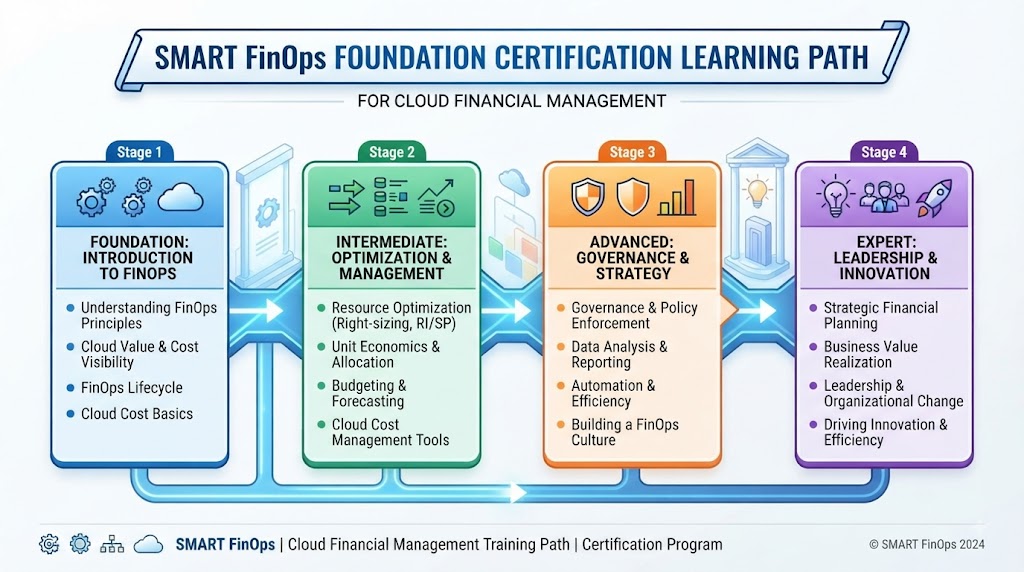
“FinOps Foundation Certification” is often used as a general term for the Foundation’s FinOps learning and certification offerings. These programs help learners develop knowledge of FinOps principles, cloud economics, cost allocation, optimization, reporting, collaboration, and value-based technology decisions.
The best-known starting credential is the FinOps Certified Practitioner certification. It is designed to establish a foundation in the FinOps Framework and in driving business value, best practices, and cultural change.
The Foundation also offers specialized and advanced learning options. Certification names, course content, prerequisites, exams, and renewal policies can evolve, so candidates should always confirm the latest details through official FinOps Foundation training pages before purchasing or scheduling an assessment.finops+1
Certifications and learning levels
| Learning option | Best suited to | Main focus |
|---|---|---|
| FinOps Certified Practitioner | Beginners and cross-functional cloud professionals | FinOps fundamentals, framework, collaboration, cost and value concepts |
| FinOps Certified FOCUS Analyst | Learners working with cost and usage data | Understanding and applying FOCUS billing-data concepts |
| FinOps Certified Professional | Experienced practitioners | Advanced, practical FinOps work and professional development |
| Topic-specific training | Professionals expanding into new technology-value areas | Specialized subjects, which may include areas such as AI value |
The Practitioner exam-only option currently lists 50 multiple-choice questions, a one-hour time limit, a 75% passing score, three attempts within 12 months of purchase, and a 24-month certification validity period.
The advanced FinOps Certified Professional path has more formal requirements. Official information states that learners need an active FinOps Certified Practitioner certification and at least six months of FinOps work experience before starting; an active FinOps Certified FOCUS Analyst certification is also required before taking the Professional exam. The Professional certification is currently valid for 36 months.
The FinOps Framework
The FinOps Framework provides a shared operating model for establishing and improving a FinOps practice. It includes principles, personas, domains, capabilities, measures of success, and maturity characteristics.
Domains and capabilities
The Framework organizes work into four major outcome-oriented domains. Capabilities are the practical areas of activity used to achieve those outcomes.
| Domain | What it helps an organization do | Example activities |
|---|---|---|
| Understand Usage & Cost | Build reliable cost visibility | Data ingestion, allocation, reporting, anomaly management |
| Quantify Business Value | Relate spend to outcomes | Budgeting, forecasting, KPIs, unit economics |
| Optimize Usage & Cost | Improve efficiency and pricing | Rightsizing, rate optimization, workload placement |
| Manage the FinOps Practice | Sustain the operating model | Governance, education, automation, chargeback |
A persona is a person or group participating in FinOps, such as engineering, finance, product, procurement, executives, or a dedicated FinOps team. A central FinOps function can enable standards and reporting, but responsibility for technology usage is shared across the organization.
A scope is a defined portion of technology spending aligned to a business construct, such as a product, cost center, environment, or team. Scopes help organizations apply FinOps at a useful level of detail instead of treating the entire cloud bill as one number.
FinOps principles
The Framework principles act as a guide for how teams work. Among the most important are:
-
Teams collaborate across engineering, finance, product, and leadership
-
Business value drives technology decisions
-
Everyone takes ownership of their technology usage
-
FinOps data should be accessible, timely, and accurate
-
FinOps should be enabled centrally
In real-world environments, this may mean engineers review cost dashboards alongside operational metrics, finance teams contribute forecasting expertise, and product leaders help define value metrics such as cost per customer, transaction, or active user.
Lifecycle and maturity
The familiar FinOps lifecycle includes Inform, Optimize, and Operate. Organizations first make usage and costs understandable, then improve efficiency and pricing, and finally operationalize processes through governance, automation, and continuous measurement.
This is not a straight line. A team might optimize a workload, deploy a new feature, and then revisit allocation, forecasting, and performance trade-offs. The Foundation’s maturity model describes a “Crawl, Walk, Run” approach: start with the activities that create the most value, then improve scope and sophistication over time.
Skills, Practice, and Preparation
Who can benefit?
FinOps certification can be relevant for professionals who influence cloud use, cost, reporting, or technology strategy. It may be especially useful for:
-
Cloud, DevOps, and platform engineers
-
Cloud architects and cloud consultants
-
FinOps practitioners, analysts, and cloud cost analysts
-
Finance, procurement, and business operations professionals
-
IT managers, engineering managers, and technology leaders
-
Product and data leaders responsible for technology-driven services
Not every role needs a certification. For some people, Foundation resources and hands-on practice may be enough. Certification is most useful when it supports a clear learning goal or helps establish a shared language across teams.
Eligibility and prerequisites
For entry-level FinOps learning, cloud experience is helpful but not necessarily the same as an official requirement. Learners benefit from understanding:
-
Basic cloud services and consumption-based billing
-
At least one major public cloud environment
-
Cost reports, tags or labels, and common infrastructure resources
-
Basic budgeting, forecasting, or business concepts
-
How engineering and finance teams make decisions
The FinOps Certified FOCUS Analyst offering states that it has no formal prerequisites, although preparation is still valuable. Always separate recommended background from mandatory eligibility rules, especially for advanced certifications.
Skills you can gain
FinOps study should build practical abilities, not only vocabulary. Important skills include:
-
Reading cloud billing and usage data
-
Designing cost allocation models using tags, accounts, projects, or business mappings
-
Building dashboards for cost visibility and anomaly detection
-
Creating budgets and forecasts
-
Identifying idle resources, oversized workloads, or underused commitments
-
Comparing cost, performance, reliability, and business trade-offs
-
Explaining cloud economics to non-technical stakeholders
-
Using unit economics, such as cost per order or cost per API request
Cost optimization in practice
Cloud cost optimization is not simply “spend less.” A low-cost architecture that slows customer transactions or prevents growth may reduce overall value.
A practical optimization process looks like this:
-
Monitor spending by service, team, environment, and product.
-
Investigate unusual increases instead of waiting for month-end invoices.
-
Identify idle virtual machines, unattached storage, inactive databases, and unused licenses.
-
Rightsize workloads using actual utilization and performance data.
-
Improve tagging or account structures so costs can be allocated correctly.
-
Forecast future demand using business plans, historical data, and planned launches.
-
Measure whether optimization changes preserve performance and business outcomes.
For instance, a company might find that its non-production environments run all night and on weekends. Scheduling them to shut down outside working hours can reduce spend without affecting production customers.
Tools and technologies
FinOps teams often use a mix of tools rather than one universal platform:
-
Native cloud billing, cost explorer, budget, and advisory tools
-
Centralized cost-management or cloud financial management platforms
-
Data warehouses and business-intelligence dashboards
-
Tagging, policy, and infrastructure-as-code tools
-
Alerting and anomaly-detection systems
-
Forecasting models and financial planning tools
The tool is not the practice. Reliable allocation rules, accountable owners, agreed metrics, and communication routines matter as much as dashboards.
Hands-on projects
Use small projects to turn theory into working knowledge:
-
Create a cost dashboard segmented by service, environment, and owner.
-
Design a tagging standard and measure allocation coverage.
-
Analyze a month of billing data for idle or oversized resources.
-
Build a simple monthly forecast with actual-versus-budget variance.
-
Write a short business case comparing on-demand pricing with commitment options.
-
Produce a cloud spending report that explains cost changes in plain language.
Preparation roadmap
-
Learn FinOps fundamentals and the relationship between finance, engineering, and business.
-
Study the official FinOps Framework, including principles, domains, personas, capabilities, and maturity.
-
Review the official material for the specific certification you plan to take.
-
Strengthen cloud economics knowledge, including usage-based pricing and discount models.
-
Practice realistic scenarios involving allocation, reporting, forecasting, and optimization.
-
Identify weak areas and revisit the official guidance.
-
Take the assessment only after confirming its current format, requirements, retake policy, and validity period.
Common mistakes include memorizing definitions without applying them, treating tagging as an afterthought, focusing only on infrastructure costs, ignoring business value, and assuming every optimization recommendation should be implemented without checking performance or risk.
Careers, Comparisons, and Future Direction
Career opportunities
Organizations use different titles, but FinOps-related work may appear in roles such as FinOps Practitioner, FinOps Analyst, Cloud Cost Analyst, Cloud Financial Management Professional, FinOps Engineer, Cloud Architect, or Cloud Consultant.
Responsibilities vary. An analyst may focus on reporting and allocation, while an engineer may automate cost controls and improve workload efficiency. A FinOps lead may build governance, stakeholder routines, and value metrics across the organization.
Compensation depends on experience, location, cloud expertise, industry, role scope, and organization size. A certification can demonstrate focused knowledge, but it does not guarantee a job, promotion, or salary increase.
FinOps compared with related paths
| Path | Primary objective | Best for |
|---|---|---|
| FinOps certification | Technology value, cloud economics, accountability, and cost optimization | Professionals managing cloud spend and business value |
| Cloud certification | Cloud services, architecture, security, and deployment | Engineers and architects building cloud systems |
| DevOps certification | Delivery automation, operations, reliability, and collaboration | Engineers improving software delivery and operations |
| Data or analytics certification | Data modeling, analysis, reporting, and visualization | Analysts building insights from business or technology data |
These paths can complement one another. For example, a cloud engineer with FinOps knowledge can make more cost-aware architectural choices, while a financial analyst with cloud knowledge can produce more meaningful forecasts.
The future of FinOps
FinOps is expanding beyond traditional cloud cost reporting. Key trends include multi-cloud visibility, automated optimization, AI-assisted anomaly detection, sustainability considerations, unit economics, and stronger integration with platform engineering.
Organizations are also becoming more interested in measuring value, not only spend. That means asking questions such as: What does each customer transaction cost? Which product feature creates value relative to its infrastructure cost? Which technology investments should be scaled, redesigned, or retired?
After an entry-level certification, choose next steps based on your role. Engineers can deepen cloud architecture and automation skills. DevOps and platform professionals can focus on policy-as-code, observability, and workload efficiency. Finance professionals can strengthen forecasting, allocation, and unit-economics analysis. Aspiring specialists can pursue advanced FinOps learning and practical cross-functional projects.
FAQs
What is FinOps Foundation Certification?
It refers to certification and training programs from the FinOps Foundation that teach FinOps practices, cloud economics, cost management, and technology value management.
Is FinOps only about reducing cloud costs?
No. FinOps aims to maximize business value from technology. Cost reduction can be an outcome, but teams also consider performance, speed, reliability, growth, and customer impact.
Who should start with FinOps Certified Practitioner?
It is suitable for people who want foundational FinOps knowledge, including cloud engineers, finance professionals, IT managers, architects, consultants, and aspiring FinOps practitioners.
Are formal prerequisites required for FinOps certification?
Requirements vary by credential. The FinOps Certified FOCUS Analyst currently states that no formal prerequisites are required, while advanced paths have defined requirements.
How should I prepare for a FinOps assessment?
Study official materials, learn the Framework, understand basic cloud billing, and practice scenarios involving allocation, optimization, budgets, and forecasting.
Where can I find official FinOps learning resources?
Use the FinOps Foundation website and its official training catalog for current certification, course, and assessment information.
What is cloud cost allocation?
It is the process of assigning technology costs to the teams, products, customers, projects, or cost centers responsible for using them.
What does rightsizing mean in FinOps?
Rightsizing means matching a resource’s capacity to actual workload needs. It can include reducing oversized instances, changing service tiers, or selecting more appropriate services.
How does FinOps support budgeting?
FinOps combines historical cost data, usage trends, planned product changes, and business assumptions to create and refine spending forecasts and budgets.
Can finance professionals learn FinOps without becoming cloud engineers?
Yes. Finance professionals can contribute significantly through forecasting, reporting, allocation, governance, and business-value analysis. Basic cloud knowledge still improves collaboration.
What is the FinOps Framework used for?
It provides a common model for organizing FinOps work through principles, personas, domains, capabilities, and maturity guidance.
When should an organization adopt FinOps?
Organizations should begin when cloud or technology spending requires more visibility, ownership, forecasting, or cross-functional decision-making. Starting small is often more effective than waiting for costs to become unmanageable.
Conclusion
FinOps helps organizations manage cloud and technology spending as a shared business responsibility rather than a billing problem owned by one department. It brings engineering, finance, and business teams together to improve visibility, accountability, optimization, and value-based decisions. A FinOps Foundation Certification can be a useful part of a broader professional learning path, especially for people working with cloud platforms, cost data, architecture, financial planning, or technology strategy. The strongest learning approach combines official Framework study with hands-on work: analyze billing data, improve allocation, build forecasts, identify waste, and communicate trade-offs clearly.