
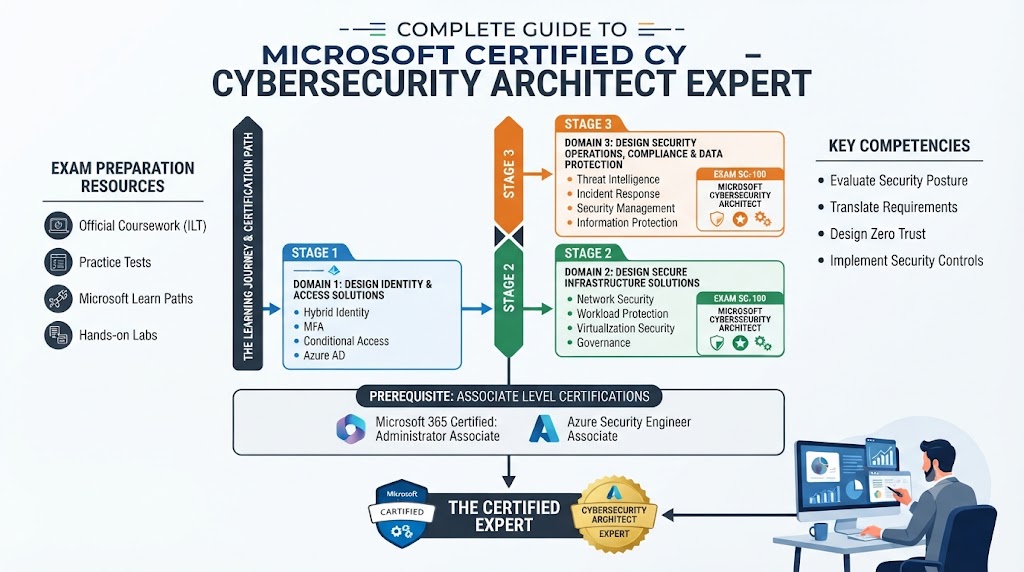
As a domain expert with two decades of hands-on experience in enterprise software engineering and cloud security architecture, I have watched security evolve from a perimeter-based checklist into a core business driver. Today, modern infrastructure spans hybrid boundaries, multicloud deployments, and edge environments, making robust security a non-negotiable engineering standard.If you are a working engineer, software developer, or engineering manager looking to validate high-level design authority, mastering enterprise cloud defense is your ultimate career accelerator. This master guide explores the Microsoft Certified Cybersecurity Architect Expert credential, breaking down everything you need to know to evaluate, plan, and pass this industry-defining certification.
1. Core Metadata & Navigation
-
Track: Microsoft Security, Compliance, and Identity
-
Level: Expert
-
Who it’s for: Software Engineers, Cloud Security Engineers, Infrastructure Architects, and Technical Managers
-
Prerequisites: Foundational or associate-level certifications such as Azure Security Engineer Associate (AZ-500) or Security Operations Analyst Associate (SC-200)
-
Skills covered: Zero Trust strategy, Governance Risk Compliance (GRC), Security Operations (SecOps), Identity & Access, Infrastructure Security, and Application/Data Protection
-
Recommended order: Complete foundational cloud training, secure an associate-level credential (like AZ-500 or SC-200), master architectural frameworks, and then attempt Exam SC-100.
-
Official Link: Microsoft Certified Cybersecurity Architect Expert Certification
2. About Certification Name: Microsoft Certified Cybersecurity Architect Expert
What it is
This expert-level certification validates your ability to translate enterprise business requirements and risk profiles into robust, scalable cybersecurity strategies. It focuses heavily on designing solutions across Zero Trust, governance, compliance, platform protection, and operations using Microsoft technologies.
Who should take it
-
Senior software and systems engineers transitioning into security-first design roles.
-
Cloud architects responsible for defining secure foundations across multicloud ecosystems.
-
Engineering managers and tech leads who oversee compliance, risk management, and overall organizational security posture.
Skills you’ll gain
-
Designing modern governance, risk, and compliance (GRC) frameworks aligned with business goals.
-
Architecting enterprise-wide Zero Trust strategies covering identity, endpoints, data, and networks.
-
Planning centralized security operations and automated threat response structures using Microsoft Defender and Microsoft Sentinel.
-
Specifying security requirements for SaaS, PaaS, and IaaS service delivery models.
Real-world projects you should be able to do after it
-
Build an end-to-end Zero Trust migration strategy for a multinational enterprise moving from legacy on-premises architecture to a hybrid cloud model.
-
Design an automated threat detection and incident response pipeline utilizing SIEM and XDR capabilities across multi-cloud infrastructure.
-
Establish a continuous security posture management framework that flags misconfigurations, compliance drifts, and identity vulnerabilities in real time.
Preparation plan
-
14-Day Accelerated Plan: Ideal for seasoned cloud architects with active associate certifications (AZ-500/SC-200). Focus entirely on architectural design patterns, case studies, and official Microsoft Learn modules for Exam SC-100.
-
30-Day Standard Plan: Best for working engineers. Dedicate 1 to 2 hours daily reviewing security frameworks, Azure security benchmarks, and practicing scenario-based design questions.
-
60-Day Comprehensive Plan: Recommended if you need to bridge knowledge gaps across identity management, data protection, and hybrid infrastructure administration. Combine theoretical modules with hands-on lab environments.
Common mistakes
-
Treating the exam as a memorization test rather than an exercise in situational, architectural decision-making.
-
Ignoring non-technical components such as compliance, risk evaluation, and governance frameworks (GRC).
-
Underestimating the depth of cross-platform integration requirements between Microsoft tools and third-party or hybrid architectures.
Best next certification after this
-
CISSP (Certified Information Systems Security Professional): To expand your portfolio into vendor-neutral, executive-level managerial security governance.
-
Microsoft Certified: DevOps Engineer Expert: To deeply integrate security governance directly into rapid software delivery pipelines (DevSecOps).
3. Choose Your Path
Architecting secure systems requires close collaboration across the entire software delivery lifecycle. Select your specialization path below to align your security expertise with your domain engineering goals:
-
DevOps: Focuses on embedding continuous security checks, secret management, and infrastructure-as-code validation directly into deployment pipelines.
-
DevSecOps: Centers on shifting security left, implementing automated vulnerability scanning, dependency tracking, and runtime application protection.
-
SRE (Site Reliability Engineering): Prioritizes building resilient, fault-tolerant architectures capable of weathering sophisticated ransomware and DDoS attacks with minimal downtime.
-
AIOps/MLOps: Targets the unique security challenges of machine learning pipelines, protecting training data integrity, model parameters, and AI-driven API endpoints.
-
DataOps: Concentrates on data governance, classification, encryption-at-rest and in-transit, and lifecycle compliance across massive data lakes.
-
FinOps: Integrates cloud cost optimization with security posture management, ensuring that risk reduction strategies do not create financial waste.
4. Top Training Institutions
Navigating enterprise certifications requires structured mentorship, lab environments, and real-world scenario training. Several specialized institutions provide comprehensive training-cum-certification bootcamps for the Microsoft Certified Cybersecurity Architect Expert program:
-
DevOpsSchool: Offers intensive, instructor-led architectural bootcamps tailored for enterprise engineers seeking practical, hands-on cloud design mastery.
-
Cotocus: Specializes in corporate workforce transformation, delivering structured training modules focused on hybrid cloud defense and compliance.
-
Scmgalaxy: Focuses on bridging development, operations, and security pipelines through structured mentoring and practical project scenarios.
-
BestDevOps: Delivers targeted certification readiness programs designed around real-world architectural case studies and best practice frameworks.
-
devsecopsschool: Provides deep-dive modules focusing heavily on shifting security left, pipeline integration, and modern cloud-native defense mechanisms.
-
sreschool: Emphasizes high availability, system resiliency, disaster recovery planning, and robust infrastructure protection strategies.
-
aiopsschool: Tailors its curriculum toward securing modern data workloads, machine learning workflows, and automated intelligence pipelines.
-
dataopsschool: Focuses on enterprise data governance, compliance frameworks, and secure big-data processing topologies.
-
finopsschool: Combines secure cloud architecture principles with efficiency frameworks to manage risk while maintaining fiscal accountability.
5. Conclusion
Achieving the Microsoft Certified Cybersecurity Architect Expert designation is a definitive milestone for any software engineer or technical manager aiming to lead enterprise defense strategies. By moving beyond simple tool administration into high-level system design, you position yourself as a crucial decision-maker capable of guiding organizations through complex digital transformations. Commit to a structured preparation plan, embrace the Zero Trust philosophy, and future-proof your career in an increasingly interconnected technological landscape.