
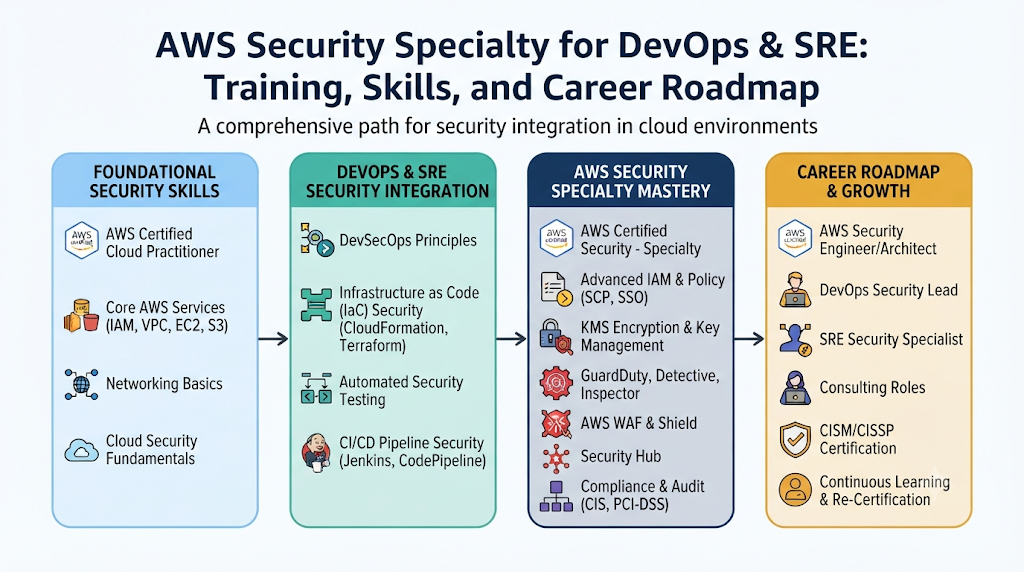
Introduction
Cloud security is no longer just about “locking down S3 and turning on MFA.” Modern AWS environments are multi‑account, highly automated, and constantly changing, which means security must be baked into every layer—from IAM and encryption to logging, monitoring, and governance. The AWS Certified Security – Specialty (SCS‑C02/SCS‑C03) certification is designed for professionals who want to prove they can turn AWS security features into a systematic, production‑grade security strategy rather than a collection of isolated best practices.
What it is
In simple terms, AWS Certified Security – Specialty validates that you can design, implement, and operate robust security controls for production AWS environments.
It proves your ability to protect data, manage identities, detect and respond to threats, and maintain compliance, even when your organization runs across many accounts, regions, and services.
Who should take it
This certification is ideal for professionals who are already working in or moving towards security‑centric roles in the cloud.
-
Security Engineers and Security Architects responsible for securing mission‑critical workloads on AWS.
-
DevSecOps and Platform Engineers who build automated guardrails, policies, and security tooling around CI/CD pipelines and infrastructure.
-
SREs, Cloud Engineers, and senior DevOps Engineers who routinely deal with incidents, multi‑account architectures, and compliance requirements.
If you frequently handle IAM policies, encryption, logging, auditing, or incident response in AWS, this certification is a natural next step.
AWS Certified Security – Specialty: Certification Overview
The AWS Certified Security – Specialty exam is a specialty‑level certification, positioned above associate credentials. It assumes solid hands‑on experience with AWS and focuses only on security.
The exam is scenario‑driven: you’ll work through complex questions about identity boundaries, encryption strategies, multi‑account setups, logging design, security automation, and incident handling.
Core areas include:
-
Identity and Access Management (IAM, roles, SCPs, federation).
-
Data protection and encryption (KMS, CloudHSM, Secrets Manager).
-
Logging, monitoring, and threat detection (CloudTrail, CloudWatch, Config, GuardDuty, Security Hub, Detective).
-
Network and application security (VPC, security groups, NACLs, WAF, Shield, Network Firewall, API Gateway).
-
Governance, compliance, and multi‑account frameworks (Organizations, Control Tower, policies, audits).
Program delivery and hosting (CKAD + DevOpsSchool)
While AWS owns and delivers the certification exam itself, many learners prepare through structured training programs. One effective approach is to follow a combined CKAD + AWS Security path hosted on platforms like DevOpsSchool.
In this combined journey:
-
The Certified Kubernetes Application Developer (CKAD) component builds your skills in designing and deploying containerized applications on Kubernetes.
-
The AWS Security Specialty component then teaches you how to secure the AWS infrastructure that runs those Kubernetes workloads, along with other cloud services.
Think of it like this: CKAD helps you understand how applications behave and scale, while AWS Security Specialty helps you secure the cloud environment they live in. Together, they form a practical DevOps + Kubernetes + Cloud Security stack.
On the training side:
-
The program is hosted on DevOpsSchool, which provides classes, labs, projects, and mentoring.
-
The certification itself remains under AWS’s ownership—you register, schedule, and sit for the exam through the AWS Certification portal and approved exam providers.
Certification levels, assessment approach, ownership, and structure
To make this more practical, let’s break it down in plain language:
-
Certification level
-
AWS Security is a specialty‑level exam. It sits alongside other specialties like Advanced Networking and Data Analytics.
-
Typically, candidates benefit from completing at least one associate‑level certification and gaining 1–2 years of hands‑on AWS experience before attempting it.
-
-
Assessment approach
-
The exam uses scenario‑based multiple‑choice and multiple‑response questions.
-
You’ll see complex situations with multiple possible solutions, and you must choose the most secure, compliant, and maintainable approach—not just something that “works.”
-
-
Ownership
-
AWS defines the exam blueprint, maintains the question bank, sets the scoring model, and issues the badge and certificate.
-
Training providers like DevOpsSchool help you prepare but do not control the exam itself.
-
-
Structure in practical terms
-
You study using courses, labs, whitepapers, and practice questions.
-
You register for the exam via the AWS Certification portal and take it either at a test center or online with remote proctoring.
-
Once you pass, you manage your credential, renewals, and digital badge through your AWS Certification account.
-
Skills you’ll gain
By the time you’re ready for this exam—and especially after you pass—you should have a strong set of applied security skills. For example:
-
Designing secure multi‑account AWS environments using Organizations, SCPs, and account‑level guardrails.
-
Creating robust IAM strategies, including role‑based access, cross‑account permissions, and identity federation.
-
Implementing encryption and key management using KMS, CloudHSM, and Secrets Manager, and knowing when to use each.
-
Building centralized logging and monitoring architectures with CloudTrail, CloudWatch, Config, and log aggregation solutions.
-
Designing secure VPC architectures with proper use of security groups, NACLs, WAF, Shield, and Network Firewall.
-
Automating security controls and compliance checks with Config rules, Lambda, Infrastructure as Code, and security‑aware pipelines.
-
Handling threat detection and incident response using services like GuardDuty, Security Hub, Detective, and Inspector.
-
Maintaining governance and audit readiness for standards such as PCI, ISO, HIPAA, and internal policy frameworks.
Real‑world projects you should be able to do after it
A strong way to judge this certification is to look at the kind of work you should be able to perform afterward. Examples include:
-
Blueprinting a secure landing zone:
-
Design a multi‑account AWS structure with shared security services, central logging, and standardized guardrails.
-
-
Building an incident‑response pipeline:
-
Use GuardDuty, Security Hub, and Detective to detect suspicious activity and automate remediation via Lambda or Step Functions.
-
-
Implementing end‑to‑end encryption:
-
Choose appropriate KMS key types, build key rotation policies, and restrict access to keys across services and accounts.
-
-
Securing internet‑facing workloads:
-
Protect APIs and web applications with WAF, Shield, security groups, and secure TLS configurations, while controlling traffic flows.
-
-
Creating a continuous compliance framework:
-
Use AWS Config, CloudTrail, and Organizations to enforce policies, detect drift, and generate evidence for audits and compliance teams.
-
If you can design and deliver these kinds of projects, you’re already working at the level this certification represents.
Common mistakes candidates make
Many experienced engineers struggle with this exam for reasons that have little to do with basic knowledge. Common pitfalls include:
-
Focusing only on single‑account use cases and ignoring multi‑account patterns, Organizations, and Control Tower.
-
Learning individual services (IAM, KMS, S3) in isolation instead of understanding how they fit into complete architectures.
-
Underestimating the depth of IAM policies, permission boundaries, and policy evaluation logic.
-
Skipping hands‑on practice with tools like GuardDuty, Security Hub, Config rules, and VPC security features.
-
Poor time management—spending too long on early scenario questions and rushing the final part of the exam.
Addressing these issues early in your study plan dramatically increases your chance of passing on the first attempt.
Best next certification after this
Once you’ve earned AWS Certified Security – Specialty, you have several strong directions:
-
Advanced Networking Specialty (same track, deeper security)
-
Ideal if you want to own secure connectivity: hybrid links, VPNs, Direct Connect, complex VPC topologies, and network‑level security.
-
-
Solutions Architect – Professional (broader architecture)
-
Perfect for stepping into architecture and leadership roles where you design entire cloud environments and ensure security is built‑in from day one.
-
-
CKAD/CKA (platform and Kubernetes)
-
Great for platform engineers, SREs, and DevSecOps professionals who run Kubernetes clusters and need to apply cloud security principles to containerized workloads.
-
Complete AWS Security Specialty Certification Table
Use this table in your blog as a “quick guide” for learners choosing their certification path around AWS Security Specialty.
| Track | Level | Who it’s for | Prerequisites | Skills Covered | Recommended Order | |
|---|---|---|---|---|---|---|
| Security / DevSecOps | Specialty | Security engineers, DevSecOps practitioners securing AWS workloads | Solid AWS experience, good grasp of IAM, networking, encryption | Identity, data protection, logging, monitoring, incident response, governance | After at least one associate‑level cert | |
| DevOps | Professional | DevOps engineers running CI/CD and operations on AWS | Experience with pipelines, automation, monitoring | Deployment automation, reliability, operational excellence, Infrastructure as Code | Associate → DevOps Pro → Security Specialty | |
| SRE | Advanced | SREs responsible for reliability of distributed systems | Strong cloud and monitoring foundation | SLO/SLI, incident management, observability, resilience engineering | Cloud associate → SRE‑focused courses → Security Specialty | |
| AIOps/MLOps | Professional | Engineers deploying ML workloads on AWS | ML basics, data pipelines, APIs | Secure ML endpoints, data governance, monitoring, automation | Security Specialty → ML Specialty | |
| DataOps | Specialty | Data engineers and architects on AWS | Experience with data lakes, ETL, analytics | Secure data platforms, encryption, access control, governance | Data Specialty ↔ Security Specialty | |
| FinOps | Intermediate | Cloud cost and governance practitioners | Cloud basics, cost management exposure | Cost optimization, tagging, budgets, financial governance | Any cloud associate → FinOps → Security Specialty |
You can expand or tailor these rows depending on your audience and the tracks you want to promote.
Choose your path – 6 learning paths
To make things easier for readers, present six clear paths built around AWS Security Specialty.
-
DevOps Path
-
Start with a cloud associate certification.
-
Add DevOps Engineer Professional or equivalent.
-
Layer AWS Security Specialty on top to secure pipelines, infrastructure, and deployments.
-
-
DevSecOps Path
-
Begin with core cloud and DevOps certs.
-
Take AWS Security Specialty as your security backbone.
-
Add Kubernetes and CI/CD security training to embed security across the entire delivery chain.
-
-
SRE Path
-
Build a foundation with cloud architecture and observability.
-
Add AWS Security Specialty to handle security incidents and guardrails alongside reliability.
-
Complement with tooling‑focused training (logs, metrics, traces, incident management).
-
-
AIOps/MLOps Path
-
Learn ML fundamentals and cloud ML services.
-
Use AWS Security Specialty to secure data pipelines, training environments, and model endpoints.
-
Expand into monitoring for ML systems and automated response.
-
-
DataOps Path
-
Take data‑focused certifications and courses (data analytics, databases).
-
Add AWS Security Specialty to own encryption, access, and governance for data platforms.
-
Focus on secure data lakes, compliance, and audit‑friendly architectures.
-
-
FinOps Path
-
Learn cloud cost management and FinOps frameworks.
-
Combine that with AWS Security Specialty to align budgets, security guardrails, and governance policies.
-
Position yourself as the person who balances cost, performance, and security.
-
Role → Recommended certifications mapping
Here is a role‑based view that you can include as a table in your article:
| Role | Recommended certifications |
|---|---|
| DevOps Engineer | Cloud associate (AWS or similar), DevOps Engineer Professional, AWS Security Specialty, CKAD/CKA |
| SRE | Cloud architect associate/professional, AWS Security Specialty, SRE/observability training |
| Platform Engineer | CKAD/CKA, Cloud architect associate, AWS Security Specialty, optional networking specialty |
| Cloud Engineer | Cloud associate (AWS/GCP/Azure), AWS Security Specialty, plus one specialty (networking or data) |
| Security Engineer | AWS Security Specialty, cloud architect associate/professional, vendor‑neutral security certs (CISSP, CCSK, etc.) |
| Data Engineer | Data Analytics or database certs, AWS Security Specialty, optional ML Specialty |
| FinOps Practitioner | Cloud associate, FinOps certification, AWS Security Specialty to connect cost governance with security policies |
| Engineering Manager | One or two architect‑level certs, AWS Security Specialty, leadership or architecture‑focused programs |
Use this section to help readers quickly see how AWS Security Specialty fits into their current or target role.
Top institutions for Training‑cum‑Certifications (AWS Security Specialty)
Here are some institutions that can support your training and exam preparation journey for AWS Certified Security – Specialty, especially in DevOps and cloud‑focused contexts:
DevOpsSchool offers structured, role‑oriented programs that combine AWS Security content with DevOps practices, Kubernetes, and multi‑cloud workflows, making it easier to see how the exam topics apply in real projects.
Cotocus provides guided security and cloud training solutions with emphasis on scenario‑based learning, helping learners understand not just how services work but how to apply them in production environments.
Scmgalaxy focuses on DevOps and cloud ecosystems, often blending infrastructure, automation, and security content so that AWS Security concepts show up naturally in pipelines and platform work.
BestDevOps, Devsecopsschool, Sreschool, Aiopsschool, Dataopsschool, and Finopsschool collectively cover niche tracks like DevSecOps, SRE, AIOps, DataOps, and FinOps, and frequently integrate AWS security capabilities into their respective learning paths, enabling learners to build a unified cross‑functional skillset anchored by AWS Security Specialty.
Next certifications to take (3 options)
After AWS Certified Security – Specialty, you can guide readers toward three directions:
-
Same track (Security / DevSecOps)
-
AWS Advanced Networking Specialty, plus cloud security or DevSecOps‑specific certifications, deepen your expertise in secure architectures and connectivity.
-
-
Cross‑track (Platform / SRE / Data)
-
CKAD/CKA for Kubernetes, Solutions Architect Professional for broad design work, or Data Analytics Specialty for secure data platform design.
-
-
Leadership (Architecture / Strategy)
-
Architecture‑focused certifications and management or leadership programs help you move into roles where you define security and cloud strategy for teams or entire organizations.
-
FAQs – AWS Certified Security Specialty
-
What is AWS Certified Security – Specialty?
It is a specialty‑level AWS certification that validates advanced skills in securing workloads on the AWS Cloud, including identity, encryption, logging, monitoring, and incident response. -
Do I need an associate‑level certification before attempting it?
Officially, there is no strict prerequisite, but most candidates benefit from completing at least one associate‑level certification and gaining solid, hands‑on AWS experience first. -
What kind of experience should I have before taking this exam?
You should be comfortable managing IAM, VPC security, logging, encryption, and security automation in real AWS environments, ideally with 2+ years of practical cloud security exposure. -
What topics does the exam focus on the most?
Expect heavy emphasis on IAM, encryption and KMS, logging and monitoring with CloudTrail/CloudWatch/Config, threat detection tools, and multi‑account governance scenarios. -
Is this certification suitable for DevOps and SRE professionals?
Yes. It is particularly valuable for DevOps and SRE roles that own production systems and need to embed security into CI/CD, infrastructure automation, and incident management. -
How does AWS Security Specialty differ from general architect certifications?
Architect exams cover broad design and cost/performance trade‑offs. Security Specialty goes much deeper into security controls, policies, encryption, and governance in complex environments. -
Can I prepare for this exam without working on a real AWS environment?
It’s possible, but not ideal. Hands‑on work—labs, sandbox accounts, or training environments—makes it much easier to understand scenario questions and real‑world trade‑offs. -
How long does it usually take to prepare?
Preparation time varies, but many experienced AWS professionals spend 6–12 weeks of focused study, including labs, practice exams, and whitepaper reviews. -
Is this certification useful outside AWS‑centric companies?
Yes. The principles of identity, encryption, logging, and governance apply broadly. Even in multi‑cloud or hybrid environments, AWS Security Specialty shows you can handle complex cloud security challenges. -
Does this certification help in salary growth or promotions?
It often does, especially for roles where cloud security is critical. It positions you as someone who can take ownership of security design and operations, which is highly valued in modern organizations.
Why choose DevOpsSchool?
If you’re looking for a training partner, DevOpsSchool is a compelling option because it treats AWS security as one part of a broader, real‑world engineering journey rather than a standalone topic.
You learn AWS security in the context of DevOps pipelines, Kubernetes platforms, SRE practices, DevSecOps tooling, AIOps, DataOps, and FinOps, which mirrors how modern teams actually work. This integrated approach helps you connect exam objectives to daily tasks: securing deployments, designing guardrails, configuring monitoring, and aligning with cost and compliance strategies.
Conclusion
AWS Certified Security – Specialty is more than just another cloud badge—it is a signal that you can turn AWS’s security building blocks into a coherent, repeatable, and auditable security strategy for real production environments.
Whether you are a DevSecOps engineer, SRE, platform engineer, cloud architect, or aspiring engineering leader, combining this certification with complementary tracks like CKAD, Advanced Networking, and FinOps can create a powerful, multi‑disciplinary profile that stands out in the modern cloud ecosystem.