
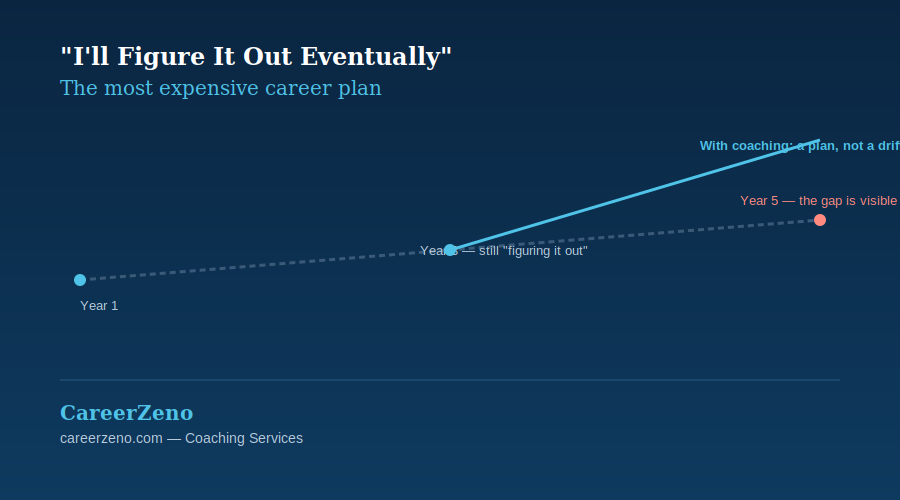
Most people don't plan their careers so much as react to them — taking the next reasonable-looking offer, staying in a comfortable role a year longer than intended, assuming clarity will arrive on its own eventually. It rarely does without help, which is a large part of why professional coaching services exist.
The Cost of Drifting
Reactive career decisions aren't necessarily bad ones, but they tend to compound. A role taken because it was available, rather than aligned with a longer-term goal, can quietly turn into three or four years of drift. The cost isn't visible in any single decision — it shows up later, as a gap between where someone expected to be and where they actually are. Each individual choice feels reasonable in isolation: staying a bit longer for stability, taking a lateral move because it seemed safer, deferring a hard conversation about growth until "things settle down." None of these decisions looks like a mistake in the moment. The pattern only becomes visible in hindsight, once several years of small deferrals have added up to something significant.
Why Reflection Alone Rarely Solves This
Thinking about career direction in isolation tends to produce more of the same patterns, since the same assumptions and blind spots that created the drift are still doing the thinking. Someone who has spent years avoiding a hard conversation about compensation, for instance, is unlikely to suddenly see that avoidance clearly just by thinking harder about their career on their own. The blind spot isn't a lack of intelligence or effort — it's structural, built into how difficult it is to evaluate a familiar situation from the inside.
An outside perspective interrupts that loop by asking questions the person wouldn't think to ask themselves: why this option and not the other one, what's actually being avoided, what would need to be true for this to feel like genuine progress rather than motion for its own sake.
What Coaching Actually Provides
Structured coaching typically covers several practical areas rather than a single conversation. It usually starts with clarifying what actually matters — separating real priorities like growth, flexibility, or compensation from options that simply sound appealing in isolation. From there, it extends into evaluating offers and opportunities with a more structured, less instinct-driven approach, mapping a realistic plan toward a longer-term goal, and preparing for the specific conversations — negotiations, transitions, difficult exits — that tend to get avoided the longest.
Accountability is often the piece that makes the difference between insight and actual change. A single conversation can produce clarity, but clarity without follow-through tends to fade within weeks. Regular check-ins keep a plan moving even after the initial motivation from a first coaching session has worn off.
Turning Intentions Into an Actual Plan
The difference between "I'll figure it out eventually" and a coached plan usually isn't information — most people already have a rough sense of what they want. The difference is structure: a defined next step, a timeline, and someone checking in on whether it actually happened. Without that structure, good intentions tend to lose out to whatever feels most urgent in a given week, which is rarely the long-term career question that matters most.
CareerZeno are built to replace "I'll figure it out eventually" with an actual plan, before another year passes by default rather than by choice.