
The translation of John 1:1c has long been a subject of debate among theologians and Bible translators. The central issue is whether the correct translation of the Greek text is "the Word was a god" or "the Word was God." The New World Translation (NWT) used by Jehovah's Witnesses chose the former, which has elicited significant criticism from Christian theologians. The arguments used by Jehovah's Witnesses to translate John 1:1c touch on various aspects, all of which can be examined and refuted from linguistic, theological, and contextual perspectives.
Greek Grammatical and Syntactical Analysis
According to the original Greek text, John 1:1c reads: "καὶ θεὸς ἦν ὁ λόγος" (kai theos ēn ho logos).
Greek Grammar and Syntax:
- Subject and Predicate: In Greek, "ὁ λόγος" (ho logos - the Word) is the subject and "ἦν" (ēn - was archaic: "vala") is the verb. The term "θεὸς" (theos - God) functions as a predicate nominative.
- The use of "ἦν" (ēn) verb ("was") is significant as it indicates continuous past existence. This means that the Word always existed and was not created.
- Article Usage: The definite article "ὁ" (ho) appears with the word "λόγος" (logos) but not with the word "θεὸς" (theos). This absence is crucial for understanding the nature and identity described. According to Greek grammar, specifically Colwell's rule, a definite predicate nominative that precedes the verb does not necessarily need to have an article to be considered definite.
- The word "θεὸς" (theos) without the article (anarthrous) may indicate a qualitative aspect, suggesting that the Word shares in the nature and essence of God.
- In John 1:1c, the qualitative nature of "θεὸς" (theos) indicates that the Word possesses God's nature. This interpretation aligns with the idea that the Word is fully divine, sharing all attributes of God without being personally identical with God the Father.
Impact of Translation: Translating "θεὸς" as "a god" instead of "God" significantly changes the theological implications. The traditional translation supports the divine nature of Christ, asserting that the Word (Logos) is fully God.
Colwell's Rule: This rule states that a definite predicate nominative preceding the verb usually does not have an article but should still be considered definite. In John 1:1, in the structure "καὶ θεὸς ἦν ὁ λόγος" (kai theos ēn ho logos), "θεὸς" (theos) precedes the verb ("ἦν" - ēn). According to Colwell's rule, "θεὸς" is definite, meaning "God," not "a god." Thus, in John 1:1, "θεὸς" is definite and should be translated as "God" rather than "a god."
Harner's Main Points:
- Qualitative Emphasis: According to Harner, the "theos" in John 1:1c bears a strong qualitative emphasis and cannot be considered definite. This qualitative nature means that "the Word" (Logos) possesses the attributes or nature of "theos" (God).
- Alternative Structures: Harner examined several possible Greek structures that John could have used if he intended to convey different meanings:
- "ho logos ēn ho theos": This would mean that the Logos and God are exactly equivalent, which contradicts John 1:1b ("the Word was with God") as it implies a personal distinction.
- "theos ēn ho logos"
- "ho logos ēn theos": This would mean "the Word was a god" or a divine being, which Harner notes was not chosen by John, indicating this was not the intended meaning.
- "ho logos ēn theios": This would mean "the Word was divine," suggesting a lesser degree of divinity, which was also not chosen.
Primary Qualitative Meaning: Harner concluded that the structure John used (B. "theos ēn ho logos") emphasizes that the Word possesses the same nature as God without being identical to God the Father. Thus, Harner's analysis indicates that John 1:1c claims that the Logos (Word) possesses the same nature as God without being a separate god, refuting the "a god" interpretation.
The complexity of the Greek language in relation to nouns and articles is significant. The lack of an article before a predicate nominative does not necessitate an indefinite meaning. In Greek, like in English, the absence of an article can imply an indefinite, definite, or qualitative meaning. For instance, "an apple" when indefinite, "the apple" when definite, and simply "apple" when qualitative.
All exegetes agree that in the sentence, the Logos is the subject, and God is the predicate. Thus, it asserts that the Logos is God, not that God is the Logos. The more challenging question is the meaning of the article-less "God" in this context.
In the Greek language, an article-less predicate nominative before the verb can indicate identification with a definite entity or a qualitative description. The traditional Trinitarian doctrine excludes the former (since Jesus is neither the Father nor the Trinity itself) and asserts the latter, stating that "the Word was divine." This position was held by many early church fathers against Arianism, asserting the full divinity of the Word rather than a vague divine (godlike) quality.
The word "theos" holds a unique definite meaning in the New Testament, grounded in the Jewish monotheistic concept of God, even considering the Philonic concept of logos. Therefore, when stating that an anarthrous predicate nominative in John 1:1 carries a qualitative significance, it implies that the Logos possesses all attributes of deity without being just a "divine (godlike) entity."
Ernest Cadman Colwell's 1933 study on the use of the Greek article, which has become a vital part of Greek grammar, concluded that predicate nouns functioning as definite before the verb typically lack an article. Thus, the absence of an article does not imply an indefinite or qualitative meaning, and the definite meaning is determined by context.
In Greek, article-less nouns often carry a qualitative meaning, referring to the nature of an entity. P.B. Harner's linguistic study, "Qualitative Anarthrous Predicate Nouns: Mark 15:39 and John 1:1," highlights that in this context, the term "theos" carries a qualitative sense, indicating the Word's divine nature, not that it was "a god." This interpretation aligns with the Christian tradition of viewing Jesus as fully divine but distinct from the Father.
Harner did not dispute the validity of Colwell's rule but emphasized that Colwell overlooked the qualitative nouns. Additionally, Harner noted that 80% of the nouns involved in Colwell's rule are qualitative rather than definite, with only 20% being definite.
Paul Stephen Dixon's study on article-less predicate nouns in John's Gospel reached similar conclusions. Harner and Dixon's respected studies reinforced the view that in John 1:1c, "θεὸς ἦν ὁ λόγος" is more likely qualitative rather than definite or indefinite.
In this case, "θεὸς" demonstrates the nature of the Logos, not its identity. As with the apple analogy, the qualitative meaning aligns with "This is apple." "The Word was God," not a god, nor the God, but God in nature. One could say, "The Word is ["made of"] of God."
Despite the absence of articles before nouns elsewhere in the Greek text, the New World Translation does not insert an indefinite article before terms like "beginning" (1:2), "life" (1:4), "from God" (1:16), or "John" (1:16).
Except for Jehovah's Witnesses, virtually all scholars agree that the noun "θεὸς" in "καὶ θεὸς ἦν ὁ λόγος" is either definite or qualitative, not indefinite. Which one is it?
The argument that the lack of an article necessitates the translation "a god" is unfounded when considering other New Testament passages where "theos" appears without an article but clearly refers to the one true God. For example, in John 1:18, "θεὸν οὐδεὶς ἑώρακεν πώποτε" (theon oudeis heōraken pōpote) the word "θεὸν" (theon) appears without an article, and most translations render it as "God," not "a god."
Several examples in Scripture show that "theos" without an article is translated as "God." For instance, in John 1:6, 12, 13, and 18, "theos" appears without an article and is consistently translated as "God." Translating "theos" as "a god" in John 1:1 but not in these verses demonstrates inconsistency and theological bias.
In passages like John 3:2 and 13:3, as well as Romans 1:21, "theos" appears both with and without an article in the same context. The NWT translates both instances as "God," indicating that the lack of an article does not necessarily imply an indefinite noun.
The selective translation of "theos" as "a god" in John 1:1c, but not in other verses, demonstrates theological bias instead of adherence to Greek grammatical rules. In other verses where "theos" appears without an article (such as Hebrews 1:8, Titus 2:13, and 2 Peter 1:1), it still refers to the one true God, not "a god." This further undermines the credibility of the NWT's translation of John 1:1.
By using a lowercase letter (and an indefinite article in English), they clearly aim to avoid the conclusion that Jesus Christ was Jehovah God himself. According to them, Christ was not God but merely "a god" in a pantheon of gods inferior to Jehovah. It is important to note that no other translation follows the NWT, and numerous instances have shown that Greek scholars have demonstrated the unprofessional and biased nature of the NWT translation.
Nomina sacra
When we examine a modern edition of the original Greek text of the New Testament, such as the Nestle-Aland edition, John 1:1 reads as follows:
Ἐν ἀρχῇ ἦν ὁ λόγος καὶ ὁ λόγος ἦν πρὸς τὸν θεόν καὶ θεὸς ἦν ὁ λόγος.
[En arkhē̃ ē̃n ho lógos kaì ho lógos ē̃n pròs tòn theón kaì theòs ē̃n ho lógos.]
However, this is merely a modern textual practice. In the ancient manuscripts, there was no distinction between lowercase and uppercase letters, nor were there punctuation marks (comma, period) or diacritical marks. They also did not use spaces but wrote the entire text continuously, known as scriptio continua. Therefore, theoretically, we should see the following in an ancient manuscript:
ΕΝΑΡΧΗΗΝΟΛΟΓΟΣΚΑΙΟΛΟΓΟΣΗΝΠΡΟΣΤΟΝΘΕΟΝΚΑΙΘΕΟΣΗΝΟΛΟΓΟΣ [ENARKhĒĒNOLOGOSKAIOLOGOSĒNPROSTONThEONKAIThEOSĒNOLOGOS]
Yet, we actually see this:
ΕΝΑΡΧΗΗΝΟΛΟΓΟΣΚΑΙΟΛΟΓΟΣΗΝΠΡΟΣΤΟΝΘΝΚΑΙΘΣΗΝΟΛΟΓΟΣ [ENARKhĒĒNOLOGOSKAIOLOGOSĒNPROSTONThNKAIThSĒNOLOGOS]
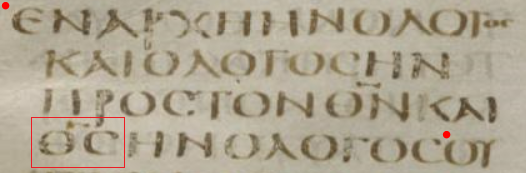
Codex Sinaiticus
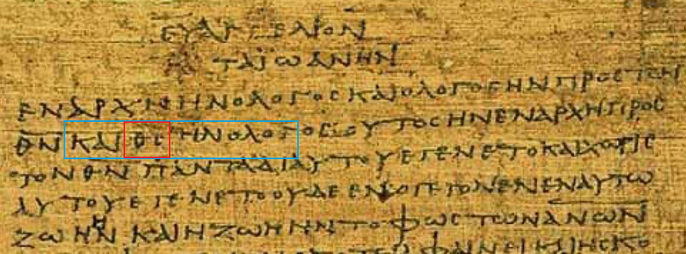
Papyrus 75
What do we observe here? The manuscript does not spell out ΘΕΟΣ (God) but only its first and last letters (ΘΣ) and marks the contraction with a line above the letters. This solution is known as nomina sacra (singular: nomen sacrum, Latin for "sacred name"). This term applies to words like God, Lord, Jesus, and Christ, which are written with only the first one or two and the last one or two letters recorded, omitting the letters in the middle. The scribes indicated these abbreviations by drawing a horizontal line above the word. For instance, Θεός (THEOS - God) referring to the true God is abbreviated as ΘΣ, or in the dative case as ΘΥ, and Κύριος (KYRIOS - Lord) as ΚΣ, or in the dative case as ΚΥ.
It is evident that the use of nomina sacra was an act of reverence, not merely a practical space-saving measure. They were used even when the well-established abbreviations for more frequent words like "and" (kai) were avoided, and the nomen sacrum itself was written with ample spacing. Furthermore, early scribes often distinguished between ordinary and sacred occurrences of the same word, such as 'a spirit' and the Holy Spirit, applying nomina sacra only to the latter, thus revealing an exegetical choice.
Nomina sacra are consistently observed even in the earliest surviving Christian writings, which were written in codex form, indicating that the practice already existed in the apostolic era.
The theology of the Watchtower Society acknowledges that Jesus is a "lowercase god" (a lesser god?). However, as we have seen, in the apostolic era, Greek writing did not differentiate between uppercase and lowercase letters (this only developed in the 7th-8th centuries) and was written entirely in uppercase. Thus, the Son is indicated with the same initial "GOD" in the New Testament as the Father. Therefore, if they had wanted to differentiate between a lowercase "god" and an uppercase "God" in terms of the degree of divinity, they could only have indicated it by using or omitting nomina sacra. They did indicate it, but in the case of false gods!
The Papyrus 46 manuscript provides a very interesting example in the text of 1 Corinthians 8:4-6, where the word "God" referring to the Father and the word "Lord" referring to Christ are always treated as nomina sacra, but for false "gods" and "lords" the words are written out in full:
"As for the eating of food offered to idols, we know that 'no idol in the world really exists,' and that 'there is no God [ΘΣ] but one.' Indeed, even though there may be so-called gods [ΘΕOI] in heaven or on earth—as in fact there are many gods [ΘΕOI] and many lords [KYPIOI]—yet for us there is one God [ΘΣ], the Father, from whom are all things and for whom we exist, and one Lord, Jesus Christ [KΣ IHΣ XPΣ], through whom are all things and through whom we exist."
If the theology of Jehovah's Witnesses were correct, and the Son's divinity was ontologically inferior (a lesser deity) to that of the Father, then the term "God" (ΘΕΟΣ) in John 1:1b ("...the Word was with God...") should only appear as a nomen sacrum when referring to the Father. However, when it clearly refers to the Son in John 1:1c ("...and the Word was God..."), it should have been written out fully rather than appearing as it does in all manuscripts: ΚΑΙ ΘΣ ΗΝ Ο ΛΟΓΟΣ.
Thus, the term "THEOS" (= God) and "KYRIOS" (= Lord) when applied to the Son always appear as nomina sacra in ancient manuscripts, just as they do for the Father. Therefore, when a contemporary reader read the terms "Lord" or "God" in relation to the Son, the text explicitly indicated that these titles carried exactly the same content and meaning for the Son as they did for the Father.
The terms marked by nomina sacra should thus be translated with capital letters in modern Scripture translations.
The Testimony of Early Christian Tradition
The church fathers interpreted and applied John 1:1, especially the part "and the Word was God," in various ways. The following summary presents the views of some church fathers on this matter:
Theophilus: Theophilus emphasized that the Word, who is God, existed with God from the beginning. The Word was God's counselor, and during creation, God made everything with the Word. By nature, the Word originates from God and can appear whenever the Father wills.
Clement of Alexandria: Clement emphasized that the Word is not merely a human being but God Himself, who created all things. He existed from the beginning and made the whole world. For Clement, the Word embodies divine wisdom.
Tertullian: Tertullian used John 1:1 to prove that the Word (Logos) is God and that the entire creation came into being through the Word. The Word originates from the Father's mind and thought and participated in the creation of all things.
Origen: Origen emphasized that the Word (Logos) is eternal and existed with God from the beginning. Everything that exists, whether visible or invisible, was created through the Word. For Origen, the Word possesses divine power and wisdom.
Augustine of Hippo: According to Augustine, the Word is God and equal with the Father. He explained that the Word is not a created being but has existed eternally and created all things. The incarnation of the Word occurred in Jesus Christ, who is both man and God.
Eusebius: Eusebius emphasized the eternity and divine nature of the Word, which existed with God from the beginning. The Word is the Son of God and participated in all creation as the second divine person.
Thus, the church fathers unanimously claimed that the Word is not merely a creature but God Himself, who existed eternally with the Father and participated in all creation. The incarnation of the Word was realized in Jesus Christ, who is both man and God, and through whom all things were created.
The Interpretation of the Sahidic Coptic Translation
ΑΥШ ΝЄΥΝΟΥΤЄ ΠЄ ΠϢΑϪЄ
[auō neounoute pe pšaʤe]
The Sahidic Coptic translation, dating to the 3rd century, is particularly interesting as it has both definite and indefinite articles. In John 1:1, the Sahidic Coptic text uses the term "ⲩⲛⲟⲩⲧⲉ" (noute "god"), which indeed contains an indefinite article, while in John 1:18, it uses the definite article for the Son, "ⲡⲛⲟⲩⲧⲉ" (pnoute "the God").
Linguistically, indefinite articles often evolve from the numeral ("one") (for example, the English "an" and "one" share the same etymological origin), and in this text, the inflection seemingly carries an intermediate meaning between "one" and the indefinite article. We must be cautious in understanding Coptic lexical semantics as glosses can be misleading. The usage of the indefinite article can differ from its usage in modern languages.
Jehovah's Witnesses often refer to this translation, which they claim renders the text as "and the Word was a god." The Sahidic Coptic translation, with its definite and indefinite articles, is closer in this respect to modern languages (such as English) than to Greek. The Watchtower Society claims that the Sahidic Coptic translation supports their interpretation. Firstly, even if this were true, the Coptic translation is evidently interpretive here because the phrase "was divine" (in the sense of being only "godlike") in Greek would not be "theos ēn" but "theios ēn."
Moreover, the theological background of this translation is not clarified, as Coptic Christians were never Arians, unlike the Visigoths or Vandals. If Jehovah's Witnesses were correct, Coptic Christians should have formed the main base of the Arian movement, but nothing in the 4th-century Arian debates indicates that anyone, including the Alexandrians, referred to this translation.
Coptic translators regularly used the definite article when referring to the biblical "God," but also used the indefinite article when the context required it. The term "ⲩⲛⲟⲩⲧⲉ" (ou.noute "a god") appears in Acts 28:6 and 2 Thessalonians 2:4. Conversely, it appears in Ephesians 4:6, specifically referring to the Father as "one God (i.e., the one God) who is Father of all." Why call the Father "a god" (ou.noute) in this text to express the 'heis theos' ("one God") concept? This cautions us against interpreting the indefinite article usage in the Coptic language. The use of the indefinite article in Ephesians 4:6 weakens the claim that its use in John 1:1c necessarily means the Word is an inferior god compared to the "one God."
Based on the analysis of verb tenses and sentence structures, the interpretation of the Coptic text suggests that the word "god" was used in a qualitative sense, meaning "divine nature" or "divine essence." Thus, the usage of indefinite articles in Coptic translations was complex and often determined by context.
Experts in Coptic language, such as Bentley Layton and Ariel Shisha-Halevy, point out that the Coptic indefinite article is not the same as the English indefinite article. According to Layton, the Coptic structure can also be translated in a qualitative sense, for example, "the Word was divine" or "was of divine nature." Shisha-Halevy shares a similar view, noting that in Coptic, such structures typically refer to the nature of the subject rather than an indefinite entity. Wallace notes that in Sahidic Coptic, the indefinite article can be used to denote class membership or characteristic traits, similar to what is called "qualitative usage" in Greek grammar.
In the Sahidic Coptic language, the indefinite article is often used with abstract nouns and material nouns, which is uncommon in modern languages. Analyses show that Sahidic Coptic translators often used articles in places where the Greek text did not. This suggests that the Sahidic Coptic translation followed its grammatical rules and did not necessarily reflect the exact meaning of the Greek text. Examples of qualitative meaning in Coptic:
John 1:33: "He who baptizes with [a] Holy Spirit and [a] fire" (Horner's translation). John 3:6: "What is born of the flesh is flesh and what is born of the Spirit is [a] spirit."
In John 1:18b, the Greek anarthrous "theos" is translated with a definite article into Coptic: "God the only Son" (Horner's translation). This consistency suggests that the Coptic translator likely attributed divine qualities to the Word in John 1:1, rather than treating it as an indefinite noun ("a god"). Thus, the translator emphasized the quality of divinity here, not referring to a separate (lesser) god. This contradicts the idea that "a god" would be the correct translation in John 1:1.
In the October 2011 issue of the Journal of Theological Studies, Brian J. Wright and Tim Ricchuiti concluded that the indefinite article in the Coptic translation of John 1:1 carries a qualitative meaning. They identified several such instances in the Coptic New Testament for qualitative nouns, including 1 John 1:5 and 1 John 4:8. Additionally, the indefinite article is used to refer to God in Numbers 4:31 and Malachi 2:10.
The article notes that the Sahidic Coptic translators did not consistently translate the Greek anarthrous "theos." While they mostly used the definite article, in some cases "theos" appears with an indefinite article, such as in John 1:1, 1 Corinthians 8:6, Ephesians 4:6, and 2 Thessalonians 2:4. Finally, they apply their findings to John 1:1c, where they interpret "theos" qualitatively in the translation "and the Word was God." According to their approach, the Sahidic Coptic translators aimed to highlight the divine qualities of the Word rather than presenting it as a pagan or usurping god. In summary, the study suggests that the use of the indefinite article in the Sahidic Coptic New Testament for translating the Greek anarthrous "theos" primarily served a qualitative descriptive distinction, emphasizing the divine attributes of the Word in John 1:1c.
Moreover, scholars like Jason BeDuhn and J. Warren Wells agree that the Sahidic Coptic translation does not unambiguously support the "a god" interpretation. Even BeDuhn, who often defends the New World Translation, has pointed out that it can be understood qualitatively, meaning that the Word was of divine nature, not a separate lesser god, as the theology of the Watchtower Society claims about the Son.
In summary: The solution in the Sahidic Coptic translation does not support either the New World Translation's solution or the Watchtower Society's Christology.
The Characteristics of the Greek Language and the Theological Context
The correctness of translating the Greek text is not only a grammatical but also a theological question. In the Greek language, the use of nouns without an article is often qualitative, meaning that it refers to the true divine nature of the Word, not that the Word is a lower-ranking god. This approach aligns with the basic principles of Christian theology, which hold that the Father, the Son, and the Holy Spirit all share in the divine nature. According to John 1:1b, "the Word was with God" (pros ton theon), which clearly distinguishes between the person of the Word and the Father but does not suggest that the Word is of lower status.
Other Scholarly Opinions and Criticisms
The NWT translation is problematic not only based on Greek grammatical analyses but also on theological interpretations and historical context. The NWT translators claim that the translation "a god" more accurately reflects the original Greek text, but this approach ignores the peculiarities of the Greek language and the basic principles of Christian theology. Several renowned theologians and biblical scholars, such as Murray J. Harris and Robert Harvey Strachen, assert that the correct translation of John 1:1c is "and the Word was God." This interpretation is not only grammatically but also theologically more accurate, as it emphasizes the divine nature of Jesus.
Leading Greek scholars like Dr. William Barclay, Dr. F. F. Bruce, and Dr. Julius Mantey unanimously criticize the translation "a god" in John 1:1 as grammatically and contextually incorrect. Their expertise and consistent scholarly work provide a strong counter-argument against the anti-Trinitarian translation. Jehovah’s Witnesses have misleadingly cited and misinterpreted the views of Greek scholars to support their translation, further weakening the credibility of the NWT translation.
Phillip B. Harner's study on qualitative anarthrous predicate nouns concludes that "θεὸς" (theos) in John 1:1c means that the Word shares in the essence and nature of God. Phillip B. Harner’s study on anarthrous predicate nouns, particularly in John 1:1, is frequently cited by Jehovah’s Witnesses to support their translation. However, Harner’s conclusions do not actually support the "a god" translation used in the New World Translation (NWT). Instead, Harner emphasizes the qualitative aspect of the predicate noun "theos" in John 1:1c.
Both Harner and Harris, who are key scholars in the debates about John 1:1, actually support the traditional interpretation that "the Word was God," reflecting the qualitative nature of the Word as a being with God’s nature. Their analyses do not support the "a god" translation, which would introduce theological polytheism contrary to John’s monotheistic framework. The broader scholarly consensus also confirms this interpretation, consistent with the traditional view that the Logos is fully divine and shares the same nature as God the Father.
Paul Dixon, through statistical analysis, concluded that anarthrous predicate nouns are predominantly qualitative, further supporting the interpretation that the Word is fully divine.
William Barclay accused the Watchtower of selectively quoting and misinterpreting his views, stating, "The Watchtower article, by careful cutting, made me say the opposite of what I meant to say." He clarified that Jesus is of the same essence as God but distinct from God the Father.
Hans-Jürgen Becker’s translation "ein Gott" reflects the interpretation of the anarthrous "theos" in the Greek text. However, Becker’s commentary indicates that he does not regard the Logos as a separate or inferior god. He sees the Logos as closely connected to God, participating in creation, and divine in nature. Becker emphasizes that the Logos deserves to be called "God" due to its divine nature and eternal preexistence, much more in line with traditional Christian views of the Trinity.
The Watchtower frequently quotes scholars such as E.C. Colwell, Frederick Danker, and C. H. Dodd selectively or out of context to support the New World Translation (NWT). When read in full, these scholars generally do not support the NWT translations, especially the theological conclusions drawn by Jehovah’s Witnesses. Instead, these scholars highlight grammatical possibilities without endorsing the doctrinal interpretations imposed by the NWT. It is important to consider the full context and intent of scholarly quotes to accurately understand their positions on translation issues.
The scholars selectively used and sometimes misinterpreted by the Watchtower to support the NWT translation of John 1:1c often do not reflect the broader views of scholars. Most cited scholars either reject the notion of Jesus being a lower-ranking deity or interpret the text to affirm the traditional Trinitarian doctrine.
Additional Theological Considerations
The theological arguments are also important in interpreting John 1:1c. According to Christian theology, the Father, the Son, and the Holy Spirit all share in the divine nature, so the translation "the Word was God" better expresses the full divine nature of Jesus. Early Christian creeds, such as the Nicene Creed, also emphasize the divine nature of Jesus and his equality with the Father. The concept of "deity" does not signify a family name but the unique attributes shared by the Father, Son, and Holy Spirit, such as omnipotence, omniscience, eternity, and omnipresence.
In these verses, John presents the eternal divine existence and activity of the Word (Logos). The Word is uncreated, existing eternally, and was already present at the beginning of time. This contrasts with heretical views (such as those of the Arians) that the Word was a created being.
The term "Logos," as found in John’s Gospel, can be translated in various ways: "Word," "Reason," or "Wisdom." By "Logos," John the Apostle means the only begotten Son of God, who is in the bosom of the Father (John 1:18) and who is eternal life with the Father (1 John 1:1-3). In the Book of Revelation, the "Logos" appears as the Word of God (Revelation 19:13), who comes to judge the ungodly
.
The term "Logos" in Greek means "thought," "concept," "word," and "speech." John interprets the Logos as the second person of the Trinity, the Son of God, and Christ. In the Old Testament and other ancient texts, the Word is often identified with God’s wisdom or personified word.
In the Old Testament, the term "Logos" is synonymous with "wisdom" (Proverbs 8:12, 22; Wisdom 7:21; Sirach 24) and also known as the Son of God (Proverbs 30:4). The reference to the Messiah as the Word and Son of God is also found in Jewish literature, such as the Targum translations.
The phrase "In the beginning" aligns with the explanation in Proverbs 8:23, referring to the eternity of wisdom. This phrase echoes Genesis 1:1, indicating that the Logos existed before the creation of the world. The term "beginning" here refers to the time before any creation, emphasizing the preexistence of the Word (Logos). John uses the term "beginning" to highlight the eternal and uncreated nature of the Word. The Word existed before the creation of the world and was not brought into being in time. John, therefore, emphasizes that the Logos (Word) is eternal and possesses God’s nature.
John does not say that the "Logos" was "in God," but "with God," expressing the personality of the Logos and distinguishing him from the Father. The preposition "πρὸς" (pros) suggests an intimate and personal relationship. This means that the Word was in close, face-to-face communion with God the Father, indicating distinction yet intimate relationship. John emphasizes that the Word was "with God," expressing the closest relationship between the Word and the Father while maintaining the distinction between the two persons. "God" here refers to the person of the Father, not merely His divine essence.
Although the Holy Spirit is not explicitly mentioned in John 1:1, He is implicitly included in the relationship between the Father and the Son, as later mentioned in John 16:13.
In the prologue of John’s Gospel, Jesus Christ is spoken of as the Word (Logos). It states that the Logos, in the beginning - when everything came into being (ἐγένετο) through the divine act of creation - already was (ἦν). Not just anywhere, but with God (πρὸς τὸν θεόν). Then, unexpectedly, it adds: "and the Word was God" (καὶ θεὸς ἦν ὁ λόγος).
In the statement ("the Word was God"), "God" is the predicate, indicated by the absence of the article in Greek. The subject is "the Word," so the sentence means: "The Word, which was with God from eternity, is divine in nature and being." This interpretation is consistent with other parts of the New Testament (Romans 9:5; Hebrews 1:2-13), where the eternal existence, personality, and divine nature of the Word are emphasized.
The 4th-century Arians incorrectly placed a period after "God was."
"Clearly, in the translation 'the Word was God,' the term 'God' refers to the nature or essence rather than the person. However, in common English usage, 'God' is used as a proper name, referring to the person of the Father or the entire Deity comprising three persons. Furthermore, 'the Word was God' implies that 'the Word' and 'God' are interchangeable terms, as if the statement were mutually true. However, the Word is not the Father nor the Trinity... The translation cannot stand without explanation." (Murray Harris – Jesus as God, p. 69)
The structure thus indicates "theos" in a qualitative sense. The Word is not God in the same sense as the "theos" mentioned in John 1:1b; he is not the Father (God in the absolute sense) or the Trinity. The point is that the Logos possesses the same uncreated nature (φύσις physis, natura) or essence (οὐσία ousia, substantia) as God the Father, with whom he exists eternally. This verse echoes in the Nicene Creed:
"God [qualitatively or derivatively] from God [personally, thus: the Father] Light from Light, true God from true God... of one substance with the Father [homoousios]."
Thus, this second "theos" must be understood qualitatively rather than personally. It is possible to read the verse as "the Word [was what] God [was]," which indeed is a very precise translation of the Greek grammar and intent.
Conclusions and Theological Interpretation
The Eternity of the Word: John 1:1 expresses that the Word (Logos) has existed from eternity, even before creation. The Personality of the Word: The Word is a personal being, not just an abstract concept or attribute. The Divine Nature of the Word: The Word shares fully in God’s divine nature and existence.
This traditional Christian interpretation reinforces the doctrine of the Trinity, in which the Father, the Son (Logos), and the Holy Spirit are all God yet distinct persons. In the statement "the Word was God," "God" is the predicate while "the Word" is the subject. John thus expresses that the Word is divine in nature but a distinct person from the Father.
The eternity, personality, and divine nature of the Word are consistent with the Christian doctrine of the Trinity, which holds that the Father, the Son (Word), and the Holy Spirit are all God but distinct persons.
Therefore, when Jehovah’s Witnesses translate John 1:1c in the New World Translation (NWT) as "and the Word was a god," this translation suggests that Jesus is a separate, lower-ranking god different from the one true God, Yahweh. This view is problematic because it introduces the concept of multiple gods, which contradicts biblical monotheism.
The Bible repeatedly declares that there are no other "gods" besides Yahweh: Deuteronomy 32:39, Deuteronomy 32:21, Isaiah 43:10. The Jehovah’s Witnesses’ interpretation leads to theological inconsistencies: There are no gods besides Yahweh (Deuteronomy 32:39). Jesus is identified as God (John 1:1). Therefore, Jesus must be Yahweh God.
The biblical context and theological analysis indicate that Jesus cannot be "a god" alongside the true God. The "a god" translation used in John 1:1c by the NWT contradicts the clear monotheistic teachings of the Scriptures. Therefore, the traditional translation "the Word was God" accurately reflects the biblical doctrine of Jesus' divinity and the unity of the Godhead.
Summary
There is not such a sharp distinction between "theos" and "ho theos" as the self-taught Greek linguists of the Watchtower imagine. The New Testament frequently refers to the Father or God in general as "theos" without the "ho" article, for instance, in Mark 12:27 (God is not the God of the dead), Romans 8:33 (It is God who justifies), 2 Corinthians 5:19 (God was reconciling the world to himself in Christ), Galatians 6:7 (God cannot be mocked), Philippians 2:13 (It is God who works, etc.), 1 Thessalonians 2:5 (God is a witness). Therefore, it is completely unnecessary to doubt Jesus' deityon the alleged basis that Scripture never calls him "ho theos" (which is not even true; see John 20:28), because just as the Father is called both "ho theos" and simply "theos," so is he.
The translation of John 1:1 as "the Word was a god" is not supported by Greek grammar, context, or scholarly consensus. The translation "a god" used by the New World Translation (NWT) suggests a lower-ranking, created being, which is neither supported by Greek grammar nor the context of John’s prologue. Greek grammatical rules and context suggest a qualitative interpretation, not an indefinite article interpretation. The consistent application of grammatical rules, contextual analysis, and the opinions of recognized scholars confirm the traditional translation "the Word was God."
Leading biblical scholars like William Barclay, F. F. Bruce, and Julius Mantey unanimously criticize the translation "a god" as grammatically and theologically incorrect. Studies by Phillip B. Harner and Paul Dixon also support that "theos" in John 1:1c is qualitative, indicating the true divine nature of the Word and not a lower-ranking god.
The Word, or Jesus Christ, is not a created being but an eternally existing divine person in the most intimate relationship with the Father. This is a fundamental teaching of the Christian faith, consistent with other parts of the New Testament. This supports the doctrine of the Trinity and the full divinity of Christ, countering the anti-Trinitarian interpretation.
An analysis of various translations and scholarly commentaries of John 1:1, including the Coptic version, reveals a consensus emphasizing the qualitative nature of "theos" in John 1:1c. This qualitative interpretation indicates that the Word (Logos) shares in God’s divine nature, consistent with monotheistic theology. Misunderstandings and selective quotations have led to misrepresentations, but the scholarly and contextual evidence supports the traditional translation: "the Word was God," emphasizing the divine nature of the Word without suggesting polytheism.
The New World Translation solution is problematic in several respects. Greek grammatical and syntactical analysis, detailed examination of the Coptic translation, and scholarly and theological arguments all support that the traditional translation "and the Word was God" more accurately reflects the original text’s meaning and early Christian belief. The "a god" translation ignores the peculiarities of the Greek language and the principles of Christian theology, offering an interpretation inconsistent with Christian creeds and the rest of the Bible.