
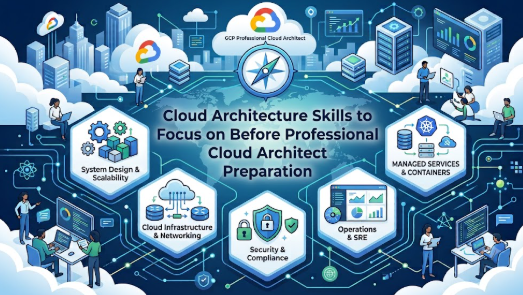
Cloud computing has evolved from a simple infrastructure alternative to the primary engine driving global digital transformation. Today, enterprise technology strategies rely on distributed architectures, containerized microservices, serverless frameworks, and intelligent data pipelines. Modern organizations need technical leaders who can bridge the gap between high-level business goals and complex cloud infrastructure.
The Google Cloud Professional Cloud Architect role addresses this demand. Rather than focusing solely on individual service configurations, a cloud architect designs resilient, secure, scalable, and cost-optimized environments across hybrid and multi-cloud ecosystems. Developing these capabilities requires a clear understanding of modern computing paradigms, networking fundamentals, security governance, and software engineering principles.
This educational guide explores the core skills, architectural principles, key technologies, practical use cases, and structured learning paths necessary to master enterprise solutions design on Google Cloud.
What Is Google Cloud Professional Cloud Architect?
The Google Cloud Professional Cloud Architect role represents an advanced technical domain centered on designing, developing, and managing enterprise cloud solutions. Cloud architects assess complex organizational requirements and translate them into secure, scalable, and reliable cloud infrastructures.
Unlike entry-level cloud credentials that focus primarily on foundational cloud literacy, professional architecture design requires deep technical expertise combined with strategic decision-making capabilities.
Organizations recognize this technical domain because it validates an architect's ability to leverage Google Cloud technologies to solve real-world business challenges, optimize operational workflows, and maintain enterprise governance.
Why Is This Architectural Domain Important?
As enterprises migrate legacy workloads to cloud-native platforms, IT operations require higher levels of reliability, dynamic scaling, and strict security compliance.
Key Factors Driving Architectural Importance:
-
Rising Adoption of Hybrid and Multi-Cloud Architectures: Organizations increasingly operate across multiple cloud providers and on-premises datacenters. Architects must design interconnected systems that allow data and workloads to move smoothly across diverse environments.
-
Shift to Microservices and Serverless Architectures: Modern application development relies heavily on containerization and event-driven computing. Architectural mastery ensures microservices communicate securely and scale efficiently.
-
Enterprise Security and Compliance Demands: Data breaches and regulatory requirements mandate zero-trust security frameworks, granular access management, and automated auditing.
-
Operational Efficiency and Cost Optimization: Unchecked cloud infrastructure can lead to unnecessary operational costs. Professional architecture emphasizes dynamic resource allocation, automated scaling, and cost-conscious infrastructure choices.
Key Features of Cloud Architecture Expertise
Mastering professional cloud architecture requires technical depth across multiple computing paradigms. Key technical features of this learning discipline include:
-
End-to-End Infrastructure Planning: Designing compute, network, and storage foundations tailored to specific enterprise workloads.
-
Security & Governance Integration: Building robust identity structures, resource hierarchies, encryption policies, and compliance guardrails.
-
Resilience & High Availability Design: Structuring systems to withstand infrastructure failures through multi-region deployments, failover mechanisms, and disaster recovery strategies.
-
Automation & Infrastructure as Code (IaC): Utilizing declarative templates to provision, manage, and scale cloud resources programmatically.
-
Continuous Monitoring & Observability: Implementing real-time telemetry, centralized logging, and alerting systems to maintain operational health.
Core Skills Developed in Professional Cloud Architecture
Developing architecture-level proficiency equips IT professionals with diverse technical competencies:
1. System Design and Scalability
Architects learn to design stateless and stateful applications capable of dynamic auto-scaling. They evaluate trade-offs between horizontal and vertical scaling, compute types, and queue-based decoupling mechanisms.
2. Cloud Security and Compliance
Learners master Identity and Access Management (IAM), role-based access control (RBAC), organization policy constraints, and customer-managed encryption key (CMEK) integration.
3. Advanced Network Design
Architects learn to design custom Virtual Private Cloud (VPC) networks, configure VPC Peering, manage shared VPC architectures, and secure ingress and egress traffic using firewalls and Cloud Armor.
4. Database & Storage Strategy Selection
Determining the right database engine—whether transactional (SQL), NoSQL, key-value, or analytical—is critical for performance and cost management.
5. Automation and DevOps Integration
Architects master infrastructure provisioning automation using declarative configuration tools, supporting rapid deployment cycles within continuous integration and continuous deployment (CI/CD) pipelines.
Key Technologies and Platforms Covered
A cloud architect must navigate a wide spectrum of platforms, services, and core concepts:
Compute Services
-
Compute Engine: Custom virtual machines for IaaS-based workloads.
-
Google Kubernetes Engine (GKE): Enterprise container orchestration platform for managing microservices.
-
Cloud Run: Fully managed serverless container runtime built on Knative standards.
Storage and Managed Databases
-
Cloud Storage: Unified object storage for unstructured data with varying access tiers.
-
Cloud SQL & Cloud Spanner: Managed relational databases designed for standard applications and globally distributed, strongly consistent transactions, respectively.
-
Bigtable & Firestore: NoSQL database solutions optimized for analytical workloads and real-time mobile/web sync.
Networking and Content Delivery
-
Virtual Private Cloud (VPC): Global software-defined networks providing secure isolated subnets.
-
Cloud Load Balancing: High-performance, global load distribution across compute targets.
-
Cloud Interconnect & VPN: Dedicated or IPsec-based hybrid connectivity solutions.
Who Should Consider This Architecture Path?
This learning path is designed for technology professionals aiming to lead technical strategy and infrastructure design:
-
Cloud Engineers & Systems Administrators: Professionals wanting to transition from hands-on provisioning to high-level solution architecture.
-
DevOps Professionals & Site Reliability Engineers (SREs): Engineers seeking to deepen their knowledge of scalable system design, automated governance, and infrastructure management.
-
Software Developers & System Architects: Engineers looking to build cloud-native applications and modernize legacy monoliths.
-
Data Engineers & Security Specialists: Technical leads aiming to integrate security controls and data processing pipelines into broader cloud infrastructure.
-
IT Managers & Technology Consultants: Leaders requiring technical clarity to evaluate architectural trade-offs, manage cloud budgets, and drive enterprise modernization.
Step-by-Step Learning Guide
To build genuine architectural expertise, learners should follow a structured, practical study plan:
Step 1 – Learn the Fundamentals
Establish a solid grasp of core cloud concepts: compute, networking, virtualization, and cloud storage paradigms. Understand basic resource hierarchy structures (Organizations, Folders, Projects, and Resources).
Step 2 – Master Core Infrastructure
Practice configuring custom Virtual Private Cloud (VPC) networks, subnets, firewall rules, and internal/external load balancers. Learn how traffic flows between regions and how to set up hybrid VPNs.
Step 3 – Understand Application Containerization
Explore container management using Google Kubernetes Engine (GKE) and Cloud Run. Learn how microservices communicate, deploy autoscaling policies, and manage application configurations.
Step 4 – Focus on Security and Access Management
Learn how Cloud IAM roles, service accounts, and policy inheritance operate. Understand zero-trust network principles, secret management, and encryption standards for data at rest and in transit.
Step 5 – Practice Infrastructure Automation
Gain practical experience using Infrastructure as Code (IaC) tools like Terraform. Practice provisioning repeatable cloud environments programmatically rather than relying on manual console actions.
Step 6 – Design for Observability and SRE
Study Site Reliability Engineering (SRE) principles. Learn to establish Service Level Indicators (SLIs), Service Level Objectives (SLOs), and Service Level Agreements (SLAs). Configure central logging and alerting dashboards.
Step 7 – Analyze Real-World Architecture Patterns
Review enterprise case studies to analyze requirements, identify technical challenges, and choose optimal compute, storage, and networking architectures.
Core Concepts Explained Simply
Understanding key architectural concepts in plain language helps anchor complex theories:
Shared Responsibility Model
In cloud computing, security responsibility is divided between the cloud provider and the customer. The provider secures physical facilities, hardware, and underlying core platforms. The customer is responsible for securing identity access, application code, data encryption, and network configuration.
Shared VPC (Virtual Private Cloud)
A Shared VPC lets an organization connect resources from multiple projects to a common Virtual Private Cloud network. This enables network administrators to maintain centralized network security control while allowing individual project teams administrative isolation.
Decoupled Architectures with Pub/Sub
In traditional systems, when Service A calls Service B directly, a failure in Service B causes Service A to fail. Event-driven messaging introduces an intermediate message broker (Pub/Sub). Service A publishes events to a topic, and Service B processes them independently. This pattern prevents system-wide cascading failures.
Real-World Use Cases
Cloud architects apply these concepts across diverse business scenarios:
1. E-Commerce Multi-Region High Availability
-
Challenge: High traffic spikes cause regional server overload during major sale events, risking downtime.
-
Architecture Solution: Deploy applications across multiple regions using Managed Instance Groups (MIGs) backed by a Global HTTP(S) Load Balancer. Use Cloud Spanner for globally consistent inventory tracking and transaction consistency.
2. Modernizing Legacy Monoliths with Microservices
-
Challenge: Legacy monolithic applications are difficult to scale, update, and maintain.
-
Architecture Solution: Containerize application modules into microservices running on Google Kubernetes Engine (GKE) or Cloud Run. Connect services securely using an internal API gateway and manage continuous deployment via automated pipelines.
3. Enterprise Hybrid Cloud Data Migration
-
Challenge: Securely processing sensitive corporate data stored in on-premises datacenters while moving analytics to the cloud.
-
Architecture Solution: Establish a private connection using Dedicated Interconnect. Stream operational data using Pub/Sub and Dataflow into BigQuery for near-real-time analytics, maintaining strict governance through customer-managed encryption keys (CMEK).
Career Opportunities and Roles
Developing expertise in cloud architecture opens pathways to diverse technical leadership positions:
Cloud Solutions Architect
-
Responsibilities: Designs scalable cloud foundations, evaluates technical feasibility, creates reference architectures, and collaborates with engineering teams to deploy multi-tiered enterprise systems.
Enterprise Systems Architect
-
Responsibilities: Oversees technology landscapes across hybrid environments, ensures security compliance, defines technical governance frameworks, and optimizes multi-cloud platform infrastructure.
DevOps Technical Lead / SRE Manager
-
Responsibilities: Implements Infrastructure as Code (IaC) standards, builds automated continuous deployment pipelines, establishes monitoring systems, and maintains high application availability.
Cloud Security Architect
-
Responsibilities: Establishes identity governance policies, designs zero-trust network boundaries, manages key management infrastructure, and enforces regulatory compliance frameworks across cloud environments.
Benefits of Developing Cloud Architectural Expertise
Building system architecture capabilities offers significant long-term professional value:
-
Validated System Design Capability: Demonstrates the ability to translate complex business problems into reliable, scalable cloud solutions.
-
Deeper Understanding of Modern Infrastructure: Moves beyond single compute instances to embrace serverless computing, microservices, and global network design.
-
Enhanced Problem-Solving Skills: Teaches structured methodologies to evaluate design trade-offs, solve system bottlenecks, and plan for high availability.
-
Cross-Domain Expertise: Bridges gaps across computing platforms, network management, data engineering, and enterprise security frameworks.
-
Strategic Career Mobility: Prepares technology professionals to step into high-impact advisory and technical leadership roles.
Common Challenges and Practical Solutions
Learners facing advanced architecture concepts often encounter complex technical hurdles:
-
Solution: Create a clear decision framework based on data characteristics. If data requires strong global consistency across geographic regions, choose Cloud Spanner. For structured relational data within a single region, select Cloud SQL. For unstructured object data, use Cloud Storage.
Challenge 2: Managing Complex IAM Roles
-
Solution: Avoid assigning roles directly to individual user accounts. Instead, define group identities based on job responsibilities, assign pre-defined roles to those groups, and leverage organizational policies to enforce enterprise guardrails.
Challenge 3: Balancing Cost and High Availability
-
Solution: Avoid over-provisioning multi-region resources unnecessarily. Reserve multi-region deployments for critical production workloads, while utilizing single-region, multi-zone architectures for development and testing environments.
Common Mistakes to Avoid
When building enterprise architecture knowledge, avoid these operational pitfalls:
-
Skipping Fundamental Networking Knowledge: Attempting to design complex cloud solutions without understanding basic subnets, firewall logic, CIDR ranges, and routing protocols.
-
Relying Solely on Graphical User Interfaces: Provisioning production infrastructure manually via the console instead of practicing Infrastructure as Code (IaC) principles.
-
Ignoring Observability: Designing systems without centralized logging, key metric tracking, or early alerting mechanisms.
-
Neglecting Security Guardrails: Treating security as an afterthought rather than integrating access management and encryption early in the design process.
-
Memorizing Solutions Without Understanding Constraints: Learning architectural patterns without evaluating business requirements, budget limits, or recovery objectives.
Comparative Analysis: Architectural Learning Approaches
| Feature / Dimension | Hands-on Project-Based Learning | Theory-Focused Reading | Practice-Based Case Study Analysis |
| Primary Focus | Infrastructure creation & tool mastery | Core definitions & documentation review | Real-world problem solving & system design |
| Practical Capability | High (builds real implementation skills) | Low (lacks real execution practice) | High (develops strategic design thinking) |
| Tool Familiarity | Direct experience with CLI & IaC tools | Conceptual knowledge of tools only | Deep understanding of tool trade-offs |
| System Troubleshooting | Excellent (learns via live debugging) | Poor (does not experience real errors) | Good (analyzes failure scenarios theoretically) |
| Time Investment | Higher (requires active building time) | Lower (passive reading) | Moderate (focused scenario evaluation) |
| Best Suited For | Engineering execution & automation | Quick knowledge refreshment | Technical architects & strategic leads |
Frequently Asked Questions
What fundamental knowledge should someone have before studying cloud architecture?
Learners should understand fundamental networking concepts like IP addressing, subnets, DNS, and firewalls. Basic experience with Linux administration, command-line operations, container concepts, and relational databases is also beneficial. Prior hands-on experience with any major cloud platform simplifies the learning process.
How does a Cloud Architect differ from a DevOps Engineer?
A Cloud Architect focuses on high-level system design, evaluating business requirements, choosing compute and data platforms, and defining security and disaster recovery strategies. A DevOps Engineer focuses primarily on implementing continuous integration pipelines, managing automated deployments, and maintaining operational reliability.
Why is Infrastructure as Code (IaC) important for cloud architects?
Infrastructure as Code allows architects to define entire cloud setups using code files rather than manual console actions. This approach ensures deployments are consistent, repeatable, easily tracked through version control, and protected against human error.
How do modern cloud architectures support disaster recovery?
Cloud platforms support disaster recovery through global resource distribution, automated database replication, object lifecycle policies, and asynchronous messaging queues. Architects leverage these tools to build multi-region failover solutions that meet defined Recovery Point Objectives (RPO) and Recovery Time Objectives (RTO).
What is the role of Kubernetes in cloud solution architecture?
Kubernetes provides automated orchestration for containerized microservices. It handles container deployment, horizontal scaling, self-healing, and load distribution across compute nodes, making it a critical component of modern, cloud-native application architectures.
How do enterprise architects handle cloud security governance?
Security governance relies on strict identity and access rules, centralized policy constraints, and continuous compliance monitoring. Architects enforce the principle of least privilege using IAM roles, secure data with encryption keys, and isolate sensitive network environments.
What is the difference between Cloud SQL and Cloud Spanner?
Cloud SQL is a fully managed relational database service ideal for standard regional web applications using engines like PostgreSQL, MySQL, or SQL Server. Cloud Spanner is an enterprise-grade, globally distributed relational database designed for massive scale, horizontal expansion, and global transactional consistency.
Why is decoupled messaging important in cloud applications?
Decoupled messaging platforms like Pub/Sub allow microservices to communicate asynchronously without direct dependencies. This separation prevents downstream processing bottlenecks, absorbs unexpected traffic spikes, and improves overall system resilience.
How do Site Reliability Engineering (SRE) principles fit into cloud architecture?
SRE principles bring software engineering practices to system operations. By defining clear SLIs, SLOs, and SLAs, architects can make data-driven decisions that balance rapid application feature deployment with system stability and uptime.
How long does it typically take to develop comprehensive cloud architecture skills?
Developing complete architectural proficiency depends on prior technical experience. Professionals with existing system administration, networking, or software engineering experience typically require three to six months of structured study and hands-on practice.
Final Summary
Developing solution design expertise through the Google Cloud Professional Cloud Architect domain provides a structured framework for building enterprise-grade cloud environments. By mastering core compute choices, global networking, dynamic scaling, robust access governance, and automated deployment strategies, technology professionals build the capabilities required to transform business goals into secure and reliable technical realities.
A successful learning journey combines conceptual study with active practice. Prioritizing system design logic, analyzing real-world architectural scenarios, and mastering automation tools equips aspiring architects to build resilient cloud platforms ready for future growth.