
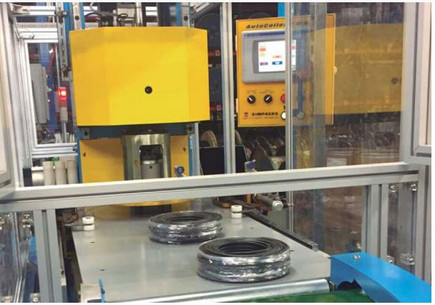
Automatic machines for coil winding are highly precise equipment in the manufacturing of cable wires. These machines automate the process of winding wire into precise coils, which are used in numerous industry applications. Automatic winding machines can do the job without much human intervention, making them more accurate, faster, and consistent than manual machines.
Critical Components of Automatic Coil Winding Machine
● Spindle: Starting with the spindle, which holds the core of the winding machine and rotates during the process. The motor of an automatic coil winding machine drives the motor and ensures accuracy in rotation speed.
● Wire tensioner: It controls the tension of the wire as it is fed onto the bobbin or core. This is a crucial element for achieving consistent and high-quality coils.
● Controller: The controller of the winding machine allows operators to set specific parameters such as wire tension and winding speed. It typically controls the entire programme; thus, it is often called the ‘brain’ of the machine.
● Wire guide: This guide ensures that the wire is placed precisely on the bobbin. In the winding machine, wire guides movies forth and back to create a uniform winding.
● Safety features: Advanced automatic coil winding machine consists of safety features including emergency stop buttons, wire break detection and overload protection.
How does an automatic coil winding machine work?
The basic principle of an automatic winding machine involves feeding wire from a spool on a rotating core. Firstly, the machine operators load the bobbin or core onto the spindle. Then, a spool of wire is fed through a series of wire guides.
These guides ensure that wires are correctly aligned before reaching the bobbin. Next, the spindle holds the bobbin rotation while the wire is fed onto it at a balanced speed and tension. After that the Machines controller directs the number of turns, wire tension, and pattern of winding.
Depending on the application, some automatic winding machines can create multiple layers of wire as well. Once the desired winding pattern is achieved, the machine automatically stops, and the coil is automatically removed from the spindle.
Advantages of using automatic coil winding machine
Automation minimizes the risk of errors that can occur during manual intervention. Thus, automatic coil winding offers numerous advantages for high-quality coils in the following:
● Speed and Efficiency: The latest automatic coil winding machines reduce the production time compared to manual processes. These machines operate at higher speeds, which allows coiling machine manufacturers to produce large quantities of coils in less time. From automotive to electronics, every industry benefits from high production demands.
● Precision and Consistency: Automation ensures precision control over wire tension, number of terms and winding pattern. It provides consistently high-quality coils with precise characteristics, which is crucial for maintaining reliable performance in critical devices.
● Cost-Effective Solution: Another utmost advantage of automatic coil winding machines is the cost-benefit. Though the initial investment is a bit higher, these machines reduce labor costs by minimizing manual intervention.
● Quick installation and easy maintenance: These automatic machines are designed to install and replace parts easily. Moreover, their self-diagnostic features can identify potential issues and provide troubleshooting guidance. Overall, automatic coil winding reduces overall downtime and maintenance costs.
Conclusion
The unique blend of automation and coil-winding machines offers precision and reliability in modern manufacturing. Along with the evolving technology, these machines continue to evolve, providing greater efficiency for various industry applications. Supermac is one of the prominent coiling machine manufacturers that provide high speed machines, often integrated with cable manufacturing equipment.